
FAA Finalizes Rule Mandating Interference-Tolerant Radio Altimeters to Mitigate 5G Risk
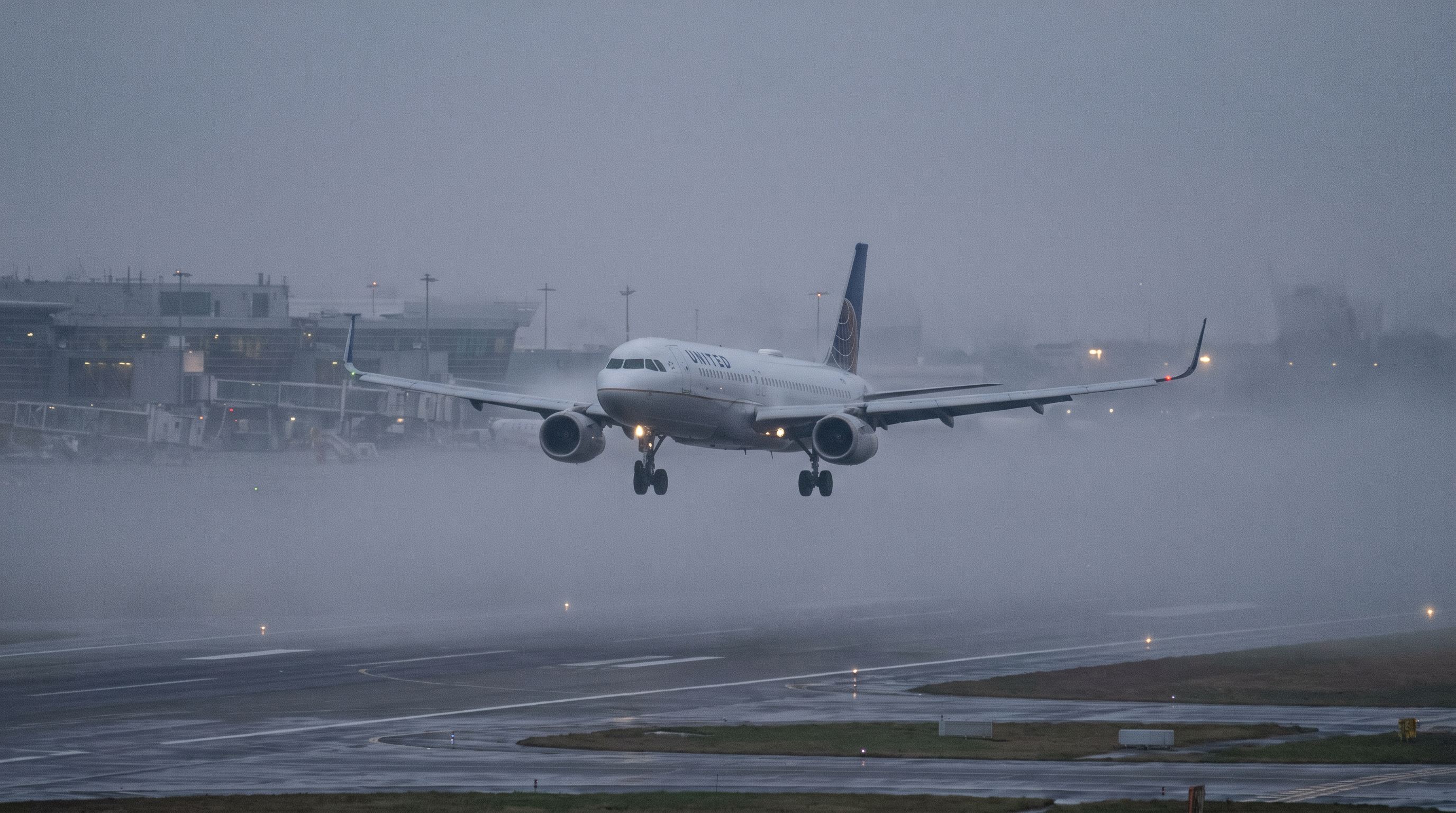
The Federal Aviation Administration has issued a final rule requiring airlines to install upgraded radio altimeters by 2030 to prevent interference from expanding 5G wireless networks.
By Irina Belova

- Aviation Regulators & Airlines
- Prioritize absolute safety during low-visibility landings and seek financial support for the massive retrofit.
- Telecommunications Industry
- Prioritize expanding 5G network capacity and securing regulatory certainty for spectrum investments.
- International Carriers
- Frustrated by the mandate's global reach, as foreign airlines must bear the full cost without U.S. rebates.
Why this matters
Without accurate radio altimeters, commercial aircraft cannot safely land in low-visibility conditions like heavy fog or snow. This final rule ensures that passengers won't face mass flight diversions or cancellations as telecommunications companies expand their high-speed 5G networks nationwide.
Key points
- The FAA has finalized a rule requiring all aircraft in U.S. airspace to install 5G-tolerant radio altimeters.
- Scheduled commercial airlines must complete the hardware upgrades by December 30, 2030.
- The mandate resolves a years-long conflict over 5G C-band signals interfering with aircraft landing systems.
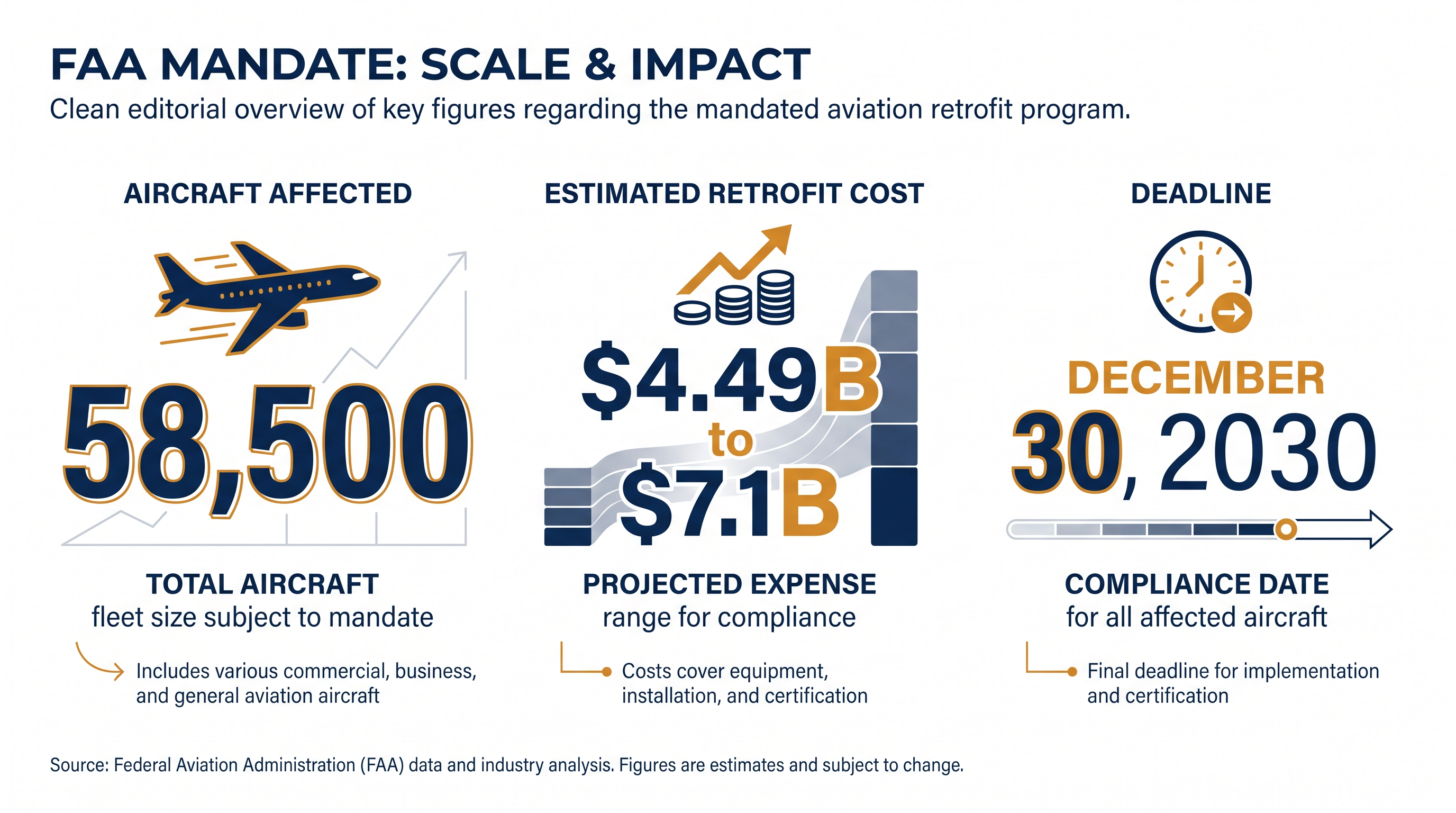
- The retrofit program covers roughly 58,500 aircraft and will cost the industry up to $7.1 billion.
- U.S. carriers will receive FCC rebates, but international airlines must fund their own upgrades.
The years-long turf war between the telecommunications industry and the aviation sector has officially reached a permanent truce, ending a period of intense regulatory friction that threatened to disrupt nationwide travel. On July 24, 2026, the Federal Aviation Administration (FAA) issued a sweeping final rule requiring all aircraft operating in U.S. airspace to be equipped with next-generation, interference-tolerant radio altimeters. The mandate arrives in tandem with a new Federal Communications Commission (FCC) order designed to clear additional spectrum for high-speed wireless networks, representing a hard-fought compromise between two of the most economically vital industries in the country. By forcing a hardware upgrade in the cockpit, the FAA has shifted away from temporary, voluntary mitigations and established a permanent technical baseline that ensures commercial flights can safely coexist with the expanding footprint of modern 5G infrastructure.[1][2]
The core objective of the new mandate is to shield critical cockpit instruments from the invisible noise generated by high-powered cellular networks. For years, aviation regulators and airline pilots have warned that 5G signals operating in the C-band spectrum could bleed over into adjacent frequencies, effectively blinding the sensitive sensors that aircraft rely on to navigate during severe weather. When visibility drops to near zero, pilots depend entirely on these instruments to understand exactly how far the aircraft is from the ground. The FAA’s final rule acknowledges that as telecommunications companies build out denser, more powerful networks to meet consumer demand, the aviation industry can no longer rely on outdated avionics that lack the necessary radio frequency filters to block out the surrounding digital chatter.[4][7]
Under the strict timeline established by the new regulation, scheduled commercial airlines have until December 30, 2030, to completely replace or upgrade their existing hardware. The FAA has made it abundantly clear that this is a hard deadline with severe operational consequences for non-compliance. After that date, any commercial aircraft lacking an approved, interference-tolerant altimeter will be legally stripped of its authorization to perform low-visibility approaches at any U.S. airport. A secondary deadline provides an additional two years of leeway for general aviation and other non-scheduled aircraft, but the message to the major carriers is unequivocal: they must modernize their fleets before the FCC’s newly auctioned spectrum goes live in the nation’s 75 largest markets.[5][6]
The sheer scale of the mandate makes it one of the most extensive and logistically complex avionics retrofit programs in modern aviation history. The FAA’s rule covers an estimated 58,500 aircraft across both the domestic U.S. fleet and the international carriers that operate within American airspace. Mechanics and avionics technicians will need to physically access the underbelly of tens of thousands of jets, removing legacy altimeter units and installing heavily shielded, next-generation replacements. This massive undertaking requires careful coordination with aircraft manufacturers like Boeing and Airbus, as well as the specialized suppliers who design the altimeters, to ensure that the global supply chain can produce and distribute the necessary hardware well before the 2030 cutoff.[4]
To fully grasp why this regulatory action was deemed an absolute necessity, one must understand the precise mechanics and critical function of a radio altimeter. Unlike a standard barometric altimeter—which calculates an aircraft's altitude based on outside air pressure and is primarily used while cruising at high altitudes—a radio altimeter is a highly specialized instrument used exclusively close to the ground. It operates by bouncing a continuous, focused radio wave straight down to the earth's surface and meticulously timing the echo as it bounces back to the aircraft's receiver. This rapid-fire calculation provides the flight crew with a hyper-accurate, real-time measurement of the aircraft’s exact height above the terrain, down to the foot.[7]
That level of precision transforms from a convenience into a matter of absolute survival during the final, critical seconds of a bad-weather approach. When a commercial airliner is descending through heavy winter fog at San Francisco International Airport, or battling a blinding nor'easter snowstorm on approach to New York's JFK, the flight crew often cannot see the runway tarmac until they are mere seconds from touchdown. During these zero-visibility scenarios, pilots rely entirely on automated landing systems, auto-throttles, and terrain-avoidance warning systems. Every single one of these automated safety nets draws its primary, foundational data directly from the radio altimeter, trusting its measurements implicitly to guide the multi-ton aircraft safely to the pavement.[5][7]
That level of precision transforms from a convenience into a matter of absolute survival during the final, critical seconds of a bad-weather approach.
If a strong signal from a neighboring frequency band bleeds into the altimeter's receiver, the consequences can be immediate and catastrophic. A compromised altimeter might register a false altitude, tricking the aircraft's flight computers into believing the plane is higher or lower than it actually is. This could cause the autopilot to prematurely flare the nose for landing while still hundreds of feet in the air, or worse, fail to trigger a pull-up warning if the aircraft is dangerously close to a mountain or radio tower. The FAA's testing confirmed that without adequate filtering, the powerful transmissions from modern cellular networks could easily overwhelm older altimeters, creating an unacceptable single point of failure during the most vulnerable phase of flight.[1][7]
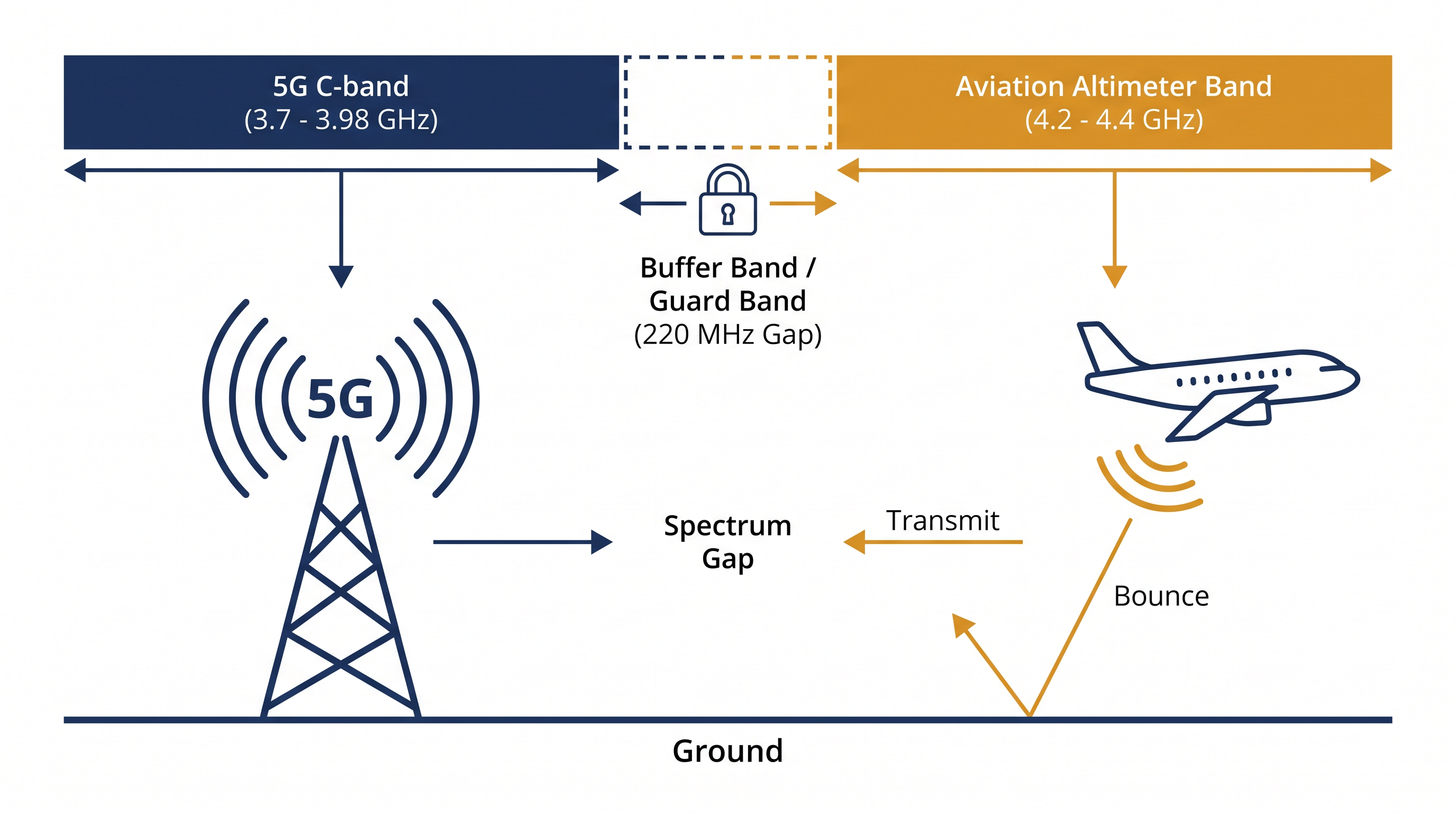
The root of the conflict stems from a simple issue of real estate within the electromagnetic spectrum. The radio frequencies used by the world's wireless devices are tightly regulated and auctioned off in specific blocks. Aircraft radio altimeters have historically operated in a dedicated frequency band ranging from 4.2 to 4.4 GHz. The problem arose when the FCC decided to auction off the adjacent C-band spectrum—ranging from 3.7 to 3.98 GHz—to telecommunications companies for their new 5G networks. Because older altimeters were designed in an era when those neighboring frequencies were relatively quiet, they lacked the sophisticated shielding required to ignore the sudden, massive influx of high-powered cellular data transmitting just down the block.[1][4]
This spectrum proximity issue originally boiled over into a full-blown crisis in early 2022, when telecom giants AT&T and Verizon began activating their newly constructed C-band networks near major U.S. airports. The rollout triggered widespread panic across the aviation sector, as airline CEOs warned of catastrophic disruptions and the FAA scrambled to issue emergency airworthiness directives. The resulting chaos led to preemptive flight cancellations, diverted international routes, and a frantic, eleventh-hour agreement that saw the telecom companies implement voluntary, temporary power limits on their 5G towers near runways. While that truce prevented an immediate shutdown of the airspace, it was always viewed as a temporary band-aid rather than a permanent cure.[2][7]
The FAA's new rule officially converts those temporary, voluntary mitigations into a permanent, hardware-based solution that places the onus of safety squarely on the aircraft itself. Over the past four years, the agency has conducted exhaustive joint testing with the FCC, aerospace engineers, and telecom experts to determine exactly how much interference a modern, well-designed altimeter can safely filter out. By establishing strict new performance standards for the avionics, the FAA has created a regulatory framework that allows the aviation industry to adapt to the modern digital environment, rather than perpetually fighting to keep the airspace around airports artificially quiet.[1][2]
This hardware-focused resolution allows the FCC to confidently move forward with its broader telecommunications strategy, which includes auctioning an additional 160 MHz of upper C-band spectrum by mid-2027. To ensure the new altimeters are not overwhelmed, the FCC's companion order includes a series of permanent, baked-in safeguards. These include strict caps on the maximum transmit power of 5G towers, limitations on the physical height and upward tilt of cellular antennas near flight paths, and the preservation of a permanent "buffer band" of unused frequencies separating the telecom data from the aviation signals. Together, these measures create a layered defense that protects the integrity of the cockpit instruments.[1][6]
Upgrading tens of thousands of aircraft to meet these new standards will require a massive financial investment from the aviation industry. Current estimates place the total industry-wide retrofit bill anywhere between $4.49 billion and $7.1 billion, depending on the specific hardware required for different aircraft types. To help ease this immense financial burden and incentivize rapid compliance ahead of the 2030 deadline, the FCC has structured a targeted rebate program. This program will be funded directly by the proceeds generated from the upcoming spectrum auction, effectively using the telecom industry's expansion to subsidize the aviation sector's necessary safety upgrades.[3][5][7]
However, that financial relief is strictly limited to domestic operators, creating a significant point of contention for the international aviation community. Major Asia-Pacific carriers—including Japan Airlines, ANA, Qantas, Korean Air, and Singapore Airlines—along with European and Middle Eastern operators, must fund their own fleet upgrades entirely out of pocket. Because they are required to comply with the FAA mandate to maintain their authorization for low-visibility landings at U.S. airports, these foreign airlines are forced to absorb millions of dollars in retrofit costs without any access to the U.S.-funded rebate program, sparking frustration over the unilateral nature of the American regulatory approach.[5]
Despite the financial friction for international carriers, the establishment of the 2030 deadline provides the definitive technical and economic certainty that both industries have desperately craved since the crisis began. Telecommunications companies can now confidently invest billions in building out their high-speed 5G networks without the looming threat of sudden aviation injunctions or forced power-downs. Simultaneously, the flying public can board winter flights with the assurance that their aircraft are equipped with the latest technology, fully capable of navigating the invisible, crowded noise of the modern radio spectrum to deliver them safely to the runway.[1][4]
How we got here
Early 2022
Initial C-band 5G rollout near U.S. airports triggers aviation warnings, flight cancellations, and voluntary telecom delays.
January 2023
The FAA proposes an initial airworthiness directive requiring early altimeter retrofits and filters.
July 2026
The FAA issues the final rule mandating next-generation, interference-tolerant altimeters for all aircraft.
Mid-2027
The FCC is scheduled to close its auction for an additional 160 MHz of upper C-band spectrum.
December 2030
Final deadline for scheduled commercial airlines to complete altimeter upgrades or lose low-visibility landing authorization.
Viewpoints in depth
Aviation Regulators & Airlines
Focused on eliminating single points of failure during low-visibility landings.
The FAA and the broader airline industry emphasize that safety margins cannot be compromised for network speed. Their primary concern has always been the catastrophic potential of a false altimeter reading during a zero-visibility approach, where pilots have no visual reference to the ground. By forcing a hardware upgrade rather than relying on voluntary, temporary telecom limits, regulators believe they have permanently eliminated a critical vulnerability, ensuring that automated landing systems can be trusted implicitly regardless of the surrounding digital environment.
Telecommunications Industry
Focused on expanding 5G network capacity and securing regulatory certainty.
Wireless carriers and the FCC view the resolution as a necessary and long-overdue step to unlock billions of dollars in economic value. The telecom sector has frequently pointed out that 5G and aviation coexist safely in dozens of other countries, arguing that the U.S. aviation sector was simply slow to upgrade outdated, poorly shielded equipment. The new FAA rule provides the concrete regulatory certainty telecom companies need to confidently bid on the 2027 spectrum auction and build out infrastructure without fear of sudden injunctions.
International Carriers
Frustrated by the financial burden of complying with a U.S.-centric mandate.
Foreign airlines view the U.S. mandate as an expensive, unilateral burden that disproportionately impacts their bottom lines. Because the FCC's rebate program is funded entirely by U.S. spectrum auctions, international operators from Europe and the Asia-Pacific must absorb the full cost of retrofitting their fleets. They argue that they are being forced to pay millions of dollars to fix an interference issue created by the U.S. government's spectrum auction strategy, just to maintain their historical access to American airports during winter weather.
What we don't know
- It remains unclear exactly how much of the $7.1 billion retrofit cost will be covered by the FCC's rebate program for U.S. carriers.
- Aviation authorities have not detailed how strictly they will enforce the 2030 deadline if global supply chain issues delay the manufacturing of new altimeters.
Key terms
- Radio Altimeter
- An instrument that bounces radio waves off the ground to measure an aircraft's exact altitude, critical for automated landings.
- C-band
- A range of wireless frequencies used for high-speed 5G networks that sits directly adjacent to the frequencies used by aircraft altimeters.
- Buffer Band
- An empty slice of the radio spectrum kept intentionally clear to prevent signals from one frequency from bleeding into another.
- Autoland
- An aircraft system that fully automates the landing procedure, relying heavily on precise radio altimeter data during low-visibility conditions.
Frequently asked
Will this altimeter mandate make my flights more expensive?
The retrofit will cost the industry billions, but U.S. airlines will receive FCC rebates funded by spectrum auctions, likely minimizing the impact on passenger ticket prices.
Are passenger cell phones on planes causing this interference?
No. The interference risk comes from large 5G cellular transmission towers on the ground near airports, not from passenger mobile devices inside the aircraft cabin.
What happens if an airline fails to upgrade by the 2030 deadline?
Aircraft without interference-tolerant altimeters will be legally barred from performing low-visibility landings at U.S. airports, forcing them to divert or cancel flights during bad weather.
Sources
Source coverage
7 outlets
3 viewpoints surfaced







[1]Federal Aviation AdministrationAviation Regulators & Airlines
FAA will issue a final rule to ensure aircraft radio altimeters can withstand interference from 5G
Read on Federal Aviation Administration →[2]POLITICO ProTelecommunications Industry
FAA will require aircraft to upgrade instrumentation to resist 5G interference
Read on POLITICO Pro →[3]Inside TowersTelecommunications Industry
FAA Approves Rule to Protect Aircraft from 5G Interference
Read on Inside Towers →[4]AeroMorningAviation Regulators & Airlines
FAA Orders Replacement of 58,500 Radio Altimeters in Landmark 5G Safety Rule
Read on AeroMorning →[5]AirTravelerAviation Regulators & Airlines
FAA sets 2030 deadline for aircraft altimeter upgrades, impacting Asia-Pacific carriers
Read on AirTraveler →[6]AvioRadarInternational Carriers
FAA to publish final rule requiring mandatory upgrades to aircraft radio altimeters
Read on AvioRadar →[7]MiGFlugInternational Carriers
The FAA Ends the 5G Fight With the Cockpit
Read on MiGFlug →
Every angle. Every day.
Get travel stories with full source coverage and perspective breakdowns delivered to your inbox.