
Explainer: Why Gasoline Prices Lag Behind Crude Oil Drops
Following a DOJ probe into alleged price gouging, economists point to refining bottlenecks and the 'rockets and feathers' effect to explain why pump prices fall slower than crude oil.
By Factlen Editorial Team
- Political Figures & Consumers
- Argue that the lag in pump prices is evidence of corporate price gouging and demand immediate relief for drivers.
- Economic Researchers
- View the price lag as a natural market phenomenon driven by asymmetric pass-through and behavioral economics.
- Energy Supply Chain
- Emphasize supply chain bottlenecks, refining costs, and the independent ownership of gas stations as the primary drivers of retail prices.
What's not represented
- · Independent Gas Station Owners
Why this matters
Understanding the mechanics of gasoline pricing helps consumers make sense of frustrating delays at the pump, revealing how global crude markets, refining bottlenecks, and local station economics actually dictate the cost of a fill-up.
Key points
- President Trump ordered a DOJ probe into Exxon and Chevron after gas prices fell only 14% compared to a 40% drop in crude oil.
- Economists attribute the lag to the 'rockets and feathers' effect, where retail prices rise quickly but fall slowly.
- Independent gas station owners often use the slow decline to recoup losses sustained when wholesale prices initially spiked.
- Refining costs, state taxes, and transportation make up nearly half the cost of gasoline, limiting how far pump prices can mathematically fall.
The recent 60-day ceasefire between the United States and Iran has brought a wave of relief to global energy markets, reopening the Strait of Hormuz and sending crude oil prices tumbling.[1][3]
Since their peak in March, U.S. crude oil prices have plummeted by roughly 40%, dropping below $70 a barrel for the first time in months as maritime traffic normalizes.[2][3]
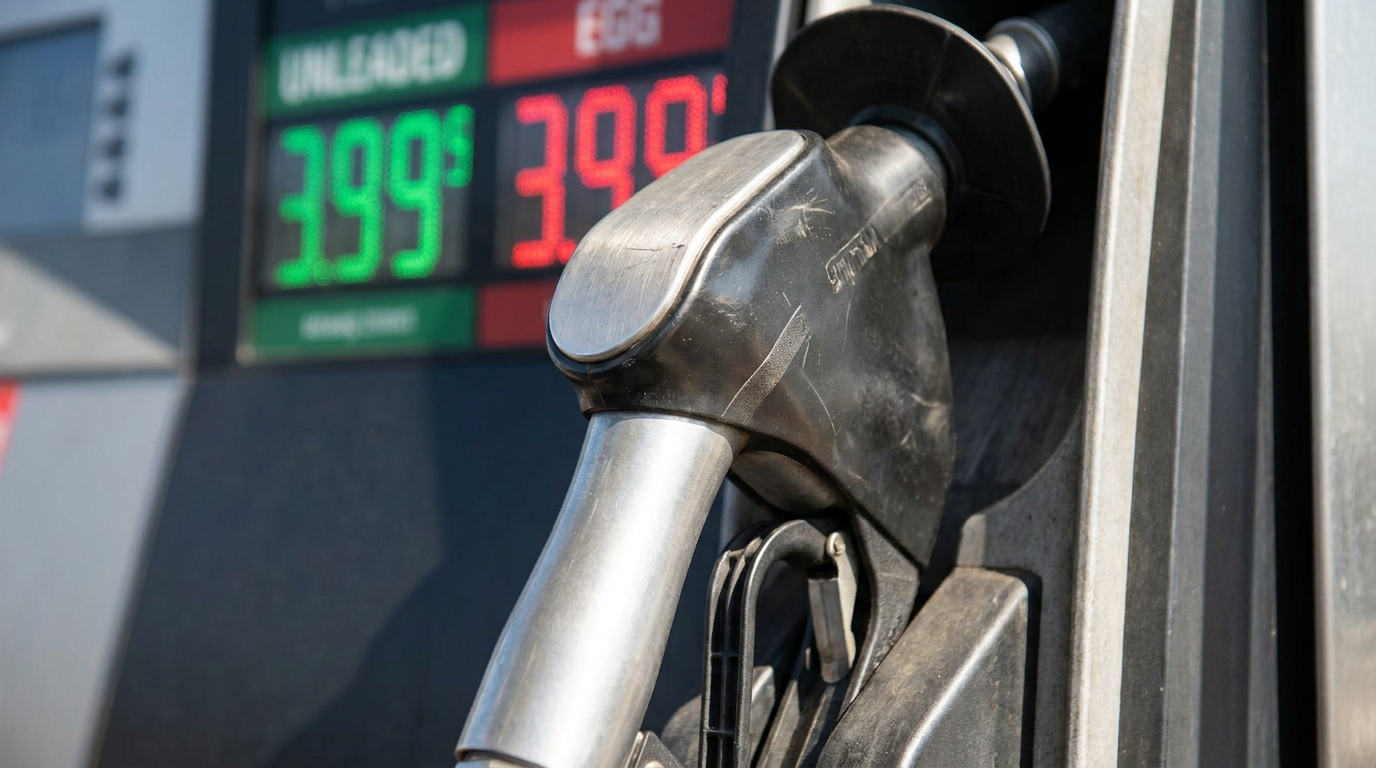
Yet, for American drivers pulling up to the pump, the relief has felt sluggish. While the national average for a gallon of regular gasoline has fallen from a peak of $4.56 to $3.92, that represents only a 14% decline.[1][2]
This glaring discrepancy prompted President Donald Trump to order the Department of Justice to investigate major oil producers, including ExxonMobil and Chevron, for alleged price gouging.[1][2][3]
In a late-night social media post, the president argued that pump prices should be falling "commensurate with the sharply lower prices they are paying for oil," capturing a frustration shared by millions of consumers.[1][2]

However, energy economists and supply chain experts point out that the disconnect between crude oil and retail gasoline is a well-documented structural feature of the energy market, not necessarily a sign of illicit collusion.[4][6]
To understand why pump prices lag, one must first look at the physical journey of oil. Crude oil is merely a raw material; it cannot be pumped directly into a car's gas tank.[6]
It must first be purchased by refineries, which use complex thermal and chemical processes to "crack" the heavy hydrocarbon molecules into lighter, usable products like gasoline, diesel, and jet fuel.[5][6]
The profitability of this process is measured by a metric known as the "crack spread," typically calculated using a 3-2-1 ratio: three barrels of crude yield roughly two barrels of gasoline and one barrel of diesel.[5]
When geopolitical conflicts disrupt global shipping, as seen recently in the Middle East, refineries often scramble to secure alternative supplies, and their utilization rates max out.[5]
Even when the price of the raw crude drops, the cost of the refined product can remain elevated if refining capacity is tight or if the system is still clearing out expensive inventory purchased weeks earlier.[5][6]
Beyond the refinery, the retail market operates on a behavioral economic principle famously dubbed the "rockets and feathers" effect.[4]
Coined by economists to describe asymmetric price transmission, the phenomenon observes that retail gas prices shoot up like a rocket when crude prices rise, but drift down like a feather when crude prices fall.[4]

The root of this effect lies in the ownership structure of local gas stations. Contrary to popular belief, the vast majority of branded gas stations are not owned by "Big Oil" corporations, but by independent small-business franchisees.[6]
When wholesale gasoline prices spike suddenly, these independent owners face a dilemma: if they immediately pass the full cost onto consumers, they risk losing market share to the station across the street.[4][6]
As a result, station owners often absorb the initial price shock, operating at razor-thin or even negative margins during the "rocket" phase to keep their customers loyal.[4]
When wholesale prices eventually fall, station owners do not immediately slash their retail prices. Instead, they enter the "feather" phase, holding pump prices steady for a few weeks to recoup the losses they sustained during the spike.[4]
Furthermore, crude oil only accounts for roughly 50% to 60% of the final price of a gallon of gasoline. The remainder consists of relatively fixed costs that do not change when the global oil market fluctuates.[6]
State and federal taxes, transportation, marketing, and station operating costs remain constant whether crude is trading at $120 or $70 a barrel.[6]

Mathematically, a 40% drop in the price of crude oil only applies to half the cost of the final product, meaning the maximum theoretical drop at the pump would be closer to 20%, even before accounting for refining margins and the rockets-and-feathers lag.[6]
How we got here
March 2026
U.S. crude oil prices peak amid geopolitical tensions and disruptions in the Strait of Hormuz.
May 2026
U.S. retail gasoline prices hit a high of $4.56 per gallon.
Mid-June 2026
A ceasefire agreement reopens shipping lanes, sending crude oil prices down by roughly 40%.
June 24, 2026
President Trump orders a DOJ investigation into oil companies over the slower 14% decline in retail gas prices.
Viewpoints in depth
The Political View
Elected officials argue the price lag is artificial and punitive.
Politicians and consumer advocates point to the raw numbers: if the primary ingredient drops by 40%, the final product should reflect a similar discount. They argue that consolidated market power allows major oil companies to artificially prop up retail prices, padding corporate profits at the expense of everyday drivers. This viewpoint drives calls for federal investigations and antitrust scrutiny whenever pump prices fail to mirror crude oil charts.
The Economic View
Economists attribute the lag to 'rockets and feathers' market behavior.
Researchers note that asymmetric price transmission is a well-documented feature of the retail fuel market. Because consumers are highly sensitive to price increases, independent station owners often absorb losses when wholesale costs spike to avoid losing customers. When wholesale costs finally drop, those same owners hold retail prices steady for a period—the 'feather' phase—to recoup their earlier losses before local competition forces them to lower prices.
The Industry View
The energy sector points to refining bottlenecks and fixed costs.
Industry representatives emphasize that crude oil is only one component of gasoline. The 'crack spread'—the cost to refine crude into usable fuel—can remain high if refineries are operating at maximum capacity or recovering from supply chain shocks. Furthermore, nearly half the cost of a gallon of gas consists of fixed expenses like state taxes, transportation, and marketing, which do not decrease just because the global price of crude oil falls.
What we don't know
- Whether the DOJ investigation will uncover any internal communications suggesting coordinated price-fixing among major producers.
- Exactly how long it will take for the current 'feather' phase to conclude and bring pump prices to their new baseline.
Key terms
- Crack Spread
- The profit margin a refinery makes by purchasing crude oil and 'cracking' it into refined products like gasoline and diesel.
- Rockets and Feathers
- An economic term describing how retail prices rise quickly (like a rocket) when wholesale costs increase, but fall slowly (like a feather) when costs decrease.
- Wholesale Price
- The cost that independent gas station owners pay to purchase refined gasoline before selling it to consumers.
- Asymmetric Pass-Through
- The phenomenon where a change in the cost of raw materials is not passed on to the consumer at the same speed or magnitude in both directions.
Frequently asked
Why don't gas prices drop immediately when oil drops?
Gas stations are mostly independently owned. Owners often hold prices steady when wholesale costs drop to recoup the losses they absorbed when costs initially spiked.
How much of the gas price is actually crude oil?
Crude oil typically accounts for 50% to 60% of the price of a gallon of gasoline. The rest is taxes, refining, and distribution.
Are oil companies illegally fixing prices?
While the DOJ is investigating, economists generally attribute the price lag to standard market mechanics, fixed costs, and local competition rather than illegal collusion.
When will gas prices fully reflect the drop in oil?
Economists suggest it can take anywhere from four to eight weeks for a drop in crude oil prices to fully feather down to the retail pump.
Sources
Source coverage
6 outlets
3 viewpoints surfaced






[1]The GuardianPolitical Figures & Consumers
Trump says he instructed justice department to investigate oil firms over high gas prices
Read on The Guardian →[2]Fox BusinessPolitical Figures & Consumers
Trump alleges gas price gouging, calls for DOJ investigation
Read on Fox Business →[3]ReutersPolitical Figures & Consumers
Trump calls for probe into gasoline price 'gouging'
Read on Reuters →[4]Federal Reserve Bank of St. LouisEconomic Researchers
Oil and gas prices move together like rockets and feathers
Read on Federal Reserve Bank of St. Louis →[5]Argus MediaEnergy Supply Chain
US refining margins mixed amid crude volatility
Read on Argus Media →[6]American Petroleum InstituteEnergy Supply Chain
What Drives U.S. Gasoline Prices?
Read on American Petroleum Institute →
Every angle. Every day.
Get energy stories with full source coverage and perspective breakdowns delivered to your inbox.