
Explainer: How the Coffee Industry is Moving to Close the Global Pesticide Loophole
A landmark 2026 report reveals that the global coffee supply relies heavily on pesticides banned in consuming nations, sparking a push for agroecological farming and stricter traceability.
By Factlen Editorial Team
- Environmental Watchdogs
- Advocacy groups arguing that the export of domestically banned pesticides is an environmental injustice.
- Coffee Producers
- Farmers and producing nations balancing crop yields against environmental and health risks.
- Sustainable Coffee Brands
- Roasters and retailers advocating for organic certifications and traceable supply chains.
What's not represented
- · Agrochemical Manufacturers
- · Conventional Coffee Retailers
Why this matters
Billions of people drink coffee daily, yet the supply chain's reliance on hazardous chemicals affects both consumer health and the ecosystems of producing nations. Understanding this loophole empowers buyers to seek out certifications and farming practices that prioritize safety and sustainability.
Key points
- A 2026 report reveals 59% of pesticides used in global coffee production are banned in the EU.
- The 'chemical boomerang' loophole allows wealthy nations to export banned pesticides and re-import them as residues on coffee beans.
- While roasting degrades some chemicals, stable compounds like glyphosate can survive and enter the brewed cup.
- Transitioning to shade-grown, agroecological farming naturally reduces pest pressure without synthetic chemicals.
- New traceability laws like the EU Deforestation Regulation are forcing companies to map supply chains, aiding chemical monitoring.
In June 2026, a coalition of environmental organizations—including Coffee Watch and the Pesticide Action Network (PAN)—released a landmark report titled "Poison in Your Coffee." The comprehensive study synthesized government data, scientific literature, and field research across major producing regions like Brazil, Vietnam, Kenya, and Colombia. It revealed a stark reality: the global coffee industry has become deeply dependent on highly toxic agricultural chemicals. However, rather than simply diagnosing a crisis, the report serves as a blueprint for structural reform, outlining how regulatory shifts, agroecological farming, and consumer choices can dismantle this chemical dependency.[3][4][5]
At the heart of the issue is a regulatory loophole known as the "chemical boomerang." Wealthy consuming nations, particularly in the European Union and the United States, have banned or severely restricted numerous pesticides due to their documented links to cancer, neurotoxicity, and ecological collapse. Yet, chemical manufacturers in these same nations are legally permitted to produce and export these prohibited substances to coffee-producing countries in the Global South. Because regulatory oversight in these regions is often weaker, farmers utilize the chemicals to maintain crop yields. The treated coffee is then legally imported back into the consuming nations, bringing the banned chemicals full circle.[3][5]
The scale of this chemical reliance is staggering. The 2026 report identified 159 active pesticide ingredients currently used in global coffee production. Of those, 60 percent are classified by the World Health Organization as Highly Hazardous Pesticides (HHPs), and 59 percent are explicitly banned within the European Union. In Brazil, the world’s largest coffee producer, farmers applied nearly 20 million liters of pesticides to coffee crops in a single year—a higher volume per hectare than is used for staple crops like maize or soy. In Kenya, coffee accounts for 27 percent of national pesticide use despite occupying less than one percent of agricultural land.[4][5]

Climate change is actively exacerbating this chemical dependency. As global temperatures rise and rainfall patterns become increasingly erratic, traditional coffee-growing regions are experiencing unprecedented outbreaks of pests and fungal diseases, such as coffee leaf rust. In full-sun monoculture farms, these outbreaks can devastate entire harvests. Desperate to protect their livelihoods, farmers are pushed into a vicious cycle: climate stress leads to more pests, which prompts heavier pesticide application, which in turn degrades the soil and ecosystem, leaving the crops even more vulnerable to the next climate shock.[2][5]
The immediate burden of this chemical intensity falls on the producing nations. Farmworkers and rural communities face daily, repeated exposure to hazardous compounds through mixing, spraying, and contaminated groundwater. Field research indicates that protective equipment is exceedingly rare; in some regions, up to 87 percent of farmers report applying chemicals without masks or gloves. Beyond human health, the ecological toll is severe. The report notes that 46 of the active ingredients used are highly toxic to bees, while 48 contaminate rivers and watersheds, threatening the very biodiversity that coffee plants rely on for pollination and soil health.[4][5]
While farmworkers bear the brunt of the toxicity, the chemical boomerang ensures that consumers are not insulated from the fallout. Testing of coffee imports remains minimal, yet existing data paints a concerning picture. The report highlights that 19 percent of green, unroasted coffee samples contain measurable pesticide residues. In the United States, testing revealed that 72 percent of roasted coffee samples contained AMPA, a chemical breakdown product of the widely used herbicide glyphosate. These residues often appear in combinations, forming a "toxic cocktail" whose cumulative health effects remain largely unstudied by food safety authorities.[3][5]

While farmworkers bear the brunt of the toxicity, the chemical boomerang ensures that consumers are not insulated from the fallout.
The specific chemicals detected in these toxic cocktails highlight the severity of the regulatory failure. Beyond glyphosate, testing of roasted coffee samples in various global markets has frequently detected chlorpyrifos, imidacloprid, and cypermethrin. Chlorpyrifos is a neurotoxic insecticide linked to developmental delays in children, while imidacloprid is a notorious neonicotinoid heavily implicated in global bee colony collapse. The fact that these specific compounds survive the journey from a rural farm in the Global South to a consumer's morning cup underscores the inadequacy of current import screening protocols.[3][5]
A common misconception is that the intense heat of the coffee roasting process destroys all chemical residues. While it is true that pyrolytic reactions at high temperatures can degrade certain pesticide compounds—sometimes reducing their concentrations by up to 99 percent—the science is not absolute. Research confirms that highly stable chemical residues, including glyphosate, can survive the roasting cycle and pass into the final brewed cup. Consequently, while roasting mitigates some risk, it does not function as a complete purification mechanism, prompting health advocates to target the agricultural source rather than the processing stage.[6]
Despite the sobering data, the 2026 report emphasizes that the industry is not permanently locked into this toxic cycle. Solutions exist at both the regulatory and agricultural levels. One of the most immediate structural fixes is closing the export loophole. Environmental watchdogs and European policymakers are mounting a coordinated push to ban the export of domestically prohibited chemicals. By cutting off the supply of highly hazardous pesticides at the manufacturing source, consuming nations can force a rapid shift in global agricultural practices and protect both farmworkers and end consumers.[3][5]
Regulatory action at the national level has already proven highly effective. The report points to Vietnam’s 2021 ban on glyphosate as a successful case study. When the world’s second-largest coffee producer prohibited the herbicide, it demonstrated that swift legislative action can rapidly reduce chemical dependency without collapsing the national export market. This precedent provides a roadmap for other producing nations, proving that transitioning away from the most hazardous chemicals is economically viable when supported by firm government mandates.[5]

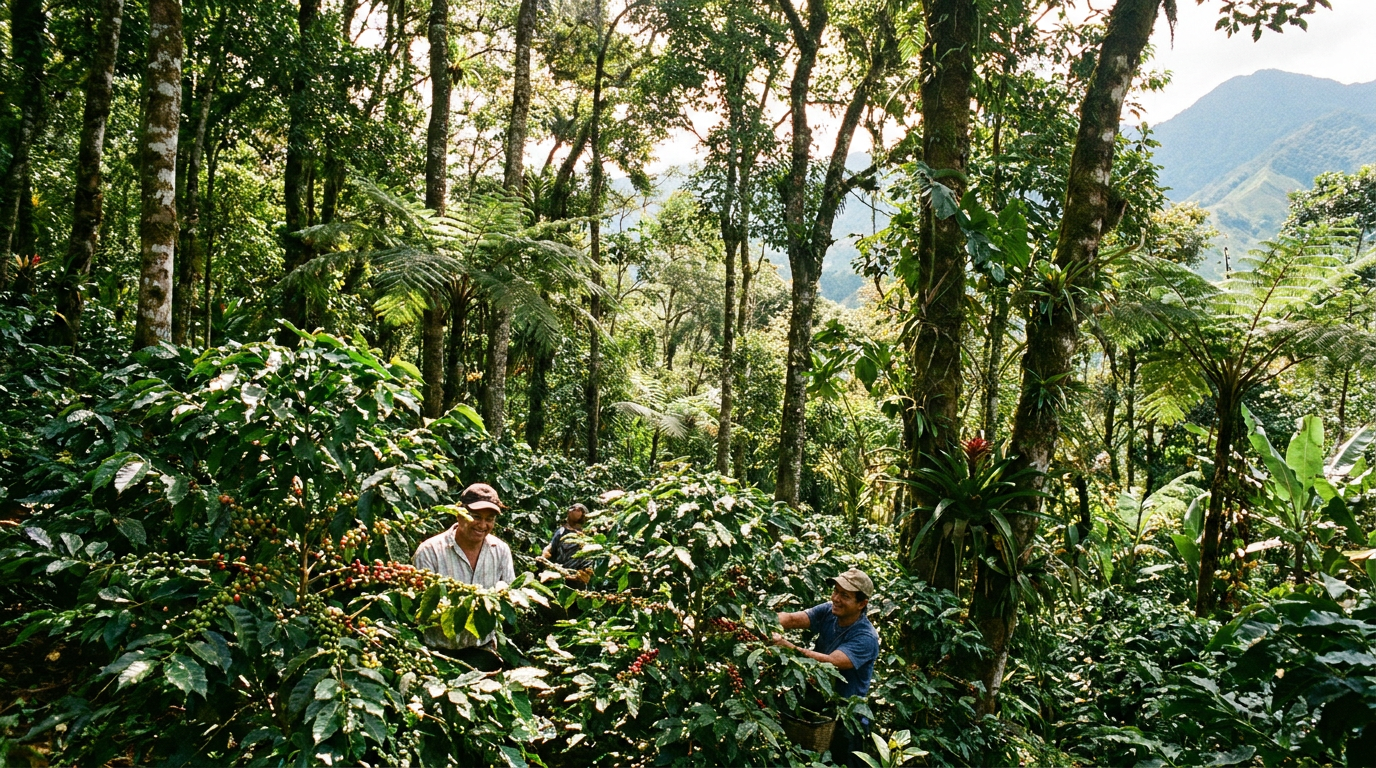
On the agricultural front, the ultimate solution lies in agroecological farming. For decades, the industry has shifted toward full-sun monocultures, which maximize short-term yields but degrade soil and invite intense pest pressure. Transitioning back to shade-grown, diversified farming systems naturally mitigates these issues. By planting coffee under a canopy of native trees, farmers can rebuild ecosystems that support natural predators. Birds, bats, and beneficial insects provide biological pest control, drastically reducing the need for synthetic insecticides while simultaneously improving soil health and water retention.[2][6]
Consumer demand is also playing a critical role in reshaping the market. As awareness of the chemical boomerang grows, buyers are increasingly seeking out certifications that guarantee cleaner supply chains. The USDA Organic certification, while not a flawless guarantee of zero chemical exposure, strictly prohibits the use of synthetic pesticides and fertilizers. By choosing organic and shade-grown labels, consumers directly fund farming practices that prioritize ecological resilience over chemical dependency, creating a financial incentive for more producers to abandon hazardous inputs.[2][6]

The push for cleaner coffee is inadvertently benefiting from parallel legislative efforts, most notably the European Union Deforestation Regulation (EUDR). Designed to prevent the import of commodities linked to forest clearing, the EUDR requires coffee companies to meticulously map their supply chains down to the specific geographic coordinates of individual farms. This unprecedented level of traceability provides the exact infrastructure needed to monitor chemical inputs. As supply chains become transparent, it becomes increasingly difficult for major roasters to obscure the agricultural practices of their suppliers.[1]
Ultimately, the transition away from highly hazardous pesticides requires a systemic economic shift. Farmers cannot bear the cost of this transition alone; abandoning cheap chemical inputs in favor of agroecological methods requires upfront capital, technical training, and temporary yield protections. The 2026 report concludes that multinational coffee corporations, which generate billions in annual profits, must invest directly in their supply chains. By paying premium prices for sustainably grown beans and subsidizing the transition to organic practices, the industry can close the pesticide loophole and secure the long-term future of global coffee production.[2][5]
How we got here
2021
Vietnam implements a nationwide ban on the herbicide glyphosate, demonstrating that rapid regulatory action can reduce chemical dependency.
2023
The European Union passes the Deforestation Regulation (EUDR), laying the groundwork for strict supply chain traceability.
June 2026
The 'Poison in Your Coffee' report is published, revealing that 59% of pesticides used in global coffee production are banned in the EU.
Viewpoints in depth
Environmental Watchdogs
Advocacy groups arguing that the export of domestically banned pesticides is an environmental injustice.
Organizations like PAN Europe and Coffee Watch view the current regulatory framework as a textbook example of the 'chemical boomerang.' They argue that wealthy nations are prioritizing corporate chemical profits over global health by allowing the export of pesticides deemed too dangerous for their own citizens. Their primary legislative goal is a total ban on the export of Highly Hazardous Pesticides, forcing a structural shift in how global commodities are farmed.
Coffee Producers
Farmers and producing nations balancing crop yields against environmental and health risks.
For millions of smallholder farmers in the Global South, chemical pesticides are often viewed as a necessary evil to survive the mounting pressures of climate change. With erratic rainfall and rising temperatures fueling outbreaks of coffee leaf rust and invasive pests, farmers rely on cheap chemical inputs to prevent catastrophic crop failure. Producers argue that transitioning to organic or agroecological farming is impossible without significant financial subsidies and guaranteed premium pricing from multinational buyers.
Sustainable Coffee Brands
Roasters and retailers advocating for organic certifications and traceable supply chains.
A growing coalition of sustainable coffee companies argues that the industry's future depends on completely decoupling from synthetic chemicals. These brands champion shade-grown, agroecological farming methods that rebuild soil health and utilize natural predators for pest control. They emphasize that while organic certification processes are rigorous and expensive, they are the only reliable mechanism to protect farmworkers, preserve biodiversity, and guarantee a clean cup of coffee for the end consumer.
What we don't know
- The exact cumulative health effects of consuming 'toxic cocktails' of multiple pesticide residues over a lifetime.
- Whether upcoming European legislation will successfully ban the export of all domestically prohibited chemicals.
- How quickly major multinational coffee chains will transition their entire supply chains to certified organic or agroecological sources.
Key terms
- Chemical Boomerang
- A regulatory loophole where wealthy nations export domestically banned pesticides to developing countries, only to re-import them as residues on agricultural products.
- Highly Hazardous Pesticides (HHPs)
- Chemicals acknowledged by the World Health Organization to present particularly high levels of acute or chronic risk to health or the environment.
- Agroecology
- A farming approach that mimics natural ecosystems, using biodiversity and natural predators rather than synthetic chemicals to manage pests and maintain soil health.
- Pyrolytic Reaction
- A chemical decomposition process driven by high temperatures, such as roasting, which can break down certain pesticide compounds.
Frequently asked
Does roasting coffee destroy all pesticide residues?
No. While the high heat of roasting degrades many chemical compounds, highly stable residues like glyphosate can survive the process and end up in the brewed cup.
What is the 'chemical boomerang'?
It refers to the practice of wealthy nations banning toxic pesticides domestically, but continuing to manufacture and export them to producing countries, eventually re-importing the chemicals as residues on crops like coffee.
How can consumers avoid pesticides in their coffee?
Choosing certified organic coffee is the most reliable method, as it strictly prohibits the use of synthetic pesticides. Shade-grown certifications also indicate farming practices that rely less on chemical inputs.
Sources
Source coverage
6 outlets
3 viewpoints surfaced






[1]Perfect Daily GrindSustainable Coffee Brands
Poison in Your Coffee report finds global coffee industry is heavily dependent on Highly Hazardous Pesticides
Read on Perfect Daily Grind →[2]RiverfordSustainable Coffee Brands
A wake-up call for coffee's chemical pesticide dependency
Read on Riverford →[3]PAN EuropeEnvironmental Watchdogs
New report 'Poison in Your Coffee' reveals the widespread use of highly hazardous pesticides
Read on PAN Europe →[4]Pesticide Action Network UKEnvironmental Watchdogs
There's a crisis brewing in the global coffee industry
Read on Pesticide Action Network UK →[5]Coffee WatchEnvironmental Watchdogs
Poison in Your Coffee: The widespread use of Highly Hazardous Pesticides
Read on Coffee Watch →[6]Peak State CoffeeSustainable Coffee Brands
How to Avoid Pesticides in Coffee
Read on Peak State Coffee →
Every angle. Every day.
Get food drink stories with full source coverage and perspective breakdowns delivered to your inbox.