
EEOC Rescinds Decades-Old Voluntary Affirmative Action Guidance, Creating Uncertainty for Corporate DEI Programs
The Equal Employment Opportunity Commission has withdrawn its 1979 guidelines that protected corporate voluntary affirmative action programs from reverse-discrimination lawsuits. The move forces employers to urgently audit their diversity initiatives as the agency shifts toward strictly colorblind enforcement.


- EEOC & Conservative Legal Advocates
- Argue that Title VII requires strictly colorblind employment practices and that the old guidance encouraged unlawful discrimination against majority groups.
- Civil Rights & Women's Advocacy Groups
- Argue the rescission ignores systemic workplace barriers, sows confusion, and weaponizes civil rights law against marginalized groups.
- Corporate HR & Employment Counsel
- Focused on compliance and risk mitigation, advising companies to audit DEI programs and pivot to process-oriented inclusion.
Why this matters
For over 40 years, corporate America relied on this EEOC guidance to legally protect their Diversity, Equity, and Inclusion (DEI) programs from reverse-discrimination lawsuits. Its removal forces thousands of companies to urgently audit and potentially dismantle their hiring targets, fellowships, and diversity initiatives to avoid federal scrutiny and legal liability.
Key points
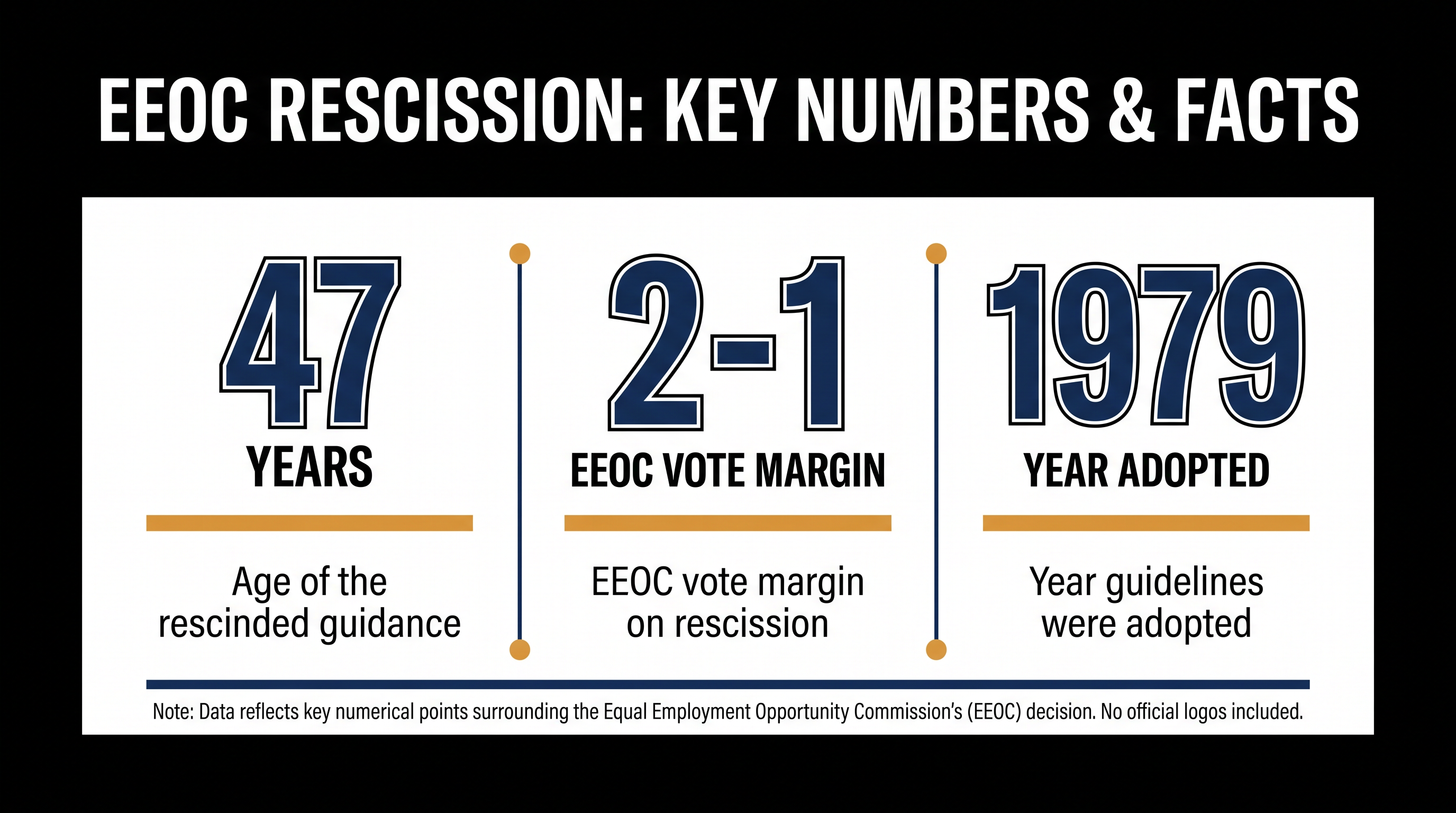
- The EEOC voted 2-1 to rescind its 1979 Affirmative Action Guidelines and Compliance Manual Section 607.
- The rescission removes a 47-year-old 'safe harbor' that protected corporate DEI programs from reverse-discrimination lawsuits.
- EEOC Chair Andrea Lucas argued the old guidance conflicted with the colorblind text of Title VII and recent Supreme Court precedent.
- Civil rights groups warn the move will sow confusion and deter lawful efforts to build diverse workforces.
- Legal experts advise companies to urgently audit their DEI programs and eliminate explicit demographic targets or quotas.
On June 30, 2026, the U.S. Equal Employment Opportunity Commission (EEOC) voted 2-1 to rescind its decades-old guidelines on voluntary affirmative action. The decision marks a profound shift in federal civil rights enforcement, dismantling a regulatory framework that has shaped corporate hiring practices since the Carter administration. By withdrawing the 1979 Affirmative Action Guidelines and the related Compliance Manual Section 607, the agency has effectively removed the federal blessing that allowed companies to explicitly consider race and sex when attempting to correct historical workforce imbalances.[1][2]
The immediate impact of this rescission falls squarely on corporate America, eliminating a crucial "safe harbor" that employers have relied upon for nearly 50 years to design and defend Diversity, Equity, and Inclusion (DEI) programs. For decades, human resources departments operated under the assurance that if they followed the EEOC's written roadmap, they would be shielded from federal prosecution and private lawsuits alleging reverse discrimination. With that shield now gone, companies are navigating a precarious new legal landscape where their diversity initiatives are suddenly vulnerable to intense scrutiny.[3][6]
To understand the magnitude of this shift, it is essential to understand the mechanism of the old rule. Adopted in 1979, the Affirmative Action Guidelines (29 C.F.R. Part 1608) allowed employers to conduct voluntary self-analyses of their workforces. If a company discovered a "manifest imbalance" in traditionally segregated job categories—such as a glaring lack of women in executive roles or minorities in skilled trades—the guidelines permitted them to implement temporary, flexible measures to correct it, provided those measures did not unnecessarily trammel the rights of majority-group employees.[2][4]
Crucially, these guidelines provided a statutory good-faith defense under Section 713(b)(1) of the Civil Rights Act. If an employer was sued for discrimination by a white or male employee who felt passed over due to a diversity initiative, the company could point to the EEOC's written framework in court to prove their affirmative action plan was reasonable, lawful, and endorsed by the federal government. This safe harbor gave corporate counsel the confidence to approve ambitious representation targets and diversity-focused fellowships.[5][6]
Today, that legal defense is entirely unavailable. Without the guidance, employers can no longer rely on the agency's framework to justify hiring targets, demographic-specific leadership programs, or executive compensation tied to diversity metrics. Employment law firms are warning clients that the EEOC will no longer treat the old guidelines as a basis for shielding any employment practice from scrutiny, forcing companies to evaluate their programs strictly against the raw text of federal statutes and recent court rulings.[8]
The rationale for the abrupt change, according to EEOC Chair Andrea Lucas and the commission's conservative majority, is that the 1979 framework "ran afoul" of the actual text of Title VII of the Civil Rights Act. Title VII explicitly prohibits employment discrimination against any individual on the basis of race, color, religion, sex, or national origin. The current commission argues that the old guidance improperly encouraged employers to violate this core principle by endorsing race- and sex-conscious employment decisions under the guise of voluntary affirmative action.[1][4]
The agency heavily cited recent Supreme Court precedent to justify the rollback. The EEOC pointed to the 2023 Students for Fair Admissions v. Harvard ruling, which struck down race-conscious college admissions, and the 2025 Ames v. Ohio Department of Youth Services decision, which clarified that Title VII protects all individuals equally, regardless of their group status. The commission concluded that the concept of "reverse discrimination" is a misnomer; discrimination based on a protected characteristic is unlawful regardless of who is harmed or benefited.[1][5]
The rescission reflects a broader philosophical pivot at the EEOC toward a strictly "colorblind" reading of civil rights law. The agency's newly adopted National Enforcement Plan explicitly prioritizes cases of intentional discrimination—including bias against majority groups within corporate DEI programs—over disparate impact claims. This marks a stark departure from the agency's historical focus on addressing systemic, seemingly neutral policies that disproportionately harm minority workers.[4][6]
Unsurprisingly, the regulatory rollback has triggered a fierce backlash from civil rights and women's advocacy organizations. Groups like the National Women's Law Center have sharply criticized the move, arguing that the rescission is deliberately designed to "sow confusion and deter employers from taking lawful steps" to ensure fair and inclusive workplaces. Advocates warn that the sudden removal of the safe harbor will have a massive chilling effect, prompting companies to abandon diversity efforts entirely out of fear of litigation.[7]

Unsurprisingly, the regulatory rollback has triggered a fierce backlash from civil rights and women's advocacy organizations.
Critics further maintain that removing the guidelines ignores the entrenched, systemic barriers that minorities and women still face in corporate America. By adopting a strictly colorblind enforcement model, they argue, the EEOC is effectively weaponizing civil rights law against the very marginalized groups it was originally written to protect, making it exponentially harder for employers to proactively dismantle structural inequality within their own ranks.[7]
Despite the sweeping regulatory changes, employment attorneys emphasize a critical legal reality: the rescission itself does not rewrite Title VII, nor does it automatically render all voluntary affirmative action plans illegal. The EEOC has simply withdrawn its own interpretive guidance; it does not have the power to overrule the Supreme Court or amend the underlying statutes passed by Congress.[4][8]
In fact, older Supreme Court decisions that upheld certain flexible, remedial affirmative action plans in the workplace—such as United Steelworkers v. Weber (1979) and Johnson v. Transportation Agency (1987)—have not been explicitly overturned by the high court. A carefully designed voluntary affirmative action plan may still be legally defensible if it is strictly remedial, supported by a documented barrier, temporary, and designed to avoid quotas.[4][6]
However, the enforcement landscape has undeniably narrowed, and the margin for error has vanished. Employment law firms are urgently warning clients that the EEOC is now actively scrutinizing corporate programs that use protected characteristics in eligibility, selection, scoring, or preferences. Even if a program might technically survive a Supreme Court challenge under the Weber precedent, few companies want to endure the cost and public scrutiny of a federal investigation to prove it.[6][8]
In response to the heightened risk, HR departments and in-house counsel across the country are rapidly auditing their existing DEI initiatives. Programs that establish hard demographic quotas, mandate diverse candidate slates, or restrict internships and mentorships to specific minority groups are widely considered high-risk and are being quietly dismantled or restructured.[5][8]
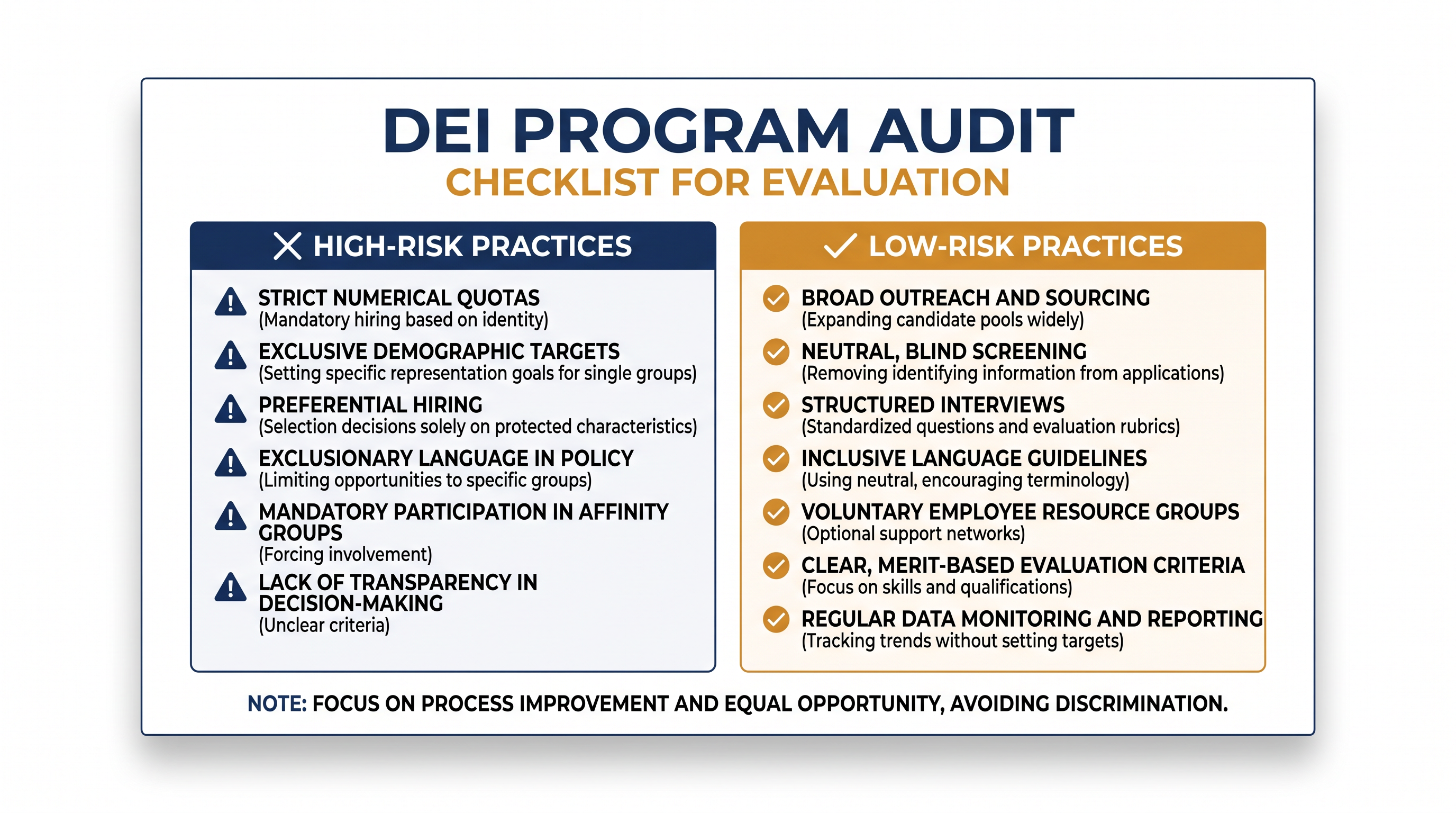
Legal experts advise that companies can still legally build diverse workforces, but their methods must fundamentally change. The focus is shifting away from demographic outcomes and toward process-oriented inclusion. Rather than setting targets for how many women or minorities must be hired, companies are being advised to focus on removing bias from the hiring process itself.[5][6]
Lawful strategies now emphasize expanding the top of the recruitment funnel. This includes broadening outreach to a wider variety of universities and professional organizations, eliminating unnecessary degree requirements that disproportionately screen out minority candidates, and ensuring that all networking, training, and mentorship opportunities are strictly open to all employees, regardless of race or sex.[6]
The EEOC's move is part of a sweeping 2025-2026 administrative effort to dismantle federal DEI mandates across the government. This broader deregulatory push includes the revocation of Executive Order 11246, which previously required federal contractors to maintain affirmative action programs, and the rescission of federal workplace harassment guidelines that protected transgender employees.[3][6]
The agency is also moving aggressively to eliminate the EEO-1 workforce demographic reporting requirements. Chair Lucas has argued that forcing employers to collect and submit annual data on the race and sex of their employees imposes unnecessary financial burdens and stands in direct tension with the requirement that employment practices be colorblind, as the data collection itself could facilitate unlawful discrimination.[1][2]
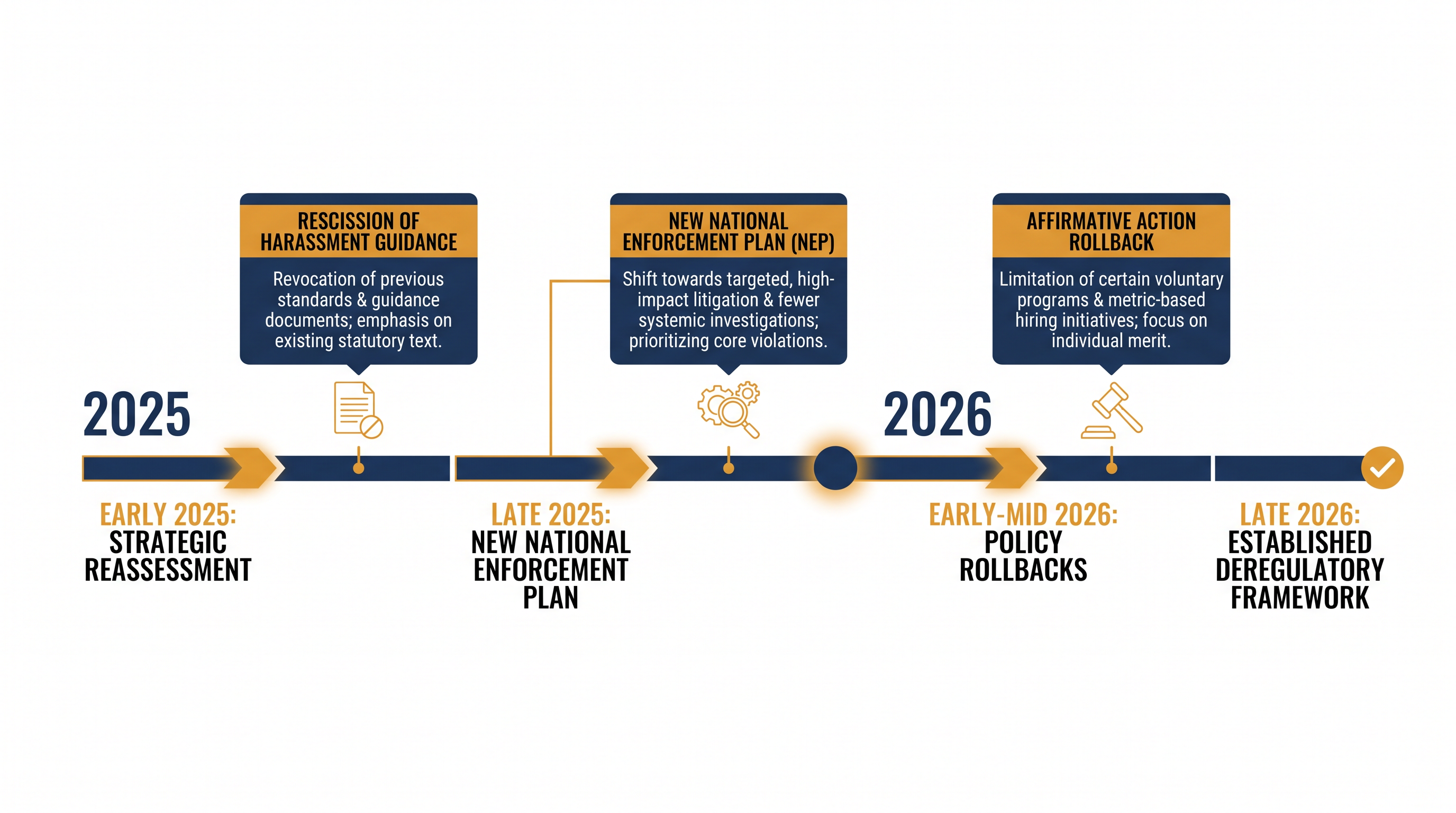
Ultimately, the removal of the EEOC's safe harbor leaves employers to navigate a precarious legal gray area without a federal roadmap. While companies are not legally required to abandon their commitment to equal opportunity, the threat of federal investigation and the rising tide of reverse-discrimination lawsuits are forcing a massive recalibration of how diversity is achieved in the modern workplace.[1][8]
The final fate of voluntary affirmative action in the private sector will likely be decided by the federal courts. Until the Supreme Court explicitly revisits its older precedents in light of the current legal climate, corporate America must balance its inclusion goals against a rapidly narrowing window of legal tolerance, ensuring that every employment decision is demonstrably merit-based and universally accessible.[4][6]
How we got here
1964
Title VII of the Civil Rights Act is passed, prohibiting employment discrimination based on race, color, religion, sex, or national origin.
1979
The EEOC adopts the Affirmative Action Guidelines, providing a safe harbor for voluntary programs designed to correct workforce imbalances.
June 2023
The Supreme Court strikes down race-conscious college admissions in Students for Fair Admissions v. Harvard.
January 2025
The Trump administration revokes Executive Order 11246, ending federal contractor affirmative action mandates.
June 2026
The EEOC votes 2-1 to rescind the 1979 Affirmative Action Guidelines and Compliance Manual Section 607.
Viewpoints in depth
The Colorblind Enforcement View
Proponents argue that Title VII protects all individuals equally and prohibits any consideration of race or sex in employment.
Led by EEOC Chair Andrea Lucas and conservative legal groups, this camp asserts that the 1979 guidelines were fundamentally incompatible with the plain text of the Civil Rights Act. They point to recent Supreme Court rulings, such as Ames v. Ohio Department of Youth Services, to argue that "reverse discrimination" is simply discrimination. In their view, corporate DEI programs that establish demographic targets or exclusive fellowships are illegal, and removing the federal safe harbor is a necessary step to restore merit-based, evenhanded enforcement of civil rights laws.
The Structural Equity View
Civil rights advocates argue the rescission ignores entrenched workplace disparities and deters lawful inclusion efforts.
Organizations like the National Women's Law Center view the EEOC's rollback as a coordinated effort to dismantle corporate diversity. They argue that the original 1979 guidelines correctly recognized that temporary, flexible measures are sometimes necessary to correct historical segregation and "manifest imbalances" in the workforce. By removing the safe harbor, this camp warns that the EEOC is deliberately sowing legal confusion, chilling lawful efforts to build diverse talent pipelines, and weaponizing Title VII against the very marginalized groups it was enacted to protect.
The Corporate Compliance View
Employment lawyers and HR professionals are focused on navigating the new legal risks without abandoning inclusion entirely.
For corporate counsel, the rescission is a massive shift in risk management. Without the EEOC's good-faith defense, companies are highly vulnerable to reverse-discrimination lawsuits if their DEI programs rely on protected characteristics. This camp is advising immediate audits of all hiring, promotion, and compensation practices. However, they emphasize that companies do not have to abandon diversity altogether; instead, they must pivot from outcome-based quotas to process-based inclusion, such as expanding recruitment outreach and removing biased screening criteria.
What we don't know
- Whether the Supreme Court will explicitly overturn its older precedents, such as United Steelworkers v. Weber, which allowed limited workplace affirmative action.
- How aggressively the EEOC will pursue enforcement actions against companies that maintain process-oriented, rather than outcome-oriented, diversity initiatives.
- The extent to which the removal of the safe harbor will actually reduce diversity in corporate leadership over the next decade.
Key terms
- Safe Harbor
- A legal provision that protects employers from liability if they act in good-faith reliance on written agency guidance.
- Title VII
- The section of the Civil Rights Act of 1964 that prohibits employment discrimination based on race, color, religion, sex, or national origin.
- Disparate Treatment
- Intentional employment discrimination against an individual based on a protected characteristic.
- Disparate Impact
- Employment practices that are seemingly neutral but have a disproportionately negative effect on a protected group.
- Manifest Imbalance
- A significant underrepresentation of a protected group in a specific job category compared to the available labor pool.
Frequently asked
Does this mean all corporate DEI programs are now illegal?
No. While programs that use strict demographic quotas or exclusive eligibility criteria are at high risk, companies can still lawfully promote diversity through broad recruitment outreach and unbiased hiring processes.
Did the Supreme Court outlaw affirmative action in the workplace?
Not explicitly. The 2023 Harvard decision applied to higher education, and older Supreme Court cases allowing limited workplace affirmative action have not been formally overturned, though the legal landscape is narrowing.
What should employers do now?
Legal experts advise employers to audit their DEI initiatives, remove any explicit race or sex-based targets, and ensure that all employment decisions are based on merit and open to all individuals.
Sources
Source coverage
8 outlets
3 viewpoints surfaced







[1]HR DiveCivil Rights & Women's Advocacy Groups
EEOC rescinds affirmative action guidelines
Read on HR Dive →[2]ReutersCorporate HR & Employment Counsel
EEOC votes to rescind its 1979 interpretive guidance on voluntary affirmative action
Read on Reuters →[3]Bloomberg LawCorporate HR & Employment Counsel
EEOC Seeks to Revoke Rule Shielding Affirmative Action Plans
Read on Bloomberg Law →[4]Jackson LewisEEOC & Conservative Legal Advocates
EEOC Votes to Rescind Affirmative Action Interpretive Guidelines and Related Compliance Manual
Read on Jackson Lewis →[5]DLA PiperCorporate HR & Employment Counsel
US federal: EEOC withdraws affirmative action guidance under Title VII
Read on DLA Piper →[6]Michael BestEEOC & Conservative Legal Advocates
EEOC Rescinds Affirmative Action Guidance: What Employers Need to Know
Read on Michael Best →[7]National Women's Law CenterCivil Rights & Women's Advocacy Groups
EEOC rescinds affirmative action guidelines - National Women's Law Center
Read on National Women's Law Center →[8]Employment Law LetterCorporate HR & Employment Counsel
EEOC Rescinds Longstanding Affirmative Action Guidance
Read on Employment Law Letter →
Every angle. Every day.
Get careers work stories with full source coverage and perspective breakdowns delivered to your inbox.