
DOJ Challenges State Workplace AI Laws: What the New Litigation Task Force Means for Employers
The Department of Justice has launched a specialized litigation task force to challenge state-level artificial intelligence regulations, creating a complex compliance environment for businesses.


- State Regulators & Advocates
- Argue that local laws are necessary to prevent algorithmic bias and protect workers.
- Corporate Compliance Teams
- Focused on navigating regulatory uncertainty by building adaptable AI governance frameworks.
- Federal Deregulators
- Argue for a uniform, minimally burdensome national framework to foster AI innovation.
Why this matters
As employers increasingly rely on AI for hiring and performance monitoring, they are caught in a jurisdictional tug-of-war. Understanding how to build flexible, human-in-the-loop governance frameworks is essential for companies to avoid penalties while the courts determine the future of workplace tech regulation.
Key points
- The DOJ's new AI Litigation Task Force is actively challenging state-level workplace AI regulations in court.
- Federal officials argue that state laws unconstitutionally burden interstate commerce and stifle technological innovation.
- State regulators maintain that local laws are necessary to protect workers from algorithmic bias and opaque automated decisions.
- Legal experts advise employers to continue complying with state laws while building flexible, human-in-the-loop AI governance frameworks.
The integration of artificial intelligence into the American workplace has accelerated rapidly, promising unprecedented efficiencies in hiring, performance monitoring, and daily operations. But for the companies deploying these tools, the regulatory landscape has suddenly become a high-stakes tug-of-war. The U.S. Department of Justice (DOJ) has officially launched a National AI Litigation Task Force, a specialized unit designed with a singular mandate: to aggressively challenge state-level laws that regulate artificial intelligence.[1][2]
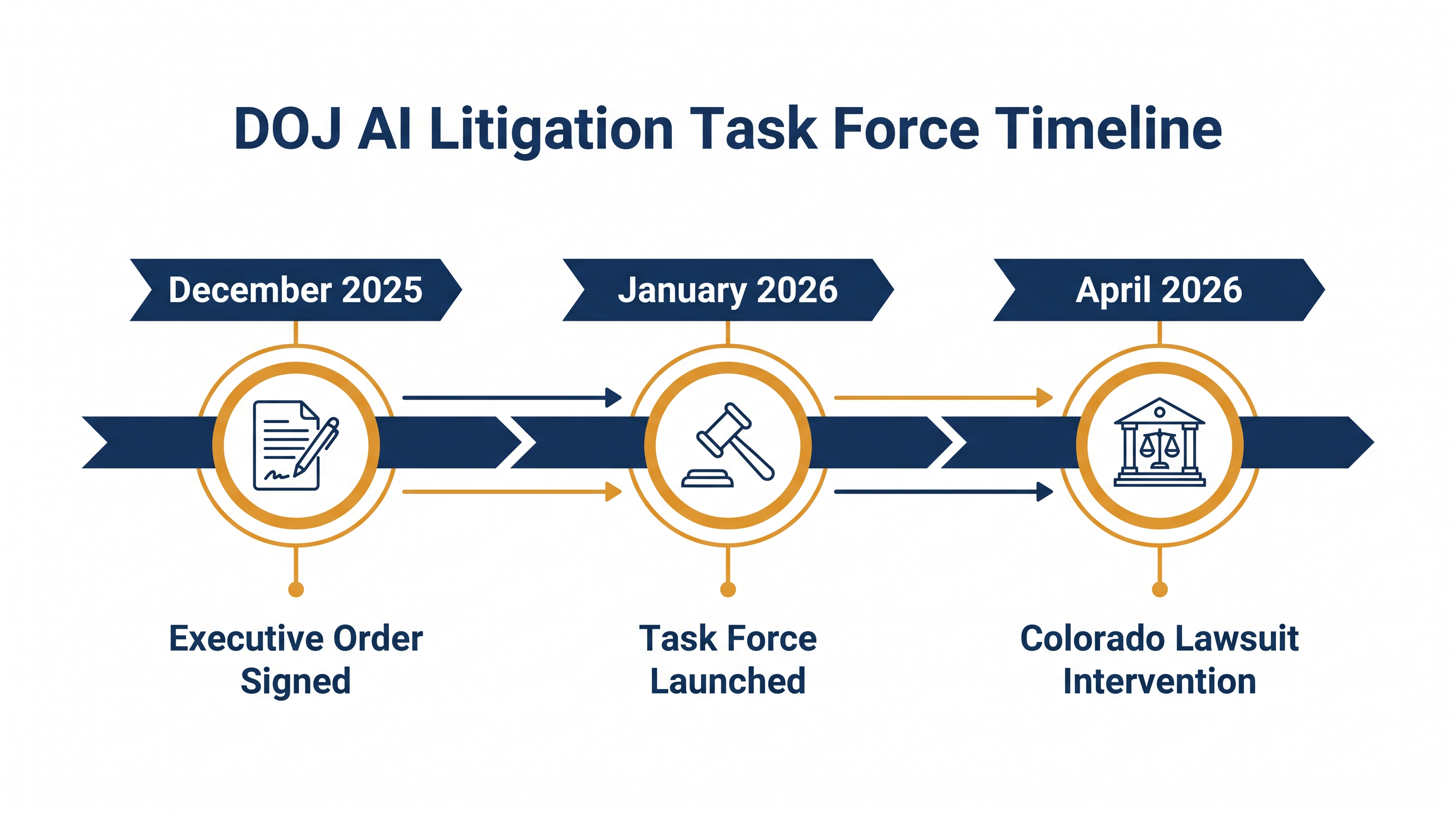
The initiative stems from a December 2025 executive order signed by President Donald Trump, which directed federal agencies to foster a "minimally burdensome national policy framework" for AI development. In a subsequent internal memorandum, Attorney General Pam Bondi formalized the task force, instructing it to target state regulations that allegedly create a patchwork of compliance hurdles for technology companies.[1][3]
For employers and human resources departments, this federal pushback creates an immediate and complex dilemma. Over the past two years, states across the country have raced to fill a federal legislative void by passing their own workplace technology laws. These state statutes typically require companies to conduct bias audits, disclose when AI is being used in hiring, and maintain human oversight over automated decisions.[4][7]
Now, the DOJ is arguing that these state-level mandates unconstitutionally regulate interstate commerce and are preempted by existing federal frameworks. The task force is actively intervening in active litigation to dismantle these rules, leaving corporate compliance teams caught between state regulators demanding strict oversight and a federal government actively working to invalidate those very requirements.[1][2]
The mechanism of the DOJ's strategy relies heavily on the courts rather than immediate executive nullification. The executive order itself does not automatically void any existing state AI law. Instead, it directs the DOJ to systematically identify and litigate against statutes that the administration views as overreach.[3][4]
The first major test of this strategy materialized in April 2026, when the DOJ intervened in a lawsuit filed by the artificial intelligence company xAI against the state of Colorado. The target was Colorado's SB24-205, a landmark law designed to prohibit "algorithmic discrimination" in high-stakes areas like employment, lending, and housing.[6]
Colorado's law required AI developers and deployers to satisfy rigorous reporting and prevention requirements to ensure their algorithms did not unintentionally discriminate based on race, sex, or other protected characteristics. It also included specific carve-outs allowing algorithms designed to advance diversity or redress historic discrimination.[6]
The DOJ's intervention argued that Colorado's requirements violated the Equal Protection Clause of the Fourteenth Amendment. Federal attorneys contended that the law effectively forced AI companies to inject ideological bias into their products and unlawfully compelled them to alter truthful outputs to meet state-mandated diversity metrics.[6]
The DOJ's intervention argued that Colorado's requirements violated the Equal Protection Clause of the Fourteenth Amendment.
While the federal government pushes for deregulation to maintain global technological dominance, state lawmakers argue their regulations are essential guardrails. States like California, Illinois, and New York have enacted or proposed legislation aimed at protecting workers from opaque algorithmic decisions.[2][4]
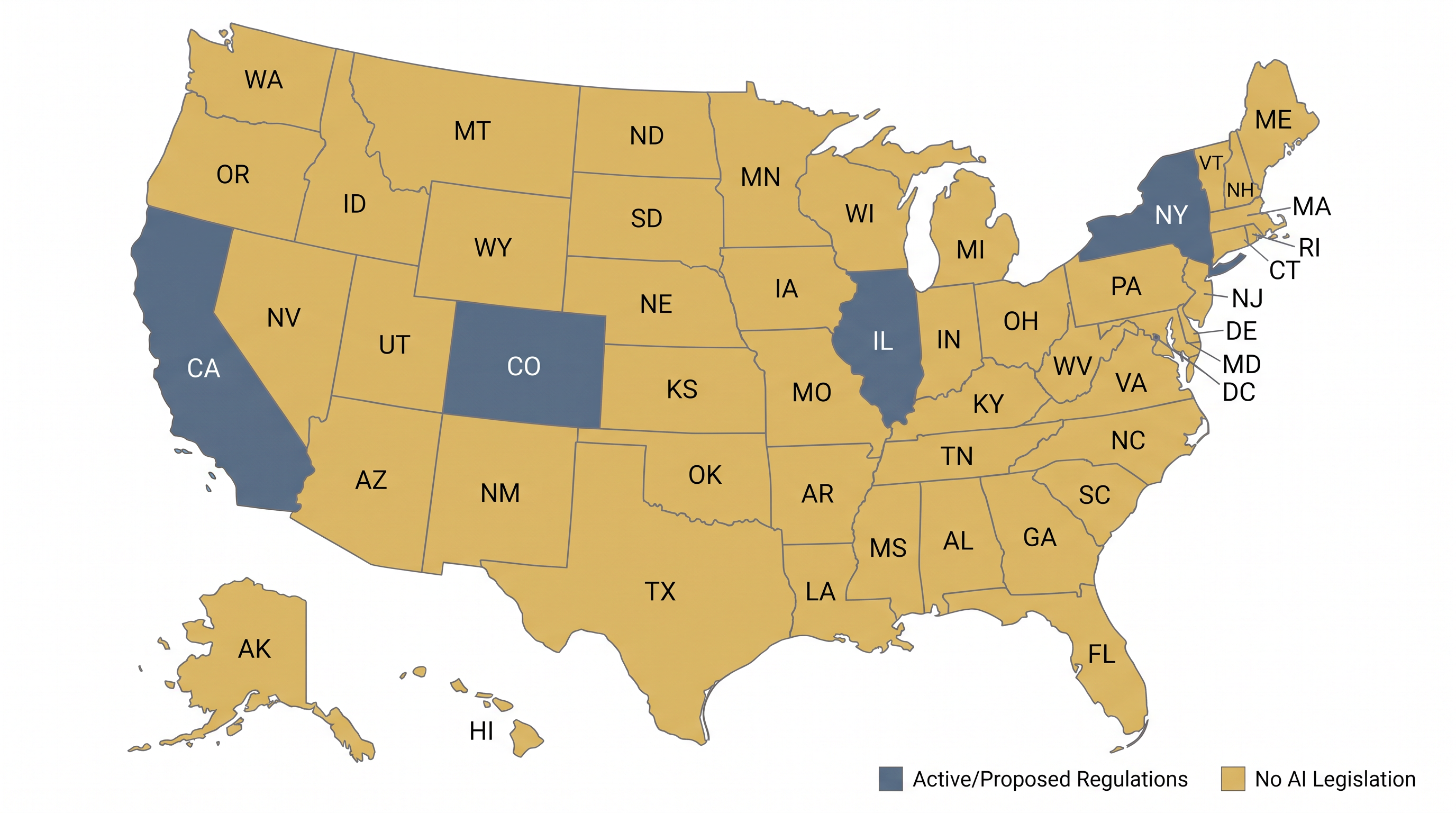
These state frameworks share a common architecture: they demand transparency. If an AI system is screening resumes, analyzing video interviews, or monitoring worker productivity, state regulators want employers to prove the system is not disproportionately discarding qualified candidates based on flawed data patterns.[4]
Worker advocates and state attorneys general maintain that without these local laws, employees have little recourse if an automated system unfairly terminates them or denies them a job. They view the DOJ's task force as an attempt to strip away necessary consumer and worker protections under the guise of promoting innovation.[2]
For corporate boards and in-house counsel, the tension between federal and state authorities translates into profound uncertainty. Legal analysts warn that companies cannot simply abandon their compliance efforts in anticipation of a federal victory. Until a court formally enjoins a state law, or Congress passes a comprehensive federal statute that explicitly preempts state action, local regulations remain fully enforceable.[3][5]
Consequently, legal experts are advising employers to engineer their compliance programs to meet the most demanding state standards, rather than attempting to retrofit their systems later. Building a flexible, documented governance framework allows organizations to adapt regardless of which side ultimately prevails in court.[4]
Interestingly, while the DOJ is fighting state-level AI regulations, the department's own internal guidelines for corporate compliance emphasize the need for rigorous AI oversight. The DOJ's updated Evaluation of Corporate Compliance Programs explicitly directs federal prosecutors to assess how companies identify, manage, and mitigate the risks associated with emerging technologies.
This means that even in the absence of state laws, federal regulators expect companies to demonstrate that they have implemented robust controls over their AI tools. Prosecutors are looking for explicit risk assessments, continuous monitoring, and clear protocols for human intervention when an AI system makes a critical workplace decision.
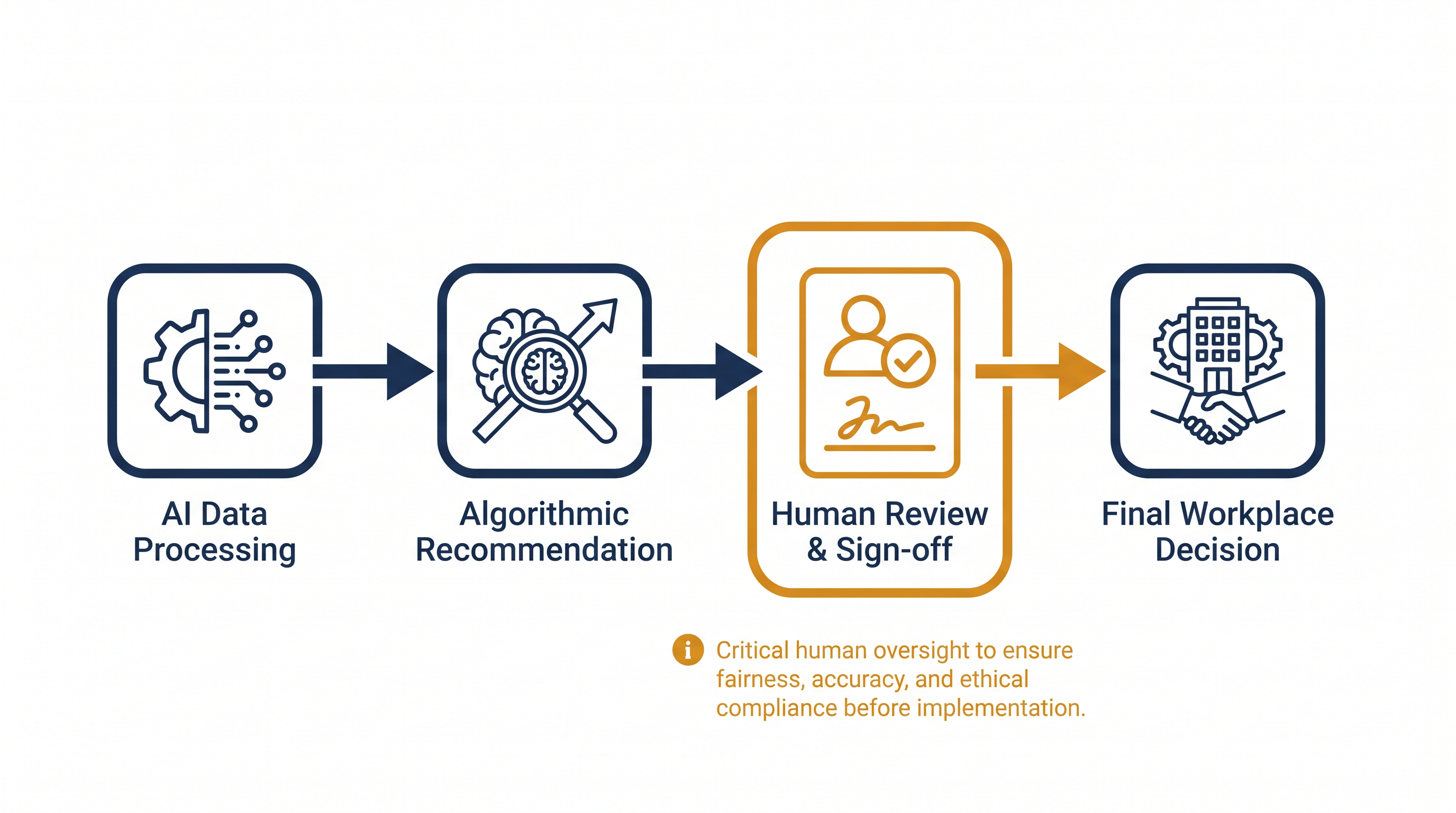
The concept of "human-in-the-loop" oversight has therefore become a cornerstone of responsible AI deployment. Employers are increasingly required to document exactly which actions an autonomous agent can complete on its own, and which high-stakes decisions—such as hiring or firing—require a human manager to review and sign off.[4]
Looking ahead, the conflict over workplace technology regulation is expected to play out over years, not months. The DOJ's task force is currently evaluating a broader catalog of state laws identified by the Commerce Department as excessively burdensome, signaling that more federal lawsuits are imminent.[3][4]
Simultaneously, the administration is pushing Congress to enact a uniform federal preemption framework that would permanently override state AI laws. However, with bipartisan pushback from lawmakers who favor state autonomy, the legislative path remains highly uncertain.[3][5]
In the interim, employers must navigate a fractured landscape. The most resilient organizations are those treating AI integration not merely as a software upgrade, but as a fundamental shift in corporate governance that requires continuous auditing, transparent policies, and a clear chain of human accountability.[4]
How we got here
December 2025
President Trump signs an executive order directing the establishment of a minimally burdensome national policy framework for AI.
January 2026
Attorney General Pam Bondi officially launches the DOJ's AI Litigation Task Force to challenge state AI regulations.
March 2026
The Commerce Department begins evaluating state AI laws to identify those deemed excessively burdensome to federal policy.
April 2026
The DOJ intervenes in a lawsuit against Colorado's SB24-205, marking the task force's first major legal challenge against a state workplace tech law.
Viewpoints in depth
Federal Deregulators
Argue for a uniform, minimally burdensome national framework to foster AI innovation.
The DOJ and the current administration maintain that a patchwork of 50 different state regulatory regimes creates insurmountable compliance costs, particularly for startups. By challenging state laws under the Commerce Clause and Equal Protection Clause, they aim to remove barriers to technological advancement and secure U.S. global dominance in artificial intelligence.
State Regulators & Worker Advocates
Argue that local laws are necessary to prevent algorithmic bias and protect workers.
State attorneys general and labor advocates contend that federal inaction has left workers vulnerable to opaque, automated decision-making systems. They argue that state-level mandates for bias audits, transparency, and human oversight are essential guardrails against discriminatory hiring and monitoring practices, and view federal preemption as an attack on consumer protection.
Corporate Compliance Teams
Focused on navigating regulatory uncertainty by building adaptable AI governance frameworks.
Caught between conflicting state and federal directives, corporate counsel and HR leaders are prioritizing flexible compliance architectures. Rather than waiting for the courts to resolve the jurisdictional battle, these teams are engineering their systems to meet the most stringent state requirements while simultaneously satisfying the DOJ's own internal guidelines for corporate AI risk management.
What we don't know
- Whether the federal courts will ultimately agree that state AI laws violate the Interstate Commerce Clause or Equal Protection Clause.
- If Congress will successfully pass a comprehensive federal preemption framework to override state regulations.
- How the Commerce Department's upcoming evaluation of 'onerous' state laws will impact federal funding for non-compliant states.
Key terms
- Algorithmic Discrimination
- The phenomenon where an artificial intelligence system produces biased or unfair outcomes based on protected characteristics like race, gender, or age.
- Interstate Commerce Clause
- A constitutional provision that gives the federal government the power to regulate commerce across state lines, often used to challenge state laws that overly burden national business operations.
- Preemption
- A legal doctrine establishing that federal law supersedes conflicting state laws, a key argument used by the DOJ task force.
- Human-in-the-loop (HITL)
- An AI governance model where a human operator is required to review and approve an automated system's recommendation before a final decision is made.
Frequently asked
Does the DOJ task force immediately invalidate state AI laws?
No. All current and pending state and local AI laws remain fully enforceable unless and until a federal court formally blocks them through an injunction.
Should employers stop complying with state AI hiring rules?
Legal experts advise against halting compliance. Employers must continue to follow active state laws to avoid local penalties while the federal challenges progress through the courts.
What is the Colorado AI Act (SB24-205)?
It was a landmark state law requiring AI developers and deployers to satisfy disclosure and prevention requirements to ensure their algorithms did not cause unintentional discrimination.
What does the DOJ expect from corporate compliance programs?
Even as it challenges state laws, the DOJ's internal guidelines require companies to demonstrate robust oversight, explicit risk assessments, and human-in-the-loop controls for their AI tools.
Sources
Source coverage
7 outlets
3 viewpoints surfaced






[1]U.S. Department of JusticeFederal Deregulators
Justice Department Intervenes in Lawsuit Challenging Colorado AI Law
Read on U.S. Department of Justice →[2]CBS NewsState Regulators & Advocates
DOJ creates AI task force to challenge state regulations
Read on CBS News →[3]Fisher PhillipsCorporate Compliance Teams
What the New Executive Order on AI Means for Employers
Read on Fisher Phillips →[4]Epstein Becker GreenCorporate Compliance Teams
How Should Employers Approach Workplace AI Governance
Read on Epstein Becker Green →[5]BakerHostetlerFederal Deregulators
Inside the DOJ's New AI Litigation Task Force
Read on BakerHostetler →[6]Jenner & BlockState Regulators & Advocates
DOJ Intervenes in Challenge to Colorado AI Act
Read on Jenner & Block →[7]Inside Global TechCorporate Compliance Teams
Key legislative and regulatory developments related to artificial intelligence
Read on Inside Global Tech →
Comments

Every angle. Every day.
Get careers work stories with full source coverage and perspective breakdowns delivered to your inbox.