
CFPB Reopens Credit Card Late Fee Debate With Formal Request for Information to OIRA
The Consumer Financial Protection Bureau has initiated a new review of credit card late fees, submitting a formal Request for Information to federal regulators just a year after a previous $8 fee cap was vacated in court.


- Banking Industry & Issuers
- Argues that late fees are necessary to cover collection costs and deter missed payments, and that strict caps violate the CARD Act.
- Regulatory Analysts
- Focuses on the procedural mechanisms of the CFPB's actions and the legal viability of future rulemaking.
- Consumer Advocates
- Emphasizes the financial burden of high penalty fees on cardholders and educates consumers on their current rights.
Why this matters
Credit card late fees cost consumers billions annually, and the rules governing how much banks can charge are once again under federal review. Understanding the current legal limits—and the CFPB's renewed data collection—helps cardholders navigate their rights and potential future costs.
Key points
- The CFPB has submitted a Request for Information (RFI) to federal regulators regarding credit card late fees.
- The move reopens the debate over penalty charges after a 2024 rule capping fees at $8 was vacated by a federal judge.
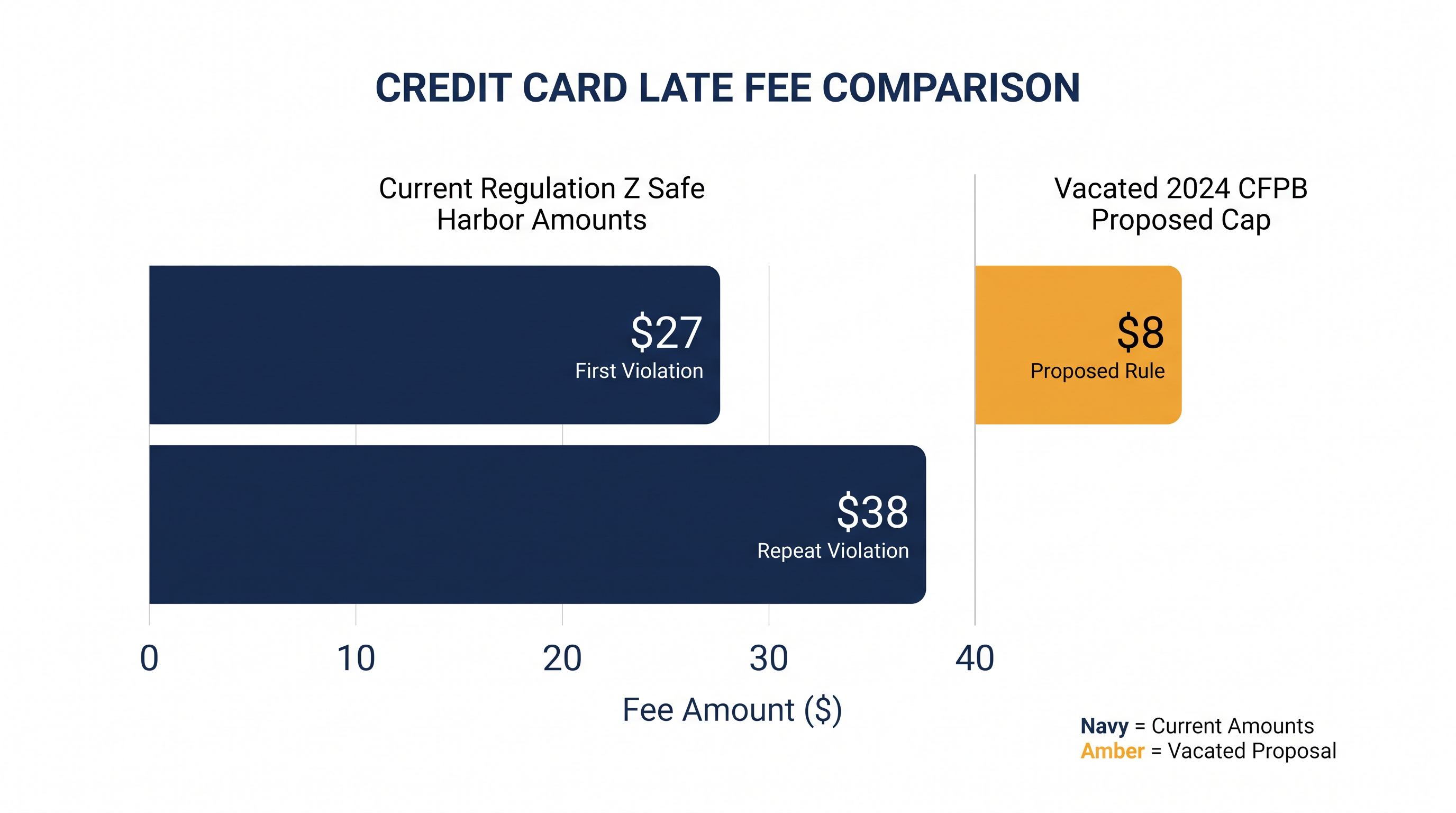
- Current safe harbor rules allow issuers to charge up to $27 for a first late payment and $38 for repeat violations.
- The RFI will gather updated market data on issuer collection costs and consumer payment behavior.
- Analysts note the fact-gathering step does not guarantee a new rule but signals continued regulatory scrutiny.
The Consumer Financial Protection Bureau (CFPB) has officially taken the first formal step toward revisiting the federal regulation of credit card late fees, signaling that the contentious debate over consumer penalty charges is far from over. In early July 2026, the Bureau submitted a Request for Information (RFI) titled "Credit Card Late Fees and Late Payments" to the Office of Information and Regulatory Affairs (OIRA) for interagency review. This procedural move places the issue back on the active regulatory docket, catching many financial industry observers by surprise. The submission indicates that despite recent legal setbacks and a change in administrative leadership, the federal watchdog agency continues to view the billions of dollars collected annually in credit card penalty fees as a critical area of market oversight.[1][3]
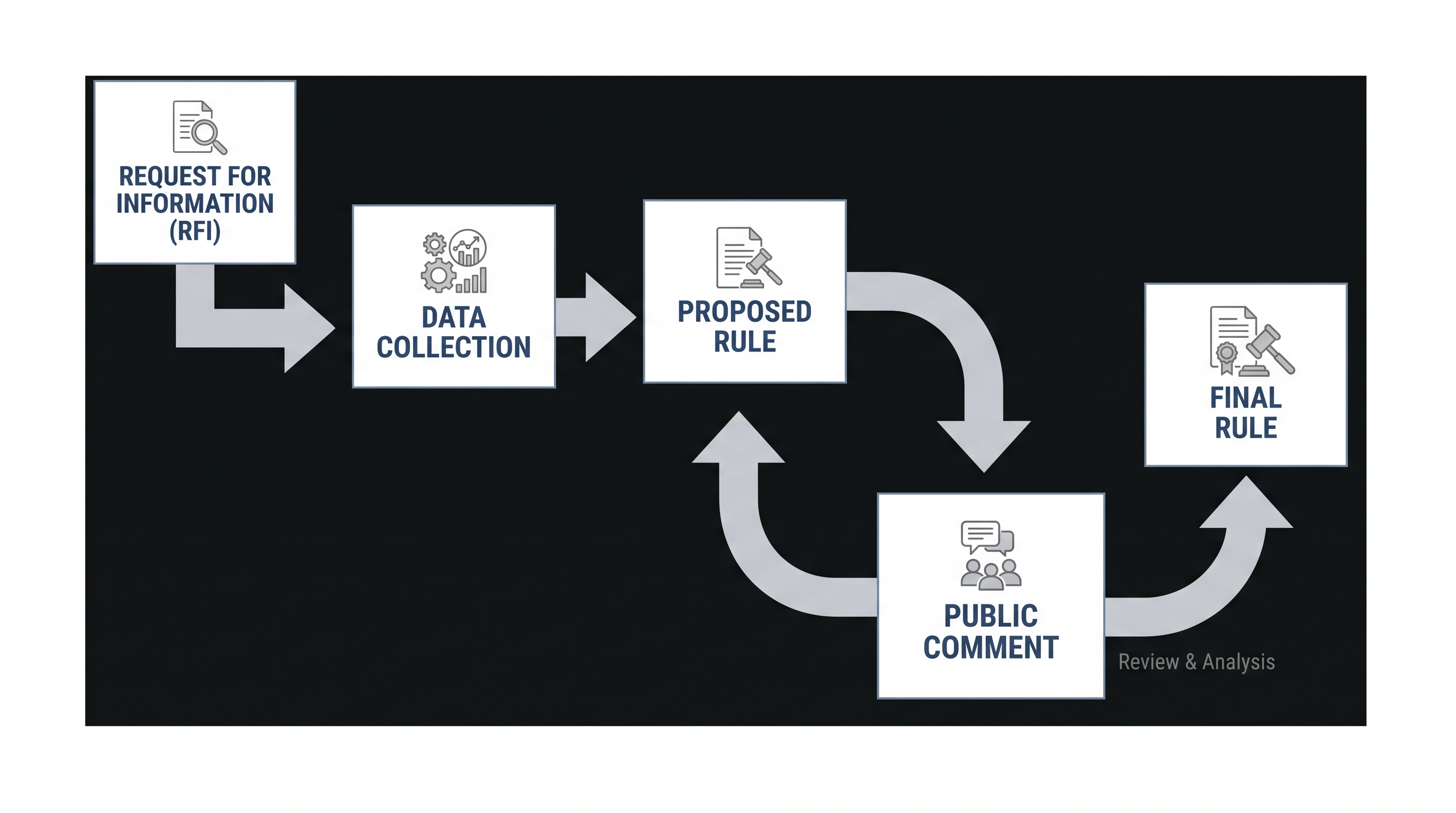
While the document itself has not yet been publicly released, the submission to OIRA marks a significant development in the landscape of consumer finance. An RFI is typically an early, fact-gathering stage in the federal rulemaking process. It allows a regulatory agency to collect broad market data, solicit stakeholder feedback, and build an empirical evidence base before deciding whether to draft new, binding regulations. Because the specific questions in the RFI remain under interagency review, financial institutions and consumer advocates are left to speculate on the exact scope of the inquiry. However, legal experts note that this foundational step is essential for any agency looking to justify future policy shifts, ensuring that any subsequent proposals are grounded in current, defensible market realities rather than outdated assumptions.[1][5]
The renewed focus on late fees is particularly notable given the turbulent recent history of the CFPB's regulatory efforts in this exact domain. Just last year, the Bureau, operating under its current leadership, made headlines when it abandoned the legal defense of a highly controversial 2024 rule that would have drastically reduced the amount banks could charge consumers for missing a payment deadline. That previous initiative, finalized in the waning days of the Biden administration, represented one of the most aggressive consumer protection measures in the credit card industry's history. Its sudden demise in the courts led many to believe the issue of late fees had been permanently shelved, making the new RFI a surprising pivot that has reignited discussions across the financial sector.[4][5]
To understand the stakes of the current data-gathering effort, it is necessary to look back at the mechanics of the vacated 2024 rule. That regulation aimed to aggressively cut the "safe harbor" late fee—the standard amount that credit card issuers are permitted to charge without having to explicitly prove to regulators that the fee perfectly reflects their actual collection costs. The CFPB's 2024 framework sought to slash this safe harbor threshold from an industry average of roughly $32 down to a flat $8. The rule was specifically tailored to apply to large credit card issuers with more than one million open accounts, a massive cohort that the Bureau noted covers over 95% of all outstanding credit card balances in the United States.[4][6]
At the time of its finalization, the CFPB estimated that the $8 cap would save American cardholders approximately $10 billion annually by eliminating what the agency characterized as excessive and punitive penalty charges. Furthermore, the 2024 rule would have eliminated the automatic annual inflation adjustments that had historically allowed the safe harbor amount to creep upward year after year. It also included a provision limiting late fees so that they could never exceed 25% of the consumer's required minimum payment for that billing cycle. These sweeping changes were designed to fundamentally alter the economics of credit card issuing, shifting billions in revenue from bank balance sheets back into the pockets of consumers.[1][3][6]
However, the ambitious $8 cap never actually took effect for consumers. Almost immediately after the rule was finalized, banking industry trade associations and the U.S. Chamber of Commerce launched a coordinated legal challenge to block its implementation. The industry plaintiffs filed suit in federal court, arguing forcefully that the CFPB had exceeded its statutory authority under the Credit Card Accountability Responsibility and Disclosure (CARD) Act of 2009. They contended that the new rule was procedurally defective and effectively imposed an unlawful price control that would force banks to absorb the costs of delinquent accounts, ultimately leading to higher interest rates and reduced credit access for all borrowers.[3][4]
However, the ambitious $8 cap never actually took effect for consumers.
The core of the banking industry's legal argument rested on the specific language of the CARD Act, which explicitly allows credit card issuers to charge penalty fees that are "reasonable and proportional" to the consumer's violation. Industry lawyers argued that an $8 flat fee completely ignored the actual, documented costs of collections—such as mailing notices, making phone calls, and managing delinquent accounts—and stripped away the necessary deterrent value that prevents consumers from paying late in the first place. They maintained that the CFPB's methodology for arriving at the $8 figure was flawed and failed to account for the complex risk models that sustain the modern credit card ecosystem.[4][5]
The legal battle came to an abrupt conclusion following a change in presidential administrations. The newly appointed leadership at the CFPB made the strategic decision to cease defending the 2024 regulation in court. In early 2025, a federal judge in Texas issued an injunction and ultimately vacated the rule entirely, ruling that the agency's strict fee cap clearly violated the statutory requirements of the CARD Act. Rather than pursue further appeals, the parties agreed to formally vacate the rule as part of a settlement. This maneuver ended a year of intense, high-stakes litigation and effectively wiped the Biden-era regulation from the books, resetting the regulatory landscape to its previous state.[3][4]
With the 2024 rule officially discarded, the pre-existing Regulation Z safe harbor framework remains the governing law for credit card late fees today. Under these established rules, issuers are legally permitted to charge up to $27 for a first-time late payment. If a consumer misses another payment within the same billing cycle or during any of the following six billing cycles, the issuer is allowed to escalate the penalty, charging up to $38 for the repeat violation. These figures represent the maximum safe harbor amounts that regulators presume to be compliant without requiring the bank to submit detailed cost-justification analyses. Crucially, unlike the vacated 2024 proposal, the current Regulation Z framework includes a built-in mechanism for annual inflation adjustments. The safe harbor figures are recalculated yearly based on a specific formula tied to the Consumer Price Index, meaning the actual maximum amount a consumer might see on their credit card statement can fluctuate over time. Because of these automatic adjustments, the legally permissible late fees remain significantly higher than the $8 cap that many consumers mistakenly believe is currently in effect due to outdated news coverage.[6]
Now, the submission of the new RFI to OIRA suggests that the CFPB is not entirely finished with the late fee debate. Legal experts and regulatory analysts speculate that the Bureau may be seeking to update its factual record to account for shifts in the macroeconomic environment since its last major data collection effort in 2022. By gathering fresh empirical data, the agency can establish a new baseline understanding of how late fees are currently impacting household finances, particularly in an era characterized by fluctuating interest rates and evolving consumer debt burdens. This updated record would be a necessary prerequisite for any future policy actions, ensuring they are built on contemporary evidence.[3][5]
Industry participants anticipate that the forthcoming RFI will ask credit card issuers to provide highly detailed, updated data on their internal collection costs. The Bureau is likely to seek evidence regarding consumer payment patterns, the frequency of repeat violations, and feedback on the overall effectiveness of the current Regulation Z safe harbor amounts. By asking issuers to open their books, the CFPB can evaluate whether the $27 and $38 thresholds genuinely reflect the costs banks incur when a payment is missed, or if those safe harbors have morphed into a reliable profit center that exceeds the "reasonable and proportional" standard mandated by the CARD Act.[1][2]
Beyond simply updating the math, the Bureau might also be exploring entirely alternative regulatory approaches that could withstand the intense legal scrutiny that doomed the 2024 rule. Rather than attempting to impose a strict, low-dollar cap across the entire industry, regulators might consider adjusting the underlying methodology used to calculate safe harbor fees. This could involve creating tiered fee structures based on the size of the outstanding balance, requiring more granular cost disclosures from issuers, or implementing new rules regarding how and when late fees are assessed during the billing cycle. Furthermore, some political and financial analysts suggest that the request for information could be utilized as part of a broader populist messaging strategy. With midterm elections approaching, demonstrating active oversight on consumer affordability and "junk fees" allows the administration to signal its commitment to lowering everyday costs for Americans. By initiating an RFI rather than immediately proposing a new rule, the CFPB can show forward momentum on a popular consumer issue without instantly triggering another massive, multi-year legal battle with well-funded banking trade groups.[1][4][5]
For now, financial institutions, credit card issuers, and compliance teams are waiting anxiously for the RFI to be officially published in the Federal Register to gauge the Bureau's exact priorities. Legal teams across the banking sector are already preparing to aggregate their internal cost data to ensure they can robustly defend their current fee structures during the upcoming public comment period. Analysts caution that an RFI does not guarantee that a new rule will ever be proposed; it is entirely possible that the agency will review the submitted data and decide that the current market equilibrium is acceptable. Nevertheless, the mere existence of the inquiry clearly places late-payment practices back on the active regulatory docket. It serves as a stark reminder that consumer financial protection remains a dynamic and highly contested arena, forcing banks to continuously justify their pricing models against the statutory requirements of federal law.[3][4]
In the meantime, consumer advocates remind cardholders that while the regulatory ceiling allows for fees up to $38, consumers still have practical options for managing these costs. Issuers frequently waive a first-time late fee upon request as a customer service gesture, regardless of what the federal safe harbor technically allows them to charge. Cardholders who miss a payment due to an oversight are encouraged to call their bank immediately, as a simple phone call can often result in the fee being reversed. Furthermore, consumers are advised to clearly distinguish between a genuine late fee and a billing dispute. If a penalty fee appears on a statement due to an issuer error—such as a payment that was submitted on time but processed incorrectly by the bank's system—it falls under billing-error dispute rights rather than late-fee regulations. Federal law provides a distinct set of protections for billing errors, requiring the issuer to investigate and correct the mistake without penalizing the consumer. Understanding these nuances ensures that cardholders can effectively advocate for themselves while the broader regulatory debate continues in Washington.[6]
How we got here
2009
Congress passes the CARD Act, requiring credit card penalty fees to be reasonable and proportional.
2022
The CFPB issues an Advance Notice of Proposed Rulemaking to gather initial data on credit card late fees.
March 2024
The CFPB finalizes a rule capping late fees at $8 for large issuers, aiming to save consumers $10 billion annually.
Early 2025
A federal judge vacates the 2024 rule after the new administration declines to defend it in court.
July 2026
The CFPB submits a new Request for Information to OIRA, officially reopening the late fee debate.
Viewpoints in depth
Banking Industry & Issuers
Argues that late fees are necessary to cover collection costs and deter missed payments.
Financial institutions and their trade associations maintain that credit card late fees are a critical component of risk management. They argue that the costs associated with delinquent accounts—such as mailing notices, dedicating customer service hours, and adjusting risk models—are substantial. Furthermore, they emphasize that penalty fees serve as a necessary deterrent that encourages on-time payments, which ultimately keeps interest rates lower for the broader consumer base. From this perspective, strict regulatory caps like the vacated $8 rule violate the CARD Act's requirement that fees be 'reasonable and proportional' to the violation.
Consumer Advocates
Emphasizes the financial burden of high penalty fees on vulnerable cardholders.
Consumer protection groups argue that current late fee structures disproportionately harm low-income and subprime borrowers who are already struggling with debt. They view the $27 to $38 safe harbor amounts as excessive and punitive, functioning more as a reliable profit center for large banks than a genuine mechanism for cost recovery. Advocates strongly supported the CFPB's previous efforts to cap fees at $8, arguing that such a reduction would keep billions of dollars in the pockets of American households and prevent a single missed payment from triggering a cascading cycle of debt.
Regulatory Analysts
Focuses on the procedural mechanisms and legal viability of the CFPB's actions.
Legal and regulatory observers view the CFPB's new Request for Information through a procedural lens, noting that the agency must carefully rebuild its empirical evidence base after its 2024 rule was vacated in court. They point out that gathering updated market data is a necessary prerequisite to any future rulemaking, ensuring that new policies can withstand inevitable legal challenges from the banking sector. Analysts also highlight the strategic nature of the RFI, suggesting it allows the administration to signal active oversight on consumer affordability without immediately committing to a specific, legally vulnerable fee cap.
What we don't know
- It remains unclear what specific data points the CFPB is requesting from credit card issuers, as the RFI document has not been publicly released.
- Regulators have not indicated whether they intend to propose a new fee cap or explore alternative regulatory approaches.
- It is unknown how the banking industry will respond to the data request or if they will challenge the inquiry.
Key terms
- Request for Information (RFI)
- An early step in the federal rulemaking process where an agency asks for public and industry data before proposing a new regulation.
- OIRA
- The Office of Information and Regulatory Affairs, a White House agency that reviews draft regulations and information requests.
- Safe Harbor
- A legally defined fee amount that regulators presume is compliant, protecting issuers from enforcement actions if they stay below it.
- CARD Act
- A 2009 federal law that established consumer protections for credit cards, including rules that penalty fees must be reasonable and proportional.
- Regulation Z
- The federal regulation that implements the Truth in Lending Act, dictating how lenders must disclose credit terms and fees.
Frequently asked
What is the current maximum late fee a credit card can charge?
Under current regulations, issuers can charge up to $27 for a first late payment and up to $38 for subsequent violations within six billing cycles.
Is the $8 late fee cap still in effect?
No. The $8 cap proposed in 2024 was vacated by a federal judge in 2025 and is not legally enforceable.
Does the new CFPB request mean fees will be lowered again?
Not necessarily. A Request for Information is a fact-gathering step, and it remains unclear if the CFPB will propose a new rule or simply update its market research.
Can I get a late fee waived?
Yes, many credit card issuers will waive a first-time late fee as a customer service gesture if you contact them and request it.
Sources
Source coverage
6 outlets
3 viewpoints surfaced






[1]Receivables InfoRegulatory Analysts
CFPB Signals Possible New Review of Credit Card Late Fee Rules
Read on Receivables Info →[2]PwCRegulatory Analysts
CFPB agenda, credit risk, supervision and insurer solvency – July 24, 2026
Read on PwC →[3]Consumer Finance MonitorRegulatory Analysts
CFPB Signals It May Revisit Credit Card Late Fee Regulation
Read on Consumer Finance Monitor →[4]American BankerBanking Industry & Issuers
The Consumer Financial Protection Bureau plans to request information from credit-card issuers about their late fees
Read on American Banker →[5]PYMNTSBanking Industry & Issuers
CFPB Submits Request for Information on Credit Card Late Fees
Read on PYMNTS →[6]Clear Value CardsConsumer Advocates
The CFPB capped credit card late fees at $8 in 2024. A federal court vacated that rule in 2025. Here's what issuers can actually charge today.
Read on Clear Value Cards →
Comments

Every angle. Every day.
Get finance stories with full source coverage and perspective breakdowns delivered to your inbox.