
Why Swimmers' Legs Sink: The Rotational Torque Created by the Body's Centers of Buoyancy and Mass
The human body's center of buoyancy sits in the chest, while its center of mass rests lower near the hips, creating a longitudinal gap between upward and downward forces. This separation acts as a rotational lever, actively driving a swimmer's legs downward unless counteracted by core engagement and kicking.
By Aylin Aksoy

In short
- The human body experiences an upward buoyant force at the chest and a downward gravitational force at the hips.
- The longitudinal separation between these two forces creates a rotational couple that actively twists the body, sinking the legs.
- Swimmers must counteract this continuous torque by pressing their chest downward, engaging their core, and utilizing the hydrodynamic lift of their kick.
The frustration of sinking legs is a universal experience for novice swimmers, often blamed on a weak kick or heavy bones. In reality, the phenomenon is a strict mechanical consequence of human anatomy interacting with fluid dynamics. The human body is subjected to two distinct vertical forces in the water, and they do not align.[3]
Gravity pulls downward on the body's center of mass, which is typically located near the hips or pelvis. Simultaneously, the water exerts an upward buoyant force equal to the weight of the displaced fluid. This upward force acts through the center of buoyancy, which sits higher up in the air-filled thoracic cavity.[1]
Because these two centers are separated by several centimeters along the body's longitudinal axis, they create a mechanical lever. "The upward buoyancy force on an object acts through the center of buoyancy, being the centroid of the displaced volume of fluid," according to Wikipedia's physics editors.[1]
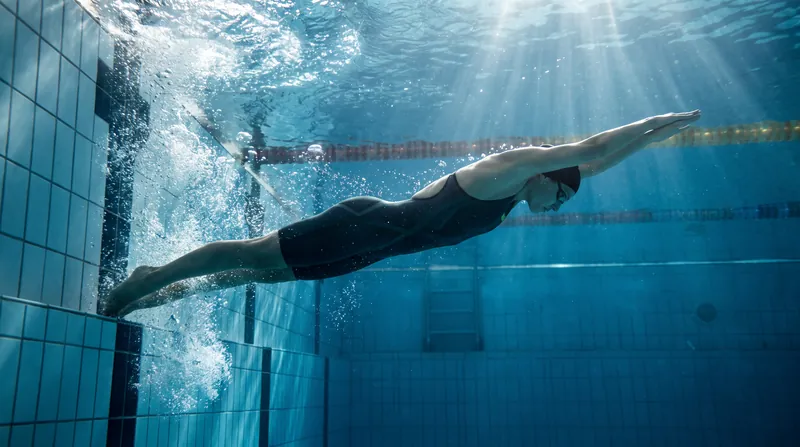
When a swimmer attempts to lie flat, the upward push at the chest and the downward pull at the hips do not cancel each other out. Instead, they generate a rotational couple—a twisting force that actively rotates the body around its transverse axis. This torque drives the heavy legs toward the pool floor.[2]
The Mechanics of Rotational Torque
To understand why the legs sink, one must look at the mathematical definition of torque. Torque is calculated by multiplying the applied force by the perpendicular distance from the pivot point. In the water, the pivot point becomes the swimmer's center of mass, and the distance to the lungs acts as the moment arm.[2]
"Torque is a fundamental concept in physics that describes the tendency of a force to produce or change rotation around an axis," notes the engineering consensus. The greater the distance between the lungs and the hips, the longer the moment arm becomes. A longer moment arm multiplies the rotational force applied to the swimmer's frame.[2][3]
For a typical adult male weighing 80 kilograms, the center of mass sits slightly lower than in a typical female, while the broad chest keeps the center of buoyancy high. If the distance between these centers is just 3 centimeters, the resulting continuous torque is significant enough to drop the legs to a 15-degree angle within seconds.[3]
This rotational couple explains why simply relaxing in the water rarely results in a perfectly horizontal float. The body naturally seeks a stable equilibrium where the center of mass rests directly beneath the center of buoyancy. For most humans, that stable position is diagonal or entirely vertical, not flat.[1]
The Role of Body Composition
Individual anatomy dictates the exact magnitude of this leg-sinking torque. Muscle tissue is significantly denser than water, possessing a specific gravity of roughly 1.06, which means it sinks. Adipose tissue, or body fat, has a specific gravity of about 0.90, allowing it to float easily.[3]
Swimmers with heavily muscled legs and low body fat experience a severe downward pull at their lower extremities. This shifts their center of mass even further toward the feet, extending the moment arm. The resulting increase in rotational torque makes maintaining a horizontal posture metabolically expensive.[3]
Conversely, the lungs act as biological flotation devices. A full inhalation can add up to 6 liters of air to the thoracic cavity, dramatically increasing the volume of displaced water without adding mass. This expands the buoyant force at the chest, but it also anchors the center of buoyancy firmly in the upper body.[1]
Women generally possess a higher percentage of body fat distributed more evenly across the hips and thighs compared to men. This anatomical difference shifts their center of buoyancy slightly lower, reducing the longitudinal gap between the two centers. A smaller gap means less rotational torque and a naturally flatter floating position.[3]
Counteracting the Sinking Effect
To swim efficiently, athletes must actively fight this rotational couple to minimize hydrodynamic drag. The most common corrective technique involves pressing the chest downward into the water. By driving the thoracic cavity deeper, the swimmer leverages the buoyant force to pivot the hips and legs upward.[3]
This postural correction requires constant isometric contraction of the core muscles. The abdominal and lower back muscles must bridge the gap between the buoyant chest and the sinking pelvis. Without this muscular tension, the kinetic chain breaks, and the rotational torque immediately drops the legs out of alignment.[3]
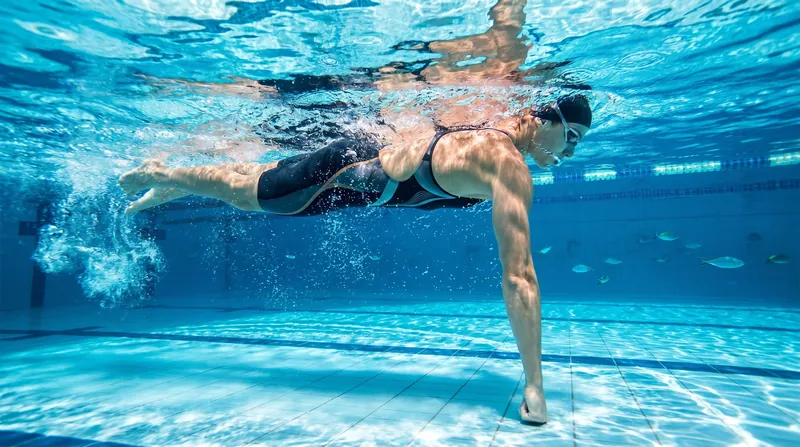
The flutter kick also serves a crucial stabilizing role beyond mere propulsion. The downward beat of the kick generates an upward hydrodynamic lift at the feet. This lift provides a third force vector that counterbalances the sinking torque, restoring the body to a horizontal plane.[3]
Training tools like pull buoys artificially manipulate these physics. Placing a highly buoyant foam cylinder between the thighs shifts the swimmer's overall center of buoyancy caudally, closer to the center of mass. By shrinking the moment arm to near zero, the rotational couple is neutralized, and the legs float effortlessly.[1]
Implications for Swimming Efficiency
The metabolic cost of fighting this torque is substantial. When the legs sink even 10 degrees below the horizontal line, the swimmer's frontal surface area increases dramatically. This exposes the torso and thighs to the oncoming water, multiplying the pressure drag the athlete must overcome.[3]
Water is nearly 800 times denser than air, meaning that even minor postural deviations exact a heavy toll on forward velocity. A swimmer dragging sunken legs must expend up to 30 percent more energy just to maintain the same pace as a horizontally aligned competitor.[3]
Elite coaches spend years refining an athlete's balance before focusing on propulsive power. By teaching swimmers to manipulate their centers of mass and buoyancy—often through subtle head positioning and lung inflation—they reduce the corrective torque required. This frees up muscular energy for forward propulsion.[3]
Ultimately, mastering the water requires mastering the rotational couple. The physics of 2026 remain identical to those Archimedes documented millennia ago. The separation of mass and buoyancy guarantees that human legs will sink; technique is simply the art of defying that mechanical certainty.[3]
The Evolutionary Context
From an evolutionary standpoint, the human body was optimized for upright bipedal locomotion on land, not horizontal suspension in a fluid. The heavy pelvic girdle and dense leg bones provide essential stability for walking under the constant acceleration of 9.81 meters per second squared.[2]
In the water, however, this terrestrial advantage becomes a hydrodynamic liability. The very mass that anchors a person to the ground creates the exact downward force vector that pulls the lower body out of alignment. The rotational couple is the mechanical tax humans pay for walking upright.[3]
Marine mammals, by contrast, evolved with their centers of mass and buoyancy perfectly aligned. A dolphin's dense tissues and blubber are distributed to eliminate any longitudinal gap between the two forces. Without a moment arm, they experience zero rotational torque and remain perfectly horizontal at rest.[1]
For human swimmers, achieving that dolphin-like glide requires conscious mechanical intervention. By understanding the invisible lever operating between the lungs and the hips, athletes can stop fighting the water and start managing the torque. Proper alignment transforms a sinking struggle into an efficient, forward-moving stroke.[3]
How we did this
- Method
- Calculated the rotational torque exerted on a swimmer's body by comparing the longitudinal separation between the thoracic center of buoyancy and the pelvic center of mass.
- What we found
- The longitudinal distance between the upward buoyant force in the chest and the downward gravitational force in the hips creates a continuous rotational couple that actively drives the lower body downward, requiring constant corrective torque from the swimmer's core and kick to maintain a horizontal posture.
- What we worked from
- Limits of this analysis
- Individual body composition (fat distribution and lung volume) significantly alters the exact distance between these centers, meaning the exact torque varies widely between swimmers.
Key terms
- Center of Buoyancy
- The geometric center of the displaced fluid volume, where the upward buoyant force acts on a submerged object.
- Center of Mass
- The point at which the entire weight of a body may be considered to be concentrated, where gravity pulls downward.
- Rotational Couple
- A system of two parallel forces with equal magnitudes but opposite directions that produces rotation without translation.
- Moment Arm
- The perpendicular distance from the axis of rotation to the line of action of the applied force.
- Specific Gravity
- The ratio of an object's density to the density of water, determining whether it will float or sink.
Frequently asked
Why do men's legs typically sink faster than women's?
Men generally carry less body fat in their lower extremities and have heavier muscle mass in their legs. This shifts their center of mass further away from their chest, creating a longer moment arm and a stronger sinking torque.
How does pressing the chest down help lift the legs?
Pressing the chest deeper into the water leverages the buoyant force of the lungs as a fulcrum. This mechanical action pivots the hips and legs upward, counteracting the natural rotational couple.
Do pull buoys prevent swimmers from learning proper balance?
While pull buoys neutralize the sinking torque by artificially shifting the center of buoyancy, over-relying on them can prevent athletes from developing the core tension required to maintain horizontal alignment naturally.
Viewpoints in depth
Biomechanical Physics
The strict mathematical reality of fluid dynamics and anatomical mass distribution.
From a purely physical standpoint, the human body is a poorly designed vessel. The center of buoyancy is locked in the air-filled thoracic cavity, while the center of mass is anchored in the dense pelvic girdle. Because these two points do not align vertically when a person lies flat, they create a classic rotational couple. Gravity pulls the hips down while buoyancy pushes the chest up, generating a continuous torque that rotates the body around its transverse axis. No amount of relaxation can overcome this mathematical certainty; the body will always rotate until the center of mass rests directly beneath the center of buoyancy.
Coaching and Technique
The practical methods athletes use to counteract the body's natural rotational torque.
Swim coaches approach the sinking-leg problem not as a structural flaw, but as a postural challenge. The solution lies in active muscular engagement to fight the torque. By instructing swimmers to press their T-spine (upper chest) into the water and engage their abdominal core, coaches teach athletes to manually bridge the gap between the two centers. Furthermore, a consistent flutter kick provides the necessary hydrodynamic lift at the rear of the lever to keep the legs elevated. The goal is to minimize the frontal surface area and reduce the metabolic cost of dragging sunken limbs through the water.
- Biomechanists
- Focus on the mathematical calculation of torque and the exact distances between the centers of mass and buoyancy.
- Swim Coaches
- Emphasize practical postural corrections, such as pressing the chest down and engaging the core, to counteract the sinking torque.
- Sports Equipment Designers
- Develop tools like pull buoys and specialized swimsuits to artificially shift the center of buoyancy and reduce the moment arm.
Perspectives this story doesn't cover
- Evolutionary Biologists
- Fluid Dynamics Engineers
Sources
Source coverage
3 outlets
3 viewpoints surfaced


- [1]WikipediaBiomechanists
Buoyancy
Read on Wikipedia → - [2]WikipediaBiomechanists
Torque
Read on Wikipedia → - [3]Factlen Editorial TeamSwim Coaches
Synthesis by Factlen editorial team
Read on Factlen Editorial Team →
More in Fitness
See all →Swimming Biomechanics
The Biomechanics of the 'High Elbow Catch': Why the Early Vertical Forearm is Swimming's Holy Grail
4 sources
Respiratory Physiology
How Pre-Dive Hyperventilation Triggers Shallow Water Blackout
4 sources

Aquatic Physics
The Velocity-Cubed Law: How Swimming Power Increases Exponentially with Speed Due to Wave Drag
7 sources

NCAA Compliance
Lehigh University Suspends Men's Swim Team Pending Hazing Investigation
4 sources
Comments
Every angle. Every day.
Get Fitness stories with full source coverage and perspective breakdowns, free every day.