
The Physiology of the Talk Test: How Non-Metabolic Carbon Dioxide Restricts Speech During Exercise
When aerobic exercise intensity crosses a specific threshold, the body buffers lactic acid with bicarbonate, producing a sudden surge of non-metabolic carbon dioxide. The respiratory system's urgent drive to exhale this excess gas overrides the ability to speak comfortably, creating the physiological boundary known as the first ventilatory threshold.

In short
- During moderate exercise, the body buffers lactic acid with bicarbonate, producing non-metabolic carbon dioxide.
- The brainstem detects this carbon dioxide spike and forces a rapid breathing rate to expel the gas, decoupling ventilation from oxygen demand.
- This autonomic respiratory drive physically prevents the sustained exhalations required for speech, creating the boundary known as the first ventilatory threshold.
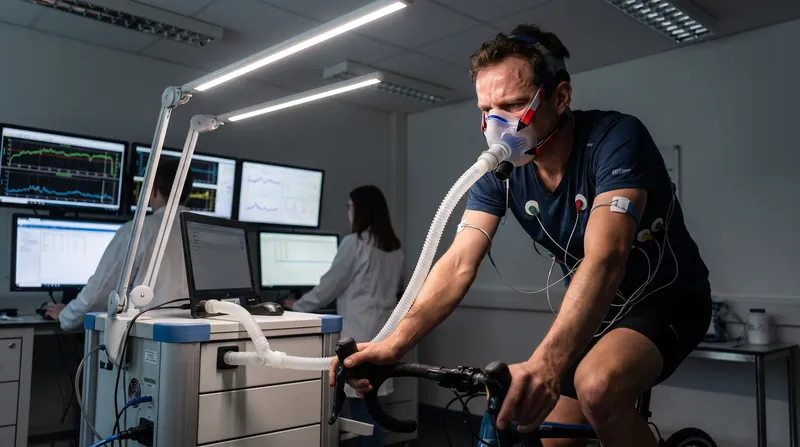
In cardiopulmonary rehabilitation centers and elite training labs in 2026, the inability to speak during exercise is no longer treated as a casual coaching cue. The Talk Test is utilized as a validated, non-invasive marker of a profound chemical shift in the bloodstream.
When a runner or cyclist pushes their pace, there is a distinct moment when conversation breaks down. This boundary, known as the first ventilatory threshold, represents the exact intensity where the body's acid-neutralizing system overwhelms the respiratory system's ability to form words.
Below this threshold, exercise remains purely aerobic and highly efficient. The muscle cells use oxygen to break down glucose and fat, producing metabolic carbon dioxide as a predictable, steady byproduct of the Krebs cycle.
During this easy phase, a person's breathing rate increases linearly with their oxygen demand. The lungs easily clear the metabolic carbon dioxide, and exhalations can be smoothly controlled to vibrate the vocal cords for normal, sustained speech.
The Anaerobic Shift
As intensity climbs, aerobic metabolism cannot supply energy fast enough to meet the demand. The muscle cells increasingly rely on anaerobic glycolysis, a faster metabolic pathway that does not require oxygen but produces lactic acid as a byproduct.
Lactic acid rapidly dissociates into lactate and hydrogen ions within the muscle tissue. It is the accumulation of these positively charged hydrogen ions that drops the pH of the blood, creating an acidic environment that impairs muscle contraction and enzyme function.
The body cannot tolerate a significant drop in blood pH without severe consequences. If the hydrogen ions were left unchecked, the resulting acidosis would rapidly shut down the metabolic pathways that allow the muscle fibers to contract, forcing the athlete to an immediate halt.
To prevent catastrophic acidosis, the body deploys its primary chemical defense, known as the bicarbonate buffering system. Plasma bicarbonate intercepts the hydrogen ions as they exit the muscle cells, binding to them to neutralize the rising acidity.
When bicarbonate binds to a hydrogen ion, it forms carbonic acid, which immediately breaks down into water and carbon dioxide. This specific chemical reaction is the invisible engine behind the sudden loss of breath during a hard workout.
Non-Metabolic Carbon Dioxide
This newly formed carbon dioxide is termed non-metabolic because it originates from acid buffering, not from cellular aerobic respiration. According to stoichiometric models of human physiology, buffering one millimole of lactic acid generates approximately 22.3 milliliters of this non-metabolic gas.
As anaerobic energy production ramps up, the buffering system works continuously to protect the muscles. It dumps massive volumes of non-metabolic carbon dioxide into the venous blood returning to the lungs, dramatically altering the blood's gas composition.
This process creates a stark divergence between the oxygen the body consumes and the carbon dioxide it produces. While the muscles are still utilizing oxygen at a steady rate, the chemical buffering reaction adds an entirely separate stream of exhaust gas into the circulatory system.
Specialized chemoreceptors in the brainstem and carotid arteries monitor these blood gas levels constantly. They are highly sensitive to carbon dioxide, prioritizing its rapid removal above almost all other physiological drives to maintain a stable internal pH.
Detecting the sudden spike in carbon dioxide, the brainstem triggers a disproportionate increase in minute ventilation. The breathing rate decouples from oxygen consumption, spiking sharply to blow off the excess gas before it can further acidify the blood.
The Mechanics of Speech
Human speech requires a slow, controlled, and prolonged exhalation to push air steadily across the vocal cords. The brain must consciously override the autonomic respiratory rhythm to coordinate this precise airflow and form recognizable words.[3]
At the first ventilatory threshold, the autonomic drive to expel non-metabolic carbon dioxide becomes too powerful to override. The brainstem forces rapid, forceful exhalations, physically shattering the sustained airflow required to speak in full sentences.[3]
This mechanical conflict explains why the Talk Test accurately maps to internal chemistry. A 2011 clinical trial published by the National Institutes of Health demonstrated that the exact point where speech becomes uncomfortable perfectly matches the ventilatory threshold measured by laboratory gas exchange equipment.[3]
During that trial, participants exercising at 64 to 71 percent of their maximum oxygen consumption reached the equivocal stage of speech. At this exact intensity, their blood lactate levels and carbon dioxide output spiked, confirming the buffering mechanism was active.[3]
Clinical and Athletic Applications
Forward Physical Therapy utilizes this physiological marker in 2026 to prescribe exercise without expensive lab gear. Identifying the first ventilatory threshold allows clinicians to set precise intensities that drive aerobic adaptation without overstressing recovering patients.
"These are not arbitrary heart rate zones from a formula," the Forward Physical Therapy clinical team writes regarding the threshold. "They are physiological inflection points unique to each person, and they shift as fitness improves."
For endurance athletes, crossing this threshold means entering a state where fatigue accelerates. The buffering system can only neutralize so much acid before the bicarbonate reserves deplete, eventually leading to the second ventilatory threshold where speech becomes entirely impossible.
This mechanism also explains the endurance sports practice of sodium bicarbonate loading. By ingesting bicarbonate before a race, athletes artificially expand their blood's buffering capacity, delaying the pH drop and pushing their ventilatory threshold to a higher power output.
The practice is particularly common in middle-distance track events and rowing, where the anaerobic demand is exceptionally high. While effective at delaying acidosis, the strategy requires precise dosing, as consuming too much sodium bicarbonate can cause severe gastrointestinal distress before the race even begins.
The practice is particularly common in middle-distance track events and rowing, where the anaerobic demand is exceptionally high.
"Sodium bicarbonate is a proven performance aid that can help buffer the increase in acidity associated with high-intensity exercise," notes the 2026 sports science brief from VOOM Nutrition. The supplement allows athletes to maintain a higher intensity for longer before the acid accumulation forces a slowdown.
By tracking the exact wattage or pace where speech falters, athletes and clinicians map the boundary of the bicarbonate buffer in real time. The threshold shifts upward as mitochondrial density improves with training, requiring a progressively higher workload to generate the acid that silences the voice.
How we did this
- Method
- Compared the stoichiometric carbon dioxide yield of bicarbonate buffering against baseline aerobic metabolic CO2 production to quantify the respiratory load that triggers the ventilatory threshold.
- What we found
- The sudden inability to speak in full sentences during exercise is not caused by an oxygen deficit, but by a mechanical conflict: the respiratory system must expel approximately 22.3 milliliters of non-metabolic CO2 for every millimole of lactic acid buffered, forcing an autonomic breathing rate that physically prevents the sustained exhalations required for speech.
- What we worked from
- Non-metabolic CO2 yield per millimole of lactic acid buffered: 22.3 mL
- Talk Test equivocal stage intensity match: Equivalent to ventilatory threshold — National Institutes of Health
- Limits of this analysis
- This analysis relies on stoichiometric models of buffering and does not account for individual variations in chemoreceptor sensitivity or baseline lung capacity.
Key terms
- First Ventilatory Threshold (VT1)
- The exercise intensity where breathing rate first increases disproportionately to oxygen consumption to expel excess carbon dioxide.
- Non-Metabolic Carbon Dioxide
- Carbon dioxide generated by chemical buffering reactions in the blood, rather than by cellular aerobic respiration.
- Bicarbonate Buffering
- The body's primary mechanism for neutralizing acid, where bicarbonate ions bind with hydrogen ions to form water and carbon dioxide.
- Lactic Acid
- A byproduct of anaerobic glycolysis that dissociates into lactate and hydrogen ions, lowering blood pH.
Frequently asked
Does struggling to speak mean I am not getting enough oxygen?
No. The inability to speak comfortably is driven by the urgent need to exhale excess carbon dioxide, not a deficit of incoming oxygen.
Can I improve my ventilatory threshold?
Yes. Consistent aerobic training increases mitochondrial density, allowing the body to sustain higher intensities before relying heavily on anaerobic glycolysis and triggering the buffering response.
Why do athletes consume sodium bicarbonate before races?
Ingesting sodium bicarbonate artificially increases the blood's buffering capacity, delaying the drop in pH and allowing athletes to sustain high-intensity efforts longer before fatigue sets in.
Viewpoints in depth
Exercise Physiologists
Focus on the precise measurement of gas exchange and metabolic thresholds to understand cellular respiration.
For exercise physiologists, the ventilatory threshold is a window into cellular metabolism. By measuring the exact ratio of oxygen consumed to carbon dioxide exhaled in a laboratory setting, researchers can pinpoint the exact millisecond the body shifts from purely aerobic energy production to anaerobic glycolysis. This data allows them to map the stoichiometric efficiency of the bicarbonate buffering system and understand how different training modalities alter the body's ability to clear hydrogen ions.
Clinical Rehabilitation Specialists
Value validated, non-invasive tools like the Talk Test to safely prescribe exercise for recovering patients.
In clinical settings, expensive gas exchange equipment is often impractical. Rehabilitation specialists rely on the Talk Test because it translates complex blood chemistry into a simple, actionable metric. By keeping a recovering patient just below the intensity where speech falters, clinicians ensure the patient is working hard enough to drive cardiovascular adaptation without crossing into anaerobic stress, which could overwhelm a compromised system.
Endurance Athletes and Coaches
Focus on maximizing buffering capacity and delaying acidosis to sustain high-intensity performance.
For competitive athletes, the accumulation of hydrogen ions represents the onset of inevitable fatigue. Coaches design interval training specifically to stress and expand the body's natural bicarbonate buffering capacity. Additionally, athletes often utilize sodium bicarbonate supplementation to artificially load their blood with buffers, buying them crucial extra minutes of high-intensity output before the acidic environment impairs muscle contraction and forces a reduction in pace.
- Exercise Physiologists
- Focus on the precise measurement of gas exchange and metabolic thresholds to understand cellular respiration.
- Clinical Rehabilitation Specialists
- Value validated, non-invasive tools like the Talk Test to safely prescribe exercise for recovering patients.
- Endurance Athletes and Coaches
- Focus on maximizing buffering capacity and delaying acidosis to sustain high-intensity performance.
Perspectives this story doesn't cover
- Pulmonologists treating chronic respiratory diseases
- Sports dietitians formulating buffering supplements
Sources
Source coverage
3 outlets
3 viewpoints surfaced


- [1]Factlen Editorial TeamExercise Physiologists
Synthesis by Factlen editorial team
Read on Factlen Editorial Team → - [2]National Institutes of HealthExercise Physiologists
Validity of the Talk Test for Evaluation of Exercise Intensity in Healthy Population
Read on National Institutes of Health → - [3]National Institutes of HealthExercise Physiologists
Relationship between the Talk Test and ventilatory threshold
Read on National Institutes of Health →

More in Fitness
See all →Exercise Physiology
Mechanical Friction Along the Parietal Peritoneum Causes Runner's Side Stitches
7 sources

Cardiac Rehab
Exercise-Based Cardiac Rehab Cuts Heart Attacks by 28% and Hospital Admissions by 35%, Cochrane Review Finds
6 sources

Ventilatory Thresholds
The Exponential Increase in VE/VCO2: How the Respiratory Compensation Point Defines the Highest Sustainable Endurance Pace
7 sources
Metabolic Health
How Zone 2 Training Triggers Mitochondrial Biogenesis and Enhances Fat Oxidation
10 sources

Comments
Every angle. Every day.
Get Fitness stories with full source coverage and perspective breakdowns, free every day.