
Personalized, Accelerated TMS Therapy Achieves Depression Remission in Days, Not Months
A condensed, five-day protocol for transcranial magnetic stimulation (TMS) is demonstrating remission rates for treatment-resistant depression that rival or exceed standard six-week courses. By utilizing targeted magnetic pulses and an accelerated schedule, the therapy offers rapid relief for patients who have exhausted traditional medication options.

In short
- Accelerated TMS condenses 30 to 50 treatment sessions into a single five-day workweek.
- The therapy uses targeted magnetic pulses to stimulate underactive brain regions linked to mood regulation.
- Clinical trials show remission rates significantly higher than standard TMS and traditional antidepressants.
The prevailing narrative around clinical depression is that recovery is inherently slow. Patients are routinely told to expect a grueling marathon of trial and error: weeks waiting for a new selective serotonin reuptake inhibitor (SSRI) to take effect, months of psychotherapy to build cognitive coping mechanisms, and a gradual, non-linear path toward baseline.
If medications fail, the next step is often a six-week commitment to daily clinic visits for standard transcranial magnetic stimulation (TMS). But emerging clinical data is upending that timeline entirely. A condensed, high-intensity version of TMS is proving that for many patients, profound relief does not require months of waiting. It can happen in just five days.[1][2]
To understand the magnitude of this shift, one must first look at the reality of treatment-resistant depression (TRD). A patient is typically diagnosed with TRD after failing to respond to at least two different antidepressant medications. In practice, many patients have tried half a dozen drugs, enduring a carousel of side effects—from weight gain to emotional blunting—without experiencing any meaningful lifting of their despair.
For this population, the statistical likelihood of achieving remission with yet another oral medication drops into the single digits. The brain's neural pathways have become entrenched in a depressive state, requiring a more direct intervention to break the cycle.[3]
Standard TMS emerged as that direct intervention. Cleared by the FDA in 2008, the therapy uses an electromagnetic coil placed against the scalp to deliver magnetic pulses to the prefrontal cortex, the region of the brain involved in mood regulation. These pulses induce small electrical currents that stimulate sluggish nerve cells.
The clinical results for standard TMS are solid: large studies show that it significantly reduces symptoms in 60 to 70 percent of patients, with 30 to 35 percent achieving full remission. However, the standard protocol comes with a massive logistical flaw: it requires patients to sit in a clinic chair for 20 to 40 minutes, five days a week, for up to six weeks.[1][2][3]
For a vast swath of the population, that schedule is an insurmountable barrier. Working professionals cannot easily abandon their jobs for an hour every weekday afternoon. Parents and caregivers cannot reliably secure daily childcare for a month and a half. Consequently, a highly effective, non-systemic treatment has remained out of reach for many who desperately need it. The psychiatric community recognized that if the therapy could be condensed without losing its efficacy, it would fundamentally change the accessibility of neuromodulation.[1][2][3]
That realization led to the development of accelerated TMS. Rather than spreading 30 to 40 sessions over a month and a half, researchers began testing protocols that delivered multiple sessions per day. The most intensive of these protocols compresses the entire treatment course into a single five-day workweek. Patients arrive at the clinic in the morning and undergo up to ten short stimulation sessions throughout the day, with 50-minute resting breaks in between. By Friday afternoon, they have received the equivalent magnetic dose of a full six-week standard course.[1][2][3]
This rapid delivery is made possible by a specific type of magnetic pulsing known as intermittent theta burst stimulation (iTBS). Traditional TMS delivers pulses at a steady, continuous frequency. iTBS, by contrast, delivers rapid bursts of stimulation that mimic the brain's natural theta rhythms—the specific brainwave frequencies associated with learning and neuroplasticity. Because iTBS is highly efficient at inducing changes in cortical excitability, a single session can be completed in just three to ten minutes, allowing clinicians to safely stack multiple sessions into a single day without overwhelming the patient.[3]
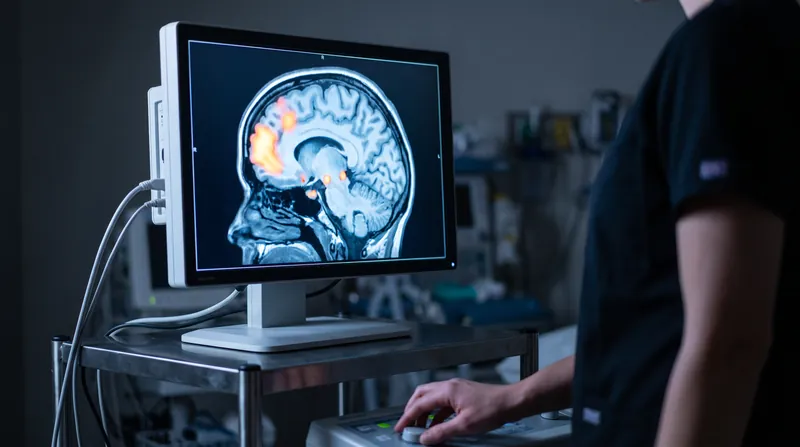
The most prominent iteration of this approach is the Stanford Accelerated Intelligent Neuromodulation Therapy, or SAINT protocol. Developed by researchers at Stanford Medicine, SAINT combines the accelerated iTBS schedule with advanced neuroimaging. Before treatment begins, patients undergo a functional MRI (fMRI) scan to map their individual brain connectivity. Because the exact location of the mood-regulating circuits can vary slightly from person to person, the fMRI allows clinicians to pinpoint the precise millimeter of the cortex that will yield the best therapeutic response.[3]
The clinical data emerging from the SAINT trials has been nothing short of staggering. In a double-blind, randomized clinical trial, researchers observed a remission rate of 79 percent among patients with severe, treatment-resistant depression. Within days, participants who had been actively suicidal reported a complete lifting of their depressive symptoms.
Achieving a near-80 percent remission rate in a population that has historically hovered around 30 percent is a generational leap in psychiatric efficacy. The data suggests that the accelerated, personalized approach is not just faster; it is fundamentally more effective at rewiring entrenched depressive circuits.[3]
Regulatory bodies have recognized the weight of this evidence. In 2021, the FDA granted the SAINT protocol a breakthrough therapy designation, a status reserved for interventions that demonstrate substantial improvement over existing therapies for serious conditions. By late 2022, the FDA officially cleared the SAINT Neuromodulation System as a commercial medical device, paving the way for specialized clinics to begin offering the personalized, five-day treatment to the public.[3]
While the Stanford data set the benchmark, independent research continues to validate the accelerated model. In February 2026, a study conducted by UCLA Health evaluated a five-by-five protocol—five sessions a day for five consecutive days—against the standard six-week course. The study, which included 175 patients with treatment-resistant depression, found that the accelerated group experienced meaningful symptom reductions that were statistically comparable to the group undergoing the grueling six-week regimen.[1][2]
Crucially, the UCLA researchers uncovered a vital nuance regarding the timeline of recovery. They noted that a subset of patients in the accelerated group showed minimal improvement immediately after finishing their five-day course. However, in the weeks that followed, those same patients experienced a sudden, significant lifting of their depression.
This delayed onset is a critical insight: the brain's neuroplastic rewiring continues long after the magnetic pulses stop. Clinicians now explicitly warn patients that a lack of immediate euphoria on Friday afternoon does not equal treatment failure; the therapeutic cascade has been initiated, and the benefits may simply take a few weeks to manifest.[1][2][3]
Despite the overwhelmingly positive data, the evidence pack comes with necessary caveats, particularly regarding durability. While the short-term remission rates are exceptional, the psychiatric community is still mapping how long these benefits last without ongoing intervention. For some patients, the five-day protocol provides years of relief. For others, depressive symptoms may begin to creep back after several months. In these cases, patients often return for a brief tune-up round of stimulation—typically just one or two days of treatment—to sustain their remission.[3]
The most immediate hurdle for patients seeking accelerated TMS is financial. Standard, six-week TMS is now widely covered by major health insurance plans, provided the patient has documented proof of failing prior antidepressant trials. However, because the accelerated protocols and fMRI-guided targeting are relatively new, many insurance providers classify them as investigational or out-of-network. Consequently, patients seeking the five-day treatment often face out-of-pocket costs ranging from several thousand to over ten thousand dollars, creating a stark equity gap in access to rapid relief.[2][3]
Advocates and clinicians are actively lobbying insurance boards to update their coverage policies, arguing that the upfront cost of a five-day TMS protocol is ultimately cheaper than years of ineffective medication management, lost workplace productivity, and psychiatric hospitalizations. As more clinical data from institutions like UCLA and Stanford accumulates, the pressure on insurers to cover accelerated neuromodulation will only intensify.[1][2][3]
The shift from a six-week ordeal to a five-day intervention represents a paradigm change in mental health care. It offers a tangible, evidence-backed lifeline for those who have been told that their condition is intractable. For patients navigating the exhausting reality of treatment-resistant depression, the clinical data offers a profoundly reassuring message: the brain's capacity to heal is robust, and the timeline to reach that healing is finally aligning with the urgency of the disease.[1][2][3]
Key terms
- Transcranial Magnetic Stimulation (TMS)
- A non-invasive procedure that uses magnetic fields to stimulate nerve cells in the brain to improve symptoms of depression.
- Treatment-Resistant Depression (TRD)
- A clinical diagnosis for patients whose depression does not improve after trying at least two different antidepressant medications.
- Intermittent Theta Burst Stimulation (iTBS)
- A highly efficient form of TMS that delivers magnetic pulses in a pattern mimicking the brain's natural theta rhythms, allowing for much shorter sessions.
- Neuroplasticity
- The brain's ability to reorganize itself by forming new neural connections, which TMS aims to stimulate in mood-regulating areas.
- SAINT Protocol
- Stanford Accelerated Intelligent Neuromodulation Therapy, a specific FDA-cleared accelerated TMS method that uses fMRI to personalize the magnetic targeting.
Viewpoints in depth
Clinical Researchers & Neurologists
Focus on the neuroplasticity mechanisms and the unprecedented remission rates achieved through targeted stimulation.
For the researchers pioneering these protocols, the success of accelerated TMS proves that depression is a circuit-level network problem that can be physically rewired. They point to the fMRI data showing how targeted magnetic pulses can reverse the backward flow of electrical signals in the brain's sadness-control circuits. Their primary focus is refining the targeting algorithms to push remission rates even higher and establishing standardized maintenance protocols to ensure the relief lasts.
Patient Access Advocates
Argue that the logistical and financial barriers to accelerated TMS must be dismantled immediately.
Advocacy groups emphasize that a treatment is only revolutionary if people can actually get it. They argue that the standard six-week TMS protocol is inherently classist, as it requires a level of job flexibility and childcare access that many working-class patients lack. While they celebrate the five-day protocol as a logistical breakthrough, they are highly critical of insurance companies for refusing to cover the accelerated timeline, arguing that denying coverage for a faster, more effective treatment is both medically unethical and economically short-sighted.
Insurance & Health Economics Analysts
Weigh the high upfront costs of personalized neuromodulation against long-term psychiatric savings.
Health economists acknowledge the impressive clinical data but approach the widespread rollout of fMRI-guided accelerated TMS with financial caution. The personalized imaging and intensive clinical monitoring required for a five-day protocol carry a high upfront price tag. However, analysts note that if the 79 percent remission rate holds in the general population, the treatment will ultimately save the healthcare system money by drastically reducing emergency room visits, psychiatric hospitalizations, and decades of ongoing medication management for treatment-resistant patients.
- Clinical Researchers
- Focus on the neuroplasticity mechanisms and the unprecedented remission rates achieved through targeted stimulation.
- Patient Access Advocates
- Argue that the logistical and financial barriers to accelerated TMS must be dismantled immediately.
- Health Economists
- Weigh the high upfront costs of personalized neuromodulation against long-term psychiatric savings.
Perspectives this story doesn't cover
- Individuals who experienced relapse after accelerated TMS without maintenance therapy
- Rural patients who lack geographic access to specialized neuromodulation clinics
Sources
Source coverage
3 outlets
3 viewpoints surfaced



- [1]ScienceDailyClinical Researchers
New brain stimulation approach could treat depression in just 5 days
Read on ScienceDaily → - [2]SciTechDailyClinical Researchers
This 5-Day Brain Treatment Is Giving People With Depression New Hope
Read on SciTechDaily → - [3]Factlen Editorial TeamPatient Access Advocates
Synthesis by Factlen editorial team
Read on Factlen Editorial Team →

More in Health
See all →Psychiatric Genetics
The 20 Percent Variance: How Four Environmental Factors Interact with Genetics to Drive Schizophrenia Risk
6 sources
Depression Treatment
Bouldering and Value-Based Therapy Outperform Standard Care for Depression in New Clinical Trial
2 sources

Memory Reconsolidation
How Protein Synthesis Inhibition During Memory Retrieval Blocks Fear Reconsolidation
10 sources

Neural Circuitry
How Cognitive Restructuring Modifies the Prefrontal Cortex-Amygdala Circuit to Reduce Emotional Reactivity
7 sources
Comments
Every angle. Every day.
Get Health stories with full source coverage and perspective breakdowns, free every day.