
Oracle Cuts 21,000 Jobs as Tech Industry Pivots Capital from Payroll to AI Infrastructure
Oracle's latest regulatory filing reveals a 13% workforce reduction over the past year, explicitly citing internal AI adoption as the company reallocates billions toward data center infrastructure.

For decades, the growth and health of the technology sector were reliably measured in human capital. A rising headcount signaled a thriving company, while hiring freezes hinted at trouble. But in June 2026, Oracle's annual Form 10-K filing with the Securities and Exchange Commission codified a historic reversal of that traditional metric.
The database and cloud-computing giant revealed that it had eliminated roughly 21,000 jobs over the preceding 12 months, shrinking its global workforce by nearly 13 percent. The disclosure marks a watershed moment for the enterprise software industry, providing concrete evidence that the economics of technology companies are fundamentally changing. Human talent is no longer the sole engine of scale; instead, automated systems are beginning to decouple operational output from payroll size.[1][2]
The sheer scale of the reduction—dropping Oracle's total headcount from 162,000 down to 141,000—makes it one of the largest single-year workforce contractions in the company's multi-decade history. While technology sector layoffs have become increasingly common in the post-pandemic era, Oracle's regulatory filing provided a rare, unvarnished explanation for the cuts.
Bypassing the usual corporate euphemisms about 'macroeconomic headwinds' or 'synergy,' the company explicitly stated that 'the adoption and deployment of AI technologies across our operations have resulted, and may continue to result, in reductions to our workforce.' This level of transparency in an SEC filing is highly unusual and sets a new precedent for how publicly traded companies report the impact of automation to their shareholders.[3][4]
This plain-language admission highlights a fundamental mechanical shift in how enterprise software companies operate internally. Artificial intelligence is no longer just a premium product being packaged and sold to external customers; it is an internal operational lever being pulled to automate middle-management, auditing, compliance, and routine coding tasks. By deploying these advanced systems internally, Oracle has effectively automated away layers of its own bureaucracy.
This allows the company to maintain, or even increase, its software output while shedding tens of thousands of salaries. It is the realization of a long-predicted economic theory: that AI would eventually serve as a deflationary force on white-collar labor, allowing massive corporations to operate with significantly leaner human teams.[5]
However, the immediate human cost of this automation is only half of the new economic equation. The capital saved from payroll reductions is not simply being returned to shareholders as profit or used for stock buybacks; instead, it is being aggressively redirected into physical infrastructure.
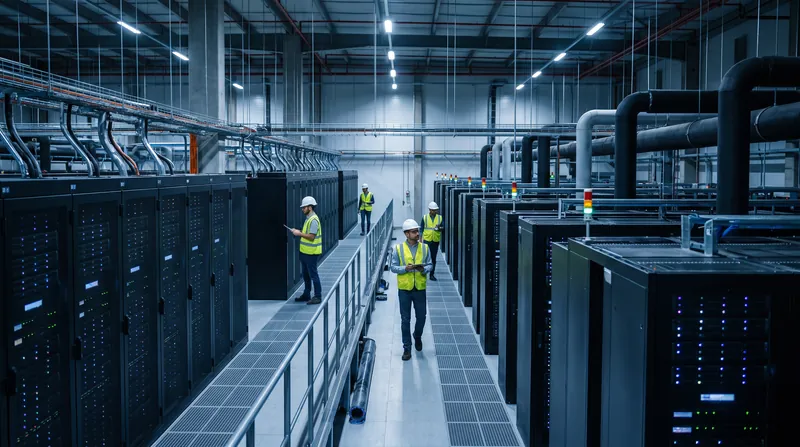
The technology industry is currently engaged in an unprecedented arms race to build the massive data centers required to train and run next-generation AI models, and the price tag for this physical footprint is staggering. Human capital is quite literally being traded for compute capital, as companies scramble to secure the GPUs, server racks, and energy grid access necessary to power the next decade of software.[2][5]
The financial metrics behind this pivot are breathtaking. In fiscal 2026, Oracle's capital expenditures surged to $55.7 billion—a massive leap from the $21.2 billion spent just the year prior. To maintain its competitive footing against deep-pocketed cloud rivals like Microsoft, Google, and Amazon, Oracle projects that its net infrastructure spend will climb even higher, reaching an estimated $70 billion in the current fiscal year.
This pivot represents a literal transfer of wealth from human talent to silicon processors and real estate. The company is betting its future on the premise that owning the physical infrastructure of AI will ultimately yield higher margins than employing the engineers who traditionally built software.[1][3]
The financial mechanics of executing this transition have been brutal on the balance sheet. Oracle disclosed that it incurred $1.84 billion in severance payments and other restructuring costs to execute the 21,000 layoffs over the past year. Meanwhile, the sheer volume of its data center investments pushed the company's free cash flow into negative territory, hitting a deficit of $23.7 billion for the fiscal year.
Wall Street has watched this cash burn with growing unease, contributing to an 11 percent decline in Oracle's stock price since the start of the year. Investors are increasingly questioning whether the massive capital expenditures will generate enough new revenue to justify the near-term financial pain.[1][2][3]
The restructuring has rippled aggressively across Oracle's global footprint, sparing few divisions. Reports indicate that the Oracle Health unit—formerly Cerner, which Oracle acquired for $28 billion in a highly publicized deal—bore a significant portion of the cuts, with thousands of specialized roles eliminated.
International engineering hubs were also hit hard by the reorganization; in late June, the company began notifying hundreds of employees in its Romanian operations that their positions were being phased out. These targeted reductions suggest that Oracle is systematically identifying divisions where legacy processes can be replaced by automated workflows, regardless of geographic location or past strategic importance.[6]
Oracle is far from alone in executing this strategy. The broader technology sector is undergoing what some industry analysts have dubbed the 'SaaSpocalypse,' as legacy software-as-a-service providers frantically re-engineer their business models around generative AI. Companies including Meta, Amazon, and Cloudflare have all executed similar maneuvers throughout 2026, explicitly citing internal AI efficiencies as justification for reducing headcount while simultaneously pouring billions into GPU clusters.
This industry-wide pattern confirms that Oracle's layoffs are not an isolated event caused by poor management, but rather a structural realignment of how the entire technology sector allocates its capital. The era of hoarding human talent has officially given way to the era of hoarding compute power.[3][5]
Yet, this aggressive reallocation of capital carries significant and immediate operational risks. In its own regulatory filing, Oracle cautioned investors that the rapid restructuring could lead to 'shortages of sufficiently skilled employees in certain roles, loss of valuable institutional knowledge, and damage to employee morale and retention.'
The company openly acknowledged that if its AI investments fail to yield the expected market dominance, or if competitors achieve higher market acceptance, the hollowing out of its human workforce could leave it deeply vulnerable. You cannot easily rehire decades of institutional memory once it has been severed, making this a high-stakes gamble on the flawless execution of automated systems.[2][5]
For the 21,000 displaced workers, the transition presents a complex and rapidly shifting landscape. While traditional SaaS roles are shrinking at legacy companies like Oracle, the broader enterprise ecosystem still requires deep institutional knowledge to manage complex cloud migrations and AI integrations.
Competitors and specialized consulting firms are closely watching the talent spillover, recognizing that skills honed in legacy database management are often highly transferable to emerging AI-augmented workflows. Platforms like Salesforce and specialized cloud integrators may absorb much of this talent, as they seek to balance their own AI investments with the need to maintain stable, trust-based relationships with enterprise clients.[6]
Ultimately, Oracle's 2026 restructuring serves as a definitive case study in the new economics of automation. It proves that the immediate impact of artificial intelligence on the white-collar workforce is not a theoretical future event, but a present-day financial mechanism actively reshaping corporate balance sheets.
Ultimately, Oracle's 2026 restructuring serves as a definitive case study in the new economics of automation.
As the industry continues to trade payroll for compute power, the definition of a 'tech company' is fundamentally shifting from an employer of software engineers to an operator of physical infrastructure. For the broader economy, it is a stark warning that the AI revolution will be built on a foundation of intense capital reallocation, with human workers bearing the immediate transitional costs.[4][5]
Key points
- Oracle reduced its global workforce by 13%, eliminating 21,000 jobs over the past 12 months.
- The company explicitly cited internal AI adoption as a primary driver of the workforce reductions.
- Capital saved from payroll is being redirected into physical AI infrastructure, with CapEx reaching $55.7 billion.
- Oracle's restructuring mirrors a broader tech industry trend of trading human capital for compute power.
Unanswered questions
- Whether Oracle's massive $70 billion infrastructure gamble will generate enough new revenue to offset the capital expenditure.
- How much of the $1.84 billion in restructuring costs went directly to employee severance versus facility closures.
- If the remaining 141,000 employees will face further cuts as internal AI tools become increasingly sophisticated.
How we got here
May 2025
Oracle reports a global headcount of 162,000 full-time employees before the major restructuring begins.
March 2026
Initial reports leak regarding a massive impending workforce reduction tied to rising data center costs.
May 31, 2026
Oracle concludes its fiscal year with its headcount officially reduced to 141,000.
June 22, 2026
The company files its Form 10-K, explicitly citing AI adoption as a primary driver of the job cuts.
- Tech Workforce
- Focuses on the immediate human cost, the loss of institutional knowledge, and the destabilizing effect of the 'SaaSpocalypse'.
- Corporate Management
- Views the workforce reductions as a necessary reallocation of capital to win the highly competitive AI infrastructure race.
- Financial Analysts
- Expresses concern over the massive capital expenditures, negative free cash flow, and the uncertain long-term ROI of the AI pivot.
- Industry Ecosystem
- Monitors the spillover of highly skilled talent and the broader shift from software services to physical compute infrastructure.
Perspectives this story doesn't cover
- Local economies and municipalities affected by the sudden closure of international engineering hubs.
- Enterprise customers navigating potential service disruptions during the vendor's internal restructuring.
Sources
Source coverage
6 outlets
4 viewpoints surfaced






- [1]The IndependentFinancial Analysts
Oracle reveals 21,000 layoffs in last year were due to AI
Read on The Independent → - [2]QuartzFinancial Analysts
Oracle cuts 21,000 jobs, citing AI adoption, in fiscal 2026
Read on Quartz → - [3]Fast CompanyTech Workforce
Oracle layoffs: 21,000 jobs cut, software giant trades human talent for AI tech
Read on Fast Company → - [4]ForbesCorporate Management
Microsoft’s AI Buildout Sent Carbon Emissions Up 25% Last Year
Read on Forbes → - [5]National CIO ReviewCorporate Management
Oracle's 21,000 Job Cuts Reveal the New Economics of AI
Read on National CIO Review → - [6]Salesforce BenIndustry Ecosystem
Oracle Layoffs: 30,000 Employees to Lose Their Jobs by June 15
Read on Salesforce Ben →
More in Finance
See all →Industrial Software
Schneider Electric Agrees to $22.6 Billion All-Cash Takeover of Industrial Software Maker PTC
5 sources

Market Mechanics
The Mathematical Mechanics of Batch Auction Uncrossing in Stock Exchange Closing Prices
5 sources

Bond Valuation
The Iterative Process That Solves the Bond Price Formula for Yield-to-Maturity
6 sources

Sanctions Enforcement
US Treasury Sanctions Iranian Crypto Exchange BitBank Over Hormuz Transit Payments
6 sources

Comments
Every angle. Every day.
Get Finance stories with full source coverage and perspective breakdowns, free every day.