
The Great Casual Dining Reset: Why Major Chains Are Closing Hundreds of Locations in 2026
Major restaurant brands are shedding underperforming legacy locations in 2026, pivoting away from massive dining rooms to focus on modernized experiences, better food quality, and sustainable growth.
By Factlen Editorial Team
- Restaurant Operators
- Focus on shedding underperforming assets, improving unit-level economics, and modernizing footprints for long-term growth.
- Industry Analysts
- View the closures as a necessary market correction that clears out outdated concepts and opens real estate for healthier brands.
- Value-Conscious Consumers
- Frustrated by rising menu prices and shrinking portions, shifting their loyalty to brands that offer better experiences or lower costs.
What's not represented
- · Independent Restaurant Owners
- · Commercial Real Estate Landlords
- · Displaced Restaurant Workers
Why this matters
Understanding why local restaurants are closing helps consumers make sense of the shifting economy. It reveals how inflation and changing dining habits are forcing the industry to abandon outdated models in favor of better food quality and streamlined digital experiences.
Key points
- Major chains including Wendy's, Pizza Hut, and Papa John's are closing hundreds of underperforming locations in 2026.
- Analysts view the closures as a strategic 'reset' to shed outdated, unprofitable real estate.
- Consumer loyalty has plummeted as inflation drives diners to seek better value or higher-quality experiences.
- The closures create opportunities for expanding fast-casual brands to take over 'second-generation' restaurant spaces.
The American dining landscape is undergoing a dramatic contraction in 2026, with major fast-food and casual dining chains announcing hundreds of location closures. From legacy sit-down brands to global pizza giants, the industry is shedding real estate at a pace rarely seen outside of major economic recessions. For consumers accustomed to seeing the same familiar glowing signs at every suburban intersection, the sudden disappearance of local outposts can feel like a sudden retail apocalypse. However, the reality behind the boarded-up windows is far more calculated.[2][6]
While the sheer volume of shuttered storefronts might look like an industry in freefall, restaurant executives and market analysts describe the phenomenon quite differently. They view 2026 as a necessary and long-overdue 'reset'—a strategic pruning of outdated, underperforming locations designed to build a leaner, more resilient dining sector equipped for modern consumer habits. Rather than signaling the death of dining out, these closures represent a massive reallocation of capital away from bloated legacy operations and toward streamlined, high-efficiency models that can actually turn a profit in today's demanding economic environment.[1][5]
The scale of the pullback across the industry is undeniably significant. Wendy's has revealed plans to close up to 350 underperforming U.S. restaurants this year, a move executives say is specifically aimed at improving overall unit-level economics for franchisees. Meanwhile, Pizza Hut is shuttering roughly 250 locations by mid-year as part of a broader modernization strategy, and Papa John's is closing 200 older franchise stores that no longer meet the company's long-term profitability standards. These are not brands going out of business; they are titans actively choosing to shrink their footprints to protect their margins.[2][5][6][7]
Beyond the fast-food sector, legacy casual dining chains are facing even steeper existential threats as the middle of the market hollows out. Brands like Smokey Bones, On the Border, and Bahama Breeze have either shut down entirely, filed for bankruptcy, or closed massive swaths of their portfolios in recent months. The pressure on traditional sit-down models is immense. Black Box Intelligence, a leading restaurant analytics firm, estimates that a staggering 9% of all full-service restaurants are at risk of closure this year, reflecting a brutal operating environment for concepts that fail to evolve.[1][4][7]

The root cause of this nationwide contraction is a fundamental shift in consumer behavior, driven primarily by years of compounding inflation and rising operational costs. After enduring steady increases in menu prices, the addition of mandatory service fees, and noticeably shrinking portion sizes, the traditional 'casual night out' has become a genuine financial burden for many middle-class families. What used to be an easy, unthinking Tuesday night dinner decision now requires careful budgeting, forcing diners to be far more selective about where they spend their discretionary income and demanding a higher return on their investment.[2][3]
According to the 2026 Phygital Index Report published by the unified commerce firm Tillster, 69% of U.S. diners have either decreased or strictly capped their dining-out budgets due to ongoing economic conditions. As a result, the unthinking, habitual loyalty that legacy restaurant brands relied on for decades has effectively evaporated. Consumers are no longer willing to tolerate mediocre food or sluggish service simply because a restaurant happens to be conveniently located on their commute home. Instead, they are actively seeking out establishments that respect their time and their wallets.[3]
According to the 2026 Phygital Index Report published by the unified commerce firm Tillster, 69% of U.S.
The Tillster report highlighted a startling metric: 45% of consumers say their favorite restaurant has changed in just the last year—a sharp increase from previous surveys and a massive warning sign for legacy operators. Diners are migrating rapidly toward concepts that offer either undeniable, rock-bottom value or an exceptional, high-quality experience that justifies a premium price tag. The restaurants caught in the middle—those offering average food at moderately high prices—are the ones seeing their dining rooms empty out and their leases terminated.[3]
'The boundaries between digital and in-person experiences are fading, and the once-clear distinctions between restaurant categories... are dissolving,' Tillster analysts noted in their comprehensive findings. Consumers now prioritize food quality, convenience, and speed above historical brand familiarity, forcing legacy chains to rethink their entire operational models from the ground up. If a brand cannot deliver a seamless digital ordering experience, rapid drive-thru times, or a genuinely hospitable dine-in environment, modern consumers will simply take their business to a competitor who has invested in those exact capabilities.[3]

For decades, the standard casual dining playbook involved building massive, 5,000-square-foot dining rooms in sprawling suburban retail corridors. Today, those oversized footprints are a massive financial liability. High labor costs, expensive commercial leases, and a permanent, post-pandemic shift toward off-premises dining and delivery have rendered the 1990s-era restaurant model largely obsolete. Maintaining a cavernous dining room that only fills up on Friday and Saturday nights is a surefire way to bleed capital in an era of razor-thin restaurant margins.[1][5]
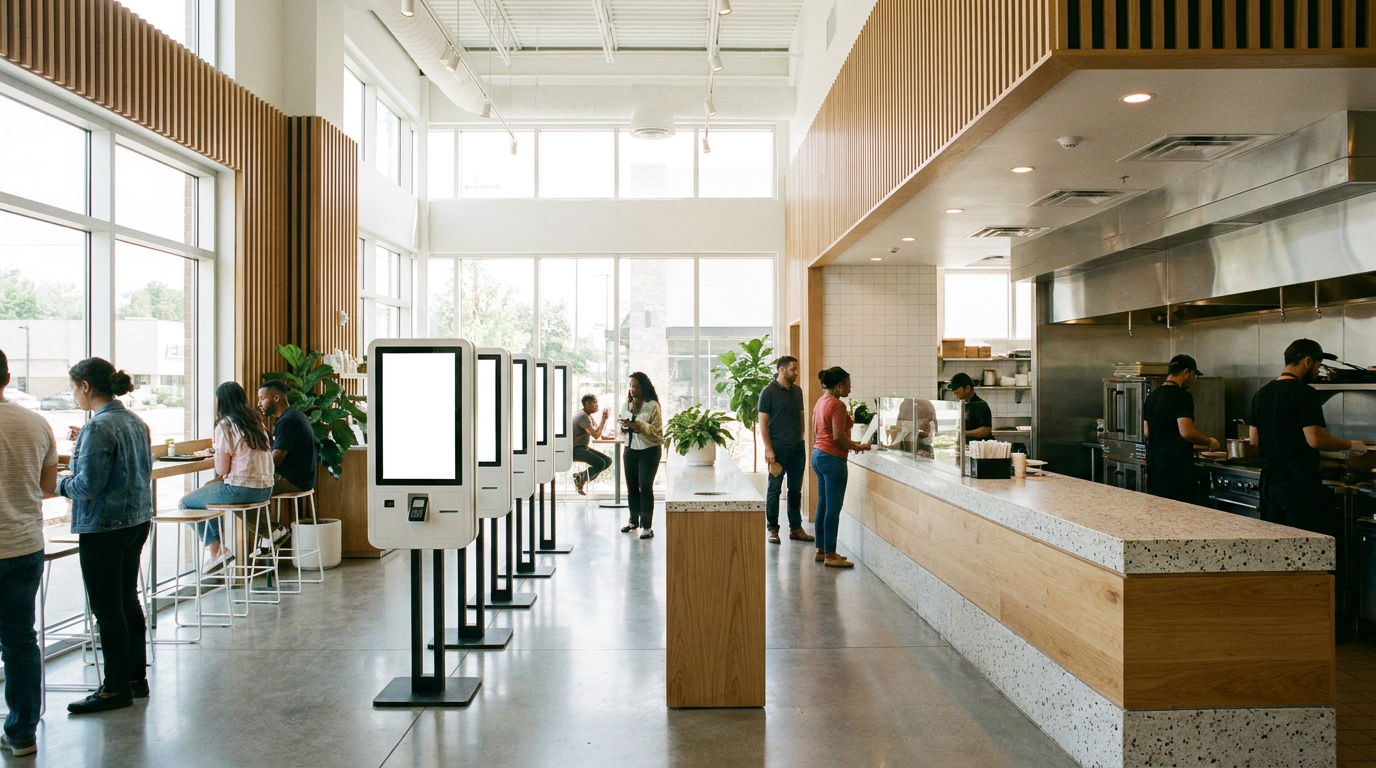
By aggressively closing these bloated, older locations, parent companies can redirect their capital toward modernizing their remaining fleets. Industry executives frequently refer to this transition as the 'Restaurant 2.0' pivot. Instead of maintaining empty dining rooms and paying for unused square footage, brands are investing heavily in digital ordering kiosks, streamlined kitchen layouts optimized for third-party delivery drivers, and dual drive-thrus that maximize vehicle throughput. The ultimate goal is to generate significantly higher sales volumes out of much smaller, highly efficient physical spaces that require fewer staff members to operate.[3][5]
'The silver lining here is that a leaner portfolio often becomes a stronger one,' explained Victor Fernandez, vice president of insights at Black Box Intelligence. When a restaurant brand stops subsidizing the bottom 10% of its underperforming units, it immediately frees up vital operational bandwidth and financial resources. Those newly available resources can then be deployed to elevate the customer experience, improve ingredient quality, and retain top-tier management at the company's most profitable and promising locations, ultimately creating a healthier business overall.[1]
Interestingly, this wave of corporate closures is creating a unique real estate opportunity for the segment of the industry that is actually experiencing growth. Expanding fast-casual brands, specialized coffee chains, and popular breakfast concepts are eagerly scooping up the 'second-generation' restaurant spaces left behind by departing legacy chains. Moving into a building that is already zoned for food service and fully equipped with commercial plumbing, grease traps, and heavy-duty ventilation saves these new operators millions of dollars in ground-up construction costs.[1]

This constant recycling of commercial real estate ensures that while specific, older brand names may vanish from local strip malls, the physical spaces rarely stay vacant for long. A shuttered legacy steakhouse or an outdated pizza buffet is often reborn within a year as a vibrant, modern eatery that better aligns with what today's neighborhoods actually want to eat. The closures are not a sign of a dying industry, but rather a healthy ecosystem naturally shedding its dead weight to make room for new growth.[1]
Ultimately, the great restaurant reset of 2026 marks the definitive end of the middle ground in American dining. Industry watchers consistently note that the brands surviving and thriving through this transition are those that clearly define their value proposition. Restaurants must now choose a lane: either compete ruthlessly on price, speed, and digital convenience, or offer a premium, high-hospitality experience that truly justifies the modern cost of dining out. The chains closing their doors today are simply the ones that failed to make that choice.[1][3]
How we got here
2020–2022
The pandemic forces a massive shift toward takeout and delivery, rendering large casual dining rooms less profitable.
2023–2025
Compounding inflation drives up menu prices and operating costs, causing consumers to pull back on dining out.
Early 2026
Major chains including Wendy's, Pizza Hut, and Papa John's announce plans to shutter hundreds of underperforming locations.
Mid 2026
Legacy brands like Smokey Bones and On the Border face total brand shutdowns or massive footprint reductions.
Viewpoints in depth
The Corporate Strategy
Why major chains are actively choosing to shrink their footprints.
For restaurant executives, closing locations is no longer seen as a failure, but as a necessary optimization. By shuttering the bottom 10% of underperforming stores—often legacy locations with massive dining rooms and expiring leases—parent companies can stop subsidizing losses. This frees up capital to invest in 'Restaurant 2.0' initiatives, such as digital ordering kiosks, streamlined kitchen layouts, and dual drive-thrus that cater to the modern preference for off-premises dining.
The Analyst Perspective
How market watchers view the casual dining contraction.
Industry analysts view the 2026 wave of closures as a healthy, albeit painful, market correction. The casual dining sector has suffered from over-expansion and a failure to adapt to changing consumer expectations. Analysts note that these closures are clearing out bloated, outdated concepts, which in turn creates a surplus of 'second-generation' real estate. This allows newer, more agile fast-casual and breakfast brands to expand rapidly without the prohibitive costs of ground-up construction.
The Consumer Reality
How inflation and shifting preferences are driving the closures.
From the diner's perspective, the traditional 'casual night out' has simply become too expensive to justify mediocre food and service. Years of compounding inflation, mandatory service fees, and shrinking portion sizes have eroded the value proposition of legacy chains. Consumers are now fiercely protective of their dining budgets, abandoning long-held brand loyalties in favor of establishments that guarantee either absolute convenience or a premium, high-quality experience.
What we don't know
- It remains unclear how many displaced restaurant workers will be absorbed by the expanding fast-casual sector.
- The long-term impact of these closures on suburban commercial real estate values is still developing.
Key terms
- Unit-level economics
- The financial performance and profitability of a single restaurant location, rather than the company as a whole.
- Second-generation space
- A commercial real estate property that was previously built out as a restaurant, complete with necessary plumbing and kitchen ventilation.
- Off-premises dining
- Food consumed away from the restaurant, including takeout, drive-thru, and delivery orders.
- Phygital
- The blending of physical and digital experiences, such as using a mobile app or digital kiosk to order food inside a physical restaurant.
Frequently asked
Why are so many restaurant chains closing in 2026?
Chains are closing underperforming locations to improve overall profitability. High operating costs, shifting consumer habits toward delivery, and a desire to modernize older restaurant footprints are driving the contraction.
Which major chains are closing the most locations?
Wendy's plans to close up to 350 locations, Pizza Hut is shuttering around 250, and Papa John's is closing 200 older franchise stores. Legacy brands like Smokey Bones and Bahama Breeze have also seen significant closures.
Does this mean these restaurant brands are going bankrupt?
Not necessarily. For giants like Wendy's and Pizza Hut, the closures are strategic moves to shed unprofitable stores and invest in new technology. However, some smaller legacy chains have filed for bankruptcy.
What happens to the empty restaurant buildings?
Many of these 'second-generation' spaces are quickly leased by expanding fast-casual or breakfast chains, as moving into an existing restaurant building saves millions in construction costs.
Sources
Source coverage
7 outlets
3 viewpoints surfaced







[1]Restaurant DiveIndustry Analysts
BBI: 15% of restaurants could close in 2026
Read on Restaurant Dive →[2]Business InsiderValue-Conscious Consumers
Chain restaurants are closing hundreds of locations across the US in 2026. See the list.
Read on Business Insider →[3]CSP Daily NewsValue-Conscious Consumers
In 2026, the dining landscape has become increasingly fractured
Read on CSP Daily News →[4]Restaurant BusinessIndustry Analysts
Once relatively rare, once-large chains are closing their doors
Read on Restaurant Business →[5]TheStreetRestaurant Operators
Restaurant chains reshaping footprints to streamline operations
Read on TheStreet →[6]Los Angeles TimesRestaurant Operators
Pizza Hut to close hundreds of locations around the U.S.
Read on Los Angeles Times →[7]The TakeoutValue-Conscious Consumers
13 chain restaurants we can't believe shut down so many locations in 2026
Read on The Takeout →
Every angle. Every day.
Get food drink stories with full source coverage and perspective breakdowns delivered to your inbox.