
How a 2.4-Trillion-Parameter Open-Weight Model and Anonymous Challengers Drove a 50% Drop in AI Costs
The release of Alibaba's massive open-weight model and the sudden appearance of stealth challengers have fundamentally altered AI economics. By leveraging sparse architectures and optimized hardware, the industry's 'cost per intelligence unit' has plummeted by half, shifting the focus from model size to serving efficiency.
By Harper Lane

In short
- The cost per intelligence unit dropped by roughly 50% in August 2026 following major open-weight releases.
- Alibaba's Qwen3.8-Max introduced a 2.4-trillion-parameter open-weight model that competes directly with proprietary APIs.
- Sparse mixture-of-experts architecture allows the massive model to activate only 95 billion parameters per token.
In August 2026, the economics of artificial intelligence fundamentally shifted. Across multiple tiers of the AI market, the cost per intelligence unit dropped by approximately 50 percent in a matter of weeks.
This sudden deflation was not driven by a single breakthrough in silicon manufacturing, but by a flood of highly capable models hitting the open ecosystem—most notably the release of a massive 2.4-trillion-parameter open-weight model and the sudden, disruptive arrival of an anonymous challenger. For enterprise developers and infrastructure teams, this price collapse signaled a new era where advanced reasoning and million-token context windows transitioned from premium luxuries to baseline expectations.[3]
The primary catalyst for this rapid price compression was Alibaba’s Qwen3.8-Max. Initially launched as a proprietary API, the model’s weights were published to the open-source community just days later, making it the largest open-weight language model released to date.
At 2.4 trillion total parameters, the model competes directly with the most advanced closed models from Western labs in coding, long-horizon agentic work, and multimodal reasoning. By releasing the weights openly, Alibaba effectively removed the artificial scarcity that had previously kept frontier-model pricing high, giving developers the freedom to host the intelligence on their own hardware.
Running a model of this unprecedented size would traditionally require prohibitive amounts of compute, but Qwen3.8-Max relies on a fine-grained sparse mixture-of-experts architecture to remain efficient. Out of its 2.4 trillion total parameters, only 95 billion are "active" for any given token of text generated.
Instead of forcing every piece of data through the entire massive neural network, a learned router directs the workload only to the specific experts needed for that exact calculation. This sparsity means that inference costs track strictly with the 95 billion active parameters, rather than the massive 2.4 trillion total.[1]
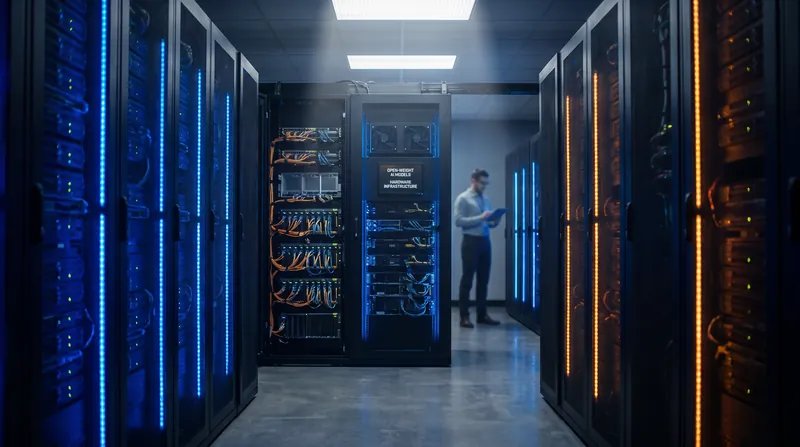
When deployed on optimized data-center infrastructure, this sparse architecture achieves remarkable throughput. For example, running on NVIDIA’s GB300 NVL72 rack-scale systems—which integrate 72 GPUs into a single massive communication domain—the model can deliver over 4,000 tokens per second per GPU. This extreme hardware and software co-design eliminates the communication bottlenecks that typically plague massive mixture-of-experts models when expert-routing traffic must cross traditional off-the-shelf networks. As a result, AI factories can now run large-parameter models in production at high throughput and low latency.[1]
To handle the massive context windows required by modern workflows, the architecture also employs a hybrid attention mechanism. As context grows toward the model's one-million-token limit, traditional attention mechanisms consume unsustainable amounts of memory and compute. By alternating between full-attention layers—where every token attends to every other token—and linear-attention layers that replace the growing cache with a bounded recurrent state, the model keeps both compute and memory strictly contained. This innovation makes the 2.4-trillion-parameter count practical to serve in real-world enterprise environments.[1]
The availability of this highly efficient architecture as an open-weight download immediately altered the pricing landscape across the industry. Even for teams opting not to self-host the model, Alibaba priced the Qwen3.8-Max API aggressively at $2.00 per million input tokens and $6.00 per million output tokens. This established a new, dramatically lower ceiling for what a frontier-class reasoning model could cost, forcing competitors to reevaluate their own pricing structures to remain relevant in an increasingly commoditized market.[3]
Simultaneously, the market was disrupted by the sudden appearance of an anonymous "stealth model" known as OX Alpha. Gaining legitimacy by outperforming established proprietary models on complex coding benchmarks, the anonymous challenger achieved widespread production adoption within 24 hours of its discovery. The combined pressure of OX Alpha’s performance and Qwen3.8-Max’s open-weight release forced established providers to slash their own API prices, resulting in the roughly 50 percent market-wide drop in the cost of raw intelligence.
As raw token prices plummet, the industry is adopting a new metric to measure value: Cost Per Intelligence Unit. This metric shifts the accounting framework away from raw computational cycles or human labor hours, focusing instead on the financial cost of the actual intelligence and decision-making generated by the system. By measuring the Cost Per Intelligence Unit, organizations can more accurately compare the return on investment of deploying a complex AI agent against the cost of traditional legacy automation or human labor.
This shift in metrics is increasingly necessary because of what industry analysts call the "paradoxical price spiral" of artificial intelligence. While the price per million processed tokens has fallen by up to 98 percent since late 2022, actual enterprise AI spending has increased by an estimated 320 percent. This paradox occurs because cheaper tokens encourage developers to build vastly more complex systems, ultimately driving total consumption and spending higher even as the unit price drops.[2]
This shift in metrics is increasingly necessary because of what industry analysts call the "paradoxical price spiral" of artificial intelligence.
The paradox is driven primarily by massively increased consumption patterns associated with autonomous AI agents. The era of simple, linear chat prompts is over. Today’s enterprise workflows rely on autonomous agents that independently process multi-stage tasks. These agentic applications accumulate system instructions, tool outputs, retrieved documents, and multi-step reasoning traces across a workflow, consuming exponentially more tokens than a human typing into a chat interface. As context grows, the sheer volume of tokens processed skyrockets.[1][2]
Where a simple interaction might have cost a few cents in 2023, an orchestrated multi-agent system in 2026 can cost thirty times as much, simply because the agents are doing vastly more complex, iterative work in the background. This explosion in token volume has led to highly unpredictable billing, with some companies reportedly exhausting their entire annual AI budgets in a matter of months. Stories of runaway agentic spending are increasingly circulating in the industry, fundamentally changing the negotiating position of enterprise purchasing departments.[2]
In response to this unpredictability, the Linux Foundation recently announced the creation of the Tokenomics Foundation. Much like the FinOps standards that helped companies manage their cloud computing spend over the last decade, the Tokenomics Foundation aims to establish uniform definitions for metrics like Cost Per Intelligence Unit and tokens-per-watt. This standardization allows purchasing departments and IT leaders to accurately forecast the cost of agentic workflows and bring runaway AI spending under control.[2]
For enterprise infrastructure teams, the open-weight release of models like Qwen3.8-Max offers a strategic way out of the API billing trap. By running these models on dedicated bare-metal GPU clusters, teams gain full control over their serving architecture and costs. They can profile each reasoning level against their specific workload mix, routing complex coding tasks to the full model while offloading simpler document processing to smaller, cheaper variants, thereby optimizing their overall Cost Per Intelligence Unit.[1][3]
This level of architectural control is essential for organizations transitioning from traditional human labor costs to hybrid intelligence models. By optimizing token usage, reducing latency, and managing decision efficiency at the hardware level, enterprises can deploy virtual workforces that replace repetitive white-collar tasks at a fraction of the legacy cost. The focus shifts entirely from paying for hours worked to paying for intelligence created.
Ultimately, the 50 percent drop in the Cost Per Intelligence Unit marks the exact moment when multi-agent orchestration transitioned from experimental research to production-critical infrastructure. With million-token context windows and advanced reasoning now serving as a baseline expectation rather than a premium differentiator, the barrier to entry for complex AI automation has been permanently lowered. The industry is no longer constrained by the cost of intelligence, but by the ability to effectively orchestrate it.[3]
Terms to know
- Cost Per Intelligence Unit (CPIU)
- A metric that measures the financial cost of the actual intelligence and decision-making generated by an AI, rather than just the raw computational cycles.
- Mixture-of-Experts (MoE)
- An AI architecture where only a specific subset of the model's neural networks (experts) are activated for any given task, saving massive amounts of compute.
- Active Parameters
- The portion of a model's total parameters that are actually used to process a single token of text, determining the true cost of running the model.
- Agentic Workflow
- A process where AI models operate autonomously, using tools, writing code, and executing multi-step reasoning without requiring a human prompt for every step.
- Linear Attention
- A memory-efficient mechanism that allows AI models to process massive context windows (like one million tokens) without running out of compute resources.
Questions readers ask
Why did AI costs drop so suddenly in August 2026?
The release of highly capable open-weight models, particularly Alibaba's 2.4-trillion-parameter Qwen3.8-Max, combined with the disruptive launch of an anonymous model called OX Alpha, forced proprietary API providers to slash their prices to remain competitive.
How can a 2.4-trillion-parameter model be cheap to run?
It uses a sparse mixture-of-experts architecture. Even though the model is massive, it only activates 95 billion parameters to process any single word, keeping the actual computing cost relatively low.
What is the 'paradoxical price spiral' in AI?
Even though the cost of individual AI tokens has dropped by up to 98 percent, companies are spending over 300 percent more on AI because autonomous agents consume vastly more tokens to complete complex, multi-step tasks.
What is the Tokenomics Foundation?
A new initiative by the Linux Foundation aimed at creating standard definitions and metrics, like Cost Per Intelligence Unit (CPIU), to help companies manage and forecast their AI spending.
Different angles
Open-Source Advocates
Believe that open-weight models are the primary driver of AI democratization and cost reduction.
This camp argues that proprietary API providers only reduce prices when forced to by the open-source community. The release of a 2.4-trillion-parameter model with open weights proves that the frontier of AI research cannot be monopolized by a few closed labs. By giving developers the freedom to download the weights and optimize the serving architecture on their own hardware, open-source advocates believe the industry is permanently shifting power away from centralized hyperscalers and toward independent builders.
Enterprise Infrastructure Teams
Focus on the hardware and engineering realities of serving massive models at scale.
For infrastructure engineers, the headline parameter count is less important than the active parameter count and the memory bandwidth required to serve it. This perspective emphasizes that 'open weight' does not mean 'free to run.' Deploying a 2.4T model requires data-center-scale accelerated compute, such as rack-scale NVIDIA NVLink domains, to handle the massive expert-routing traffic. They view the drop in AI costs not just as a pricing war, but as a triumph of extreme hardware and software co-design.
Cost-Conscious Enterprises
Concerned with the exploding total cost of ownership driven by autonomous AI agents.
While developers celebrate cheaper tokens, enterprise purchasing departments are sounding the alarm over the 'paradoxical price spiral.' This camp points out that as tokens become cheaper, developers build increasingly complex, multi-agent workflows that consume exponentially more of them. They advocate for strict FinOps-style governance and the adoption of standardized metrics like Cost Per Intelligence Unit (CPIU) to ensure that AI deployments actually deliver a return on investment rather than just burning through compute budgets.
- Open-Source Advocates
- Believe that open-weight models democratize access and force proprietary labs to cut prices.
- Enterprise Infrastructure Teams
- Focus on the hardware and engineering realities of serving massive models at scale.
- Cost-Conscious Enterprises
- Concerned with the exploding total cost of ownership driven by autonomous AI agents.
Perspectives this story doesn't cover
- Proprietary AI Labs
- Cloud Service Providers
Sources
Source coverage
3 outlets
3 viewpoints surfaced



- [1]NVIDIA Technical BlogEnterprise Infrastructure Teams
Serve Qwen3.8-2.4T-A95B, a 2.4T-Parameter Model, with Configurable Reasoning on NVIDIA GB300 NVL72
Read on NVIDIA Technical Blog → - [2]Xpert DigitalCost-Conscious Enterprises
The paradoxical price spiral of artificial intelligence
Read on Xpert Digital → - [3]Factlen Editorial TeamEnterprise Infrastructure Teams
Synthesis by Factlen editorial team
Read on Factlen Editorial Team →

More in Artificial Intelligence
See all →Continual Learning
How Elastic Weight Consolidation Stops Neural Networks From Forgetting
6 sources

AI Architecture
The Core Mechanics of LLM Hallucination: Why Models Invent Facts and the Evidence on Mitigation
7 sources

AI Infrastructure
Stripe Acquires AI Model Gateway OpenRouter for Over $7 Billion to Control AI Billing Rail
6 sources

Open-Weight AI
Benchmarks Show Open-Weight AI Models Now Match Closed Frontier Models on Quality
11 sources
Comments
Every angle. Every day.
Get Artificial Intelligence stories with full source coverage and perspective breakdowns, free every day.