
Historic Four-Way Tie Atop FIE Women's Sabre Standings Sets Up Unprecedented World Championship Race
Four fencers from four different continents are deadlocked at world number one in the FIE Women's Sabre standings, highlighting the sport's global expansion ahead of the 2026 World Championships.
By Factlen Editorial Team
- Global Fencing Advocates
- Celebrate the four-continent tie as proof that international development programs are successfully breaking Europe's historical monopoly on the sport.
- Collegiate Fencing Supporters
- View the rapid ascent of athletes like Natalia Botello as validation that the NCAA system is a premier training ground for international superstars.
- European Traditionalists
- Acknowledge the rising global threat but maintain that the technical mastery of European veterans often prevails in high-pressure World Championship bouts.
What's not represented
- · Fencers ranked 5th through 10th who could play spoiler in Hong Kong
- · National team coaches adjusting strategies for a more diverse field
Why this matters
Fencing has historically been dominated by a concentrated pocket of European nations. A four-way tie featuring athletes from Europe, the Americas, Asia, and Africa proves the sport's development programs are working, setting up a highly unpredictable and globally representative World Championship.
Key points
- Four women's sabre fencers are tied for world number one with 48 points each.
- The tie features athletes from Spain, Mexico, Japan, and Algeria, representing four different continents.
- Lucía Martín-Portugués recently won the European Championship, while Yui Sano took gold at the Asian Zonal Championships.
- Natalia Botello enters the international circuit fresh off an NCAA individual title for Ohio State.
- The tie sets up a massive battle for the number one overall seed at the upcoming 2026 World Championships in Hong Kong.
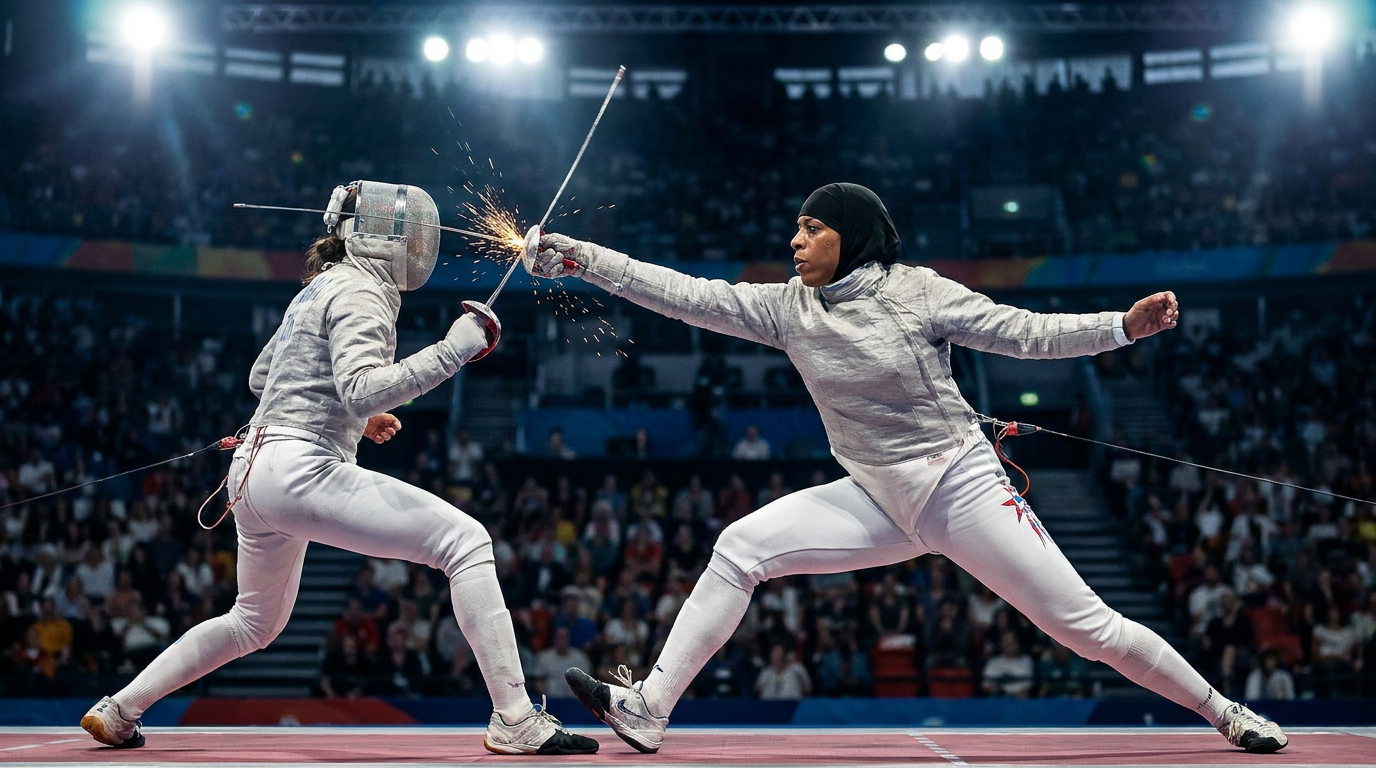
The FIE Women's Sabre standings have produced a statistical anomaly that reads like a scripted sports drama. With the 2026 World Fencing Championships in Hong Kong rapidly approaching, the race for the world number one ranking is deadlocked in an unprecedented four-way tie.[1][2]
Sitting at the absolute summit of the global leaderboard are Spain's Lucía Martín-Portugués, Mexico's Natalia Botello, Japan's Yui Sano, and Algeria's Zohra Nora Kehli. Each fencer currently holds exactly 48 ranking points, creating a perfect mathematical gridlock at the top of the sport.[1][2]
The geographic distribution of this tie is perhaps its most remarkable feature. Featuring athletes from Europe, the Americas, Asia, and Africa, the leaderboard highlights a historic shift in a sport that was once heavily monopolized by a few dominant Western and Eastern European nations.[1][4]

The veteran of the quartet is 35-year-old Lucía Martín-Portugués. The Spanish standout surged into the tie by capturing gold at the 2026 European Fencing Championships in Antony, France, defeating a stacked field of traditional European powerhouses to secure her spot at the top.[2]
Martín-Portugués's journey adds profound emotional weight to her ranking. Balancing her elite athletic career with dentistry studies, she has also become a vocal advocate for athletes competing with epilepsy—a condition she has managed since she was 17. Her recent European title proves her enduring tactical brilliance and resilience on the piste.[6][9]
On the opposite end of the career spectrum is 23-year-old Natalia Botello. The left-handed Mexican phenom from Tijuana has taken the fencing world by storm this season with an explosive, hyper-athletic style that routinely overwhelms opponents.[3][7]
Botello recently made history in the United States by winning the 2026 NCAA Women's Sabre individual title for Ohio State University. Becoming the program's first women's sabre national champion, she proved that her dominance in the grueling NCAA dual-meet format translates perfectly to the FIE international circuit.[3][8]
Botello recently made history in the United States by winning the 2026 NCAA Women's Sabre individual title for Ohio State University.
Representing Asia's rising dominance is Japan's Yui Sano. Sano vaulted into the top tier after a spectacular gold-medal performance at the 2026 Asian Senior Zonal Championships in New Delhi, India.[1]

During that championship run, Sano defeated South Korea's Sebin Choi in a thrilling final to take the individual gold. The victory added to Japan's massive medal haul and cemented Sano's status as a premier threat heading into Hong Kong.[1]
Completing the quartet is Algeria's Zohra Nora Kehli, a 25-year-old Franco-Algerian who represents the absolute pinnacle of African fencing. Kehli's path to world number one is uniquely demanding, requiring extraordinary time management and focus.[4]
Beyond her rigorous training at the elite Christian Bauer Academy and her multiple African Championship titles, Kehli serves as an elected municipal councilor in France and pursues postgraduate history studies at the Sorbonne. Her ability to compartmentalize and execute under immense pressure makes her a formidable tactical opponent.[4][5]
The mechanics of this four-way tie are a direct result of the FIE points system, which heavily weights the recent Zonal Championships. Because all four women won or placed highly in their respective continental tournaments this June, their point totals converged perfectly at the 48-point mark.[1][2]

The stakes for breaking this tie in Hong Kong are massive. The number one overall seed at the World Championships is more than just a prestige title; it guarantees a highly favorable draw in the direct elimination tableau, allowing the top seed to avoid the other major contenders until the semifinal round.[1]
The upcoming tournament will feature a fascinating clash of distinct fencing styles. Martín-Portugués's veteran timing, Botello's left-handed explosiveness, Sano's relentless pace, and Kehli's calculated precision will all be tested on the sport's biggest stage.[1][7]
Regardless of who ultimately claims the top podium spot in Hong Kong, the current FIE standings have already made history. They reflect a healthier, more diverse, and fiercely competitive era for international fencing, proving that world-class talent can now emerge from any corner of the globe.[1][4]
How we got here
March 2026
Natalia Botello wins the NCAA Women's Sabre individual title, signaling her readiness for the senior international circuit.
June 2026
Yui Sano captures gold at the Asian Senior Zonal Championships in New Delhi.
June 2026
Lucía Martín-Portugués wins the European Fencing Championships in Antony, France.
Late June 2026
The FIE standings update to reflect a perfect four-way tie at 48 points between Martín-Portugués, Botello, Sano, and Kehli.
Viewpoints in depth
Global Fencing Advocates
Celebrate the four-continent tie as proof that international development programs are working.
For decades, international fencing was heavily dominated by a select group of European nations with entrenched academy systems. Advocates for the sport's global expansion view this four-way tie as the ultimate validation of the FIE's recent development initiatives. By having top-tier contenders emerge from Mexico, Japan, and Algeria alongside Spain, the sport becomes significantly more marketable and accessible to a worldwide audience, proving that elite talent is no longer constrained by geography.
Collegiate Fencing Supporters
View the rapid ascent of athletes like Natalia Botello as validation of the NCAA training pipeline.
Supporters of the American collegiate fencing system point to Natalia Botello's success as proof that the NCAA is a premier incubator for international talent. The grueling dual-meet format of college fencing forces athletes to fence a high volume of varied opponents under immense pressure. Analysts argue that this environment perfectly prepares young fencers like Botello to transition seamlessly to the FIE senior circuit, bringing an explosive athleticism that challenges traditional European tactical styles.
European Traditionalists
Maintain that the technical mastery of European veterans often prevails in high-pressure World Championship bouts.
While acknowledging the exciting narrative of a globally diverse leaderboard, traditional analysts caution against counting out the established European guard. They argue that veterans like Lucía Martín-Portugués possess a depth of tactical experience and blade-work mastery that is difficult to replicate. In the high-stakes environment of a World Championship direct elimination bracket, traditionalists believe that this seasoned composure will ultimately overcome the raw speed and athleticism of newer challengers.
What we don't know
- Which of the four fencers will secure the highly coveted number one overall seed for the World Championships in Hong Kong.
- How the pressure of the four-way tie will affect the fencers' performances in the final tune-up events.
- Whether a dark horse contender from outside the top four will capitalize on the intense focus surrounding the current leaders.
Key terms
- Sabre
- One of the three Olympic fencing weapons, characterized by fast, slashing attacks where points can be scored with the edge or point of the blade.
- FIE
- The Fédération Internationale d'Escrime, the international governing body for Olympic fencing.
- Zonal Championships
- Major continental tournaments (e.g., European, Asian, Pan American, African Championships) that award significant points toward world rankings.
- Direct Elimination
- The knockout bracket phase of a fencing tournament, following the initial pool rounds.
- Lamé
- The electrically conductive jacket worn by sabre and foil fencers to register valid hits on the electronic scoring apparatus.
Frequently asked
How did four fencers end up with the exact same score?
The FIE points system heavily weights recent Zonal Championships. Because all four fencers won or placed highly in their respective continental tournaments (Europe, Americas, Asia, Africa) in June 2026, their point totals converged at exactly 48.
Why does the number one ranking matter for the World Championships?
The top seed receives the most favorable draw in the direct elimination bracket, meaning they will not have to face the other top-ranked fencers until the semifinal or final rounds.
What is the difference between sabre and the other fencing weapons?
Sabre is a fast-paced, aggressive weapon where points can be scored with the edge of the blade, unlike foil and epee which are thrusting-only weapons. It relies heavily on explosive speed and right-of-way rules.
Sources
Source coverage
9 outlets
3 viewpoints surfaced







[1]FIEGlobal Fencing Advocates
FIE Senior Ranking 2025-2026 - Women's Sabre
Read on FIE →[2]Liquipedia FencingGlobal Fencing Advocates
FIE Senior Ranking 2025-2026 - Women's sabre
Read on Liquipedia Fencing →[3]Ohio State BuckeyesCollegiate Fencing Supporters
Natalia Botello 2025-26 Fencing Roster
Read on Ohio State Buckeyes →[4]Olympics.comGlobal Fencing Advocates
Zohra Nora Kehli: Olympian and African Champion
Read on Olympics.com →[5]Sorbonne UniversitéEuropean Traditionalists
High-level fencer and History student: Zohra Nora Kehli
Read on Sorbonne Université →[6]Redacción MédicaEuropean Traditionalists
La futura dentista diestra con la espada: Lucía Martín-Portugués
Read on Redacción Médica →[7]Diario ASCollegiate Fencing Supporters
Natalia Botello hace historia en el sable universitario
Read on Diario AS →[8]Eleven WarriorsCollegiate Fencing Supporters
Ohio State Fencer Natalia Botello Becomes Women's Program's Fourth Individual National Champion
Read on Eleven Warriors →[9]Mar de SomnisEuropean Traditionalists
Lucía Martín-Portugués, deportista olímpica de esgrima, con epilepsia desde los 17 años
Read on Mar de Somnis →

More in sports
See all 33 stories →Standings
FIDE Women's Circuit Standings: Assaubayeva Takes the Lead as Teenagers Hnatyshyn and Savitha Shri Crash the Top 10
8 sources
Injury
Global Netball Injury Report: Harvey Returns to Form as Poi Leads Steel From the Sidelines
7 sources
Standings
Northern Mystics Claim Record Fourth ANZ Premiership Title With Grand Final Victory Over Southern Steel
4 sources
Injury
AFL Injury Update: Carlton Sweats on Weitering's Calf as Hawthorn Loses Impey
7 sources
Every angle. Every day.
Get sports stories with full source coverage and perspective breakdowns delivered to your inbox.