
Hamas Agrees to Surrender Arms and Relinquish Governance in Gaza, Peace Board Confirms
Palestinian armed factions have formally agreed to a comprehensive disarmament and governance transfer under a UN-backed roadmap. However, a fundamental dispute over the sequencing of Israeli withdrawal threatens to stall the transition.

The fundamental disagreement blocking the resolution of the Gaza war is no longer about whether Hamas will surrender its weapons, but the precise sequencing of how and when that disarmament occurs. For months, international mediators have struggled to align the demands of a heavily armed militant organization with the security imperatives of the Israeli state.
On Wednesday, the diplomatic calculus shifted significantly when the Gaza Peace Board confirmed that Palestinian armed factions have formally agreed to a comprehensive disarmament and governance transfer. This development introduces a new structural reality to the conflict, transitioning the debate from a question of ultimate objectives to a high-stakes standoff over the mechanics of implementation and the verification of compliance.[1][2]
The announcement, delivered to the United Nations Security Council by High Representative Nikolay Mladenov, marks the first time Hamas has explicitly consented to relinquish both its military arsenal and its administrative control over the enclave. Under the terms of the US-backed 15-point roadmap, governing authority would pass entirely to a UN-recognized transitional body designated as the National Committee for the Administration of Gaza.
Mladenov framed the concession as a critical breakthrough that could dramatically improve sustainable living conditions for Palestinians while providing durable, verifiable security guarantees for Israelis. The agreement theoretically dismantles the governance structure that has defined the territory since 2007.[1][3]
Yet the diplomatic breakthrough immediately collided with the entrenched military reality on the ground. While the US-championed roadmap envisions a synchronized, phased process where weapons decommissioning triggers a gradual Israeli military withdrawal, the Israeli government maintains a strict and unyielding "disarmament-first" doctrine. Prime Minister Benjamin Netanyahu has explicitly rejected the phased sequencing proposed by the Peace Board, demanding absolute and verified demilitarization before any troop redeployment or large-scale reconstruction begins. This fundamental divergence in sequencing—synchronized steps versus absolute preconditions—now forms the primary barrier to ending the hostilities.[1][4]
The scope of the agreed disarmament, as outlined in the UN briefing, is unprecedented in its comprehensive nature. Mladenov detailed to the Security Council that the framework targets "every category of weapon in Gaza," explicitly stating that there will be no grey zones and no categories left out of the audit.
The mandate covers heavy artillery, the extensive subterranean tunnel networks, domestic weapons production facilities, hidden arms depots, and even the personal firearms held by individual faction members. The sheer logistical complexity of locating, cataloging, and destroying this decentralized arsenal presents a massive operational challenge for international monitors.[1][3]
Under the proposed security architecture, the National Committee for the Administration of Gaza would become the sole entity authorized to possess or control weapons within the territory, effectively dissolving the militant wings of Hamas and allied factions.
This transition relies heavily on the anticipated deployment of an International Stabilization Force, which would be tasked with managing the volatile security vacuum during the handover period. The success of this phase depends entirely on the willingness of armed factions to submit to external audits and the capacity of international forces to secure decommissioned stockpiles before they can be hidden or repurposed.[3][4]
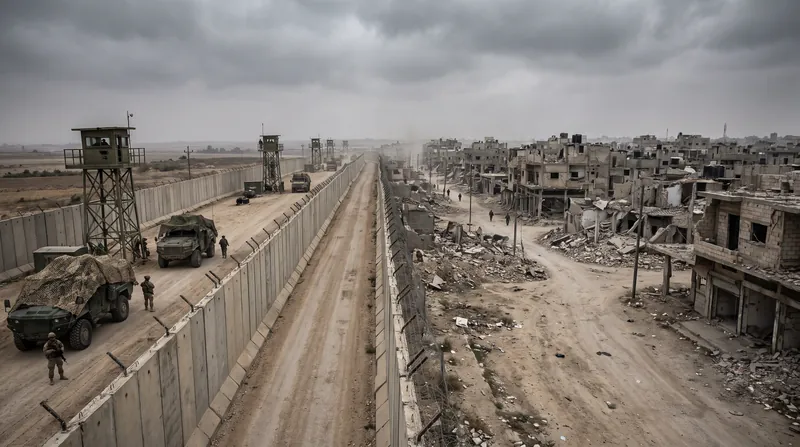
The mechanism for verifying this disarmament remains the most volatile friction point between the negotiating parties. The roadmap explicitly links the withdrawal of Israeli forces beyond a designated military demarcation—referred to as the yellow line—to specific, verified decommissioning milestones. While Hamas has committed to these phased terms with international mediators, the Israeli military insists on conducting its own active verification through ongoing kinetic operations. A political source emphasized to the AFP that there will be "no withdrawal whatsoever" without genuine, absolute disarmament verified by Israeli intelligence rather than international observers.[5]
The severe tension between diplomatic agreements in New York and ground realities in the Middle East was starkly underscored over the weekend. Israeli forces executed a series of strikes against what the military identified as Hamas weapons storage facilities, including sites located adjacent to civilian infrastructure such as the Al-Aqsa Martyrs Hospital.
The Israeli military argues these operations are strictly necessary to ensure genuine disarmament and neutralize imminent threats. Conversely, Palestinian civil defense representatives and international observers warn that continued kinetic strikes threaten to collapse the fragile ceasefire and derail the political transition before it can begin.[5]
This standoff presents a classic asymmetric negotiation trap that mediators must now navigate. The US-backed framework attempts to use phased withdrawal and the promise of humanitarian reconstruction as vital leverage to secure voluntary disarmament from the factions. The Israeli position calculates that yielding any territorial control before the militant infrastructure is entirely dismantled invites a reconstituted threat and sacrifices their primary strategic advantage. Bridging this gap requires engineering a verification mechanism robust enough to satisfy Israeli security demands while maintaining the phased incentives required to ensure Palestinian compliance.[4]
As the UN Security Council reviews the implementation parameters of the 15-point roadmap, the international focus shifts entirely from securing the initial agreement to engineering a viable, bulletproof enforcement mechanism. The ultimate success of the Peace Board's initiative now depends on whether mediators can construct a timeline that simultaneously executes the disarmament of Hamas and the withdrawal of Israeli forces without triggering a security collapse. Until that sequencing is resolved, the agreement remains a profound diplomatic milestone suspended over an active and highly volatile military theater.[1][4]
Viewpoints in depth
The Phased Transition Framework
The US-backed 15-point roadmap linking gradual Israeli withdrawal to verified weapons decommissioning under UN oversight.
For: Incentivizes militant compliance by offering tangible governance transfer and reconstruction milestones in exchange for arms. Against: Leaves Israeli forces exposed to residual capabilities during the transition period and relies on untested international enforcement. Evidence: Mladenov's UN Security Council briefing confirming Hamas's agreement to transfer authority to the 15-point National Committee for the Administration of Gaza (NCAG). Fits well when: A robust International Stabilization Force can guarantee security during the handover and both parties accept incremental risk. Does not fit when: Armed factions retain hidden stockpiles outside the UN audit, or when domestic political pressure prevents either side from making the first concession.
The Disarmament-First Doctrine
The Israeli government's requirement that all militant infrastructure be dismantled before any troop withdrawal or reconstruction.
For: Eliminates the risk of a reconstituted threat and ensures absolute security before yielding territorial control. Against: Stalls humanitarian reconstruction indefinitely and removes the primary diplomatic leverage needed to secure voluntary disarmament from entrenched factions. Evidence: Prime Minister Benjamin Netanyahu's explicit rejection of the phased sequencing, alongside ongoing IDF kinetic operations targeting 5 identified weapons depots near civilian infrastructure over the weekend. Fits well when: One party possesses overwhelming military dominance and the timeline for resolution is open-ended. Does not fit when: Prolonged occupation triggers broader regional escalation, or when the humanitarian collapse demands immediate structural intervention.
Key points
- Gaza Peace Board High Representative Nikolay Mladenov confirmed Hamas has agreed to surrender all weapons and relinquish governance.
- Authority would transfer to the UN-recognized National Committee for the Administration of Gaza under a 15-point roadmap.
- The agreement covers all weapon categories, including heavy artillery, tunnels, and personal firearms.
- Israeli Prime Minister Benjamin Netanyahu rejected the phased approach, demanding full disarmament before any troop withdrawal.
What we don’t know
- Whether the International Stabilization Force has secured commitments from nations willing to deploy troops into the volatile security vacuum.
- How international monitors plan to verify the destruction of subterranean tunnel networks without Israeli military oversight.
- If the political leadership of Hamas can enforce the disarmament agreement upon decentralized and deeply entrenched militant cells.
- Phased Transition Advocates
- Argue that synchronized withdrawal and reconstruction are necessary incentives to secure voluntary disarmament.
- Security-First Proponents
- Maintain that absolute demilitarization must precede any territorial concessions to prevent a reconstituted threat.
- Regional Security Observers
- Focus on the volatility of the transition period and the risk of kinetic operations derailing the diplomatic framework.
Perspectives this story doesn't cover
- Palestinian civilians awaiting reconstruction
- Rank-and-file militant faction members
Sources
Source coverage
5 outlets
3 viewpoints surfaced





- [1]Anadolu AgencyPhased Transition Advocates
Hamas agrees to surrender arms, relinquish governance, Peace Board says
Read on Anadolu Agency → - [2]Middle East MonitorPhased Transition Advocates
Hamas agrees to surrender arms, relinquish governance, Peace Board says
Read on Middle East Monitor → - [3]Yeni ŞafakPhased Transition Advocates
Hamas agrees to surrender arms, cede Gaza governance: Mladenov
Read on Yeni Şafak → - [4]Ground NewsSecurity-First Proponents
Hamas agrees to surrender arms, relinquish governance, Peace Board says
Read on Ground News → - [5]The Express TribuneRegional Security Observers
Hamas agrees to surrender arms, relinquish governance, Peace Board says
Read on The Express Tribune →

More in World
See all →Gaza Security
Eleven Months After the Ceasefire, Gaza Is Still Caught Between Phased Transition and Military Control
4 sources
International Law
The Fourth Geneva Convention and the 'Market Regulation' Doctrine: How the Legal Status of West Bank Settlements is Defined
9 sources

Petro-State Economics
The $67 per Barrel Fiscal Break-Even Price That Dictates Saudi Arabia's Budgetary Needs
6 sources

IRGC Economy
How Iran's Revolutionary Guard Uses Article 147 to Seize No-Bid Mega-Projects From Civilian Firms
7 sources

Comments
Every angle. Every day.
Get World stories with full source coverage and perspective breakdowns, free every day.