
DC Comics Overtakes Marvel in Direct Market Sales: How the Industry Shifted in 2026
Driven by the success of its budget-friendly Compact line and the Absolute Universe relaunch, DC Comics has secured the top spot in direct market comic sales, ending Marvel's long-standing dominance.
By Joao Marques

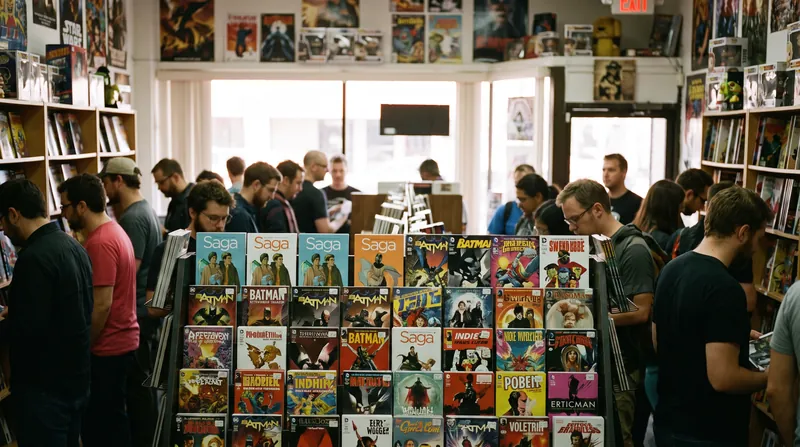
Open on a vivid scene. The local comic shop on a Wednesday morning—the traditional "New Comic Book Day"—has long been defined by a familiar visual hierarchy. For decades, the sprawling racks of single-issue "floppies" have been overwhelmingly dominated by the distinctive red-and-white Marvel logo.
But step into any of the roughly 2,000 specialty shops across North America in the summer of 2026, and the balance of power looks fundamentally different. For the first time this century, the perennial runner-up has seized the register. DC Comics has officially overtaken Marvel in both unit and dollar sales within the direct market, ending a reign that many industry observers assumed was permanent.[4][6]
If you are a reader who has felt priced out of ongoing superhero sagas, or exhausted by the relentless churn of line-wide crossover events, this shift is more than just corporate inside baseball—it is a direct referendum on how stories are sold to you.
The data from July 2026 paints a stark picture of a changing guard in the comic book industry. According to Prana Direct Market Solutions, which aggregates point-of-sale data from over 600 comic shops, DC captured 39.5 percent of all unit sales for the month, leaving Marvel trailing at a distant 31.7 percent.[1]
The financial metrics mirror the unit volume. Across those surveyed stores, DC generated over $655,000 in sales during July, comfortably outpacing Marvel’s $559,000. This is not a one-month anomaly driven by a single blockbuster issue. The July figures represent the culmination of a steady climb that began in late 2025, when DC first began closing the gap before officially taking the top spot in the first quarter of 2026. The question echoing through the industry is how the House of Ideas lost its crown to the Distinguished Competition.[1][7]
The answer lies in a fundamental rethinking of comic book economics and format innovation. For years, the industry standard has been the $4.99 monthly single issue—a price point that has increasingly alienated casual fans and younger demographics. Recognizing that this model was becoming unsustainable for anyone but the most dedicated collectors, DC pivoted aggressively toward accessibility. The publisher realized that competing with Marvel on sheer volume was a losing battle; instead, they needed to change the physical product itself.[4][5]
The vanguard of this strategy is the DC Compact Comics line. By printing complete, critically acclaimed storylines in a smaller, manga-sized digest format for a fraction of the cost of a traditional trade paperback, DC drastically lowered the barrier to entry. A reader walking into a shop with a twenty-dollar bill could suddenly walk out with two complete graphic novels instead of a handful of fragmented single issues. This format directly targeted the reading habits of a generation raised on the affordability and binge-ability of Japanese manga.[3]
Alongside this budget-friendly initiative, DC launched the "Absolute Universe"—a massive, creator-driven publishing event that reimagined core characters without the intimidating baggage of decades of continuity. Titles like Absolute Batman became immediate, runaway hits. Retailers reported that the flagship Absolute titles were selling at double the volume of Marvel's top-performing books, including the historically dominant Amazing Spider-Man. By offering clean jumping-on points, DC brought lapsed readers back to the physical shelves.[3]
While DC innovated on price and accessibility, Marvel leaned heavily into its legacy strategies. The publisher continued to rely on frequent variant covers and sprawling, interconnected crossover events like One World Under Doom. While these tactics have historically provided reliable short-term revenue spikes by appealing to completionist collectors, point-of-sale data suggests that broader reader fatigue has finally set in. The sheer volume of required reading to follow a single Marvel narrative arc has become a liability rather than a strength.[3][5]
Marvel still publishes significantly more individual titles per month than DC, maintaining a sprawling "mid-tier" of books. However, DC's strategy of publishing fewer, higher-impact titles has proven vastly more efficient for the modern retail environment. DC's top-heavy approach means their biggest books are doing multiples of what everything else is selling, which allows shop owners to order with confidence rather than gambling on dozens of marginal titles that might end up languishing in the discount bins.[2][3]
For the local comic shop owner, this market shift is a vital lifeline. The direct market has faced significant economic headwinds in recent years, with 54 percent of stores reporting lower gross sales in 2023 compared to pre-pandemic levels due to inflation and shifting consumer habits. DC's surge has brought much-needed foot traffic back into these brick-and-mortar spaces. The rivalry translates directly into varied pricing and aggressive publishing slates, meaning the regular reader sees shelves filling up with more diverse, high-quality options.[1][2]
This market share flip also sends immediate ripples through the secondary collectibles market. When a publisher dominates the cultural conversation and unit sales, demand for their key issues and graded comics naturally rises in tandem. The runaway success of the Absolute line has sparked renewed interest in DC's back catalog, driving up secondary market prices for classic runs and key character appearances as new readers seek out the source material.[2]
Marvel has not entirely ignored the shifting winds. Recognizing the existential threat posed by the Compact line, the publisher recently announced its own "Premiere Collection" line, attempting to capture a slice of the digest-sized market. However, early reception has been mixed, with industry observers noting the higher price point compared to DC's offerings and a less compelling initial lineup of collected stories. Turning around a publishing apparatus as massive as Marvel's takes time.[3]
Beyond the battle of the Big Two, the overall comic book market is actually expanding, contrary to perennial doom-saying. Global projections estimate the broader market will reach $37.1 billion by 2033, driven by a robust 8.9 percent compound annual growth rate. This growth is fueled almost entirely by the increasing recognition of graphic novels as a sophisticated storytelling medium in traditional literary spaces—a macro trend that perfectly aligns with DC's pivot toward collected, self-contained editions over serialized floppies.[4]
It is also impossible to discuss the direct market without acknowledging the steady, stabilizing presence of Image Comics. While DC and Marvel wage war over the top spot, Image comfortably holds third place with a 13.8 percent market share. By focusing exclusively on creator-owned, non-superhero titles, Image caters to a completely different demographic, proving month after month that the direct market can support diverse, idiosyncratic genres outside the traditional cape-and-cowl duopoly.[1][2]
The lingering question is whether DC can maintain this hard-won momentum through the end of the year and beyond. The direct market is notoriously fickle, and Marvel still possesses the most recognizable intellectual property on the planet, bolstered by the omnipresent marketing engine of its cinematic universe. A single universally acclaimed event series, a highly anticipated creative team shakeup, or a successful launch of their own digest line could easily swing the pendulum back in Marvel's favor. For now, however, the momentum rests firmly in Burbank.[2][6]
The lingering question is whether DC can maintain this hard-won momentum through the end of the year and beyond.
Ultimately, the real winner in this historic publisher war is the reader. Monopolies breed complacency, and Marvel’s long, undisputed dominance had arguably allowed the industry's pricing and format models to stagnate. As DC and Marvel fight tooth and nail over every single percentage point of direct market share, fans are reaping the undeniable benefits of that friction.
The result is a landscape filled with better stories, highly accessible formats, competitive pricing structures, and a renewed editorial focus on what makes the comic book medium so enduringly magical in the first place.[2]
Key points
- DC Comics captured 39.5% of direct market unit sales in July 2026, officially ending Marvel's long-standing industry dominance.
- The shift is largely attributed to DC's budget-friendly Compact Comics line and the highly successful Absolute Universe publishing initiative.
- Marvel's reliance on $4.99 single issues and sprawling crossover events has led to reported reader fatigue at the retail level.
- The global comic book market continues to grow, with projections estimating a $37.1 billion valuation by 2033 driven by graphic novels.
What we don’t know
- Whether Marvel's upcoming 'Premiere Collection' digest line will successfully win back budget-conscious readers.
- How long DC can sustain its top-heavy sales approach before needing to expand its mid-tier title offerings.
- The exact impact of digital subscription services like Marvel Unlimited and DC Universe Infinite on these physical sales trends.
How we got here
Late 2025
DC begins closing the market share gap, driven by the initial retail success of its manga-sized Compact Comics line.
Q1 2026
DC officially overtakes Marvel in direct market share for the first time this century, capturing 34.7% of the market.
March 2026
The highly anticipated DC/Marvel crossover 'Superman/Spider-Man #1' becomes the top-selling comic of the quarter.
July 2026
DC expands its lead significantly, capturing 39.5% of unit sales and generating over $655,000 across surveyed stores.
- Direct Market Retailers
- Focuses on unit economics, shelf space efficiency, and bringing lapsed readers back into physical stores.
- Format Innovators
- Argues that lowering the barrier to entry through affordable digest sizes is the only sustainable path forward.
- Industry Analysts
- Analyzes the broader global market growth and the structural challenges facing legacy publishing models.
Perspectives this story doesn't cover
- Casual Digital Readers
- International Comic Distributors
Sources
Source coverage
7 outlets
3 viewpoints surfaced






- [1]Bleeding CoolDirect Market Retailers
Comic Book Publisher Marketshare Chart For July 2026
Read on Bleeding Cool → - [2]Foro3DDirect Market Retailers
DC leads July but Marvel narrows the gap in stores
Read on Foro3D → - [3]ICv2 (via Reddit)Format Innovators
ICv2: DC Expands Lead Over Marvel for Second Quarter in a Row
Read on ICv2 (via Reddit) → - [4]AccioIndustry Analysts
Overall Comic Book Market Trends
Read on Accio → - [5]CBRIndustry Analysts
Comic Book Publisher Marketshare Chart For July 2026
Read on CBR → - [6]The Hollywood Reporter (via Reddit)Format Innovators
Hollywood Reporter article on 'the return of the superstar artist', confirms that DC 'has overtaken market share over longtime rival Marvel for the first time this century'
Read on The Hollywood Reporter (via Reddit) → - [7]4chanIndustry Analysts
/co/ - Comic Book Publisher Marketshare Chart For July 2026
Read on 4chan →
More in Entertainment
See all →Direct Market
Diamond Bankruptcy Settles Publisher Claims Over $47M in Consigned Inventory
4 sources

Entertainment Tech
Disney Memo Warns of Layoffs, Citing 'Automating Workflows' and AI Adoption
5 sources
Comic Economics
The Crowdfunding Revolution: How Direct-to-Fan Platforms Rewrote the Economics of Indie Comics
5 sources
Webtoons
The Infinite Scroll: How Vertical Comics Are Rewriting the Rules of Graphic Storytelling
4 sources

Comments
Every angle. Every day.
Get Entertainment stories with full source coverage and perspective breakdowns, free every day.