
Astrocytes Are Not Just Brain Glue: New Model Suggests They Actively Compute and Store Memories
A groundbreaking computational model proposes that star-shaped glial cells called astrocytes act as active computational units, vastly expanding the brain's memory capacity through dense associative networks.

- Computational Neuroscientists
- Focus on how the astrocyte model solves mathematical capacity limits using Dense Associative Memory.
- Biological Neuroscientists
- Emphasize the biological mechanics of the tripartite synapse and the need for in vivo experimental proof.
- Cognitive Health Researchers
- Focus on how astrocyte dysfunction could explain early cognitive decline in diseases like Alzheimer's.
Fast facts
- A new computational model suggests astrocytes actively participate in memory storage, rather than just supporting neurons.
- Astrocytes form 'tripartite synapses,' wrapping around neuronal junctions to monitor and modulate chemical signals.
- Using calcium signaling, a single astrocyte can integrate information across hundreds of thousands of synapses simultaneously.
- This architecture mirrors 'Dense Associative Memory' in AI, exponentially increasing the brain's theoretical storage capacity.
- The model offers a highly energy-efficient way for the brain to store a lifetime of complex patterns and experiences.
- If validated experimentally, the discovery could reshape both Alzheimer's research and the design of future AI hardware.
Why this matters
For decades, neuroscience has treated neurons as the sole architects of thought, struggling to explain how the brain stores a lifetime of memories with limited connections. If astrocytes actively compute, it rewrites textbook biology, opens new avenues for treating Alzheimer's, and provides a biological blueprint for vastly more powerful artificial intelligence.
How we got here
Late 19th Century
Astrocytes are identified and named for their star-like shape, but are assumed to be passive 'glue' holding neurons together.
Late 1990s
The concept of the 'tripartite synapse' emerges as researchers observe astrocytes wrapping around neuronal junctions and responding to neurotransmitters.
2016
AI researchers Dmitry Krotov and John Hopfield propose 'Dense Associative Memory' models, allowing multi-node interactions in artificial networks.
Early 2020s
Laboratory experiments reveal that disrupting astrocyte-neuron connections in the hippocampus severely impairs memory in animal models.
May 2025
MIT and IBM researchers publish the theoretical model in PNAS, mathematically linking astrocyte biology to Dense Associative Memory.
The human brain is a biological paradox. It contains roughly 86 billion neurons, which communicate across trillions of synaptic connections to encode every face we recognize, every word we speak, and every experience we recall. Yet, from a purely mathematical standpoint, the traditional model of memory storage—where information lives exclusively in the strengthened connections between pairs of neurons—struggles to account for the sheer volume of data a human accumulates over a lifetime. If neurons only couple in pairs, the network's storage capacity hits a mathematical ceiling long before it can explain human cognition.
For decades, neuroscientists have searched for the missing variable in this equation. Now, a collaborative team from MIT and the IBM Watson AI Lab has proposed a radical solution: the brain's massive storage capacity relies on a completely different, long-overlooked type of cell. According to a computational model published in the Proceedings of the National Academy of Sciences, star-shaped glial cells known as astrocytes are not just passive support structures, but active computational units that encode memories alongside neurons.[1]
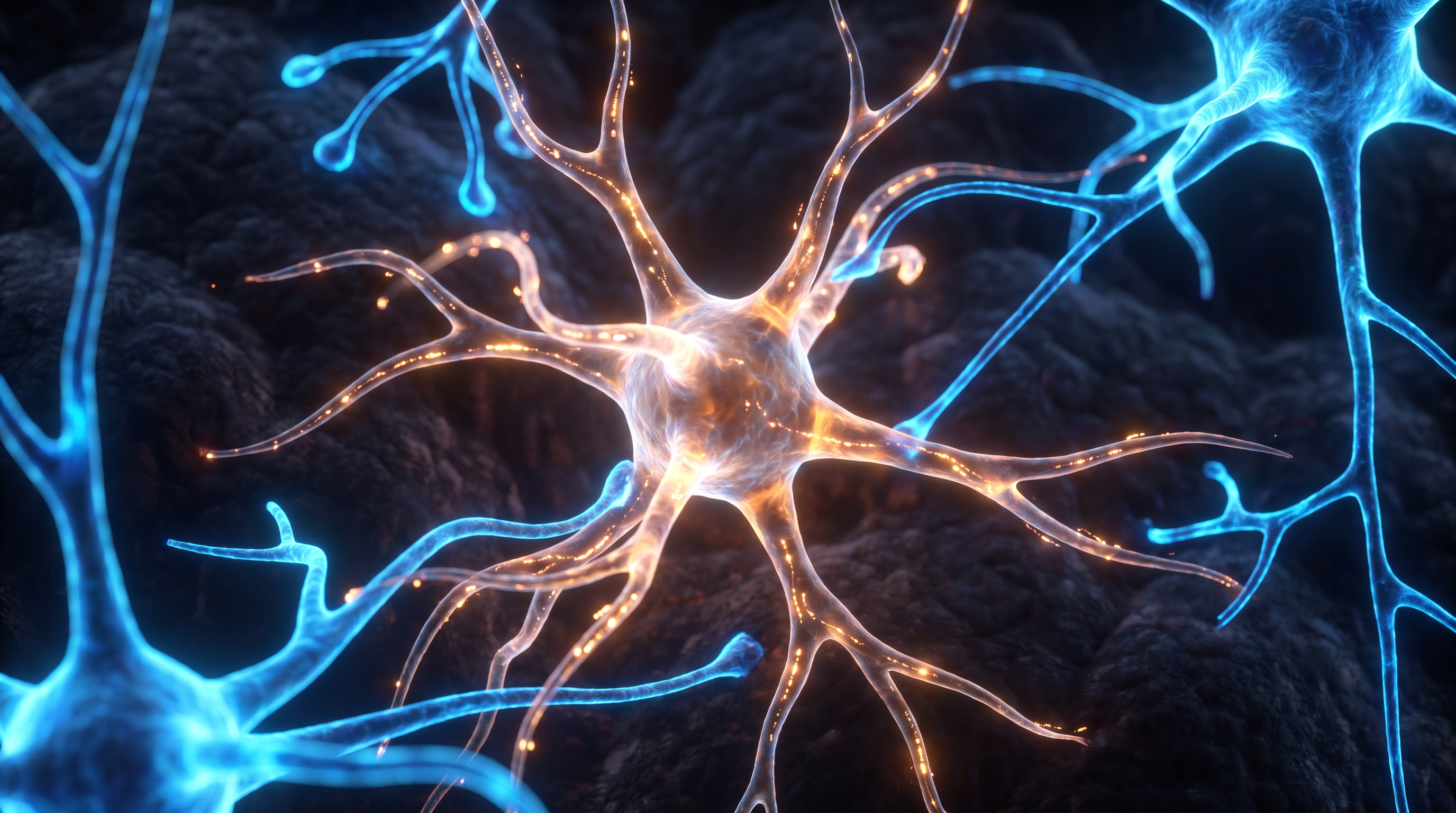
To understand the mechanism, it helps to look at the physical architecture of the brain. Astrocytes outnumber neurons in many regions of the brain. They are named for their star-like shape, featuring a central cell body that extends into millions of microscopic, branching tendrils. Historically, these cells were relegated to the role of biological housekeepers—clearing away cellular debris, delivering nutrients from the bloodstream, and maintaining the chemical balance around neurons.[2]
But high-resolution imaging has revealed a more intimate relationship. An astrocyte's tendrils physically wrap around the synaptic junctions where two neurons meet, creating what biologists call a "tripartite synapse." In this three-way handshake, the astrocyte is perfectly positioned to eavesdrop on the chemical conversation happening between the pre-synaptic neuron sending a signal and the post-synaptic neuron receiving it.
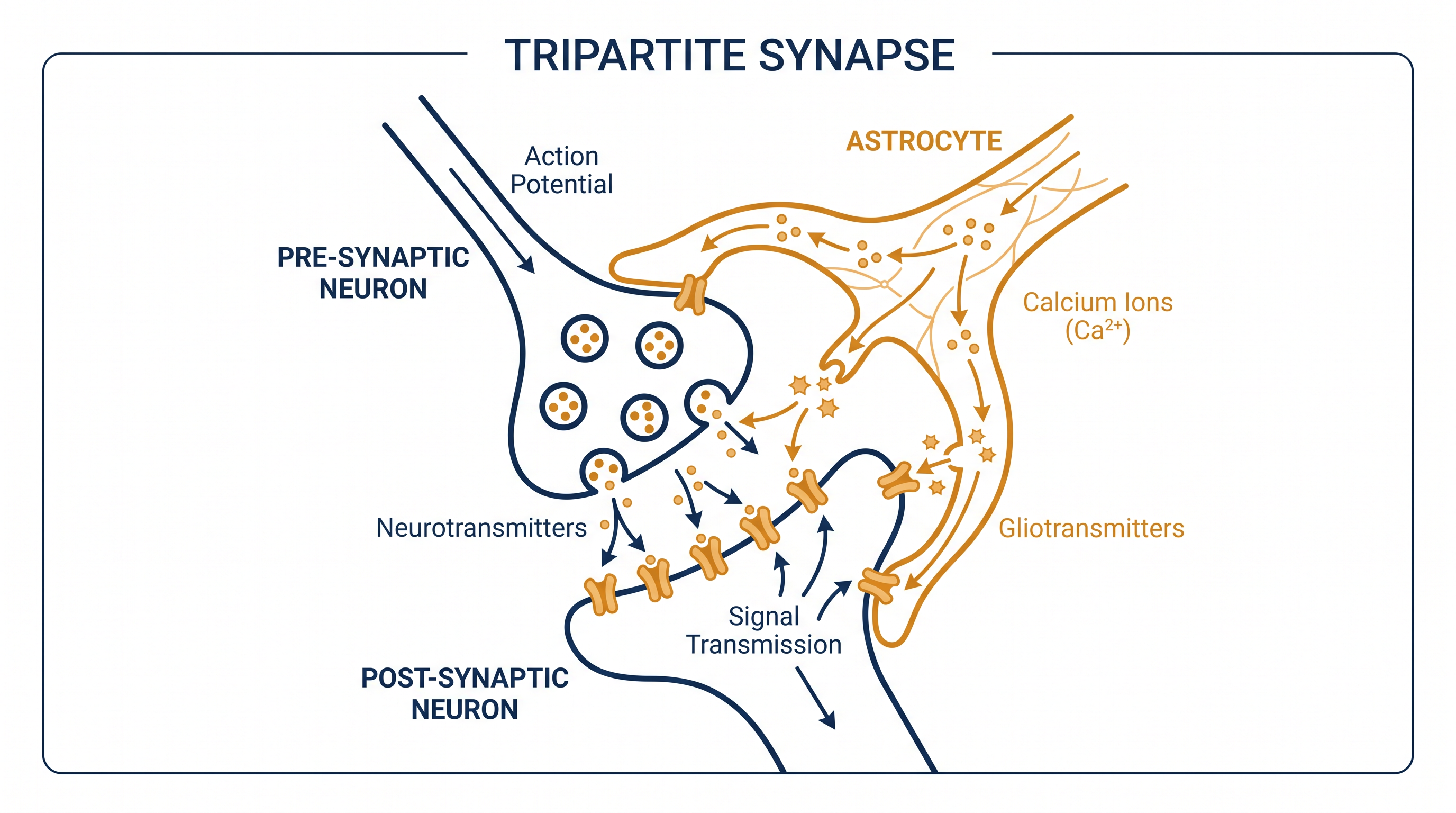
Unlike neurons, astrocytes do not fire rapid electrical action potentials. Instead, they communicate through a slower, chemical language based on calcium. When a neuron fires and releases neurotransmitters into the synapse, the wrapping astrocyte detects these molecules. In response, the astrocyte alters its own internal calcium levels, sending waves of charged calcium ions rippling through its tendrils.
This calcium wave is not a passive reaction; it is a computational step. The astrocyte processes the incoming signal and can release its own chemical messengers—known as gliotransmitters—back into the synapse. This feedback loop allows the astrocyte to actively mute or amplify the neuronal signal, directly modulating the strength of the synaptic connection. It is this bidirectional communication that forms the biological basis for the new memory model.
The breakthrough by the MIT and IBM researchers came when they applied advanced machine learning mathematics to this biological reality. In artificial intelligence, traditional "Hopfield networks" store data by linking pairs of artificial neurons, much like the classical view of the brain. However, AI researchers recently developed "Dense Associative Memory" models, which allow multiple nodes to interact simultaneously, exponentially increasing the network's capacity to store and retrieve complex patterns.[1][3]
The breakthrough by the MIT and IBM researchers came when they applied advanced machine learning mathematics to this biological reality.
The researchers realized that astrocytes are the biological hardware perfectly suited to run a Dense Associative Memory network. Because a single astrocyte can extend its tendrils to contact hundreds of thousands—or even millions—of different synapses, it acts as a massive integration hub. It bridges multiple neural connections that would otherwise be isolated from one another, allowing the brain to achieve the higher-order, multi-node interactions required for dense memory storage.[1][3]
In this proposed architecture, a memory is not stored solely in the weight of a single synapse between two neurons. Instead, the memory is distributed across the dense web of the astrocyte's processes, encoded by gradual, spatial-temporal changes in calcium flow. When a partial cue is encountered—like the smell of a childhood home—the astrocyte helps the neural network complete the pattern and retrieve the full memory.[1]
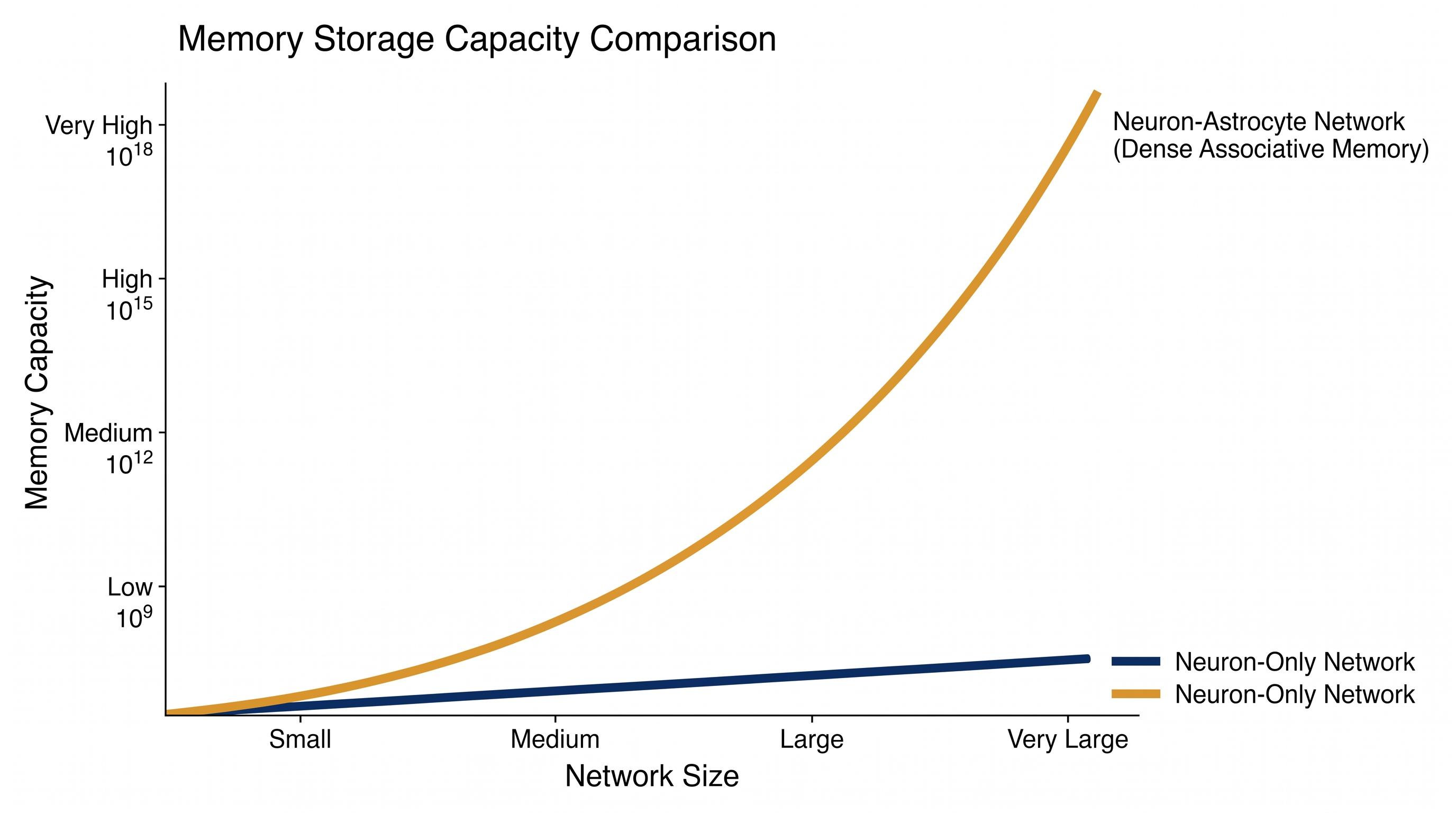
This model elegantly solves the brain's capacity problem. By treating each of the astrocyte's millions of processes as an independent computational unit, the network's storage potential scales exponentially rather than linearly. The researchers demonstrated mathematically that a neuron-astrocyte network can store vastly more information than a neuron-only network, achieving a memory scaling law that outperforms any previously known biological implementation.[1][3]
The energy implications are equally profound. Neurons are metabolically expensive; firing electrical action potentials requires massive amounts of cellular energy. Astrocytes, relying on slower calcium dynamics, operate at a fraction of the energy cost. By offloading complex pattern storage to the astrocytic network, the brain can maintain a massive database of experiences without requiring an unsustainable caloric intake.[3]
While the mathematics are compelling, the researchers are transparent about the current limits of the evidence. The Dense Associative Memory model of astrocytes remains a theoretical framework. Proving it definitively will require experimental neuroscientists to manipulate calcium signaling within specific astrocyte processes in living animals, and then observe whether those precise interventions selectively disrupt memory formation or retrieval.[2]
Early experimental clues already point in this direction. Recent laboratory studies have shown that when the physical connections between astrocytes and neurons in the hippocampus—the brain's memory center—are chemically or genetically disrupted, animals exhibit profound memory deficits, even if their neurons remain perfectly healthy.
If validated in vivo, this paradigm shift will have immediate consequences for medicine. Neurodegenerative conditions like Alzheimer's disease are currently viewed primarily as disorders of neurons and the toxic proteins that kill them. But if astrocytes are the actual hard drives of the brain's dense memory network, early cognitive decline might be driven by the breakdown of astrocyte-neuron communication, offering an entirely new target for therapeutic drugs.[2][3]
The discovery is also feeding back into the field that helped uncover it: artificial intelligence. The flexible, multi-node connectivity of astrocytes closely mirrors the "attention mechanisms" used in modern AI transformers like large language models. By studying how biological astrocytes optimize energy and storage, computer scientists hope to design next-generation neuromorphic chips that mimic glial cells, potentially breaking the current energy bottlenecks in AI training.[3]
Viewpoints in depth
Computational Neuroscientists
Focus on the mathematical scaling laws and the implementation of Dense Associative Memory.
For researchers at the intersection of AI and biology, the astrocyte model solves a glaring mathematical problem. Traditional models of neural networks, where neurons only connect in pairs, simply cannot store enough patterns to account for human cognition without catastrophic interference (where new memories overwrite old ones). By mapping the astrocyte's millions of connections to the framework of Dense Associative Memory—a concept recently popularized in machine learning—computational theorists argue that the brain achieves exponential storage scaling. They view the astrocyte as a biological multi-node hub that allows the brain to run highly efficient, energy-saving algorithms.
Biological Neuroscientists
Emphasize the need for in vivo experimental validation of the calcium signaling hypothesis.
While acknowledging the elegance of the math, experimental biologists caution that the model remains a theoretical framework. They emphasize that proving astrocytes act as computational units requires isolating and manipulating calcium waves within specific astrocyte tendrils in living, behaving animals. If disrupting these precise calcium patterns causes specific memory deficits without harming the underlying neurons, it would provide the definitive proof needed to rewrite textbook biology. Until then, they view the model as a highly plausible, but unverified, hypothesis.
Cognitive Health Researchers
Look toward the implications for treating neurodegenerative diseases like Alzheimer's.
Medical researchers view the astrocyte computation model as a potential paradigm shift for treating dementia. Historically, Alzheimer's research has focused heavily on the buildup of toxic plaques and the subsequent death of neurons. However, if memories are actually encoded in the dynamic calcium signaling of astrocytes, early cognitive decline might be caused by the functional breakdown of the tripartite synapse long before neurons actually die. This perspective suggests that future therapies should focus on protecting or restoring astrocyte-neuron communication, offering a new window for early intervention.
Key terms
- Astrocyte
- A star-shaped glial cell in the brain that supports neurons, regulates blood flow, and is now believed to actively compute and store memories.
- Tripartite Synapse
- A three-part neural connection consisting of a pre-synaptic neuron, a post-synaptic neuron, and an astrocyte tendril that wraps around the junction.
- Calcium Signaling
- The process by which astrocytes communicate internally and with each other using waves of charged calcium ions, rather than electrical impulses.
- Gliotransmitter
- Chemical messengers released by astrocytes into the synapse to modulate the strength and activity of neuronal communication.
- Dense Associative Memory
- A mathematical network model where multiple nodes interact simultaneously, allowing for exponentially higher data storage capacity than simple pairwise connections.
What we don’t know
- Whether manipulating specific calcium patterns in living astrocytes directly alters or erases specific memories in vivo.
- Exactly how the spatial-temporal patterns of calcium flow within an astrocyte are translated into long-term structural changes at the synapse.
- How astrocyte computation degrades during the early stages of neurodegenerative diseases compared to normal aging.
Frequently asked
Do astrocytes fire electrical signals like neurons?
No. Unlike neurons, which use rapid electrical action potentials, astrocytes communicate using slower chemical waves of calcium ions.
How does this change our understanding of memory?
Traditionally, memories were thought to be stored solely in the strengthened connections between two neurons. This new model suggests memories are distributed across the dense, multi-connection web of astrocyte tendrils.
Why is this important for artificial intelligence?
The way astrocytes connect multiple synapses mirrors the 'attention mechanisms' used in advanced AI. Understanding biological astrocytes could help engineers design more energy-efficient computer chips.
Has this been proven in human brains yet?
Not definitively. While the mathematics strongly support the model and early animal studies show astrocytes are crucial for memory, researchers still need to directly test how altering calcium waves affects specific memories in living subjects.
Sources
Source coverage
3 outlets
3 viewpoints surfaced



[1]Proceedings of the National Academy of SciencesBiological Neuroscientists
Neuron–astrocyte associative memory
Read on Proceedings of the National Academy of Sciences →[2]The Washington PostCognitive Health Researchers
A new model suggests that astrocytes might be used in computation
Read on The Washington Post →[3]TMCnetComputational Neuroscientists
MIT Researchers Propose Astrocytes Actively Participate in Storing Human Memories
Read on TMCnet →
Comments

Every angle. Every day.
Get science stories with full source coverage and perspective breakdowns delivered to your inbox.