
Foldable Laptops Overcome Early Durability Flaws as Next-Generation Screens Hit the Market
Advancements in ultra-thin glass and zero-gap hinges have largely solved the fragility and crease issues that plagued early foldable laptops. As prices drop below $2,000, the 17-inch flexible display is transitioning from a fragile prototype to a viable daily driver.
By Factlen Editorial Team
- Tech Optimists & Reviewers
- Celebrate the engineering marvels of UTG and zero-gap hinges, arguing the form factor is finally ready for mainstream premium buyers.
- Hardware Skeptics & Purists
- Remain cautious due to the thermal constraints and lower-wattage processors, preferring traditional clamshells for heavy workloads.
- Supply Chain Analysts
- Focus on the manufacturing yields and material transitions, noting that economies of scale are finally making the category profitable.
What's not represented
- · Corporate IT Fleet Managers
- · Right-to-Repair Advocates
Why this matters
For professionals who need desktop-sized screens but travel frequently, the foldable laptop represents the holy grail of portable productivity. Solving the durability problem means buyers can finally invest in flexible displays without fearing that a single crumb or stylus press will destroy a $2,000 machine.
Key points
- Foldable laptops have transitioned from fragile plastic screens to durable Ultra-Thin Glass (UTG).
- New teardrop hinges allow the laptops to close completely flat, preventing dust and debris from entering the chassis.
- The 2026 generation has achieved IP58 dust and water resistance ratings, a major milestone for flexible displays.
- Prices have dropped from over $3,500 to roughly $1,899, making them competitive with premium traditional laptops.
- Thermal constraints still limit these devices to lower-wattage processors, making them unsuitable for heavy video editing or gaming.
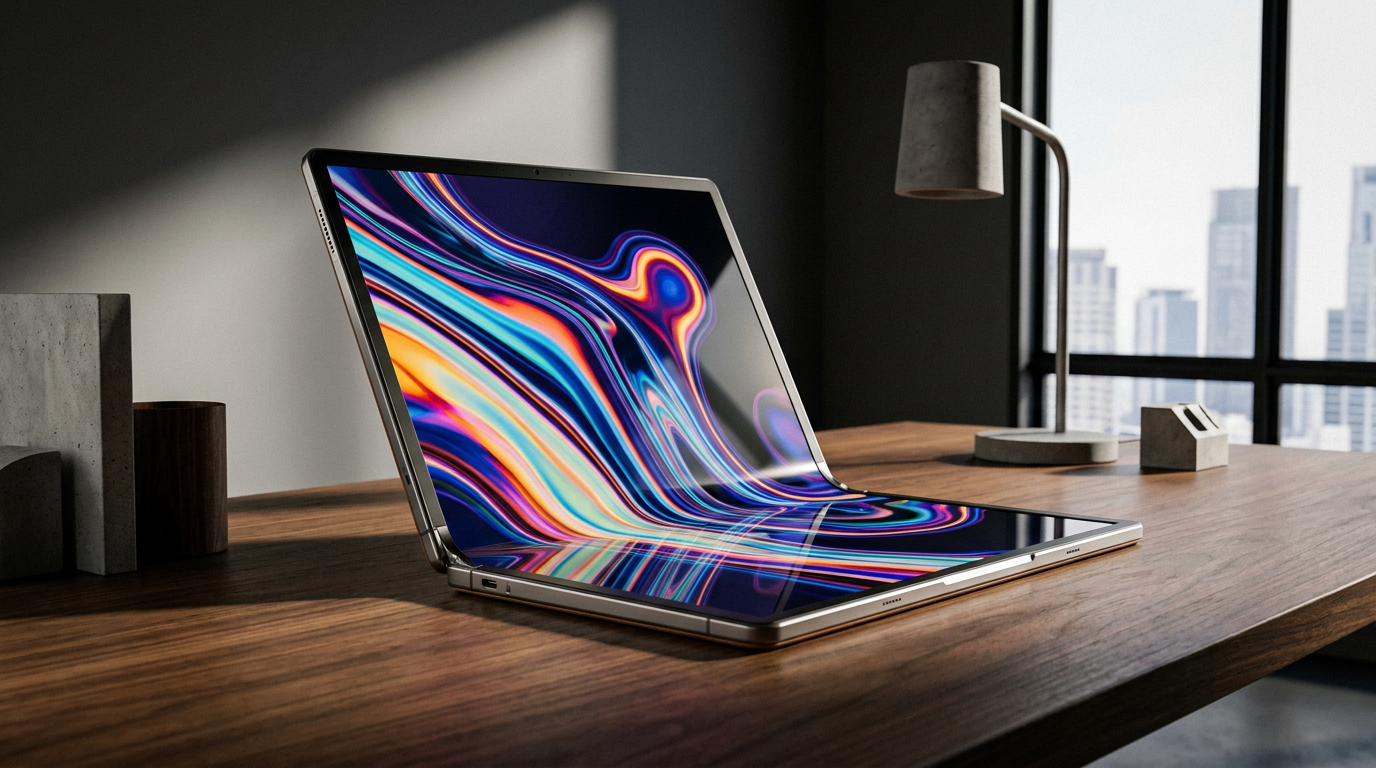
The dream of the foldable laptop has always been straightforward: carry a compact 13-inch notebook in your bag, then unfold it into a sprawling 17-inch desktop monitor at your destination. Yet, for the first half-decade of their existence, these devices were defined more by their compromises than their capabilities.[1][3]
Early adopters paid exorbitant early-adopter taxes—often exceeding $3,500—for machines with plastic screens that scratched easily, hinges that invited dust, and a distracting crease running down the center of the display. They were engineering marvels, but they were undeniably fragile.[2][4]
In 2026, the calculus is fundamentally changing. A new generation of foldable laptops from major manufacturers has arrived, bringing critical breakthroughs in materials science and mechanical engineering that finally address the form factor's fatal flaws.[1][5]
The most significant leap forward lies in the display material itself. Previous iterations relied heavily on Colorless Polyimide (CPI)—a flexible plastic that, while shatter-proof, was highly susceptible to permanent indentations from fingernails, debris, or heavy stylus use.[2][7]
Today's foldable laptops have transitioned to third-generation Ultra-Thin Glass (UTG). By chemically treating glass to be thinner than a human hair and sandwiching it between protective polymer layers, manufacturers have achieved a surface that feels like traditional glass but bends without snapping.[2][5]

This UTG breakthrough has reduced the visible crease depth by over 30 percent compared to 2024 models. When illuminated, the center fold is now virtually imperceptible from standard viewing angles, eliminating one of the most common complaints from early reviewers and consumers alike.[1][7]
But a flexible screen is only as durable as the mechanism that bends it. The hinge has historically been the Achilles' heel of foldable technology, serving as a gateway for dust, crumbs, and debris to enter the chassis and puncture the delicate display from behind.[4]
To combat this, engineers have perfected the "waterdrop" or "teardrop" hinge design for larger laptop form factors. When closed, the screen bows into a teardrop shape inside the hinge housing rather than folding flat and creasing like a piece of paper.[4][5]
To combat this, engineers have perfected the "waterdrop" or "teardrop" hinge design for larger laptop form factors.
This geometry achieves two critical goals: it drastically reduces mechanical stress on the OLED panel, and it allows the two halves of the laptop to close completely flush against each other, leaving no gap for foreign objects to slip through.[1][4]

The zero-gap closure is a game-changer for real-world durability. Combined with internal nylon bristles that sweep debris out of the hinge mechanism every time the device is opened, the latest foldables are achieving IP58 dust and water resistance ratings—a massive leap from the unrated, fragile prototypes of the past.[3][5]
Software has also finally caught up to the hardware. Microsoft's latest Windows updates include deep, native optimizations for foldable displays. The operating system now recognizes when the device is bent at a 90-degree angle, automatically snapping applications to the top half while deploying a virtual keyboard and trackpad on the bottom.[8]
For users who prefer tactile feedback, the 2026 models universally include ultra-slim Bluetooth keyboards that magnetically attach to the bottom half of the screen. This seamlessly transforms the 17-inch tablet back into a traditional 13-inch clamshell laptop, complete with physical keys and a glass trackpad.[1][3]

Despite these engineering triumphs, significant trade-offs remain. Thermal management is inherently compromised when the entire motherboard, battery, and cooling system must be crammed behind a delicate, heat-sensitive OLED panel.[6]
As a result, foldable laptops still rely on lower-wattage processors. While perfectly capable of handling heavy web browsing, office productivity, and light photo editing, they cannot compete with the sustained multi-core performance of traditional clamshell workstations or dedicated gaming laptops.[6][8]
Battery life also presents a unique challenge. Powering a massive 17-inch OLED screen requires substantial energy, and splitting the battery across two halves of a folding chassis limits total capacity. Most current models average around eight to nine hours of real-world use—adequate for a workday, but trailing the 15-plus hours offered by traditional laptops.[3][6]
Then there is the price. While the technology is maturing, manufacturing yields for large-scale UTG OLED panels remain lower than standard displays. However, economies of scale are beginning to take effect, pulling starting prices down from the stratosphere to roughly $1,899 for entry-level configurations.[3][7]

How we got here
2020
The first prototype foldable laptops launch, featuring fragile plastic screens and massive gaps when closed.
2022
Second-generation models introduce magnetic keyboards but continue to struggle with dust ingress and deep screen creases.
2024
Teardrop hinges begin appearing in laptops, reducing screen stress, but materials remain susceptible to scratching.
2026
The integration of UTG 3.0 and IP58 ratings finally solves the durability problem, readying the form factor for the mass market.
Viewpoints in depth
Tech Optimists & Reviewers
Celebrate the engineering marvels of UTG and zero-gap hinges, arguing the form factor is finally ready for mainstream premium buyers.
For technology enthusiasts and reviewers, the 2026 generation of foldable laptops represents the fulfillment of a long-held promise. By eliminating the fragile plastic screens and the dust-inviting hinge gaps, manufacturers have removed the primary anxieties associated with owning a flexible device. This camp argues that the ability to carry a 17-inch monitor in a 13-inch bag fundamentally changes mobile productivity, making the $1,899 price tag a justified premium for road warriors and executives.
Hardware Skeptics & Purists
Remain cautious due to the thermal constraints and lower-wattage processors, preferring traditional clamshells for heavy workloads.
Performance purists acknowledge the mechanical improvements but remain fixated on the inherent compromises of the form factor. Because the motherboard and cooling system must sit behind a heat-sensitive OLED panel, these laptops cannot utilize high-wattage processors or dedicated graphics cards without risking screen damage. For this camp, paying nearly $2,000 for a machine that performs like a mid-range ultrabook is a poor investment, regardless of how impressive the folding screen might be.
Supply Chain Analysts
Focus on the manufacturing yields and material transitions, noting that economies of scale are finally making the category profitable.
Industry analysts view the foldable laptop market through the lens of manufacturing maturity. The transition to Ultra-Thin Glass (UTG) was initially plagued by low production yields, keeping prices artificially high. However, as suppliers have perfected the chemical strengthening processes, yields have stabilized. This camp notes that the drop to sub-$2,000 pricing is not a promotional loss-leader, but a reflection of a maturing supply chain that will soon allow foldables to capture a significant share of the premium PC market.
What we don't know
- How the Ultra-Thin Glass will hold up to long-term degradation after three to four years of daily, real-world folding.
- Whether Apple will eventually enter the foldable laptop market, an event that would instantly validate the category for millions of consumers.
- If thermal management technology can evolve enough to allow high-performance H-series processors in future foldable chassis.
Key terms
- Ultra-Thin Glass (UTG)
- A chemically treated glass that is manufactured thinner than a human hair, allowing it to bend repeatedly without breaking while maintaining a scratch-resistant surface.
- Colorless Polyimide (CPI)
- A flexible, shatter-proof plastic used in early foldable screens that was highly susceptible to scratching and permanent fingernail indentations.
- Teardrop Hinge
- A mechanical hinge design that allows a flexible screen to bow into a waterdrop shape when closed, reducing stress on the panel and eliminating the gap between the two halves.
- IP58 Rating
- An ingress protection standard indicating that a device is highly resistant to dust (5) and can withstand continuous immersion in water (8).
Frequently asked
Can you use a stylus on the new foldable screens?
Yes. The transition to Ultra-Thin Glass (UTG) provides enough surface hardness to support active styluses without leaving permanent indentations in the screen.
Does the crease go away completely?
Not entirely, but it is significantly reduced. The 2026 models feature a crease that is roughly 30% shallower, making it virtually invisible when viewing the illuminated screen head-on.
Are foldable laptops good for gaming?
Generally, no. Due to the thermal constraints of placing a motherboard behind an OLED panel, these laptops use lower-wattage processors and lack dedicated graphics cards, making them suitable only for light or cloud gaming.
What happens if dust gets in the hinge?
Newer models feature zero-gap closures and internal sweeper bristles to keep dust out, earning them IP58 ratings. This drastically reduces the risk of debris puncturing the screen from behind.
Sources
Source coverage
8 outlets
3 viewpoints surfaced








[1]The VergeTech Optimists & Reviewers
The 2026 Foldable Laptop Generation Finally Fixes the Crease
Read on The Verge →[2]WiredSupply Chain Analysts
How Ultra-Thin Glass Saved the Foldable PC
Read on Wired →[3]CNETTech Optimists & Reviewers
Are Foldable Laptops Finally Worth Your Money?
Read on CNET →[4]Ars TechnicaHardware Skeptics & Purists
The Engineering Behind Zero-Gap Laptop Hinges
Read on Ars Technica →[5]PCMagSupply Chain Analysts
Lab Tests: 2026 Foldable Screens Survive the Torture Test
Read on PCMag →[6]Tom's HardwareHardware Skeptics & Purists
Thermal Constraints in the New Wave of Foldable OLED PCs
Read on Tom's Hardware →[7]Display Supply Chain ConsultantsSupply Chain Analysts
Q2 2026 Foldable IT Display Shipments and Material Analysis
Read on Display Supply Chain Consultants →[8]EngadgetTech Optimists & Reviewers
Windows 12's Foldable Optimizations Make Dual-Screens Usable
Read on Engadget →
Every angle. Every day.
Get shopping stories with full source coverage and perspective breakdowns delivered to your inbox.