
What is Epigenetics? The Mechanics of Gene Regulation Beyond the DNA Sequence
While the DNA sequence provides the fundamental blueprint for life, epigenetic mechanisms act as the cellular software that dictates which genes are turned on or off. This evidence pack breaks down how DNA methylation and histone modification translate environmental inputs into biological changes.
By Sofia Matos

Share this story
In short
- Epigenetics involves reversible chemical tags on DNA that turn genes on or off without altering the genetic code.
- DNA methylation typically acts as a long-term lock to silence genes, maintaining cellular identity.
- Histone modifications physically coil or uncoil DNA, allowing rapid responses to environmental changes.
The common misconception is that the DNA sequence is a rigid blueprint determining every biological outcome, acting like a read-only hard drive. In reality, the genome is more like a piano keyboard: the keys are fixed, but the music produced depends entirely on how they are played. This dynamic layer of control is the epigenome.[1]
Epigenetics, literally meaning "above" or "on top of" genetics, refers to reversible chemical modifications to DNA and its packaging proteins that alter gene expression without changing the underlying nucleotide sequence. These modifications dictate whether a specific gene is turned on, turned off, or dialed up or down in response to the environment.[2]
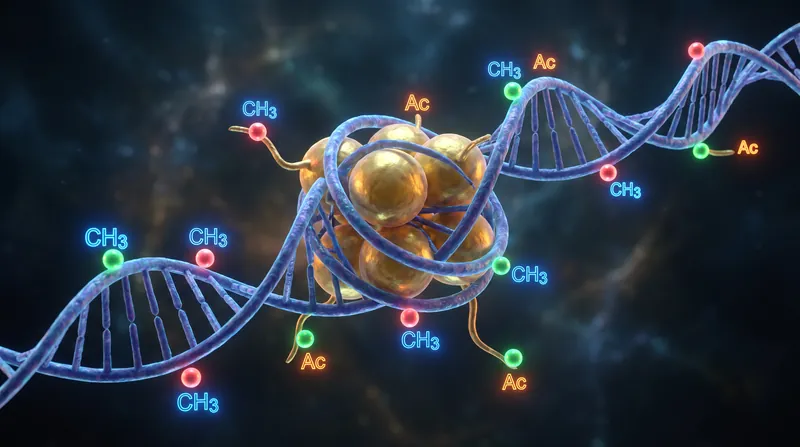
To understand the mechanics, one must look at how DNA is stored. A single human cell contains roughly two meters of DNA, which must be tightly spooled to fit inside a microscopic nucleus. It achieves this by wrapping around octamers of proteins called histones, forming a complex known as chromatin.[6]
The first primary mechanism of epigenetic regulation is histone modification. When chemical tags, such as acetyl groups, attach to the tails of these histone proteins, the chromatin structure relaxes. This open configuration allows transcription factors and RNA polymerase to access the DNA, effectively turning the gene "on" and allowing it to be read.[5][6]
Conversely, when these acetyl groups are removed by specific enzymes, the chromatin tightly coils back up. The physical machinery required to read the gene can no longer access the sequence, rendering the gene silent. Because these histone modifications can be added and removed rapidly, they allow cells to respond swiftly to environmental stimuli.[6]
The second, and more stable, mechanism is DNA methylation. This involves the direct addition of a methyl group—one carbon atom bonded to three hydrogen atoms—to the DNA molecule itself. In mammals, this typically occurs at cytosine bases that immediately precede a guanine base, known as CpG sites.[1][5]
When a cluster of these sites, called a CpG island, becomes heavily methylated, it physically blocks transcription proteins from binding to the gene promoter. Methylation acts as a long-term biological padlock, ensuring that a skin cell remains a skin cell and does not suddenly start producing liver enzymes, locking in cellular identity over a lifetime.[7]
The evidence for how environmental factors drive these changes is most clearly observed in monozygotic, or identical, twins. Because they share the exact same genetic code, any divergence in their biology or disease susceptibility must stem from external factors influencing gene expression.[4]
Studies mapping the epigenomes of twins show that at birth, their epigenetic markers are virtually indistinguishable. However, as they age, experience different diets, stress levels, and environmental exposures, their epigenomes drift apart significantly. By age 50, nearly a third of their epigenetic profiles can differ, explaining why one twin might develop an autoimmune disorder while the other does not.[3][4]
This environmental responsiveness is a double-edged sword. While it allows organisms to adapt to changing conditions, aberrant epigenetic changes are a hallmark of numerous diseases, most notably cancer. The breakdown of normal epigenetic regulation can lead to catastrophic cellular behavior.[8]
In healthy cells, tumor suppressor genes are kept active to prevent uncontrolled division. In many cancers, the promoters of these crucial genes become hypermethylated, effectively turning off the body's natural defense mechanisms and allowing tumors to grow unchecked. Simultaneously, oncogenes that drive growth may lose their normal methylation, becoming abnormally active.[5][8]
Because epigenetic modifications do not alter the hardcoded DNA sequence, they are theoretically reversible. This has spurred the development of targeted epigenetic therapies, such as DNA methyltransferase inhibitors, which aim to strip the abnormal methyl groups from tumor suppressor genes, reactivating them and restoring normal cellular control.[7]
A third layer of epigenetic control involves non-coding RNAs. While messenger RNA translates DNA into proteins, non-coding RNAs do not produce proteins. Instead, they bind to specific messenger RNAs, intercepting them before they can be translated, adding a precise post-transcriptional layer of gene silencing.[6][7]
The most heavily debated area of current epigenetic research is transgenerational epigenetic inheritance—the idea that the epigenetic effects of trauma, starvation, or toxin exposure can be passed down to offspring, affecting generations that never experienced the initial trigger.[4][8]
In plants and certain nematodes, this phenomenon is well-documented and mechanically understood. However, in mammals, the evidence remains thin and highly contested. Mammalian embryos undergo two massive waves of epigenetic "reprogramming" that wipe the slate clean, erasing the vast majority of parental methylation marks to restore pluripotency.[5][6]
While some studies suggest certain regions of the genome escape this erasure, allowing for the inheritance of acquired traits, proving this conclusively in humans is exceedingly difficult. The long human lifespan and the inability to isolate purely epigenetic factors from cultural, behavioral, or microbiome transmission make human transgenerational claims highly speculative.[5][8]
Ultimately, the epigenome serves as the critical interface between our environment and our biology. It proves that our genetic code is not a finalized script, but a dynamic, responsive system that continuously adapts to the world around it, offering profound new ways to understand human health, aging, and disease.[1][9]
How we did this
- Method
- Cross-analyzing the biochemical stability of epigenetic modifications described across clinical and molecular literature to establish a temporal hierarchy of gene regulation.
- What we found
- Epigenetic regulation operates on a bifurcated timeline: histone modifications act as rapid-response toggles for immediate environmental adaptation, while DNA methylation serves as the long-term 'memory' of those adaptations, locking in cellular identity over decades.
- What we worked from
- DNA methylation stability profile: Long-term, mitotically heritable silencing — PMC
- Histone acetylation volatility: Rapid, environmentally responsive chromatin remodeling — NCBI Bookshelf
- Limits of this analysis
- The exact duration or intensity of environmental exposure required for a transient histone modification to trigger permanent DNA methylation in human in vivo models remains unquantified.
Definitions
- Epigenome
- The complete set of chemical modifications to DNA and histone proteins that regulate the expression of genes within a genome.
- DNA Methylation
- The addition of a methyl group to a DNA molecule, typically acting to repress or silence gene transcription.
- Histones
- Proteins around which DNA winds to compact it into the cell nucleus; their modification dictates how tightly the DNA is packed.
- Chromatin
- The complex of DNA and proteins (primarily histones) that forms chromosomes within the nucleus of eukaryotic cells.
- Gene Expression
- The process by which the information encoded in a gene is used to direct the assembly of a protein molecule.
Analysis by camp
Molecular Mechanists
Focus on the precise biochemical interactions of methylation and histones that govern cellular identity.
For molecular biologists, the epigenome is a marvel of mechanical precision. They view the cell nucleus as a highly regulated physical space where the accessibility of DNA dictates all function. From this perspective, diseases are often mechanical failures—a broken enzyme that fails to remove an acetyl group, leaving a gene permanently 'on,' or a hyperactive methyltransferase that permanently locks away a necessary tumor suppressor. Their research focuses on mapping these physical interactions at the atomic level to understand exactly how transcription machinery is blocked or permitted.
Clinical Translation Advocates
Emphasize the potential of epigenetic drugs to reverse disease states like cancer by stripping abnormal markers.
Clinical researchers view the epigenome primarily through the lens of reversibility. Because epigenetic marks do not alter the underlying DNA sequence, they are theoretically erasable. This camp focuses on developing small-molecule drugs that can inhibit the enzymes responsible for aberrant methylation or deacetylation. Their goal is to 'reprogram' cancer cells back to a normal state rather than simply killing them with traditional chemotherapy, offering a more targeted and potentially less toxic approach to oncology and autoimmune management.
Transgenerational Skeptics
Argue that evidence for the inheritance of acquired epigenetic traits in humans is severely lacking.
While the idea that trauma or starvation can leave a heritable epigenetic mark on future generations is popular in the media, evolutionary geneticists remain highly skeptical of its application to humans. They point to the two massive waves of epigenetic reprogramming that occur during mammalian embryonic development, which are designed to wipe the slate clean. They argue that most human studies claiming transgenerational inheritance fail to adequately control for cultural transmission, shared environments, or the microbiome, warning against a premature return to Lamarckian ideas of inherited acquired characteristics.
- Molecular Mechanists
- Focus on the precise biochemical interactions of methylation and histones that govern cellular identity.
- Clinical Translation Advocates
- Emphasize the potential of epigenetic drugs to reverse disease states like cancer by stripping abnormal markers.
- Public Health Researchers
- Study how environmental factors, diet, and toxins shape the epigenome across a population's lifespan.
Perspectives this story doesn't cover
- Bioethicists debating the implications of epigenetic profiling for insurance and employment
- Environmental advocates focusing on industrial toxins as epigenetic disruptors
Sources
Source coverage
9 outlets
3 viewpoints surfaced






- [1]MedlinePlusMolecular Mechanists
What is epigenetics?
Read on MedlinePlus → - [2]National Human Genome Research InstituteClinical Translation Advocates
Epigenetics
Read on National Human Genome Research Institute → - [3]National Human Genome Research InstituteClinical Translation Advocates
Epigenomics Fact Sheet
Read on National Human Genome Research Institute → - [4]Centers for Disease Control and PreventionPublic Health Researchers
Epigenetics, Health, and Disease
Read on Centers for Disease Control and Prevention → - [5]PMCClinical Translation Advocates
Epigenetics: Principles and Practice
Read on PMC → - [6]NCBI BookshelfMolecular Mechanists
Genetics, Epigenetic Mechanism - StatPearls
Read on NCBI Bookshelf → - [7]PMCClinical Translation Advocates
Epigenetic Regulation and Measurement of Epigenetic Changes
Read on PMC → - [8]OxJournalPublic Health Researchers
Epigenetic Mechanisms in Health and Disease: Connecting Evolution, Viral Infections, Cancer and Autoimmune
Read on OxJournal → - [9]Factlen Editorial Team
Synthesis by Factlen editorial team
Read on Factlen Editorial Team →

More in Science
See all →Epigenetic Silencing
The Two-Step Lock: How DNA Methylation and Histone Modification Silence Genes
7 sources
CRISPR Mechanics
How a 20-Nucleotide Guide RNA Sequence Directs the Cas9 Nuclease to a Specific Genomic Locus
8 sources
Population Genetics
Calculating the Hidden Carriers: How the Hardy-Weinberg Equation Maps Population Genetics
6 sources

Genomic Sequencing
Decoding the Genome: How Synthesis, SMRT, and Nanopore Architectures Read DNA
8 sources
Comments
Every angle. Every day.
Get Science stories with full source coverage and perspective breakdowns, free every day.