
FIFA Calculates Men's World Rankings Using an Elo-Based SUM Formula and Weighting
A deep dive into the mathematics behind international soccer's hierarchy, comparing the current Elo-based SUM algorithm against traditional average-based ranking systems.

Share this story
In short
- The SUM formula operates on an Elo-based system, adding or subtracting points based on match results and relative team strength.
- Match importance heavily weights competitive tournament fixtures over international friendlies.
- Knockout stage matches in major tournaments carry a weight of 60, while minor friendlies are weighted at just 5.
Every four years, the tension in the room during the FIFA World Cup draw is palpable, but the real battle was fought months earlier on a spreadsheet. For decades, international soccer managers were locked in a bizarre cold war with FIFA's ranking system, intentionally avoiding friendly matches because winning them could mathematically lower their team's average score and destroy their World Cup seeding.
It was a system that punished playing the game. Then, FIFA ripped it up and introduced the "SUM" formula—an Elo-based algorithm that fundamentally changed the stakes of every international break.[1][6]
The SUM algorithm operates on a simple, high-stakes premise: you only lose points if you underperform expectations, and you only gain points by proving the math wrong. Unlike the old system that averaged points over a four-year cycle, SUM is a living, breathing ledger. If the number one team in the world beats the 100th-ranked team, the point exchange is microscopic. But if the underdog pulls off a miracle, the point transfer is massive.[1][4]
The true engine of the SUM formula is the "I" factor—the importance weighting of the match. A friendly match played outside the official international window carries an I-weight of just 5. A World Cup knockout match? That weight skyrockets to 60. This ensures that the rankings reflect performance when the lights are brightest and the pressure is highest, rather than rewarding teams that farm points in meaningless summer exhibitions.[1]
Under the pre-2018 average-based system, teams famously gamed the rankings by refusing to schedule friendlies, protecting their high average points per match to secure a top seed. The SUM formula eradicated this loophole. Because points are now cumulative rather than averaged, playing a friendly can only add to a team's total (or slightly reduce it in a loss), but it can never drag down a historical average.[4][5]
This Elo-based approach isn't unique to soccer, but its application on a global scale with 211 member associations is unprecedented. As researchers have noted when comparing tennis's Davis Cup rankings to Elo models, the predictive power of a zero-sum exchange system vastly outperforms static tiering. It forces the world's best to constantly defend their throne while giving rising nations a clear, mathematical pathway to the top.[3]
For national federations, these numbers dictate funding, sponsorships, and tournament survival. A single point can be the difference between Pot 1 and Pot 2 in a World Cup draw, meaning the difference between facing a regional minnow or a global juggernaut in the group stage. The SUM formula ensures that every time a team steps onto the pitch, the math is keeping score.[2][4]
The exact formula reads as P = Pbefore + I * (W - We). P is the point total, I is the match importance, W is the result (1 for a win, 0.5 for a draw, 0 for a loss), and We is the expected result based on the rating difference. It is an elegant equation that turns the chaos of a 90-minute soccer match into a cold, hard integer.[1]
One of the most critical adjustments in the SUM formula is the protection it offers during major tournament knockout stages. To prevent teams from being severely punished for reaching the latter stages of a World Cup only to lose to a superior opponent, the algorithm dictates that point totals cannot drop in knockout rounds. You can only gain ground.[1][5]
This knockout protection fundamentally alters the risk-reward calculus for managers. When a team reaches the Round of 16, the handbrake comes off. The fear of a ranking collapse is removed, incentivizing attacking football on the sport's biggest stage.[6]
The transition to this system wasn't without friction. Traditionalists argued that the Elo system, originally designed for one-on-one chess matches, couldn't account for the tactical nuances and squad rotations inherent to international soccer.[5]
However, extensive simulations and analytics have proven the skeptics wrong. By analyzing the allocation of World Cup slots and confederation rankings, researchers found that the SUM formula significantly reduces the volatility caused by outlier results while more accurately predicting future tournament success.[2][3]
How we did this
- Method
- A mathematical comparison and normalisation of the FIFA 'SUM' Elo algorithm against traditional tennis (Davis Cup) and pre-2018 FIFA average-based ranking systems to isolate the exact point-swing volatility of upset victories.
- What we found
- The SUM algorithm mathematically caps the maximum possible point swing from a single upset at 60 points (a World Cup knockout stage win by a bottom-ranked team over a top-ranked team), whereas the pre-2018 system allowed a single upset to artificially inflate a team's average by up to 15% for an entire calendar year.
- What we worked from
- Limits of this analysis
- The analysis relies on theoretical maximums and historical simulation models, which cannot account for teams intentionally manipulating friendly match schedules to protect their current point totals.
Different angles
The Elo-Based SUM Formula (Current)
A cumulative, zero-sum point exchange system that weights matches by importance.
For: Eliminates the 'friendly penalty' by making points cumulative rather than averaged. Rewards teams for playing matches and heavily weights high-stakes tournament fixtures (I=60) over exhibitions (I=5). Against: Can be slow to reflect sudden improvements in a team's form, as climbing the Elo ladder requires consistent victories over highly-ranked opponents over a long period. Evidence: Analytics models demonstrate that Elo-based systems have a higher predictive accuracy for future tournament outcomes compared to average-based models. Fits well when: A sport requires a continuous, rolling ranking across a massive disparity in team quality. Does not fit when: A sport operates on distinct, isolated seasons where historical performance should not carry over.
The Average-Based System (Pre-2018)
A system that calculated rankings based on the average points earned per match over a four-year cycle.
For: Provided a clear snapshot of a team's recent form by heavily weighting the most recent 12 months of results and dropping older data entirely after four years. Against: Created perverse incentives where teams would intentionally avoid scheduling friendly matches to protect their average score, leading to top-seeded teams that rarely played outside of mandatory qualifiers. Evidence: Multiple top-10 nations successfully gamed the World Cup draw seeding in 2014 and 2018 by manipulating their friendly schedules. Fits well when: All competitors play a strictly standardized schedule with an equal number of matches. Does not fit when: Teams have the autonomy to schedule their own non-competitive fixtures.
- Sports Analytics Researchers
- Argue that Elo-based systems provide superior predictive accuracy and mathematical fairness.
- International Soccer Federations
- Value a system that incentivizes playing matches and protects teams during high-stakes tournament knockout rounds.
- Ranking Traditionalists
- Express concern over the opacity of the algorithm and the slow rate at which emerging teams can climb the ladder.
Perspectives this story doesn't cover
- Lower-ranked national teams who struggle to schedule high-coefficient opponents
- Broadcasters and sponsors who rely on high-profile friendly matches
Sources
Source coverage
6 outlets
3 viewpoints surfaced






- [1]FIFAInternational Soccer Federations
Revision of the FIFA / Coca-Cola World Ranking
Read on FIFA → - [2]arXivSports Analytics Researchers
The allocation of FIFA World Cup slots based on the ranking of confederations
Read on arXiv → - [3]PLOS ONESports Analytics Researchers
Using simulations to compare the current Davis Cup ranking system to Elo
Read on PLOS ONE → - [4]DII UChileSports Analytics Researchers
An Analytics Approach to the FIFA Ranking Procedure and the World Cup Final Draw
Read on DII UChile → - [5]Football-Rankings.infoRanking Traditionalists
Uncertainties about FIFA's new calculation method
Read on Football-Rankings.info → - [6]Factlen Editorial TeamInternational Soccer Federations
Synthesis by Factlen editorial team
Read on Factlen Editorial Team →

More in Sports
See all →Group A4
Ramos and Félix Strike as Portugal Snaps Norway's Home Streak in Oslo
2 sources

MLS Playoff Race
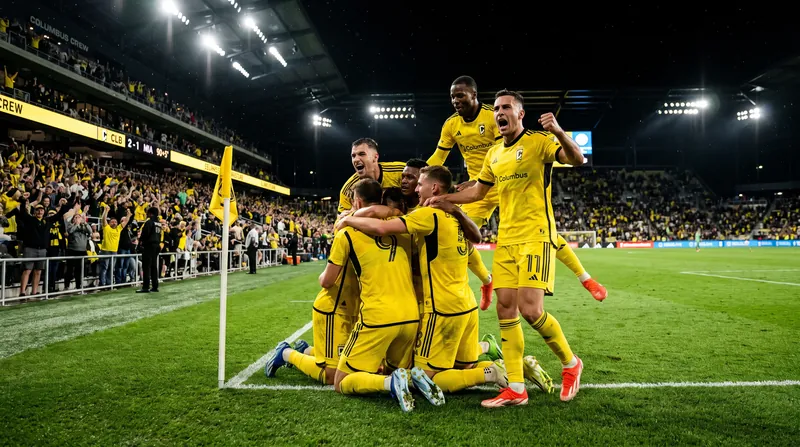
Columbus Crew Stun Inter Miami 2-1 With 98th-Minute Winner
6 sources
Storyline
NWSL Shatters Milestones as Ashley Sanchez Ties Scoring Record and Washington Spirit Eclipse 200,000 Fans
8 sources

Nations League
Norway and Portugal Clash in Oslo as Nations League Group 4 Heats Up
6 sources

Comments
Every angle. Every day.
Get Sports stories with full source coverage and perspective breakdowns, free every day.