
How PDO and AOC Frameworks Legally Shield Regional Foods From Global Imitation
Geographical indications like PDO and AOC serve as legal shields for regional foods, ensuring that products like Champagne and Parmigiano-Reggiano remain tied to their specific terroir. This framework protects traditional producers from global imitation while guiding culinary travelers toward authentic local flavors.

Share this story
In short
- Geographical Indications (GIs) are intellectual property rights protecting regional foods.
- The French AOC system pioneered the concept of tying a product's legal name to its terroir.
- EU PDO rules mandate that 100% of production and sourcing occurs within the defined region.
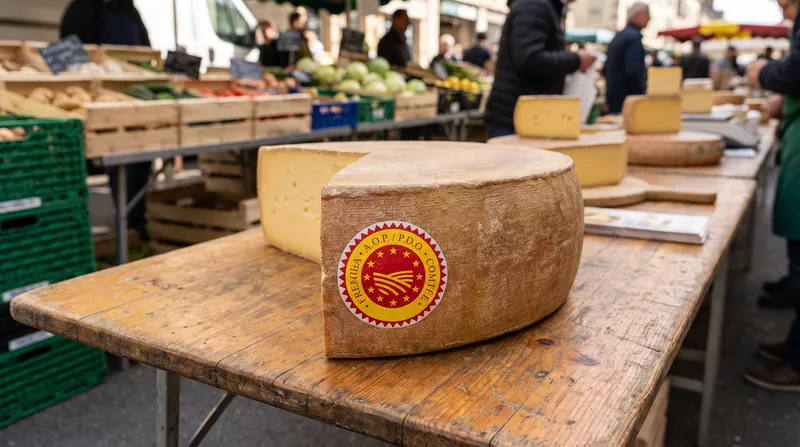
Picture yourself standing in a bustling market in Lyon, or perhaps just the cheese aisle of your local grocery store. You are holding two wedges of hard, crystalline cheese. One is labeled "Parmesan," crafted in a massive dairy facility in Wisconsin. The other bears the name "Parmigiano-Reggiano," stamped with a distinct red and yellow seal, and costs three times as much.
For decades, a quiet but fierce war has raged over these names. Is a food's identity merely a recipe that can be replicated anywhere, or is it inextricably bound to the soil, the climate, and the hands of the people in a specific geographic place?
The resolution to this culinary conflict lies in a robust legal framework known as Geographical Indications (GIs). Far from being mere marketing fluff, these designations—such as PDO, PGI, and AOC—are powerful intellectual property rights. They act as an invisible shield over the world's most cherished regional foods, ensuring that the terroir and traditional methods defining them cannot be legally hijacked by global mass production.
To understand how this protective net works, we have to look to France, the birthplace of the modern appellation system. The French concept of terroir asserts that the unique combination of a region's soil, topography, and climate imparts a distinct, unreplicable character to agricultural products. It is the reason why a Pinot Noir grown in Burgundy tastes fundamentally different from one grown in California, even if the genetic vine is identical.[3]
This philosophy birthed the Appellation d'Origine Contrôlée (AOC) system in the early 20th century, initially designed to combat wine fraud. The AOC dictates strict rules: not just where the grapes are grown, but how they are pruned, the maximum yield per hectare, and the specific winemaking techniques allowed. If a winemaker deviates from these centuries-old rules, they lose the right to print the region's name on their bottle.[3]
Recognizing the economic and cultural power of the French model, the European Union expanded this concept across the continent in 1992. The EU created a harmonized system of quality schemes to protect agricultural products and foodstuffs, giving rise to the acronyms that now dominate European food packaging: PDO and PGI.[1]
The crown jewel of this system is the Protected Designation of Origin (PDO), or Appellation d'Origine Protégée (AOP) in French. This is the strictest classification available. For a product to earn a PDO badge, every single step of its production, processing, and preparation must take place within the defined geographical area.[1]
Consider Prosciutto di Parma. Under PDO rules, you cannot simply buy pork from Germany, cure it in Italy, and call it Parma ham. The pigs must be born, raised, and slaughtered in specific Italian regions, fed a regulated diet—often including the whey from Parmigiano-Reggiano production—and the meat must be cured in the unique microclimate of the Parma hills. The environment itself is an active ingredient.
One step down in stringency, but vastly broader in application, is the Protected Geographical Indication (PGI). The PGI framework is designed to protect products where a specific quality, reputation, or other characteristic is essentially attributable to its geographical origin, but the rules offer a crucial compromise.[1]
For a PGI product, only at least one of the stages of production, processing, or preparation needs to take place in the region. This allows for the protection of regional recipes and traditional processing methods, even if the raw materials are sourced from elsewhere.[1]
A classic example is Balsamic Vinegar of Modena PGI. While the vinegar must be produced and aged in the Modena region of Italy using specific traditional methods, the grapes used to make the grape must can technically be grown outside the immediate geographical boundaries. The PGI protects the cultural know-how of the Modenese producers rather than demanding absolute agricultural isolation.
These designations are not self-policed honor systems. They are backed by rigorous European law, most recently updated in 2024 to strengthen protections both offline and online. Products bearing these seals are subject to regular audits by independent certification bodies and powerful regional consortiums that act as the legal guardians of the brand.[2]
These consortiums—like the Comité Champagne or the Consorzio del Formaggio Parmigiano-Reggiano—wield immense power. They employ inspectors who test soil, review production logs, and even conduct sensory taste tests to ensure every batch meets the historical standard. If a product fails, it is downgraded and sold under a generic name, representing a massive financial loss for the producer.
The tension re-emerges, however, when these European products cross the Atlantic. The United States and the EU have fundamentally different legal philosophies regarding food names. The US relies primarily on trademark law and often views terms like "feta," "brie," or "parmesan" as generic descriptors of a style of cheese, rather than a geographic indicator.
This philosophical divide has led to fierce battles in international trade negotiations. The EU aggressively pushes for bilateral agreements that force other nations to recognize and protect its GIs, arguing that American "Champagne" or "Gorgonzola" is inherently deceptive to consumers and dilutes the heritage of the original creators.[4]
For the culinary traveler, understanding this mechanics transforms a simple meal into a masterclass in geography and history. When you sit at a café in rural Spain and order a plate of Jamón Ibérico de Bellota PDO, that red and yellow seal is a guarantee. It is a legal receipt proving that the ham came from a purebred Iberian pig that roamed freely in ancient oak forests, eating acorns.
Ultimately, Geographical Indications are a mechanism of preservation. In an era of hyper-globalized, hyper-efficient food supply chains, PDOs and PGIs draw a line in the soil. They declare that some flavors cannot be decoupled from their origins, ensuring that the world's most historic foods remain exactly where they belong.
How we did this
- Method
- A comparative synthesis of the European Union's PDO/PGI regulatory criteria against France's national AOC framework to map the exact stringency of geographic sourcing requirements.
- What we found
- While consumers often view these labels interchangeably as generic markers of 'quality,' the legal frameworks actually create a strict hierarchy of terroir dependence, where PDO/AOC mandates absolute geographic lock-in for every raw material, whereas PGI functions more as a cultural recipe protector that permits imported raw ingredients as long as the local processing tradition is maintained.
- What we worked from
- EU PDO requirement for 100% regional production: All stages in defined area — European Commission
- EU PGI requirement for partial regional production: At least one stage in defined area — European Commission
- French AOC terroir and traditional method requirements: Strict geographic and methodological rules — Wine-Searcher
- Limits of this analysis
- This analysis focuses on the European and French frameworks and does not account for how these protections are enforced or diluted in non-EU markets like the United States.
Key terms
- Terroir
- The unique combination of soil, climate, topography, and traditional human practices that gives a regional agricultural product its distinct character.
- PDO (Protected Designation of Origin)
- The strictest EU quality scheme, requiring that a product is entirely produced, processed, and prepared in a specific geographical area.
- PGI (Protected Geographical Indication)
- An EU quality scheme requiring that at least one stage of a product's production, processing, or preparation takes place in a specific region.
- AOC (Appellation d'Origine Contrôlée)
- The French certification system that guarantees the origin and traditional production methods of regional wines, cheeses, and agricultural products.
Frequently asked
What is the difference between PDO and PGI?
A PDO requires that 100% of the production, processing, and preparation takes place in the specific region. A PGI requires only that at least one of those stages occurs in the region.
Are AOC and PDO the same thing?
AOC is the traditional French national system, primarily used for wine and cheese. PDO is the broader European Union equivalent that encompasses the French AOC standards.
Why can I buy 'Parmesan' made in the United States?
The US legal system treats 'Parmesan' as a generic term for a style of hard cheese, whereas the EU protects 'Parmigiano-Reggiano' as a geographic indication tied exclusively to Italy.
Viewpoints in depth
Traditional Producers & Consortiums
The guardians of regional heritage who view GIs as essential survival tools against industrial agriculture.
For the farmers, winemakers, and artisans operating within these protected zones, Geographical Indications are not merely marketing tools; they are the economic foundation of their communities. Consortiums argue that the strict rules of a PDO ensure that the premium price paid by consumers flows directly back to the rural economy that sustains the tradition. They view the global use of terms like 'Champagne' or 'Feta' by foreign industrial producers as a form of cultural theft that misleads consumers and undercuts centuries of generational labor.
Global Food Manufacturers
Industrial producers who argue that historical food names have evolved into generic styles.
Outside of Europe, particularly in the United States and Australia, large-scale food manufacturers operate under a fundamentally different legal philosophy. They argue that over decades of immigration and global trade, names like 'parmesan' or 'bologna' have lost their specific geographic meaning and now simply describe a recipe or a style of food. From this perspective, EU efforts to claw back these names through international trade agreements are seen as protectionist overreach designed to monopolize markets rather than protect consumers.
Culinary Tourists & Gastronomes
Travelers and food enthusiasts who rely on GIs as a map to authentic cultural experiences.
For those who travel to eat, the alphabet soup of PDO, PGI, and AOC serves as a vital navigational tool. Gastronomes value the traceability and rigorous auditing that these labels guarantee. In a global food system increasingly dominated by opaque supply chains and ultra-processed ingredients, the culinary tourist views the GI seal as a rare promise of authenticity—a guarantee that the cheese on their plate or the wine in their glass is a direct, unadulterated expression of the landscape they are visiting.
- Traditional Producers & Consortiums
- Argue that food names are inextricably linked to specific terroirs and that global imitation constitutes cultural theft and consumer fraud.
- Global Food Manufacturers
- Maintain that historical food names have evolved into generic styles or recipes that can be ethically produced anywhere in the world.
- Culinary Tourists & Gastronomes
- Value the authenticity and traceability provided by GI labels, viewing them as essential guides for experiencing genuine local culture.
Perspectives this story doesn't cover
- Non-EU agricultural exporters
- Budget-conscious consumers
Sources
Source coverage
4 outlets
3 viewpoints surfaced




- [1]European CommissionTraditional Producers & Consortiums
Geographical indications and quality schemes explained
Read on European Commission → - [2]EUR-LexTraditional Producers & Consortiums
Geographical indications for wine, spirit drinks and agricultural products
Read on EUR-Lex → - [3]Wine-SearcherCulinary Tourists & Gastronomes
French Wine Appellations: AOC, AOP, and IGP Explained
Read on Wine-Searcher → - [4]Factlen Editorial TeamCulinary Tourists & Gastronomes
Synthesis by Factlen editorial team
Read on Factlen Editorial Team →
More in Travel
See all →Drinking Water Standards
The 1-Minute Rolling Boil and the 4-Log Reduction: How the WHO and EPA Standards Define Safe Drinking Water
7 sources

Aviation Traffic
Global Air Passenger Growth Stalls in Early 2026 as Middle East Traffic Drops 21%
4 sources

Scuba Physiology
The 1.4 ATA Limit and the 130-Foot Threshold: How Oxygen Toxicity and Nitrogen Narcosis Define Recreational Scuba Depth
9 sources

Food Authenticity
The 100% Sourcing and Processing Rule: How the EU's Protected Designation of Origin Actually Guarantees a Food's Geographical Authenticity
7 sources
Comments
Every angle. Every day.
Get Travel stories with full source coverage and perspective breakdowns, free every day.