
Texas Law Forces Nearly 400 Cities to Reverse Zoning Bans on Manufactured Homes
Senate Bill 785 takes effect September 1, requiring Texas municipalities to allow new manufactured homes by right in at least one residential district. The law aims to expand affordable housing by stripping cities of the ability to outright ban the homes.

Share this story
There is a common misconception that if you buy a piece of land in Texas, you can put whatever kind of house you want on it. The reality is that for decades, nearly 400 Texas cities have used local zoning laws to completely ban manufactured homes from their city limits. Buyers who found affordable land were routinely blocked by municipal codes that mandated traditional, site-built housing. But starting September 1, 2026, a sweeping new state law is forcing those cities to rewrite their rules and open their doors.[1][3]
Senate Bill 785, passed during the 2025 legislative session, fundamentally changes how municipalities handle alternative housing. The law requires every Texas city with zoning regulations to allow new HUD-code manufactured homes "by right" in at least one residential zoning district. Cities can no longer use administrative delay tactics, special permits, or outright bans to keep these homes out of their communities. If a city has a zoning map, it must now feature a residential classification where a manufactured home is legally permitted without discretionary hurdles.[1][2]
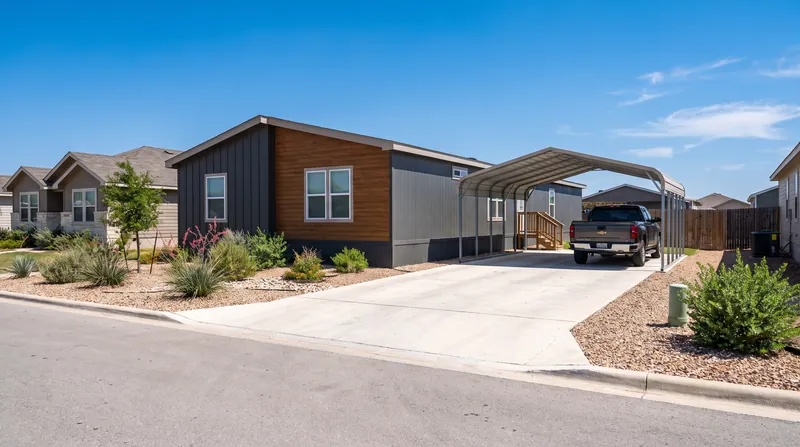
For prospective buyers, this opens a direct and actionable path to a lower mortgage payment. Manufactured housing offers a substantially cheaper entry point into homeownership compared to traditional builds. In 2025, a new single-section manufactured home averaged $87,300, while a multi-section home averaged $151,500, excluding land and taxes. In major metros like Austin, where the median sales price hovers around $416,000, the ability to place a factory-built home on a residential lot provides a critical affordability release valve for first-time buyers.[2][3]
While the state is mandating inclusion, local governments still retain significant control over the execution. The law does not force cities to open all of their residential areas to manufactured homes. Municipalities get to decide which specific district qualifies and how large that district is. This has led to a patchwork of compliance strategies as the September 1 deadline approaches. Some cities are embracing the change, while others are doing the bare minimum required by the statute.[1][3]
In Nacogdoches, for example, the city council created a new R-3M district specifically to comply with the law. They rezoned a single 69-lot subdivision to allow manufactured homes by right, but added supplemental rules requiring the homes to be no more than two years old and anchored under federal foundation guidelines. Similarly, Bellmead is working on a new residential district, though local officials have debated requirements that might favor larger developer-led communities over individual homeowners placing a single unit.[1][3]
The most important caveat for buyers to understand is that SB 785 only limits municipal government bans; it does not override private agreements. Deed restrictions, homeowners association (HOA) covenants, and historic district protections remain fully in effect. If a private subdivision's rules prohibit manufactured homes, the new state law will not change that. Buyers must still verify the zoning map and read the recorded deed restrictions on a parcel of land before purchasing it.[2]
Beyond the by-right zoning mandate, the law also eliminates discriminatory permitting practices. Historically, cities would force manufactured homebuyers to obtain a Specific Use Permit (SUP) or Conditional Use Permit (CUP), subjecting them to public hearings and extra fees. Under SB 785, cities cannot demand these special permits for a manufactured home unless they require the exact same permit for a traditional site-built home in that same zoning district. This levels the administrative playing field and speeds up the timeline from purchase to move-in.[1]
Texas is already one of the largest markets for manufactured housing in the United States, receiving over 17,400 homes in 2025—more than double the volume of Florida, the second-largest market. By removing the harshest citywide bans, the state is betting that factory-built housing can scale up to meet the intense demand for affordable units. As cities finalize their new zoning maps this month, buyers should monitor local council agendas to identify newly available districts and begin securing financing for lots that were previously off-limits.[3][4]
Viewpoints in depth
Housing Advocates & Buyers
View the law as a massive win for affordability and property rights.
For advocates and prospective buyers, Senate Bill 785 is a long-overdue correction to exclusionary zoning. By stripping cities of the ability to outright ban manufactured homes, the state is restoring property rights to landowners and opening up a vital pipeline for affordable housing. Advocates emphasize that modern HUD-code homes are built to rigorous federal safety and quality standards, making municipal bans an outdated prejudice rather than a safety measure. For buyers priced out of $400,000 site-built homes, the ability to place a $100,000 factory-built home on a residential lot is the difference between renting indefinitely and building equity.
Local Municipalities
Concerned about the loss of local control over neighborhood planning.
City councils and local planners view the state mandate as an infringement on their ability to manage municipal growth and neighborhood aesthetics. While they are complying with the law, many cities are doing so by drawing narrow districts or applying strict supplemental rules—such as requiring the homes to be brand new or limiting them to specific subdivisions. Municipal officials argue that they need the flexibility to manage infrastructure loads, property tax bases, and the visual consistency of their communities, which is why they previously relied on specific use permits to evaluate placements on a case-by-case basis.
Real Estate Legal Experts
Focused on the practical limitations of the law regarding private property restrictions.
Legal professionals point out that while SB 785 is a significant shift in public zoning law, its immediate impact on the ground may be muted in heavily developed areas. The law explicitly does not override private deed restrictions, homeowners association covenants, or historic district designations. In major metros like Austin, where a large share of established neighborhoods are governed by private HOAs, the rules against manufactured homes remain firmly intact. Experts advise buyers that while the city can no longer say no, the subdivision's private governing documents still hold veto power.
Key points
- Senate Bill 785 takes effect September 1, 2026, requiring Texas cities with zoning to allow new manufactured homes by right in at least one residential district.
- The law prevents cities from using outright bans or discriminatory special permits to block HUD-code manufactured homes.
- Municipalities retain the authority to decide which specific district allows the homes and what supplemental standards apply.
- Private deed restrictions, HOA rules, and historic district protections are not overridden by the new state law.
- Housing Advocates & Buyers
- Argue that the law restores property rights and provides a crucial affordable housing option.
- Local Municipalities
- Value local control over zoning and seek to manage the integration of manufactured homes carefully.
- Real Estate Legal Experts
- Emphasize that private deed restrictions and HOAs will still limit where these homes can be placed.
Perspectives this story doesn't cover
- Traditional Homeowners
- Manufactured Home Builders
Sources
Source coverage
4 outlets
3 viewpoints surfaced




- [1]Real Estate Law ResourceReal Estate Legal Experts
Texas Cities Can No Longer Ban Manufactured Homes Outright as of September 1, 2026: What Senate Bill 785 Changes
Read on Real Estate Law Resource → - [2]Spyglass RealtyHousing Advocates & Buyers
Texas Manufactured Home Law: How It Changes Austin Neighborhoods
Read on Spyglass Realty → - [3]TIMESOFINDIA.COMLocal Municipalities
Texas law opens door to cheaper manufactured homes as cities push back
Read on TIMESOFINDIA.COM → - [4]Realtor.comHousing Advocates & Buyers
Texas Is Opening the Door to Cheaper Homes. Some Cities Are Barely Cracking It.
Read on Realtor.com →
More in Community
See all →Municipal Utilities
Detroit City Council Votes to Explore Municipal Utility After Storm Leaves 450,000 Without Power
7 sources

Municipal Zoning
Fort Wayne City Council Rejects $2.75 Million Funding for Downtown Homeless Resource Center
3 sources
School Infrastructure
Barren County Schools $73.6 Million Facilities Plan Clears Final Public Forum
5 sources
Zoning Reform
Ashland City Council Eliminates Public Hearings and Neighbor Notification for New Housing Projects
5 sources
Comments
Every angle. Every day.
Get Community stories with full source coverage and perspective breakdowns, free every day.