
The Definitive Guide to Cooking Oils: Comparing Smoke Points, Flavor Profiles, and Nutritional Stability
For decades, home cooks have relied on smoke points to choose their cooking oils, often avoiding flavorful unrefined oils for high-heat searing. Recent chemical analyses reveal that oxidative stability, not the visible smoke point, is the true measure of an oil's safety and performance under heat.
By Kabir Mehra

- Lipid & Nutrition Scientists
- Focus on chemical stability, measuring polar compounds and lipid oxidation to determine the true safety of heated fats.
- Culinary Traditionalists
- Prioritize high smoke points and neutral flavors to prevent smoking pans and flavor interference during high-heat cooking.
- Dietary Wellness Advocates
- Advocate for unrefined, naturally extracted fats rich in antioxidants, actively avoiding heavily processed industrial seed oils.
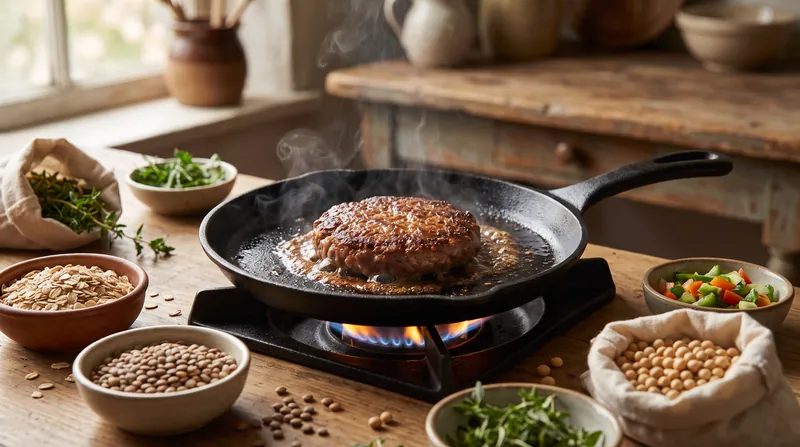
You have probably stood in your kitchen, a beautiful steak resting on the cutting board, paralyzed by the choice of which oil to pour into your cast-iron skillet. For decades, culinary wisdom has dictated a simple rule: if you are cooking over high heat, you must use an oil with a high smoke point, like refined canola, grapeseed, or sunflower oil. Extra virgin olive oil, the advice goes, should be locked away for salad dressings, lest its low smoke point ruin your meal and fill your kitchen with acrid fumes.[7]
This deeply ingrained kitchen rule is fundamentally flawed. The visible smoke point—the temperature at which an oil begins to emit a continuous bluish smoke—is not the safety threshold we have been led to believe. When a pan of unrefined oil begins to smoke, what you are actually seeing is the evaporation of trace amounts of water, free fatty acids, and aromatic compounds. It is a sensory alarm bell, certainly, but it does not indicate that the core structure of the fat is breaking down into harmful substances.[7]
To understand how an oil truly behaves in a hot pan, we have to look past the smoke and examine its oxidative stability. This is the oil's chemical resilience—its ability to resist reacting with oxygen when exposed to high temperatures. When an oil's molecular structure finally collapses under heat, it undergoes lipid oxidation, producing undesirable flavors and, more importantly, harmful chemical byproducts.[5][6]
The most concerning of these byproducts are polar compounds. These are degraded lipid molecules that have been linked to cellular damage and inflammation when consumed in high quantities. In commercial kitchens, the accumulation of polar compounds is the strict legal metric used to determine when deep-frying oil must be discarded. If we want to know which oil is safest for a hard sear, we need to measure polar compound formation, not the moment a wisp of smoke appears.[3]
The secret to an oil's thermal stability lies in its fatty acid profile. Fats are broadly categorized by their molecular bonds: saturated, monounsaturated, and polyunsaturated. Saturated fats, like those in butter or coconut oil, have no double bonds, making them highly stable and solid at room temperature. Monounsaturated fats have one double bond, offering a balance of heart-healthy fluidity and moderate heat resistance.[1]
Polyunsaturated fats, however, are the fragile glass cannons of the culinary world. Found abundantly in many popular high-smoke-point seed oils—such as soybean, sunflower, and grapeseed—these molecules contain multiple double bonds. Each of these bonds is a vulnerability, a chemical open door where oxygen can easily attach and trigger rapid degradation when the oil is heated.[1][2]
This brings us to the most surprising revelation in modern lipid research: extra virgin olive oil is exceptionally stable under high heat, routinely outperforming refined seed oils in laboratory stress tests. Despite having a relatively low smoke point of around 350°F to 410°F, high-quality extra virgin olive oil resists breaking down into polar compounds far better than oils that can theoretically withstand 450°F before smoking.[3][5]
The resilience of extra virgin olive oil comes from two distinct advantages. First, its fat profile is overwhelmingly monounsaturated, providing a robust molecular foundation. Second, because it is unrefined—essentially just the freshly pressed juice of olives—it is packed with natural antioxidants, particularly polyphenols. These antioxidants act as a chemical shield, sacrificing themselves to heat and oxygen to protect the underlying fatty acids from degrading.[3][5]
The resilience of extra virgin olive oil comes from two distinct advantages.
Refined oils, by contrast, have been stripped of these protective compounds. The industrial refining process uses heat, chemicals, and deodorizers to create a neutral-tasting, pale oil with an artificially elevated smoke point. While this makes them visually stable at high temperatures, they lack the natural antioxidant defenses required to prevent rapid oxidation once their thermal threshold is finally breached.[6]
This vulnerability is particularly evident in mixed vegetable and canola oils. When subjected to prolonged heating, these refined oils show a rapid decline in their oxidative stability index. Without a robust profile of polyphenols to defend them, the polyunsaturated fats within these blends degrade swiftly, generating polar compounds at a much faster rate than their unrefined, monounsaturated counterparts.[4]
The danger of oxidation compounds exponentially if oil is reused. Every time an oil is heated, cooled, and heated again, its chemical defenses are depleted further. Studies tracking the fatty acid composition of plant-based oils during repeated heating cycles demonstrate a sharp, cumulative increase in toxic byproducts. For the home cook, this means that saving the oil from last night's shallow fry is a false economy that drastically compromises the nutritional quality of your next meal.[1][4]
Beyond chemistry, there is the undeniable matter of flavor. Cooking is a sensory art, and the oil you choose sets the aromatic foundation for the entire dish. Unrefined oils carry the terroir of their source—the grassy, peppery bite of a robust olive oil, or the rich, nutty depth of unrefined sesame oil. Heating these oils does mellow their most delicate top notes, which is why the finest, most expensive bottles are best reserved for drizzling over a finished plate.[8]
Yet, even the most stable oil can be ruined before it ever touches a hot pan if it is stored improperly. Light, heat, and oxygen are the enemies of fresh oil. A beautiful bottle of extra virgin olive oil left on a sunny kitchen counter next to the stove will quietly oxidize in the bottle, turning rancid and developing a stale, waxy flavor. To preserve their chemical integrity, all cooking oils should be stored in a cool, dark pantry, tightly sealed against the air.[6]
So, how should you stock your kitchen? You do not need a dozen different bottles. A high-quality extra virgin olive oil can confidently handle your daily sautéing, roasting, and even moderate pan-frying, bringing both flavor and unmatched chemical stability to the skillet. For tasks where a neutral flavor is absolutely required—like baking a delicate cake or making mayonnaise—a fresh, properly stored bottle of avocado oil offers a high smoke point alongside a stable, monounsaturated fat profile.[8]
Ultimately, the way we think about cooking oils needs a fundamental reset. By abandoning the outdated smoke point myth and understanding the protective power of antioxidants and monounsaturated fats, we can cook with greater confidence. You can finally let go of the fear of a slightly smoking pan, knowing that the right oil is protecting your food, your health, and the rich, complex flavors of your meal.[8]
Key points
- The visible smoke point of an oil is a poor indicator of its chemical stability and safety under heat.
- Oxidative stability, driven by an oil's fatty acid profile and antioxidant content, is the true measure of heat resistance.
- Extra virgin olive oil outperforms many high-smoke-point refined seed oils because its polyphenols protect it from breaking down.
- Polyunsaturated fats, common in vegetable and canola oils, are highly fragile and oxidize rapidly when exposed to high temperatures.
- Reusing cooking oil exponentially increases the formation of toxic polar compounds and should be avoided.
- Proper storage in a cool, dark environment is essential to prevent oils from oxidizing before they are even used.
Key terms
- Smoke Point
- The specific temperature at which an oil begins to continuously emit visible bluish smoke, often mistaken for the point of chemical breakdown.
- Oxidative Stability
- An oil's ability to resist reacting with oxygen and breaking down into harmful byproducts when exposed to heat and light.
- Polar Compounds
- Harmful, degraded lipid molecules that form when cooking oil breaks down under high heat, linked to cellular inflammation.
- Polyunsaturated Fats
- Fat molecules with multiple double bonds in their chemical structure, making them highly reactive and prone to oxidation when heated.
- Polyphenols
- Natural antioxidant compounds found abundantly in unrefined oils like extra virgin olive oil, which protect the oil from heat damage.
Sources
Source coverage
8 outlets
3 viewpoints surfaced





- [1]MDPILipid & Nutrition Scientists
Effects of Repeated Heating on Fatty Acid Composition of Plant-Based Cooking Oils
Read on MDPI → - [2]PMC - NIHLipid & Nutrition Scientists
Investigating the Thermal Stability of Omega Fatty Acid-Enriched Vegetable Oils
Read on PMC - NIH → - [3]PMC - NIHLipid & Nutrition Scientists
A Comparison of the Stability of Refined Edible Vegetable Oils under Frying Conditions: Multivariate Fingerprinting Approach
Read on PMC - NIH → - [4]PMC - NIHLipid & Nutrition Scientists
Heating effect on quality characteristics of mixed canola cooking oils
Read on PMC - NIH → - [5]North American Olive Oil AssociationDietary Wellness Advocates
Cooking Oil and Oxidative Stability
Read on North American Olive Oil Association → - [6]Oklahoma State University ExtensionLipid & Nutrition Scientists
Edible Oil Quality
Read on Oklahoma State University Extension → - [7]MICHELIN GuideCulinary Traditionalists
All You Need to Know About Oil Smoke Point
Read on MICHELIN Guide → - [8]Factlen Editorial TeamDietary Wellness Advocates
Synthesis by Factlen editorial team
Read on Factlen Editorial Team →
Comments

Every angle. Every day.
Get lifestyle stories with full source coverage and perspective breakdowns delivered to your inbox.