
The Definitive Guide to Gratuity: Comparing Tipping Norms, Service Charges, and When to Tip in Every Major Industry
As digital checkout screens expand gratuity prompts into everyday retail, understanding the legal difference between a tip and a service charge is essential. This guide breaks down the modern etiquette of tipping across industries and where your money actually goes.
By Lan Xu

Share this story
In short
- A tip is legally the property of the employee, while a mandatory service charge belongs entirely to the employer.
- Restaurant operators increasingly use service fees to cover general overhead and back-of-house wages.
- Studies show that tipping is not an effective incentive for improving service quality.
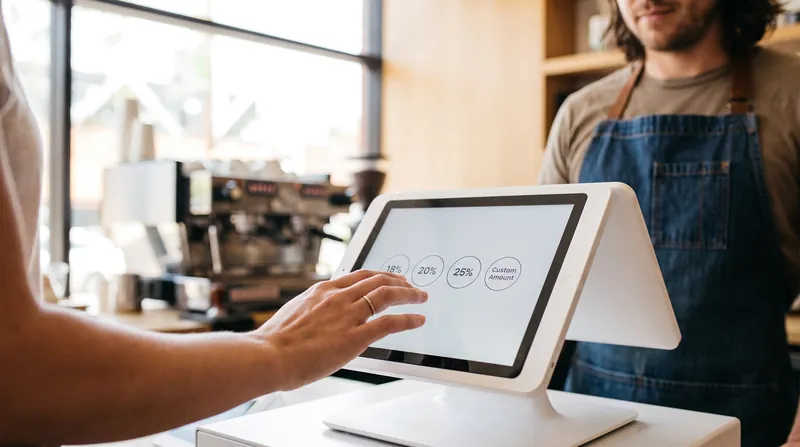
You are standing at a bakery counter, holding a single croissant in a paper bag. The cashier spins a glowing tablet toward you, and suddenly you are faced with a choice: 18%, 20%, 22%, or the socially fraught 'No Tip' button. This moment of checkout anxiety has become the defining transaction of modern American life, transforming what was once a straightforward social contract at the end of a sit-down meal into a pervasive, often confusing web of digital prompts.[7]
To navigate this landscape with confidence, you first have to understand where your money is actually going. The distinction between a 'tip' and a 'service charge' is not just semantics; it is a rigid legal boundary defined by the U.S. Department of Labor. Knowing this difference is the single most empowering tool a consumer has at the checkout counter.[1]
According to federal guidelines, a tip is entirely voluntary and belongs exclusively to the employee or a valid tip pool. A mandatory service charge, however, is legally the property of the employer. This means when you see a 20% 'fair wage fee' or 'wellness charge' on your restaurant bill, that money does not legally have to go to your server.[1]
Restaurant operators increasingly use these mandatory fees to offset general overhead, back-of-house wages, or employee benefits, rather than directly supplementing the tipped worker's take-home pay. While these are noble operational goals, the lack of transparency often leaves diners assuming they have just tipped their waiter when, legally, they have simply paid a higher menu price.[6]
The psychological friction for diners is immense. Consumers often perceive these service-included pricing models as more expensive or confusing than traditional base-plus-tip structures, even when the final out-of-pocket cost is identical. This deal perception heavily influences how people spend and return to establishments.[2]
When diners see a mandatory fee, they naturally assume the gratuity is covered and reduce their voluntary tip. This inadvertently redirects income away from the direct service provider and into the establishment's general revenue pool, fundamentally altering the economics of the service shift.[2][7]
But why do we tip in the first place? A recent behavioral study challenges the foundational myth of gratuity: that it ensures good service. Researchers found that tipping is actually not an effective incentive for improving service quality, as most consumers tip a standard percentage regardless of the experience.[4]
The roots of the American tipping system are far more complex than rewarding a job well done. The practice gained widespread traction in the United States after the Civil War, heavily influenced by the legacy of slavery and a desire to suppress labor costs.
Industries, particularly the Pullman Company and the hospitality sector, used tipping as a way to avoid paying wages to newly freed Black workers. By shifting the burden of compensation entirely onto the customer, employers established a subminimum wage system that persists in various forms today.
Today, that legacy has evolved into a sprawling etiquette matrix. For traditional sit-down dining, the standard expectation has firmly settled at 20% for good service, with 15% representing the bare minimum for acceptable service.[3][5]
In the realm of coffee shops and counter service, the rules are softer. While the tablet will almost always ask for a percentage, etiquette experts generally agree that a dollar or two per transaction—or simply rounding up—is perfectly acceptable for a standard drip coffee or pastry.[3][5]
Delivery drivers, who bear the brunt of vehicle wear and tear and unpredictable weather, rely heavily on gratuities. A standard tip of 15% to 20% of the total bill, or a minimum of $5, is considered the baseline for food delivery, regardless of the distance.[3]
The hospitality and personal care industries have their own distinct rhythms. Hotel housekeepers should generally receive $2 to $5 per day, left daily rather than at the end of the trip, as staffing rotations mean different people clean your room each day.[3][5]
Meanwhile, hair stylists, massage therapists, and other personal care professionals customarily expect 15% to 20% of the service cost. This reflects the highly personalized nature of the work and the time dedicated exclusively to a single client.[3]
As the digital point-of-sale system continues to blur the lines between retail and service, the most empowering thing a consumer can do is ask directly: 'Does this fee go to you?' By understanding the mechanics of the modern gratuity, you can ensure your generosity lands exactly where you intend it to.[6][7]
How we did this
- Method
- Cross-referencing federal labor definitions of tipped wages with consumer behavioral data and restaurant operational models to map the actual financial routing of modern service fees.
- What we found
- Because consumers psychologically process mandatory service fees as equivalent to voluntary gratuities, they frequently reduce their actual tip, inadvertently redirecting income from the direct service provider to the establishment's general revenue pool under federal labor laws.
- What we worked from
- Federal definition of service charges vs. tips: Employer property — U.S. Department of Labor
- Consumer deal perception of service-included pricing: Viewed as more expensive than base+tip — Cornell University Library
- Restaurant routing of service fees: Used for general overhead and non-tipped wages
- Limits of this analysis
- This analysis relies on generalized consumer behavior models and federal baselines; individual restaurant practices and state-level labor laws (such as those in California or New York) can significantly alter how fees are distributed.
Terms to know
- Service Charge
- A mandatory fee added to a bill by the establishment, which legally belongs to the employer and is not required to be distributed to the service staff.
- Tip Pool
- An arrangement where employees share a portion of their tips with other eligible staff members, such as bussers or bartenders.
- Tip Credit
- A provision allowing employers to pay tipped workers a subminimum cash wage, provided the employee's tips make up the difference to reach the standard minimum wage.
- Point-of-Sale (POS) Prompt
- The digital screen presented to customers at checkout that automatically suggests predefined tipping percentages.
Questions readers ask
Do I need to tip on the tax?
Etiquette experts generally agree that you should calculate your tip based on the pre-tax subtotal of your bill, though tipping on the total is a common and generous practice.
Should I tip for takeout orders?
While not mandatory like sit-down service, a 5% to 10% tip for takeout is customary to acknowledge the staff who packaged and prepared your order.
Does the kitchen staff get a portion of my tip?
It depends on the restaurant's model. Under federal law, if the restaurant pays all workers a full minimum wage, they can mandate a tip pool that includes back-of-house staff. If they take a tip credit, tips can only be shared among front-of-house workers.
Can an employer keep my tip?
No. Under the Fair Labor Standards Act, tips are the sole property of the employee. Employers cannot keep any portion of a tip for themselves or for management.
Different angles
Service Workers
Front-line staff who rely on gratuities for their livelihood.
For servers, bartenders, and delivery drivers, tips are not a bonus; they are the core component of their income. Many service workers prefer the traditional tipping model because it offers high earning potential during busy shifts. However, the rise of mandatory service charges has created friction, as workers often have to explain to confused customers that the 20% 'wellness fee' on the receipt does not go into their pocket, leading to lower overall take-home pay.
Restaurant Operators
Business owners navigating thin margins and labor shortages.
Operators argue that the traditional tipping model creates a massive, unfair wage gap between front-of-house servers and back-of-house kitchen staff. By implementing mandatory service charges, owners can legally pool that money to offer higher base wages, health benefits, and paid time off to all employees. They view these fees as a necessary evolution to create a more stable and equitable hospitality business model, despite the initial consumer pushback.
Consumers
Diners and shoppers navigating checkout fatigue.
Consumers are increasingly experiencing 'tip fatigue' as digital screens prompt them for gratuities in historically non-tipped environments like bakeries and retail stores. The introduction of service fees has compounded this frustration, leading to a demand for pricing transparency. Many diners advocate for a European-style model where the full cost of labor is simply baked into the menu price, eliminating the math and moral calculation at the end of a meal.
- Labor Advocates
- Argue that the tipping system is inherently inequitable and advocate for a universal living wage that eliminates the need for gratuities.
- Hospitality Management
- View service charges as a necessary tool to stabilize revenue, provide benefits, and close the wage gap between front-of-house and back-of-house staff.
- Consumer Advocates
- Prioritize pricing transparency, arguing that mandatory fees confuse diners and obscure the true cost of a meal.
Perspectives this story doesn't cover
- Gig economy platform developers
- International tourists navigating US norms
Sources
Source coverage
7 outlets
3 viewpoints surfaced






- [1]U.S. Department of LaborLabor Advocates
Fact Sheet #15: Tipped Employees Under the Fair Labor Standards Act (FLSA)
Read on U.S. Department of Labor → - [2]Cornell University LibraryConsumer Advocates
The Effects of Service Charges versus Service-included Pricing on Deal Perception
Read on Cornell University Library → - [3]Savant Wealth ManagementConsumer Advocates
How Much to Tip in 2025: A Practical Guide for Everyday Service
Read on Savant Wealth Management → - [4]EurekAlert!Consumer Advocates
New study: Contrary to common belief, tipping is not an effective incentive for improving service
Read on EurekAlert! → - [5]The Washington PostConsumer Advocates
Has tipping gone too far? Here's a guide on when to tip.
Read on The Washington Post → - [6]The Washington PostConsumer Advocates
6 ways to be a smarter tipper in restaurants
Read on The Washington Post → - [7]Factlen Editorial Team
Synthesis by Factlen editorial team
Read on Factlen Editorial Team →

More in Lifestyle
See all →Formalwear Rules
The Tailcoat, White Waistcoat, and White Bow Tie: The Required Garments That Define White Tie Attire
9 sources

COVID-19 Vaccines
AAFP Recommends Second 2026-2027 COVID-19 Vaccine Dose for Adults 65 and Older
4 sources

Tipping Culture
The 20% Default: How Point-of-Sale Screens Reshaped Tipping Etiquette and Service Industry Norms
3 sources
Sports Marketing
Wimbledon Bans Dedicated Influencer Accreditation, Will Confiscate Ring Lights to Enforce Court Etiquette
5 sources

Comments
Every angle. Every day.
Get Lifestyle stories with full source coverage and perspective breakdowns, free every day.