
The Architecture of Assured Access: How Blue Origin's $2.4 Billion Contract Reshaped Space Force Heavy Lift
The integration of Blue Origin as a third heavy-lift launch provider under the NSSL Phase 3 Lane 2 program marks a structural shift in U.S. military space strategy. By subsidizing a new entrant alongside SpaceX and ULA, the Space Force is prioritizing architectural resilience over immediate cost efficiency.
By Hao Li

Share this story
In short
- The U.S. Space Force awarded Blue Origin a $2.4 billion contract for seven heavy-lift missions under the NSSL Phase 3 Lane 2 program.
- Blue Origin joins SpaceX and ULA, expanding the military's heavy-lift launch provider pool from a duopoly to a triopoly.
- The Lane 2 program is reserved for the Pentagon's most critical, high-mass payloads, requiring near-perfect reliability and complex orbital insertions.
The U.S. military's access to space is no longer dependent on a duopoly. By integrating Blue Origin as a third heavy-lift provider under the National Security Space Launch (NSSL) Phase 3 Lane 2 program, the Space Force has fundamentally rewired its orbital logistics architecture.[1][3]
The $2.4 billion contract awarded to Blue Origin for seven missions between 2027 and 2032 represents more than just a procurement decision; it is a structural subsidy for resilience. For years, the Pentagon relied exclusively on United Launch Alliance (ULA) and SpaceX to lift its most sensitive and massive payloads into orbit.[1]
Now, as the demand for space-based missile warning, communications, and intelligence capabilities surges, the Space Force is paying a premium to ensure a third viable pathway to orbit. This shift acknowledges a stark reality: in a contested space environment, architectural redundancy is as critical as the satellites themselves.[1][5]
To understand the significance of Blue Origin's entry, one must look at the mechanics of the NSSL program. The Space Force divided its Phase 3 procurement into two distinct tracks, or "lanes." Lane 1 is designed for commercial-like, risk-tolerant missions, allowing newer companies to compete for lower-stakes payloads.[1][3]
Lane 2, however, is the Pentagon's most demanding launch category. It requires rockets capable of delivering heavy payloads to complex, high-energy orbits with near-perfect reliability. These are the "must-go" missions—multibillion-dollar spy satellites, GPS constellations, and secure communications nodes that form the backbone of U.S. military operations.[1][3]
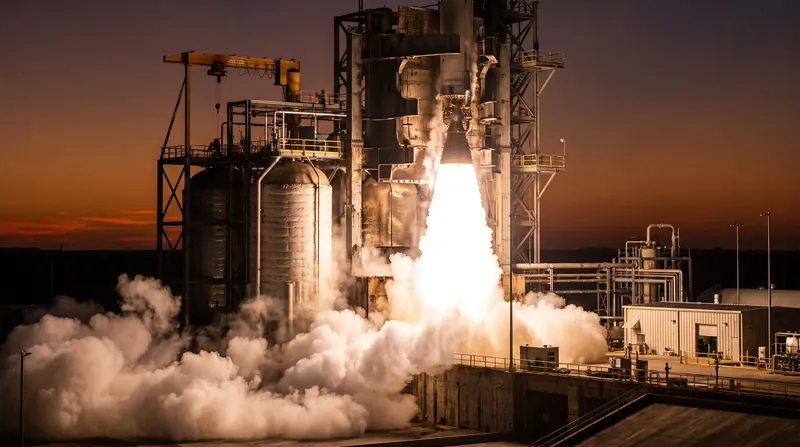
Blue Origin's New Glenn rocket, a heavy-lift vehicle featuring a reusable first stage and a massive seven-meter payload fairing, was selected for Lane 2 alongside SpaceX's Falcon family and ULA's Vulcan Centaur. The inclusion of a rocket that had not yet completed its certification flights underscores the urgency with which the Space Force is seeking to expand its industrial base.[4]
The contract distribution highlights the premium placed on this expansion. SpaceX, the dominant incumbent, received a $5.9 billion ceiling for 28 missions, while ULA secured $5.4 billion for 19 missions. Blue Origin's $2.4 billion allocation for just seven missions translates to a significantly higher per-launch ceiling, reflecting the developmental and infrastructural costs of onboarding a new heavy-lift system.[5]
A critical component of this infrastructural expansion is taking place on the ground. In April 2026, the Space Force advanced plans to lease Space Launch Complex 14 (SLC-14) at Vandenberg Space Force Base in California to Blue Origin.[2]
Vandenberg's geographic location makes it the premier U.S. site for launching payloads into polar orbits, which are essential for global reconnaissance and weather monitoring. By developing SLC-14, Blue Origin will establish a West Coast footprint to complement its existing Launch Complex 36 at Cape Canaveral, fulfilling the Lane 2 requirement that providers be able to launch from both the Eastern and Western ranges.[2][4]
This dual-coast capability is a prerequisite for assured access to space. If a hurricane damages Florida's space coast, or if a localized anomaly grounds operations at one pad, the military must still be able to deploy its assets.[2][5]
The downstream consequences of this three-provider architecture extend beyond military readiness. By underwriting the development of New Glenn and its associated infrastructure, the Space Force is indirectly subsidizing the broader commercial space economy.[5]
A robust commercial heavy-lift market lowers the barrier to entry for large-scale orbital projects, from commercial space stations to deep-space exploration. The military's demand for high-mass, high-reliability launches provides the anchor tenancy that allows companies like Blue Origin to scale their operations.[4][5]
However, the transition to a triopoly is not without friction. Blue Origin must complete a rigorous certification process, including multiple successful flights of the New Glenn vehicle, before it can begin launching Lane 2 payloads.[3][4]
The Space Force has structured the NSSL Phase 3 contracts to accommodate this developmental timeline, with the first Lane 2 missions not expected to fly until fiscal year 2027 at the earliest. In the interim, SpaceX and ULA will continue to shoulder the bulk of the national security manifest.[1]
Ultimately, the $13.7 billion Phase 3 Lane 2 procurement reflects a systems-minded approach to national defense. The Space Force is not merely buying rocket flights; it is engineering an industrial ecosystem capable of sustaining the United States' strategic advantage in an increasingly crowded and contested domain.[1][5]
How we did this
- Method
- A comparative analysis of the National Security Space Launch (NSSL) Phase 3 Lane 2 contract distribution, normalizing the awarded contract ceilings by the number of assigned missions to derive the implied per-launch cost ceiling for each of the three providers.
- What we found
- The contract structure reveals a tiered pricing ceiling where Blue Origin's entry-level allocation carries the highest per-mission ceiling ($342.8 million) compared to the established incumbent SpaceX ($210.7 million), indicating the Space Force is willing to pay a substantial premium—over 60% per launch—to subsidize the onboarding of a third heavy-lift provider and ensure architectural redundancy.
- What we worked from
- SpaceX Phase 3 Lane 2 contract ceiling and mission count: $5.9 billion for 28 missions
- ULA Phase 3 Lane 2 contract ceiling and mission count: $5.4 billion for 19 missions
- Blue Origin Phase 3 Lane 2 contract ceiling and mission count: $2.4 billion for 7 missions
- Limits of this analysis
- These figures represent maximum contract ceilings rather than fixed per-launch prices, and actual task order values may vary based on specific mission requirements, payload complexity, and orbital destinations.
Key terms
- National Security Space Launch (NSSL)
- A U.S. Space Force program that acquires launch services to ensure reliable access to space for the military and intelligence community.
- Heavy-Lift Launch Vehicle
- A class of powerful rockets capable of carrying massive payloads, typically over 20,000 kilograms, into low Earth orbit or beyond.
- Payload Fairing
- The protective nose cone at the top of a rocket that shields the satellite or spacecraft during its ascent through the atmosphere.
- Polar Orbit
- An orbit in which a satellite passes above or nearly above both poles of the Earth, commonly used for reconnaissance and weather monitoring.
- Anchor Tenancy
- A reliable, long-term commitment from a major customer (like the government) that provides a company with the financial stability to develop new technologies.
Reader questions
What is the NSSL Phase 3 Lane 2 program?
It is a U.S. Space Force procurement program designed to acquire highly reliable, heavy-lift rocket launches for the military's most critical and complex payloads, such as spy satellites and GPS constellations.
Why did the Space Force add a third provider?
To increase architectural resilience. Relying on three providers (SpaceX, ULA, and Blue Origin) ensures that if one company's rockets are grounded or a launch pad is damaged, the military still has assured access to space.
What rocket will Blue Origin use for these missions?
Blue Origin will use New Glenn, a heavy-lift launch vehicle featuring a reusable first stage and a large seven-meter payload fairing.
Where will these rockets launch from?
Lane 2 providers must be able to launch from both the East and West coasts. Blue Origin plans to launch from Launch Complex 36 in Florida and is developing Space Launch Complex 14 at Vandenberg Space Force Base in California.
Where opinion splits
Defense & Strategic Planners
Prioritizing architectural resilience and assured access to space over immediate cost efficiency.
For military strategists, the space domain has transitioned from a benign environment to a contested operational theater. Relying on a duopoly for heavy-lift capabilities presents a single point of failure—whether from a technical anomaly grounding a rocket fleet or a natural disaster disabling a primary launch facility. By deliberately funding a third provider through the NSSL Phase 3 Lane 2 contracts, defense planners are engineering redundancy into the system. They view the higher per-launch ceiling allocated to Blue Origin not as an inefficiency, but as a necessary insurance premium to guarantee that critical national security payloads can reach orbit under any circumstances.
Aerospace Industry & Systems Analysts
Focusing on the infrastructural and developmental hurdles of scaling heavy-lift launch systems.
Industry analysts emphasize that awarding a contract is only the first step in a complex systems-engineering challenge. A heavy-lift rocket like New Glenn requires massive, specialized infrastructure, such as the planned Space Launch Complex 14 at Vandenberg, to support polar orbit missions. Analysts note that the military's willingness to serve as an anchor tenant provides the financial stability necessary for companies to build out this dual-coast infrastructure. However, they also caution that the transition from development to operational cadence is fraught with technical risks, making the Space Force's phased approach—relying on incumbents while the new entrant matures—a pragmatic necessity.
- Defense & Strategic Planners
- Prioritizing architectural resilience and assured access to space over immediate cost efficiency.
- Aerospace Industry & Systems Analysts
- Focusing on the infrastructural and developmental hurdles of scaling heavy-lift launch systems.
Perspectives this story doesn't cover
- Taxpayer advocacy groups scrutinizing the cost premiums associated with subsidizing a third launch provider.
- Local environmental groups monitoring the impact of new heavy-lift launch infrastructure on the California coast.
Sources
Source coverage
5 outlets
2 viewpoints surfaced




- [1]Congressional Research ServiceDefense & Strategic Planners
Defense Primer: National Security Space Launch
Read on Congressional Research Service → - [2]U.S. Space ForceDefense & Strategic Planners
U.S. Space Force Advances Heavy Launch Capability Development at Vandenberg
Read on U.S. Space Force → - [3]WikipediaAerospace Industry & Systems Analysts
National Security Space Launch
Read on Wikipedia → - [4]WikipediaAerospace Industry & Systems Analysts
New Glenn
Read on Wikipedia → - [5]Factlen Editorial TeamAerospace Industry & Systems Analysts
Synthesis by Factlen editorial team
Read on Factlen Editorial Team →
More in Transportation
See all →Spacecraft Engineering
How Angular Momentum Storage and Conservation Maintain Spacecraft Orientation
7 sources
Space Law
The 15-Minute Threshold: How the Karman Line Defines the Boundary Between Airspace and Outer Space
6 sources

Electric Propulsion
The Physics of Electric Propulsion: How Argon Hall Thrusters Reshaped Satellite Constellations
5 sources

Orbital Mechanics
The V-Bar and R-Bar Approach: How Relative Orbital Mechanics Dictate Spacecraft Rendezvous and Docking
7 sources
Comments
Every angle. Every day.
Get Transportation stories with full source coverage and perspective breakdowns, free every day.