
UEFA Champions League Prepares for 2026/27 League Phase Draw Under Expanded Swiss Model
The 36-team UEFA Champions League draw takes place on August 27 in Monaco, utilizing a hybrid automated system to map out the eight-match league phase. The 'Swiss model' format eliminates the traditional group stage in favor of a single high-stakes table.
By Ryder James

In short
- The 2026/27 Champions League draw takes place on August 27 in Monaco.
- The 36-team "Swiss model" replaces the traditional four-team group stage with a single league table.
- Each club plays eight different opponents (four home, four away) drawn from four seeding pots.
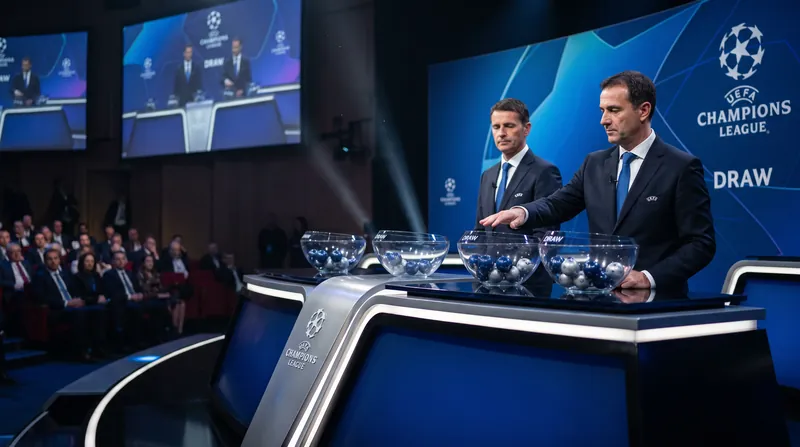
On Thursday, August 27, 36 physical balls will be drawn from a glass bowl in Monaco, but a specialized supercomputer will instantly dictate the European fate of the continent's biggest clubs. The UEFA Champions League is finalizing the schedule for its 2026/27 season, cementing the 36-team "Swiss model" that has fundamentally rewired the sport's most lucrative competition.[4]
Gone are the days of the predictable four-team group stage, where heavyweights often secured qualification with two games to spare. In its place is a single, massive 36-team league table where every goal, every point, and every goal difference metric reverberates across the entire continent.[1][3]
The sheer mathematical complexity of the new format makes a traditional manual draw impossible. If UEFA officials were to draw every opponent by hand, the ceremony would require hundreds of bowls and take several hours to complete. Instead, the governing body relies on a hybrid concept.
During the ceremony, a club is physically drawn from a pot. Immediately after, automated software designed by AE Live—a technology provider for major sports institutions—takes over, instantly selecting the club's eight opponents from the remaining pool while adhering to strict geographical and seeding constraints.[4]
The 36 participating clubs are divided into four seeding pots of nine teams each, ranked strictly by their UEFA club coefficient. This coefficient is a rolling five-year metric that rewards sustained success in European competitions.[1][3]
Every club, regardless of whether they are the reigning champions in Pot 1 or a debuting underdog in Pot 4, will play exactly eight matches in the league phase. They will draw two opponents from each of the four pots, playing one match at home and the other away.[3]
The software enforces two ironclad rules during the selection process. First, clubs from the same domestic league cannot face each other during the league phase, ensuring that a Premier League or La Liga clash is reserved for the knockout rounds. Second, a team can be drawn against a maximum of two opponents from any single foreign association.[3]
For the heavyweights in Pot 1—a tier that includes the likes of Real Madrid, Manchester City, Bayern Munich, Paris Saint-Germain, and Arsenal—the new format guarantees blockbuster matchups immediately. Because every team must play two opponents from Pot 1, the era of top seeds avoiding each other until the spring is officially over.[4]
The stakes within the 36-team table are ruthless. After all eight matchdays are completed in late January 2027, the top eight teams in the standings will bypass the playoff round entirely, advancing directly to the Round of 16.[1][3]
For the clubs that finish between 9th and 24th place, survival requires navigating a high-pressure, two-legged knockout playoff in February. The teams ranked 9th to 16th will be seeded, meaning they will host the crucial second leg against a team ranked 17th to 24th.[3][4]
The most brutal aspect of the Swiss model lies at the bottom of the table. Any club that finishes 25th or lower is eliminated from European competition entirely. The previous safety net—which allowed third-place group finishers to drop down into the UEFA Europa League—has been permanently abolished.[3]
The league phase will kick off with an exclusive Matchday 1 spread across three days from September 8 to 10, 2026. The schedule then settles into a more traditional rhythm, culminating in a synchronized final matchday on January 27, 2027, where all 18 games will kick off simultaneously to ensure sporting integrity.[3][4]
The transition to the Swiss system, originally adapted from chess tournaments, was driven by a desire to increase the density of high-stakes matches and maximize broadcasting revenue. UEFA projects that the expanded format will push annual revenues past the €4.5 billion mark.[2]
While the format was initially met with skepticism by traditionalists, the guarantee of more varied opponents and the elimination of dead-rubber matches has injected a new level of jeopardy into the autumn schedule. Every club is now fighting for table position until the final whistle of the eighth match.[4]
Jargon, explained
- Swiss Model
- A tournament format where teams are ranked in a single massive league table rather than divided into small, isolated groups.
- UEFA Club Coefficient
- A ranking system based on a club's performance in European competitions over the past five seasons, used to determine seeding pots.
- League Phase
- The new eight-match opening stage of the tournament, which replaces the traditional six-match group stage.
- Knockout Playoff
- A two-legged tie in February for teams finishing 9th to 24th to determine who advances to the Round of 16.
Common questions
How many matches does each team play in the league phase?
Each team plays exactly eight matches against eight different opponents—four at home and four away.
Can teams from the same country play each other?
No, clubs from the same domestic league cannot be drawn against each other during the league phase.
What happens if a team finishes 25th?
They are eliminated from all European competition for the season. There is no longer a safety net to drop into the Europa League.
Why is a computer used for the draw?
Because every team plays a unique set of eight opponents, a manual draw would require hundreds of bowls and take hours. The software calculates the complex permutations instantly.
Competing readings
UEFA & Broadcasters
The governing body and rights holders view the format as a commercial and sporting triumph.
For UEFA and its broadcast partners, the Swiss model solves the primary flaw of the old group stage: dead-rubber matches. By placing all 36 teams in a single table, qualification and seeding are contested until the final minute of Matchday 8. The guarantee that Pot 1 heavyweights will face each other twice in the autumn also drives massive early-season viewership, justifying the expanded €4.5 billion revenue projections.
Top-Tier Clubs
Elite teams appreciate the revenue but face unprecedented early-season pressure.
Europe's wealthiest clubs largely pushed for this format to secure more high-profile, high-revenue fixtures. However, the reality of the draw means there are no longer 'easy' groups. A Pot 1 team must navigate two matches against fellow giants and two against Pot 2 contenders just to secure a top-eight finish. The physical toll of two additional league-phase matches also stretches already congested squads to their limits.
Mid-Tier & Emerging Clubs
Smaller clubs face a steeper climb to the knockouts but gain broader exposure.
For clubs in Pots 3 and 4, the Swiss model is a double-edged sword. On one hand, they are guaranteed to host at least one true European giant, providing a massive financial windfall in matchday revenue. On the other hand, the abolition of the Europa League drop-down safety net means that a slow start in the Champions League results in total elimination from continental football by January.
- UEFA & Broadcasters
- The governing body and rights holders view the format as a commercial and sporting triumph.
- Top-Tier Clubs
- Elite teams appreciate the revenue but face unprecedented early-season pressure.
- Mid-Tier & Emerging Clubs
- Smaller clubs face a steeper climb to the knockouts but gain broader exposure.
Perspectives this story doesn't cover
- Domestic League Schedulers
- Match-Going Supporters
Sources
Source coverage
4 outlets
3 viewpoints surfaced


- [1]Wikipedia
UEFA Champions League
Read on Wikipedia → - [2]Wikipedia
Swiss-system tournament
Read on Wikipedia → - [3]UEFAUEFA & Broadcasters
New format for Champions League post-2024: Everything you need to know
Read on UEFA → - [4]Factlen Editorial TeamMid-Tier & Emerging Clubs
Synthesis by Factlen editorial team
Read on Factlen Editorial Team →
More in Sports
See all →Champions League Records
Erling Haaland Reaches 59 Champions League Goals in 59 Games, Closing in on Lionel Messi's Age Record
6 sources
Coefficient Rules
The 20% Association Floor and the Five-Year Rolling Average: How the UEFA Club Coefficient Actually Works
7 sources
Como 1907
The Relational Engine: How Cesc Fàbregas Engineered Como 1907's Historic Champions League Debut
6 sources
Tournament Rules
Opponent Performance and Disciplinary Points: The 10 Tie-Breakers for the Champions League League Phase
6 sources
Comments
Every angle. Every day.
Get Sports stories with full source coverage and perspective breakdowns, free every day.