
NASA Aborts Swift Telescope Rescue Mission, Sealing Observatory's Fiery Re-Entry
A $30 million commercial effort to boost the decaying Neil Gehrels Swift Observatory has been called off after the rescue spacecraft suffered critical control failures, dooming the 22-year-old telescope to burn up in Earth's atmosphere.
By Tariq Nasser

In short
- NASA and Katalyst Space Technologies have officially canceled the $30 million Swift Boost rescue mission.
- The LINK rescue spacecraft suffered critical reaction wheel failures, preventing it from safely docking with the telescope.
- Swift's orbit has rapidly decayed due to atmospheric drag caused by increased solar activity.
In early July, a robotic spacecraft named LINK launched from the belly of a modified L-1011 aircraft over the Pacific Ocean, tasked with a $30 million gamble: catch a falling telescope. The target was NASA's Neil Gehrels Swift Observatory, a 22-year-old gamma-ray hunter whose orbit had decayed dangerously close to Earth.
The plan was for LINK to grapple the non-cooperative Swift satellite and use its own thrusters to boost the observatory back to a safe 373-mile altitude. This bold maneuver was intended to grant the historic telescope another decade of operational life, serving as a critical test for the burgeoning commercial satellite servicing industry.[1][2]
That ambitious rescue has now been officially abandoned, sealing the fate of the historic observatory. NASA and Arizona-based Katalyst Space Technologies confirmed this week that LINK suffered critical attitude control failures shortly after reaching orbit.
While engineers managed to stabilize the spacecraft's uncontrollable spin through software patches and thruster firings, the permanent loss of two reaction wheels means LINK can no longer safely dock with or boost the observatory. The precision required to grapple a tumbling, school-bus-sized object moving at 17,000 miles per hour simply cannot be achieved without a fully functional attitude control system.[1]
The cancellation marks the end of the line for one of astrophysics' most prolific and reliable instruments. Launched in 2004 with a primary mission life of just two years, Swift revolutionized time-domain astronomy by autonomously pivoting to observe gamma-ray bursts within seconds of their detection.
It has operated for over two decades without its own propulsion system, relying entirely on momentum wheels to rapidly point its X-ray and ultraviolet telescopes at fleeting cosmic events. Its ability to act as a "first responder" for the astronomical community made it an irreplaceable asset, prompting the unprecedented rescue attempt.[2][3]
The telescope's downfall was ultimately dictated by the sun, rather than any failure of its own aging hardware. An intense surge in solar activity over the past two years—part of the current solar maximum—heated and expanded Earth's upper atmosphere.
This expansion dramatically increased the density of atmospheric molecules at Swift's altitude, creating immense friction and drag that rapidly accelerated its orbital decay. Over a short period, the observatory's altitude plummeted from a stable 373 miles down to roughly 216 miles, putting it on a direct path for an uncontrolled atmospheric re-entry.[1][3]
Facing the imminent loss of the telescope by late 2026, NASA awarded Katalyst a rapid-turnaround contract in September 2025. The agency viewed the $30 million Swift Boost mission as a high-risk, high-reward test of commercial satellite servicing capabilities.
Building a rendezvous spacecraft from scratch in under nine months was an unprecedented timeline for the aerospace industry, and NASA officials acknowledged the steep odds from the outset. The mission was designed not just to save Swift, but to prove that commercial providers could rapidly respond to orbital emergencies at a fraction of the cost of traditional government missions.[4]
"This is not the outcome we were working toward, but it does not change why this mission was worth attempting," NASA Administrator Jared Isaacman stated following the cancellation announcement. The agency noted that while the orbital boost is permanently off the table, the mission is not considered a total loss.
LINK will still attempt proximity operations near Swift to gather high-resolution data on autonomous rendezvous techniques. This data will be crucial for refining the sensor fusion and machine vision algorithms required for future servicing missions, ensuring that the lessons learned from LINK's failure are not wasted.[1]
The failure highlights the immense difficulty of in-orbit servicing, a sector heavily marketed by aerospace startups but rarely executed successfully in practice. Catching a non-cooperative, tumbling object in the vacuum of space requires flawless coordination between optical sensors, LiDAR, and thruster control—capabilities that remain highly experimental despite industry hype.
While companies envision a future where orbital tow trucks routinely refuel and repair aging satellites, the LINK mission serves as a stark reminder of the unforgiving nature of orbital mechanics and the narrow margins for error when operating in low Earth orbit.[4]
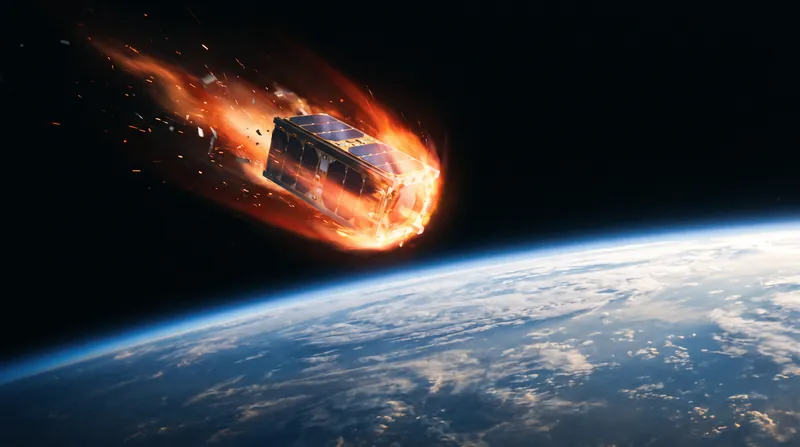
Swift is now projected to burn up in the atmosphere as early as October, creating a brilliant artificial meteor over the ocean. NASA has already powered down its scientific instruments to conserve power and is relying on other orbital assets to fill the gap in gamma-ray detection.
Swift is now projected to burn up in the atmosphere as early as October, creating a brilliant artificial meteor over the ocean.
While the fiery re-entry marks a definitive end of an era, the observatory leaves behind an unparalleled legacy of foundational discoveries. Over its 22-year lifespan, Swift fundamentally changed our understanding of black hole formation, neutron star collisions, and the mechanics behind the most violent explosions in the cosmos.[1][2]
Viewpoints in depth
Option A: High-Risk Commercial Servicing
Deploying rapid-turnaround robotic tugs to extend the life of aging orbital assets.
The Katalyst Space approach represents a paradigm shift from disposable satellites to a sustainable orbital ecosystem. By awarding a $30 million contract for a nine-month turnaround, NASA tested a model where commercial providers act as orbital tow trucks. The primary argument for this approach is cost-efficiency: saving a $250 million asset like Swift for just $30 million yields an outsized return on investment. Proponents argue that even though the LINK mission failed to boost Swift, the attempt itself advanced autonomous rendezvous software and sensor fusion capabilities. This model fits well when the target asset is structurally sound but lacks propulsion, and when the replacement cost is prohibitive. It does not fit when the target is rapidly tumbling or when the servicing spacecraft lacks redundant attitude control systems, as demonstrated by LINK's reaction wheel failures.
Option B: Planned End-of-Life & Replacement
Allowing satellites to naturally de-orbit while funding next-generation replacements.
The traditional aerospace model accepts orbital decay as a natural conclusion to a mission, focusing resources on launching modernized replacements rather than salvaging obsolete hardware. Swift was originally designed for a two-year lifespan; operating it for 22 years already represents a massive over-delivery. Critics of the commercial servicing model argue that spending $30 million on a high-risk gamble diverts funds that could be used for next-generation observatories with vastly superior sensors. Furthermore, uncontrolled re-entry of small satellites is a well-understood and safe process, whereas failed docking attempts risk creating orbital debris. This approach fits well when the asset has exceeded its design life and when newer technology is ready to assume its duties. It does not fit when the asset is a unique, irreplaceable 'first responder' with no immediate successor, which was the primary justification for attempting to save Swift.
- Commercial Servicing Advocates
- Argue that high-risk, low-cost robotic missions are essential for building a sustainable orbital economy.
- Traditional Aerospace Pragmatists
- Believe resources are better spent on next-generation replacements rather than salvaging obsolete hardware.
Perspectives this story doesn't cover
- Astronomers relying on Swift's data
- Space debris mitigation experts
Sources
Source coverage
4 outlets
2 viewpoints surfaced




- [1]CBS NewsTraditional Aerospace Pragmatists
NASA's Swift telescope will plunge toward Earth after rescue mission called off
Read on CBS News → - [2]WikipediaTraditional Aerospace Pragmatists
Neil Gehrels Swift Observatory
Read on Wikipedia → - [3]NASATraditional Aerospace Pragmatists
Neil Gehrels Swift Observatory
Read on NASA → - [4]Factlen Editorial TeamCommercial Servicing Advocates
Synthesis by Factlen editorial team
Read on Factlen Editorial Team →

More in Technology
See all →Orbital Mechanics
The 5-Year vs. 25-Year Deorbit Rule: Trade-offs in Clearing Low Earth Orbit
7 sources
Propulsion Systems
Rocket Engine Cycles Compared: The Trade-offs in Thrust, Efficiency, and Complexity
6 sources

Space Observatory
The Roman Space Telescope Launches: Why Astrophysics is Trading Deep Stares for Wide Surveys
6 sources
VLEO Propulsion
World's First Air-Breathing Satellite Thruster Set for Test, Unlocking Very Low Earth Orbit
4 sources
Comments
Every angle. Every day.
Get Technology stories with full source coverage and perspective breakdowns, free every day.