
The Specific Impulse Metric: How Exhaust Velocity Dictates the Trade-off Between Rocket Thrust and Fuel Efficiency
Specific impulse measures how efficiently a rocket engine uses propellant to generate thrust. Maximizing this efficiency fundamentally limits the raw power an engine can produce, forcing mission designers to choose between lifting heavy payloads off Earth and traveling efficiently through deep space.

- Chemical Propulsion Engineers
- Prioritize raw thrust-to-weight ratios necessary for escaping planetary gravity wells.
- Electric Propulsion Specialists
- Focus on maximizing specific impulse to enable long-duration, high-efficiency deep space missions.
- Nuclear Thermal Advocates
- Seek to bridge the gap by developing systems that offer both high thrust and double the chemical specific impulse.
Perspectives this story doesn't cover
- Commercial launch providers focused on reusability over maximum specific impulse.
- Solar sail advocates pushing for zero-propellant architectures.
The competing cases
High-Thrust Chemical Propulsion
Prioritizes raw power to overcome gravity, sacrificing fuel efficiency.
For: Chemical rockets are the only systems currently capable of lifting payloads from the Earth's surface to orbit. They achieve thrust-to-weight ratios well above 1.0, generating millions of pounds of force by combusting liquid oxygen and hydrogen. Against: The trade-off is an absolute physical limit on specific impulse, peaking around 453 seconds. Evidence: This low efficiency means that 85% to 90% of the vehicle's mass must be propellant, leaving minimal room for payload. Fits well when: escaping deep gravity wells or requiring rapid orbital insertion. Does not fit when: conducting long-duration deep space transits where fuel mass becomes prohibitive.
High-Isp Electric Propulsion
Prioritizes extreme fuel efficiency for deep space transit, sacrificing immediate thrust.
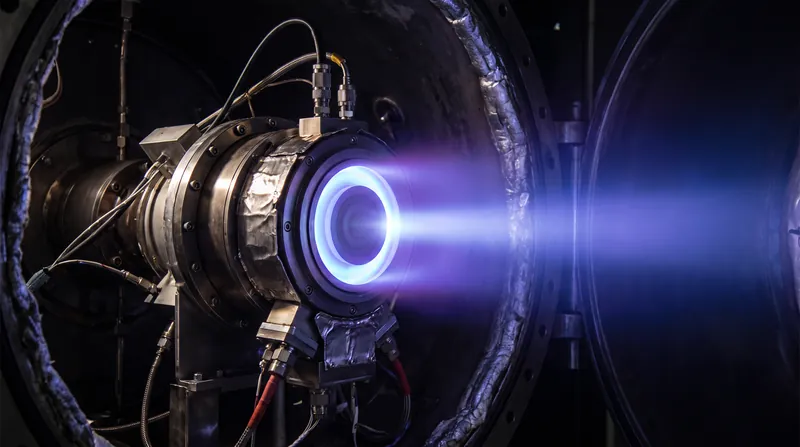
For: Electric propulsion systems, such as Hall-effect thrusters, use electromagnetic fields to accelerate ionized gas to extreme velocities, routinely achieving specific impulses above 3,000 seconds. This allows a spacecraft to execute massive velocity changes using very little propellant mass. Against: The thrust generated is minuscule—often measured in millinewtons—resulting in thrust-to-weight ratios far below 1.0. Evidence: A chemical rocket burns for minutes; an ion thruster must burn continuously for months to achieve the same velocity change. Fits well when: operating in the vacuum of space for satellite station-keeping or multi-year interplanetary trajectories. Does not fit when: launching from a planetary surface or requiring rapid maneuvering.
Nuclear Thermal Propulsion (NTP)
Attempts to bridge the gap by doubling chemical efficiency while maintaining high thrust.
For: NTP systems replace the combustion chamber with a nuclear fission reactor, heating a low-molecular-weight propellant like pure hydrogen to extreme temperatures. This architecture targets a specific impulse of 900 seconds—double the chemical limit—while still producing tens of thousands of pounds of thrust. Against: The systems require heavy radiation shielding and face significant regulatory hurdles for launch. Evidence: NASA's 2024 architecture studies show this specific impulse could halve the transit time to Mars by fundamentally altering the mass budget. Fits well when: moving heavy crewed payloads across the inner solar system. Does not fit when: operating within Earth's atmosphere, due to radiation safety protocols and heavy reactor shielding.
Specific impulse ($I_{sp}$) measures how many seconds one pound of propellant can produce one pound of thrust, and the physics of rocket propulsion dictate that an engine cannot simultaneously maximize this efficiency and its total thrust. High exhaust velocities yield high $I_{sp}$, which drastically reduces the fuel required for a mission, but generating those velocities requires energy-intensive mechanisms that produce only fractions of a Newton of force. The aerospace industry must therefore divide its hardware between high-thrust launch vehicles and high-efficiency deep space probes.[1][5]
The metric is calculated by dividing the total thrust by the weight flow rate of the propellants. "Specific impulse is a measure of the efficiency of the rocket engine," notes the NASA Glenn Research Center in its educational materials. By multiplying the $I_{sp}$ by standard Earth gravity (9.81 meters per second squared), engineers determine the engine's effective exhaust velocity. A higher number means the engine extracts more momentum from every kilogram of mass it throws out the back, directly translating to less fuel required for a given maneuver.[1][3]
Chemical rockets rely on the energy released by breaking and forming molecular bonds. The most efficient chemical pairing currently flown, liquid oxygen and liquid hydrogen, tops out at a theoretical specific impulse of roughly 453 seconds in a vacuum. This chemical limit provides immense, immediate thrust—millions of pounds of force—which is strictly necessary to overcome Earth's gravitational pull and atmospheric drag. However, it requires the vehicle to be mostly fuel. A standard orbital rocket is 85% to 90% propellant by mass, leaving very little room for the actual payload.[4][5]
Once a spacecraft reaches orbit, the requirement for high thrust vanishes, and the requirement for high specific impulse dominates. Electric propulsion systems, such as Hall-effect thrusters, use solar or nuclear power to ionize a gas like xenon and accelerate it through a magnetic field. These engines routinely achieve an $I_{sp}$ of 3,000 seconds or more. Because they eject mass at extreme velocities, they use a fraction of the propellant a chemical rocket would require for the same velocity change, fundamentally altering the economics of satellite station-keeping and interplanetary probes.[2][8]
Once a spacecraft reaches orbit, the requirement for high thrust vanishes, and the requirement for high specific impulse dominates.
The catch is the thrust output. While an electric thruster is incredibly efficient, it might only generate a few millinewtons of force—equivalent to the weight of a piece of paper resting on a hand. "The trade-off between thrust and specific impulse defines the architecture of modern spaceflight," explains the Cosmicport analysis published in September 2026. A chemical rocket burns for minutes to reach orbit; an ion thruster burns for months to reach another planet. This dichotomy forces mission planners to use multiple stages with entirely different propulsion physics.[2][4]
The aerospace industry is actively developing systems that attempt to bridge this gap. First-generation Nuclear Thermal Propulsion (NTP) systems aim to double the efficiency of the best chemical rockets, targeting an $I_{sp}$ of around 900 seconds. By using a nuclear fission reactor to heat liquid hydrogen directly, rather than relying on combustion, NTP systems can achieve high exhaust velocities while still producing tens of thousands of pounds of thrust. NASA's 2024 technical reports indicate this specific impulse could fundamentally alter the mass budget for crewed Mars missions, cutting transit times significantly.[7]
The specific impulse of any engine that relies on atmospheric pressure for its nozzle expansion changes with altitude. Theoretical analysis of $I_{sp}$ at lower geo-potential altitude ranges demonstrates that atmospheric back-pressure reduces the effective exhaust velocity. A chemical engine optimized for sea level will have a significantly lower $I_{sp}$ than one optimized for the vacuum of space, which is why launch vehicles use different engine bell designs for their first and second stages. The physics of nozzle expansion dictate that an engine cannot be perfectly efficient in both environments.[5][6]
The Tsiolkovsky rocket equation dictates that the mass ratio of a spacecraft scales exponentially with the required change in velocity, divided by the exhaust velocity. Every second of specific impulse gained at the engine level cascades through the entire vehicle design, shrinking the fuel tanks, reducing the structural mass, and increasing the payload. The next generation of deep space missions will not be enabled by larger rockets, but by propulsion systems that push the $I_{sp}$ metric well beyond the chemical limit, redefining what can be carried across the solar system.[2][7][9]
Key takeaways
- Specific impulse (Isp) measures how efficiently a rocket engine converts propellant mass into thrust.
- Chemical rockets provide massive thrust but are physically limited to an Isp of roughly 453 seconds.
- Electric propulsion achieves an Isp over 3,000 seconds but produces only fractions of a Newton of thrust.
- Nuclear thermal propulsion aims to deliver both high thrust and an Isp of 900 seconds for deep space transit.
Sources
Source coverage
9 outlets
3 viewpoints surfaced







- [1]NASA Glenn Research CenterNuclear Thermal Advocates
Specific Impulse
Read on NASA Glenn Research Center → - [2]NASA Technical Reports ServerElectric Propulsion Specialists
An Extremely High Isp Spacecraft Propulsion System
Read on NASA Technical Reports Server → - [3]Green LaunchNuclear Thermal Advocates
Specific Impulse & Acceleration Calculator
Read on Green Launch → - [4]CosmicportNuclear Thermal Advocates
Specific Impulse (Isp) in Rocket Engines Explained
Read on Cosmicport → - [5]Stanford UniversityChemical Propulsion Engineers
Aircraft and Rocket Propulsion
Read on Stanford University → - [6]IJRASETChemical Propulsion Engineers
Theoretical Analysis of Specific Impulse at Lower Geo-Potential Altitude Range
Read on IJRASET → - [7]NASA Technical Reports ServerElectric Propulsion Specialists
Effect of Engine Thrust and Isp Tradeoffs and Alternate Propellants on ΔV Budget and Architecture Mass for 1st Generation Nuclear Thermal Propulsion Flight Test Systems
Read on NASA Technical Reports Server → - [8]Firgelli AutomationsElectric Propulsion Specialists
Specific Impulse Interactive Calculator
Read on Firgelli Automations → - [9]Factlen Editorial Team
Synthesis by Factlen editorial team
Read on Factlen Editorial Team →
Comments
More in Technology
See all →Cellular Architecture
How 5G Advanced Trades Baseband Capacity for Zero-Millisecond Cell Handovers
7 sources

Android Ecosystem
Google Ships September Android Update with Gemini Vision Memory and Motion Sickness Cues
5 sources

AI Moderation
How Snapchat and LinkedIn Are Filtering AI Content From Organic Feeds While Expanding It in Ads
5 sources

OLED Technology
The Mechanism of OLED Displays: Why Dark Pixels Save Power but Accelerate Burn-In
7 sources

Every angle. Every day.
Get Technology stories with full source coverage and perspective breakdowns delivered to your inbox.