
'Chipflation' Caused by AI Memory Demand Drives Up Prices of All Consumer Electronics
The explosive demand for AI data centers is consuming the global supply of high-bandwidth memory, forcing manufacturers to shift production away from consumer chips. This physical supply squeeze, dubbed 'chipflation,' is driving up the cost of laptops, smartphones, and gaming consoles.
By Wei Zhang

Share this story
Consumers shopping for a new laptop, gaming console, or smartphone in late 2026 are encountering a frustrating reality: prices are climbing, and the usual seasonal discounts are nowhere to be found. On social media and consumer forums, the blame is often directed at corporate greed or general inflation.
Buyers assume that tech giants are simply padding their margins under the guise of macroeconomic headwinds. But the reality of this price hike is entirely physical, rooted in the microscopic architecture of the chips themselves. The culprit is not general inflation, but a highly specific supply squeeze that financial analysts have dubbed "chipflation."[1]
To understand chipflation, one must look away from the consumer electronics aisle and toward the sprawling, power-hungry data centers being built by the world's largest technology companies. The artificial intelligence boom, driven by massive language models and generative tools, requires an unprecedented amount of computational power. But processing power alone is not enough; those processors must be fed data at blistering speeds. This is where the memory bottleneck occurs, and where the consumer market's problems begin.[1][3]
Traditional Dynamic Random-Access Memory (DRAM)—the kind found in standard laptops and smartphones—is too slow and narrow to keep up with modern AI accelerators. To solve this, the industry relies on High Bandwidth Memory (HBM). HBM is a specialized architecture that stacks multiple DRAM dies vertically, connecting them with microscopic vertical wires called Through-Silicon Vias (TSVs). This three-dimensional stacked design, pioneered by companies like SK Hynix, Samsung, and Micron, allows for massive data throughput while consuming less physical space and power than a flat array of standard memory chips.[4][5]
The capability of HBM is genuinely remarkable, allowing AI systems to move terabytes of data per second. However, the manufacturing reality behind the marketing hype is brutal. Producing HBM is incredibly wafer-intensive. Because of the complex stacking and packaging required, producing one bit of HBM displaces roughly three to four bits of conventional DRAM capacity on the factory floor. Every time a silicon wafer is dedicated to feeding an AI data center, multiple wafers' worth of consumer memory are effectively erased from the global supply chain.
This displacement is happening at an industrial scale. The "Big Three" memory fabricators—Samsung, SK Hynix, and Micron—control over 90% of the global DRAM market. Faced with insatiable demand from hyperscale cloud providers who are willing to pay premium prices to secure AI infrastructure, these fabricators have aggressively shifted their production lines away from consumer-grade DDR4 and DDR5 memory. They are prioritizing high-margin HBM and server-grade memory, leaving the consumer market starved for supply.[1][4]
The hyperscalers—companies like Microsoft, Meta, Google, and Amazon—are not just buying memory; they are locking up entire supply chains. They have signed multi-year, multi-billion-dollar contracts that absorb the majority of the world's advanced packaging capacity through 2027. This is not merely an announced intention; it is shipped, contracted reality. The memory fabricators have effectively sold out of their high-end capacity, leaving consumer electronics manufacturers to fight over the remaining scraps of conventional DRAM and NAND flash storage.[2][3]
The financial impact of this shift has been swift and severe. According to market analysts, the cost of conventional computer memory has skyrocketed since early 2024. In some segments, prices have risen by hundreds of percent. This reversal is particularly jarring because, historically, the cost of computer memory has reliably decreased over time as manufacturing processes improved. The AI boom has violently inverted that decades-long trend, turning memory from a cheap commodity into a scarce, premium resource.[1][2]
Consumer electronics manufacturers are now feeling the squeeze. Memory used to account for a small, predictable fraction of a device's total bill of materials. Today, that percentage has doubled or tripled. Companies like Apple, Microsoft, and Sony have been forced to adjust their pricing strategies. Apple recently cited soaring memory costs as a factor in its hardware pricing, while gaming consoles from Microsoft and Sony have seen unexpected price bumps mid-lifecycle. The "hidden AI surcharge" is now being passed directly to the consumer.[2]
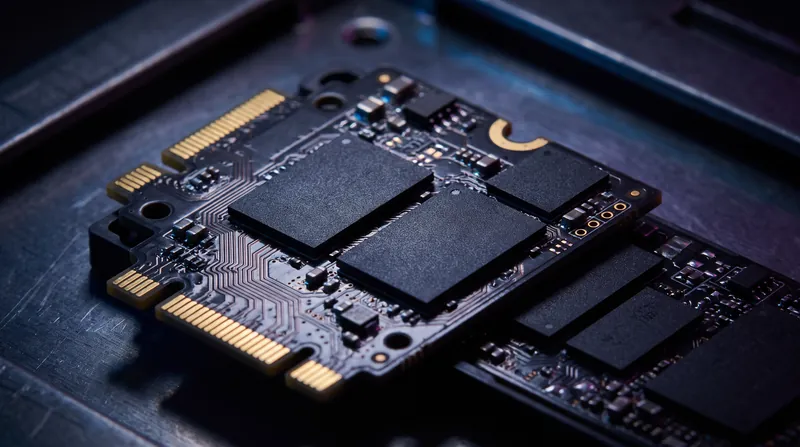
The situation is equally dire in the storage market. NAND flash, the non-volatile memory used in solid-state drives (SSDs) and smartphone storage, is experiencing a similar capacity squeeze. As data centers hoard high-capacity enterprise SSDs to store the massive datasets required for AI training, consumer SSD prices have surged. PC builders and laptop buyers are finding that upgrading their storage capacity is significantly more expensive than it was just a year ago.[1]
Is there an end in sight? The standard free-market response to high prices is to build more capacity. However, the semiconductor industry does not move quickly. Building a new, state-of-the-art memory fabrication plant costs upwards of $15 billion and takes three to four years to reach volume production. While the major fabricators are investing heavily in new facilities, that capacity will not come online in time to relieve the current pressure. The physical constraints of the supply chain mean that chipflation is a structural reality, not a temporary blip.[1]
Furthermore, the memory fabricators are currently enjoying record profit margins. After a brutal cyclical downturn in 2023, the AI-driven shortage has transformed their balance sheets. From a purely business perspective, they have little incentive to flood the market with cheap consumer DRAM and crash the prices that are currently driving their stock valuations to all-time highs. The oligopolistic nature of the memory market ensures that supply will be metered out carefully.[1][2]
For the average consumer, the takeaway is stark. The era of perpetually cheaper electronics has been paused by the demands of artificial intelligence. Until the global semiconductor supply chain can physically expand to accommodate both the voracious appetite of AI data centers and the steady needs of the consumer market, buyers should expect to pay a premium. The tension between the cloud and the consumer has been resolved, for now, in favor of the cloud.[1][3]
Key points
- The AI boom is causing a severe global shortage of computer memory, driving up prices for consumer electronics.
- AI data centers require High Bandwidth Memory (HBM), which is highly resource-intensive to manufacture.
- Producing one bit of HBM displaces roughly three to four bits of conventional consumer memory on the factory floor.
- Major memory fabricators have shifted production to prioritize high-margin AI chips over consumer components.
What we don’t know
- Whether the promised new fabrication plants coming online in 2027 will be enough to satisfy both AI and consumer demand.
- How much of the 'hidden AI surcharge' consumer electronics manufacturers will permanently bake into their base pricing models.
- If alternative memory architectures currently in research could eventually replace HBM and relieve the manufacturing bottleneck.
How we got here
Late 2023
The memory market experiences a severe supply glut, causing prices for consumer DRAM and SSDs to plummet to historic lows.
Early 2024
The generative AI boom accelerates, leading hyperscalers to place massive orders for AI accelerators and the High Bandwidth Memory required to run them.
Mid 2025
Memory fabricators begin aggressively shifting factory capacity away from consumer DRAM to prioritize high-margin HBM production.
Early 2026
The supply squeeze hits the consumer market, causing retail prices for RAM kits, SSDs, and finished electronics to spike.
August 2026
Major consumer electronics brands publicly cite memory costs as the driver behind hardware price increases.
- Hyperscale Cloud Providers
- Securing advanced memory is an existential requirement for the AI race, regardless of cost.
- Consumer Electronics Manufacturers
- Soaring component costs are destroying hardware margins and forcing unpopular retail price hikes.
- Memory Fabricators
- Prioritizing high-margin AI memory is necessary to fund the massive capital costs of new fabrication plants.
Perspectives this story doesn't cover
- Independent PC Builders
- Budget-Conscious Consumers
Sources
Source coverage
5 outlets
3 viewpoints surfaced





- [1]World Economic ForumHyperscale Cloud Providers
Chipflation: What to know about 'AI's hidden price tag'
Read on World Economic Forum → - [2]AxiosHyperscale Cloud Providers
Apple and Microsoft raise prices due to AI memory costs
Read on Axios → - [3]CNNConsumer Electronics Manufacturers
Why AI data centers are driving up consumer electronics prices
- [4]WikipediaMemory Fabricators
High Bandwidth Memory
Read on Wikipedia → - [5]Samsung SemiconductorMemory Fabricators
HBM3 | High Bandwidth Memory
Read on Samsung Semiconductor →

More in Technology
See all →Storage Hardware
100,000 P/E Cycles vs. 1,000 P/E Cycles: How NAND Cell Structure Dictates SSD Lifespan and Cost
6 sources
Display Tech
The Definitional Difference: Comparing OLED, QLED, and Mini-LED Display Technologies for Consumer Electronics
4 sources

Ambient AI
OpenAI Developing Screenless Smart Speaker with Mechanical Parts to Challenge Apple and Google
6 sources

Chip Architecture
Huawei Patents Ternary Logic Chip, Signaling Major Shift from Binary Computing Paradigm
4 sources
Comments
Every angle. Every day.
Get Technology stories with full source coverage and perspective breakdowns, free every day.