
Google Acquires Spirit Airlines' Enterprise Data Archive for $10 Million to Train AI Models
Following its May 2026 liquidation, Spirit Airlines is selling its internal corporate data to Google for $10 million. The massive archive of emails, code, and operational history will be scrubbed of personal information and used to train artificial intelligence systems.
By Layla Zaher

- Restructuring & Aviation Analysts
- Industry experts view the liquidation and data sale as a landmark precedent for asset recovery.
- AI Developers
- AI companies view enterprise data as the next essential frontier for training sophisticated models.
- Privacy Advocates
- Privacy experts emphasize the need for rigorous de-identification when monetizing corporate archives.
Key terms
- Digital Exhaust
- The trail of data left by the routine activities of a company's employees and systems, such as emails, chat logs, and IT tickets.
- De-identification
- The process of removing or obscuring personally identifiable information from a dataset to protect individual privacy.
- Chapter 11 Reorganization
- A bankruptcy process where a company attempts to restructure its debts and continue operating, which Spirit attempted twice before failing.
- Liquidation
- The process of bringing a business to an end and distributing its assets to claimants, which Spirit entered in May 2026.
Key points
- Google won a bankruptcy auction to acquire Spirit Airlines' internal enterprise data for $10 million.
- The archive includes 100 million emails, 500 million Teams messages, and 30 million lines of code.
- All customer profiles, loyalty records, and payment details are explicitly excluded from the sale.
- AI developers are increasingly purchasing corporate digital exhaust to train models on complex organizational behavior.
- Spirit Airlines ceased all flight operations in May 2026 after its second bankruptcy reorganization collapsed.
On August 14, 2026, Google won a bankruptcy auction for an unconventional and highly revealing asset: the internal enterprise data of Spirit Airlines. The technology giant agreed to pay $10 million for the digital exhaust of the defunct ultra-low-cost carrier, successfully outbidding AI data startup Mercor, which had submitted a $7.5 million backup offer. The transaction, which remains pending final approval by the U.S. Bankruptcy Court for the Southern District of New York, marks a novel intersection between corporate liquidation and artificial intelligence development. It establishes a clear market price for the internal communications and operational records of a major enterprise.[1][3][4]
The data sale is part of a broader, systemic wind-down for Spirit Airlines, which abruptly ceased all flight operations on May 2, 2026. The carrier had been navigating severe financial distress, having lost more than $2.5 billion since 2020. After a federal judge blocked its proposed $3.8 billion merger with JetBlue—a deal management viewed as its primary survival path—and a geopolitical jet-fuel spike destroyed its remaining liquidity, the airline's second Chapter 11 reorganization collapsed. The transition from a planned restructuring to a full liquidation forced the immediate termination of roughly 17,000 employees and the piecemeal auction of the company's remaining assets.[6][7][8]
While physical aviation assets like aircraft, maintenance equipment, and airport slots are standard fare in bankruptcy sales—JetBlue, for instance, purchased Spirit's 22 takeoff and landing slots at LaGuardia Airport for $58.5 million—the auctioning of an entire corporate digital history represents a new frontier in asset recovery. The dataset encompasses the operational memory of a $6 billion company across three decades of continuous operation. By packaging and selling this internal infrastructure, the bankruptcy process is extracting value from the administrative byproduct of the airline's daily functions, turning decades of routine corporate communication into a monetizable commodity.[3][4]
According to court filings and public descriptions of the deal, the archive is exceptionally comprehensive. It includes roughly 100 million employee emails, 500 million Microsoft Teams messages, and 30 million lines of production code distributed across hundreds of software repositories. The package also contains IT support tickets, corporate calendars, financial spreadsheets, and billions of transaction rows covering flight schedules, crew pairings, aircraft maintenance logs, and fuel consumption records dating back to 1986. This vast collection of files captures the granular, day-to-day reality of running a highly complex, logistics-heavy transportation network.[1][3][4]
Crucially, the acquisition does not include any consumer-facing information, reflecting strict boundaries around personal privacy in corporate liquidations. Spirit's 97.5 million passenger profiles, 50 million Free Spirit loyalty program records, and all credit card payment details are explicitly carved out of the transaction. To ensure compliance, the remaining enterprise data will be processed by a third-party de-identification agent. This agent is tasked with rigorously scrubbing the archive of any incidental personal identifiers, applying standards from the California Consumer Privacy Act and HIPAA, before Google takes possession of the files.[1][2][4]
Crucially, the acquisition does not include any consumer-facing information, reflecting strict boundaries around personal privacy in corporate liquidations.
The motivation behind Google's $10 million purchase lies in the rapidly evolving data requirements of artificial intelligence development. As major AI laboratories exhaust the supply of high-quality text available on the public internet, they are increasingly hitting a training bottleneck. To build more capable and sophisticated models, developers now need access to proprietary, structured enterprise data that can teach AI systems how complex organizations actually function, make decisions, and resolve internal conflicts over extended periods. A defunct airline provides a perfect, closed-loop dataset of corporate behavior without the competitive risks of acquiring data from an active company.[2][4][5]
Spirit's archive is particularly valuable because it provides a complete, interconnected map of corporate operations. Unlike fragmented public datasets, this internal archive links an initial IT support ticket directly to the emails discussing the problem, the software code written to address it, the peer review comments on that code, and the ultimate operational result of the deployment. This unbroken chain of cause and effect allows machine learning models to understand the full lifecycle of corporate problem-solving, mapping how human teams collaborate to overcome logistical hurdles.[1][2]
For Google, this material offers a unique opportunity to train AI models not just on what a company does, but on how its teams communicate, escalate issues, schedule resources, and manage disruptions in real time. By analyzing decades of crew scheduling adjustments, maintenance delays, and revenue management decisions, the AI can learn the underlying patterns of enterprise logistics. This depth of organizational behavior and institutional knowledge cannot be scraped from public websites, making it a highly prized asset for developing enterprise-grade AI assistants.[2][5]
The competitive bidding dynamic between Google and Mercor demonstrates that corporate digital exhaust is rapidly becoming a recognized and highly sought-after asset class. Proprietary internal information now holds significant market value entirely independent of the company that originally generated it. As AI companies continue to seek out fresh training fuel, the digital records of bankrupt or acquired firms may increasingly be viewed as lucrative intellectual property, prompting a shift in how companies manage and store their internal communications.[3][5]
This development introduces a new variable into the bankruptcy and corporate restructuring ecosystem. For trade creditors, restructuring advisors, and investment banks managing complex liquidations, the digital back office represents a previously untapped source of recovery capital. While $10 million is a fraction of Spirit's billions in outstanding debt, it establishes a precedent that a company's emails, chat logs, and code repositories are tangible assets that can be monetized to repay creditors, fundamentally altering how a failed enterprise is valued during Chapter 7 proceedings.[4][6]
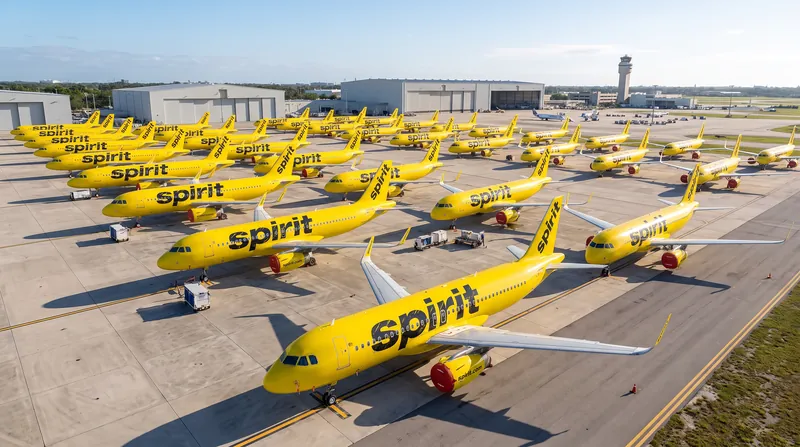
The data sale serves as the final, quiet legacy of Spirit Airlines, closing the book on a carrier that once transported 44 million passengers annually. The airline ultimately could not survive the structural pressures of the U.S. aviation market, the relentless margin pressure from legacy carriers, and the sudden macroeconomic shocks of fuel pricing. Its collapse leaves behind a grounded fleet, a disrupted ultra-low-cost travel market, and a highly valuable digital footprint that will outlive the airline itself.[6][8]
By absorbing the operational history of a defunct airline, the technology sector is effectively recycling the administrative byproduct of the aviation industry. It is a measured, systemic transfer of resources from one node of the economy to another. The internal communication, logistical planning, and software code that ultimately failed to save Spirit Airlines will now be repurposed. In a striking pivot from aviation to technology, the digital exhaust of a bankrupt carrier will serve as the foundational logic and training fuel for the next generation of artificial intelligence systems, ensuring the airline's operational memory continues to generate value long after its final flight.[3][5]
Frequently asked
Did Google buy Spirit Airlines?
No. Google only purchased the defunct airline's internal enterprise data archive for $10 million during its bankruptcy liquidation.
Will Google have access to my passenger data?
No. The sale explicitly excludes all customer profiles, loyalty program records, and payment details. The remaining data will be scrubbed by a third party.
Why does an AI company want airline data?
AI developers need massive amounts of structured, real-world corporate data to train models on how complex organizations function, communicate, and solve problems.
What happened to Spirit Airlines?
Spirit ceased all flight operations in May 2026 and entered liquidation after a blocked merger, mounting debt, and a sudden spike in jet fuel prices.
Why this matters
The $10 million sale establishes a new market for corporate digital exhaust, proving that a company's internal emails and code hold massive value for AI training. It signals a shift where the administrative byproduct of failed businesses becomes the foundational infrastructure for next-generation technology.
Sources
Source coverage
8 outlets
3 viewpoints surfaced








- [1]View From The WingRestructuring & Aviation Analysts
What Google Is Buying Out Of Spirit Airlines Bankruptcy
Read on View From The Wing → - [2]The TravelerPrivacy Advocates
From Bankrupt Airline to Data Windfall
Read on The Traveler → - [3]TroveoAI Developers
The $10M Data Auction
Read on Troveo → - [4]24/7 Wall St.Restructuring & Aviation Analysts
Alphabet (GOOGL) beat a competing bid to acquire Spirit Airlines' 100M emails
Read on 24/7 Wall St. → - [5]Simple FlyingAI Developers
Google has agreed to pay $10 million for a large collection of internal business data from Spirit Airlines
Read on Simple Flying → - [6]Securitas GlobalRestructuring & Aviation Analysts
Spirit Airlines is out of business
Read on Securitas Global → - [7]ElevenfloRestructuring & Aviation Analysts
Spirit Airlines filed for Chapter 11 twice in under a year
Read on Elevenflo → - [8]WikipediaRestructuring & Aviation Analysts
Spirit Airlines
Read on Wikipedia →
Comments
Every angle. Every day.
Get transportation stories with full source coverage and perspective breakdowns delivered to your inbox.