
Education Department Finalizes Workforce Pell Rule, Allowing Aid for 8-Week Training Programs
A historic expansion of federal financial aid now allows students to use Pell Grants for short-term, career-focused training programs. The policy aims to fill critical workforce shortages in healthcare and technology by funding credentials that take as little as eight weeks to complete.
By Paige Carter

Share this story
For decades, the conventional wisdom about federal financial aid has been absolute: Pell Grants are strictly reserved for traditional two- or four-year college degrees, and short-term job training is something you must pay for out of pocket or through private loans. That rigid divide officially collapsed this summer.
As of July 1, 2026, the new Workforce Pell Grant program allows eligible students to use federal aid for short-term, career-focused credentials that take as little as eight weeks to complete, fundamentally reshaping how the United States funds postsecondary education and workforce development.[3]
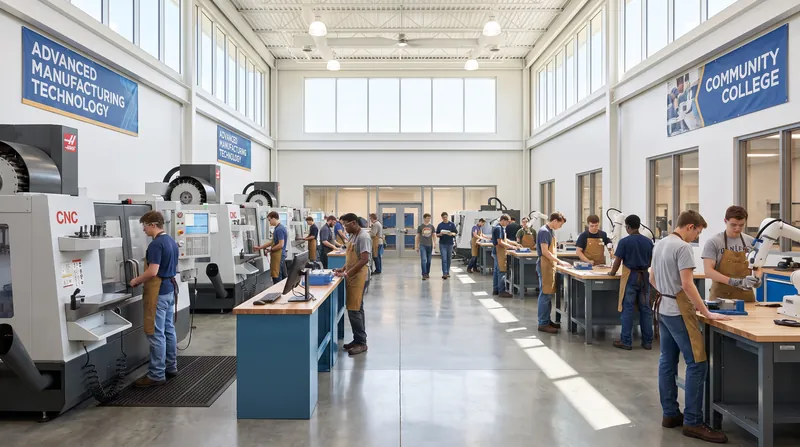
The policy shift unlocks up to several thousand dollars in non-repayable federal aid for adult learners, career changers, and recent high school graduates pursuing high-demand trades. Instead of committing to a multi-year degree program, students can now direct prorated Pell funds toward intensive 150- to 599-clock-hour programs in fields like healthcare, information technology, and advanced manufacturing. This financial bridge removes one of the most significant barriers for non-traditional students who need to acquire marketable skills quickly but cannot afford to take on the burden of traditional student loan debt.[2][3]
The rollout is already moving rapidly from federal rulemaking to local reality. In August 2026, the U.S. Department of Education officially approved the nation's first two Workforce Pell programs: an Emergency Medical Technician (EMT) certificate at Iowa Central Community College and an eight-week Clinical Medical Assistant program at Indiana's Ivy Tech Community College. These early approvals serve as a crucial proof of concept, signaling to state workforce boards and community colleges nationwide that the federal funding pipeline is officially open and actively processing institutional applications.[1]
To qualify for this new stream of federal funding, training programs must meet strict accountability metrics designed to prevent predatory practices and ensure positive outcomes. A program must demonstrate a minimum 70 percent completion rate and a 70 percent job placement rate for exiting students. Furthermore, the tuition and fees charged by the institution cannot exceed the 'value-added earnings' of its graduates, a safeguard ensuring that the training actually delivers a tangible financial return on investment in the local labor market rather than simply generating institutional revenue.[1][6]
This initiative marks a historic shift in how federal student aid is administered, creating a novel state-federal partnership. For the first time in the history of the Pell Grant program, state governors and local workforce boards are formally integrated into the approval process. States are now tasked with identifying high-skill, high-wage, or in-demand occupations within their specific borders and rigorously vetting the corresponding training programs before they are submitted to the federal government for final authorization, ensuring that federal dollars directly address regional economic needs.[5]
For employers facing persistent and crippling staffing shortages, particularly in the healthcare and skilled trades sectors, the influx of federal funding represents a massive opportunity to rebuild depleted talent pipelines. Human resources leaders and workforce development boards are already rethinking their recruitment and training strategies. They recognize that hundreds of thousands of learners will soon have the financial backing to complete short-term clinical and technical training, creating a much larger pool of qualified applicants for critical entry-level and mid-level positions that have sat vacant for months.[2][4]
Student eligibility for Workforce Pell largely mirrors the traditional Pell Grant requirements, with a few key distinctions designed to maximize workforce mobility. Applicants must meet standard low- to middle-income thresholds and must not have already earned a graduate degree. However, in a significant departure from traditional rules, students who already hold a bachelor's degree are uniquely eligible to use Workforce Pell to pivot into a new career. This specific provision lowers the barrier for college-educated adults who want to reskill quickly for higher-demand industries without taking on additional debt.[1][3]
As state legislatures and higher education institutions navigate the complexities of the new regulatory framework, the pace of program approvals is expected to accelerate significantly through the fall of 2026. With the federal funding spigot now officially open, the focus shifts entirely to community colleges and technical schools across the country.
These institutions are racing to design stackable, high-quality credentials that can meet both the stringent federal performance benchmarks and the immediate, evolving needs of local employers desperate for trained talent. The success of the program will ultimately depend on how seamlessly these local partnerships can operate.[4][5]
Viewpoints in depth
State Workforce Boards
State agencies are focused on the new administrative responsibilities and the alignment of federal aid with local economic needs.
For the first time, state governors and local workforce boards are formally integrated into the federal financial aid approval process. These agencies view Workforce Pell as a powerful lever to direct federal dollars toward specific regional skills gaps, rather than generic degree programs. However, they also face a steep administrative learning curve, as they must establish rigorous data-collection systems to verify that training providers are actually hitting the mandated 70 percent job placement and completion benchmarks before granting state-level approval.
Community Colleges & Training Providers
Educational institutions see a major opportunity to boost enrollment among adult learners and career changers.
Community colleges and technical schools are moving quickly to adapt their existing short-term programs to meet federal eligibility standards. For these institutions, Workforce Pell unlocks a massive new demographic of non-traditional students who previously could not afford out-of-pocket tuition for eight-week certificates. Administrators are prioritizing the development of stackable credentials—programs that not only lead to immediate employment but also count as credit toward future associate or bachelor's degrees, ensuring students remain engaged in the higher education system.
Healthcare & Industrial Employers
Employers view the expanded aid as a critical solution to persistent frontline staffing shortages.
Industry groups and human resources leaders have long lobbied for federal support for skills-based training. With Workforce Pell now active, employers in high-demand sectors like healthcare, advanced manufacturing, and information technology anticipate a steady influx of qualified applicants for entry-level clinical and technical roles. Many companies are actively partnering with local community colleges to design the exact curricula needed for roles like medical assistants and CNC operators, ensuring that the federally subsidized training translates directly into day-one job readiness.
Key points
- The Workforce Pell Grant program officially launched in July 2026, expanding federal aid to short-term training programs.
- Eligible programs must last between 8 and 15 weeks and align with high-demand occupations.
- The U.S. Department of Education has already approved the first programs, including EMT and medical assistant certificates in Iowa and Indiana.
- Programs must maintain a 70 percent completion and job placement rate to retain federal funding eligibility.
How we got here
July 2025
Congress passes the legislative framework establishing the Workforce Pell Grant program.
May 2026
The U.S. Department of Education publishes the final rule outlining program eligibility and accountability metrics.
July 1, 2026
The Workforce Pell Grant program officially takes effect, allowing students to use federal aid for short-term training.
August 2026
The first two eligible programs are approved in Iowa and Indiana, opening the door for nationwide implementation.
- Community Colleges & Training Providers
- Educational institutions see a major opportunity to boost enrollment among adult learners and career changers.
- Healthcare & Industrial Employers
- Employers view the expanded aid as a critical solution to persistent frontline staffing shortages.
- State Workforce Boards
- State agencies are focused on the new administrative responsibilities and the alignment of federal aid with local economic needs.
Perspectives this story doesn't cover
- Four-year universities concerned about declining enrollment in traditional degree programs.
- Labor unions evaluating the impact of short-term credentials on industry wage standards.
Sources
Source coverage
6 outlets
3 viewpoints surfaced






- [1]U.S. Department of EducationCommunity Colleges & Training Providers
U.S. Department of Education Approves Nation's Second Workforce Pell Grant Program in Indiana
Read on U.S. Department of Education → - [2]Society for Human Resource ManagementHealthcare & Industrial Employers
Workforce Pell: Expanding Access to Short-Term Job Training
Read on Society for Human Resource Management → - [3]Sophie SmartCommunity Colleges & Training Providers
New Workforce Pell Grants: Federal Aid Now Covers Short-Term Career Training
Read on Sophie Smart → - [4]SkillTradeHealthcare & Industrial Employers
Workforce Pell July 2026: What Employers Need to Know
Read on SkillTrade → - [5]National Conference of State LegislaturesState Workforce Boards
Workforce Pell State Implementation Guide
Read on National Conference of State Legislatures → - [6]Factlen Editorial TeamState Workforce Boards
Synthesis by Factlen editorial team
Read on Factlen Editorial Team →
More in Education
See all →Career Assessment
The Holland Codes (RIASEC): How Vocational Interests Predict Job Satisfaction and Career Choice
5 sources

CDL Training
Federal Crackdown Hits CDL Training Schools as FMCSA Removes Over 110 Providers
5 sources
Student Debt
First Wave of SAVE Borrowers Face Sept 29 Deadline to Avoid Automatic Transfer to Standard Repayment Plan
5 sources

AI in Education
Estonia Expands National 'AI Leap' Program to Vocational Education
4 sources

Comments
Every angle. Every day.
Get Education stories with full source coverage and perspective breakdowns, free every day.