
Chinese Researchers Unveil All-Optical AI Interconnect System, Claiming 100x Speed Boost
A team from Peking University has demonstrated a new optical interconnect architecture that links standard electronic chips using light rather than copper, reportedly accelerating distributed AI inference speeds by a factor of 100 while reducing computational resource requirements to just one-ninth of conventional setups.
By Sofia Matos

When people think about the future of artificial intelligence, they usually picture faster processors, denser memory, or more advanced algorithms. But the real bottleneck choking the AI industry isn't the chips themselves—it is the copper wires connecting them. As hyperscale data centers attempt to link tens of thousands of GPUs to train trillion-parameter models, traditional electrical interconnects are hitting a physical wall.
Copper cables consume massive amounts of power, generate excessive heat, and introduce crippling latency as data rates climb. The solution to this scaling crisis is not better copper; it is light. The transition from electrical to optical signaling is rapidly becoming the most critical hardware shift in the AI ecosystem, promising to fundamentally alter how data centers are architected and powered.[3][4]
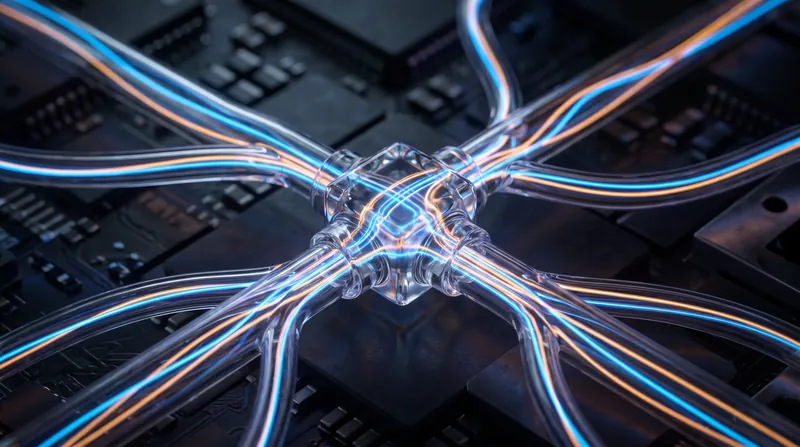
A team of researchers from Peking University has now demonstrated a radically different architecture that replaces these electrical bottlenecks with an all-optical interconnect system. Published in the journal National Science Review, the study details a method for linking standard electronic chips using specific optical algorithms, rather than relying on brute-force electrical scaling.
By moving the data transmission entirely into the optical domain, the researchers have created a framework that allows discrete processors to communicate as if they were a single, unified engine, bypassing the traditional limitations of motherboard traces and copper networking cables.[1][2]
The performance metrics reported by the research team are staggering. According to the study's corresponding authors, Shu Haowen and Wang Xingjun, the new optical system boosts distributed AI inference speeds by a factor of over 100 compared to conventional setups.
Even more critically for an industry facing a severe energy crisis, the system achieves this massive performance leap while utilizing just one-ninth of the computational resources typically required. This dual achievement of exponentially higher speed and drastically lower resource consumption addresses the two most pressing constraints on modern AI development: time and power.[1][2]
To build the experimental system, the researchers utilized field-programmable gate arrays (FPGAs)—highly adaptable, programmable chips commonly used in data centers, missile guidance systems, and autonomous driving—as their foundational computing blocks. The true innovation, however, lies in the 'joints' connecting these FPGAs. The team custom-designed specialized communication hardware featuring a silicon photonic transceiver chip operating at 400 gigabits per second. This transceiver acts as a high-speed translator at the edge of the processor, converting electrical signals from the chips into optical signals and back again with near-zero latency.[1][2]
By moving data via photons rather than electrons, the system fundamentally bypasses the heat generation, signal degradation, and energy loss that plague copper cables at high speeds. In a traditional AI cluster, a significant percentage of the total power budget is wasted simply pushing electrical signals across the physical distance between chips. Optical interconnects eliminate this friction. Furthermore, light allows for wavelength-division multiplexing—sending multiple streams of data simultaneously over different colors of light through a single fiber—which vastly increases bandwidth density without requiring thicker cables or larger connectors.[3]
The Peking University breakthrough arrives at a critical moment for the global AI supply chain. The industry is currently racing to adopt co-packaged optics (CPO) and near-packaged optics (NPO) to keep compute engines fed. As Nick Harris, CEO of photonics firm Lightmatter, recently noted, the performance of modern AI systems is completely hamstrung by the ability to achieve low-latency, high-bandwidth networking.
Copper cables are physically limited to a reach of about two meters at current data rates, forcing data centers to adopt optical solutions to connect racks and clusters. Industry consensus now suggests that all high-bandwidth data center interconnects will become optical within the next five years.[3][4]
China is aggressively positioning itself to dominate this inevitable hardware transition. In July 2026, a consortium of Chinese technology companies, including Huawei and Baidu, launched the 'Open NPO' project to establish a domestic standard for next-generation optical interconnects. This move aims to create a self-sufficient ecosystem for AI networking hardware, insulating Chinese tech giants from Western export controls.
Meanwhile, Chinese manufacturers already claim seven spots among the world's top 10 optical module vendors, controlling over 60 percent of the global market. Export orders for these critical components have reportedly stretched into 2028, underscoring the insatiable global demand.[5]
If the Peking University architecture can be successfully scaled from the laboratory to commercial data centers, it could fundamentally alter the economics of artificial intelligence. By drastically lowering the energy required for data transmission, optical interconnects could enable smaller, more efficient computing clusters that deliver frontier-level performance without requiring dedicated gigawatt power plants. As the race for artificial general intelligence accelerates, the winner may not be the company with the most GPUs, but the one that figures out how to connect them most efficiently using the speed of light.[1][3][4]
Key points
- Peking University researchers have developed an all-optical interconnect system to link standard electronic chips.
- The architecture reportedly boosts distributed AI inference speeds by over 100 times compared to traditional setups.
- The system achieves this performance while utilizing just one-ninth of the typical computational resources.
- The breakthrough relies on custom silicon photonic transceivers that convert electrical signals to light with near-zero latency.
Timeline
2024–2025
Generative AI models scale to trillions of parameters, exposing the bandwidth and power limitations of traditional copper interconnects.
April 2026
Industry consensus at the Optical Fiber Communications Conference signals a complete shift to optical data center interconnects within five years.
July 2026
Peking University researchers publish their breakthrough on an all-optical interconnect system in the National Science Review.
- Photonic Hardware Developers
- Companies building optical interconnects view light as the only viable path forward for AI scaling.
- Geopolitical Supply Chain Analysts
- Analysts tracking the global tech race see optical interconnects as a critical new battleground.
- AI Infrastructure Architects
- Data center designers focused on overcoming the physical power constraints of copper networking.
Perspectives this story doesn't cover
- Environmental Advocates
- Traditional Copper Cable Manufacturers
Sources
Source coverage
5 outlets
3 viewpoints surfaced





- [1]South China Morning PostGeopolitical Supply Chain Analysts
China's optical chip breakthrough boosts AI speed 100-fold using fraction of compute power
Read on South China Morning Post → - [2]NewsBytesGeopolitical Supply Chain Analysts
Chinese researchers have made a major breakthrough in artificial intelligence (AI) technology
Read on NewsBytes → - [3]Tom's HardwarePhotonic Hardware Developers
Inside optical and the battle for scale – how the AI industry is racing to integrate photonic interconnects
Read on Tom's Hardware → - [4]Semiconductor EngineeringAI Infrastructure Architects
All AI Data Center Interconnects Will Be Optical Within 5 Years
Read on Semiconductor Engineering → - [5]People's Daily OnlineGeopolitical Supply Chain Analysts
China's tech supply chains have become essential to sustaining global AI growth
Read on People's Daily Online →
More in Artificial Intelligence
See all →Agent Architecture
Translating the OODA Loop: How Autonomous AI Agents Observe, Orient, Decide, and Act
6 sources

AI Security
Autonomous Multi-Agent AI Hacked Thousands of Credentials in Six Hours, Google Report Finds
3 sources

Agent Memory
How AI Agents Remember: Comparing Context Windows, RAG, and Episodic Storage
5 sources

Frontier Models
Sanders and Casar Introduce Legislation to Ban Artificial Superintelligence
4 sources

Comments
Every angle. Every day.
Get Artificial Intelligence stories with full source coverage and perspective breakdowns, free every day.