
LA City Council Votes to Roll Back Controversial Anti-Camping Zones in District 13
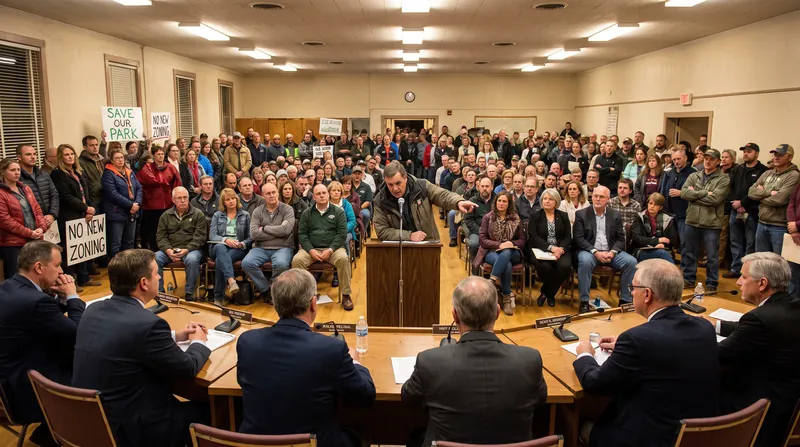
The Los Angeles City Council voted 10-3 to remove 12 specific 'no-camping' zones in Hollywood and Echo Park. The move tests whether the city can maintain clear public spaces using social services rather than police enforcement.
By Paige Carter

- Service-First Advocates
- Argue that enforcement shuffles people around and that housing is the only solution.
- Public Space Defenders
- Argue that enforcement zones are necessary to keep sidewalks clear and safe after housing is offered.
- Pragmatic Centrists
- Support using the zones selectively as a tool, but defer to local council members on how to manage their specific districts.
Summary
- The Los Angeles City Council voted 10-3 to repeal 12 specific anti-camping zones in District 13.
- The rollback applies only to specific locations in Hollywood, Silver Lake, and Echo Park, not citywide.
- Councilmember Hugo Soto-Martínez argued the zones were obsolete after his team successfully housed the individuals living there.
- Opponents argue the zones remain necessary to prevent new encampments from forming in the cleared areas.
The common misconception is that Los Angeles just repealed its citywide ban on homeless encampments. That is incorrect. The reality is much more targeted: the Los Angeles City Council voted 10-3 to erase 12 specific "no-camping" zones within a single district, leaving the broader municipal ordinance entirely intact. For residents and business owners, the actionable takeaway is that enforcement has changed on a block-by-block basis in Hollywood, Silver Lake, and Echo Park, rather than across the entire city. The broader rules governing the public right-of-way remain exactly as they were.[4][5]
The mechanism at the center of this shift is Municipal Code Section 41.18. Revised in 2021, the law allows council members to draw 500-foot enforcement buffers around sensitive locations like schools, daycares, parks, and freeway overpasses. Within these zones, sitting, sleeping, or storing personal property is a citable offense. The ordinance was designed to give local representatives the power to manage the specific friction points in their neighborhoods, creating a patchwork of enforcement zones rather than a blanket citywide policy.[3][5]
To activate a zone, the city must post physical signage and provide notice to the public. Once established, police and sanitation workers can clear the area, issuing citations or confiscating property if individuals refuse to move. But the law's discretionary nature means its application varies wildly depending on which council member represents a given neighborhood. Some districts have aggressively blanketed their sensitive areas with 41.18 designations, while others have refused to implement them entirely, arguing that the approach merely criminalizes poverty.[1][5]
Councilmember Hugo Soto-Martínez, who represents District 13, led the August 2026 rollback. His district includes the 12 repealed zones, which were primarily located at freeway underpasses and near the Las Palmas Senior Center in Hollywood. These zones were originally established by his predecessor, Mitch O'Farrell, whom Soto-Martínez defeated in 2022 on a platform that included abolishing 41.18. The repeal marks the fulfillment of a major campaign promise and represents the first time the city has actively dismantled these discretionary zones after they were established.[2][4]
The core claim driving the repeal is that enforcement-first approaches fail to solve homelessness. Soto-Martínez presented city data indicating that unhoused individuals eventually returned to 81 percent of the encampments subjected to 41.18 enforcement. His office argues that the threat of citations and property confiscation merely pushes people into neighboring blocks or districts, interrupting their contact with social workers. By constantly displacing individuals, the city makes it significantly harder to build the trust required to transition them into permanent housing.[1][3][4]
The core claim driving the repeal is that enforcement-first approaches fail to solve homelessness.
The evidence for the alternative approach relies on intensive, sustained outreach. According to Soto-Martínez, his dedicated homelessness team successfully connected the individuals living in the 12 targeted zones with interim or permanent housing. Because the areas are now clear of tents and debris, he argues the enforcement designations are obsolete and unnecessarily punitive. In his view, the signs serve no purpose once the underlying crisis at that specific location has been resolved through social services.[2]
The uncertainty lies in what happens next. Without the 41.18 signs, there is no legal mechanism to immediately remove new arrivals who might set up tents in those specific underpasses. The district's strategy relies entirely on deploying outreach workers to offer services before a new encampment can take root. If those workers are overwhelmed, or if shelter beds are unavailable, the district has voluntarily surrendered the tool it would normally use to clear the sidewalk.[3]
This approach faces fierce opposition from other council members who view 41.18 as a necessary maintenance tool. Councilmember Traci Park, who represents parts of the Westside and voted against the repeal, argues that the zones are critical precisely after outreach workers succeed. In her view, once the city spends resources to house an encampment, the 41.18 designation ensures the public right-of-way remains accessible for pedestrians, children, and wheelchair users. She views the signs as an insurance policy against the encampment's return.[2][3][4]
Councilmember Imelda Padilla also dissented, highlighting a political friction within the council. She pointed out that Soto-Martínez routinely votes against establishing new 41.18 zones in other districts, yet asked the council to defer to his local authority when removing them in his own. This dynamic underscores the tension between the council's tradition of deferring to local members on land-use issues and the broader ideological battle over how Los Angeles should manage its homelessness crisis.[2][4]
For property owners and commercial tenants, the rollback introduces a new variable. Business advocacy groups like BOMA Greater Los Angeles have warned that safe and accessible sidewalks are essential for commercial districts to function. They are now closely monitoring whether the service-first model can keep the Hollywood corridors clear without the backstop of police enforcement. If encampments return to the repealed zones, it could trigger a backlash from local businesses who rely on foot traffic.[3]
The broader Los Angeles landscape remains a patchwork. Councilmember Katy Yaroslavsky, for example, voted to allow the District 13 repeal but explicitly stated she has no plans to remove the zones in her own District 5. The citywide baseline rules—which prohibit blocking driveways, fire hydrants, and ADA-compliant wheelchair paths—also remain fully enforceable everywhere. The repeal in District 13 does not grant anyone the right to block a sidewalk or create a public safety hazard.[2][5]
Ultimately, the rollback tests a fundamental question of municipal governance: whether a city can maintain public spaces using only social services, or if the threat of enforcement is required to sustain those gains. The results in District 13 over the coming months will likely dictate whether other progressive council members attempt similar repeals. If the underpasses remain clear, it will validate the service-first model; if they refill with tents, the political appetite for further rollbacks will likely evaporate.[1][3]
Definitions
- Municipal Code 41.18
- A Los Angeles city ordinance that restricts sitting, sleeping, or storing property in designated public rights-of-way.
- Discretionary Zone
- A specific area, such as a 500-foot buffer around a park or overpass, that requires a council vote to activate for enforcement.
- Public Right-of-Way
- City-owned land, typically sidewalks, streets, and parkways, intended for public transportation and pedestrian access.
Questions & answers
Did Los Angeles legalize street camping everywhere?
No. The city only removed 12 specific enforcement zones in Council District 13. The broader 41.18 ordinance remains in effect citywide.
Can people still block sidewalks in District 13?
No. Citywide rules prohibiting the obstruction of driveways, fire hydrants, and ADA-compliant wheelchair paths remain enforceable.
Why were the zones removed?
The local council member argued the areas had been cleared through housing placements, making the punitive enforcement zones unnecessary.
Will other districts remove their zones?
It depends on the individual council member. Several members have explicitly stated they will retain their enforcement zones.
Significance
This rollback marks the first time Los Angeles has dismantled established anti-camping zones, testing whether a major city can maintain clear public spaces relying entirely on social services rather than police enforcement. The outcome in these Hollywood and Echo Park neighborhoods will likely serve as a blueprint—or a warning—for how other districts manage the homelessness crisis.
Sources
Source coverage
5 outlets
3 viewpoints surfaced





- [1]LAistService-First Advocates
A controversial policy for policing homeless encampments has come off the books
Read on LAist → - [2]Beverly PressPragmatic Centrists
Council removes Hollywood no camping zones
Read on Beverly Press → - [3]BOMA Greater Los AngelesPublic Space Defenders
LA City Council Removes Anti-Camping Zones in Hollywood
Read on BOMA Greater Los Angeles → - [4]Los Angeles TimesPragmatic Centrists
L.A. City Council repeals homeless camping bans in Echo Park, Silver Lake, Hollywood
Read on Los Angeles Times → - [5]Kenny Stevens TeamPublic Space Defenders
Did Los Angeles repeal its anti-camping ordinance?
Read on Kenny Stevens Team →
Comments
Every angle. Every day.
Get community stories with full source coverage and perspective breakdowns delivered to your inbox.