
Barclays Reports $2.3 Trillion Committed to Global Data Center Real Estate in 2026 Amid AI Boom
The artificial intelligence infrastructure buildout is reshaping commercial real estate, with $2.3 trillion committed to data centers this year driving massive downstream demand for warehouse space and new securitized financing models.
By Noor Saidi

Share this story
The artificial intelligence boom has collided with the physical world, demanding a scale of infrastructure that traditional commercial real estate was never designed to support. With power grids straining and capital markets still recovering from post-pandemic rate shocks, the sheer physical footprint required to house and power the next generation of AI models threatened to become the industry's ultimate bottleneck.
But instead of stalling, the real estate sector is rapidly re-engineering its financing and development models to absorb the surge. According to a new baseline established by Barclays, a staggering $2.3 trillion has already been committed to global data center real estate in 2026 alone, with another $3 trillion projected through 2028. This $5.3 trillion pipeline is not just building server farms; it is fundamentally reshaping adjacent property markets, energy infrastructure, and the securitized credit landscape.[1]
The scale of this capital deployment is acting as a transformative growth engine for a commercial real estate market that spent the last two years navigating valuation resets. Apollo Global Management's 2026 outlook highlights that constrained new supply in traditional sectors, combined with this massive AI-driven capital wave, is rewarding investors who can pivot to digital infrastructure.[1]
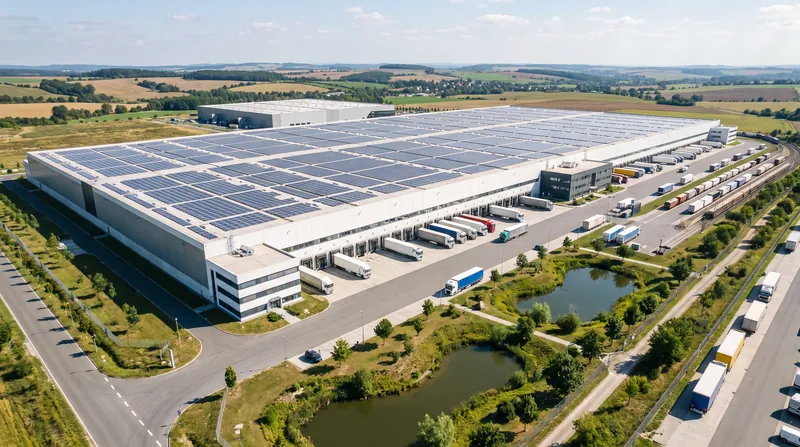
The ripple effects extend far beyond the data centers themselves, spilling over into the industrial and logistics sectors. Prologis, the world's largest owner of logistics real estate, has identified AI infrastructure as a massive new demand driver for its own warehouse portfolio.[2]
The logistics giant now estimates that every $1 trillion poured into data center capital expenditures generates an incremental 30 million to 40 million square feet of new warehouse demand. This downstream requirement—driven by the extensive supply chain, manufacturing, and staging support needed for large-scale AI projects—prompted Prologis to raise its 2026 financial guidance.[2]
Funding this physical expansion, however, requires capital structures that exceed the capacity of traditional single-asset commercial mortgages. JPMorgan estimates that AI hyperscalers will need approximately $1.5 trillion in external investment-grade financing over the next five years, a figure that surpasses current market capabilities.[5]
To bridge this gap, the structured finance market is rapidly adapting. Data-center asset-backed securities (ABS) and commercial mortgage-backed securities (CMBS) are emerging as critical tools to finance stabilized portfolios of operating facilities. Outstanding data-center securitization issuance has surged to $61 billion in 2026, up from just $4 billion in 2020.[3]
Barclays projects that if this trajectory holds, outstanding data-center securitizations could reach $180 billion by the end of 2028, comprising roughly 20 percent of the esoteric ABS market. This shift allows sponsors to create scalable funding platforms, pooling diversified portfolios of data centers supported by long-term lease cash flows from investment-grade tech giants.[3]
Yet, securing the capital and the land only solves two-thirds of the equation; the final, and perhaps most acute, tension in the AI real estate story is power. Data centers are consuming electricity at a rate that outpaces the ability of local utilities to build conventional capacity, making reliable, low-carbon power generation one of the most urgent investment themes of the year.[4]
To address this, capital is flowing into next-generation energy infrastructure that can be co-located with data center developments. Barclays has highlighted companies like NET Power, which pairs gas turbines with post-combustion carbon capture, as critical to delivering large-scale, dispatchable power without violating corporate climate commitments.[4]
Ultimately, the $2.3 trillion committed this year signals that technology-driven real estate has become the most dynamic growth segment in the global market. For commercial property owners, developers, and local communities, the AI boom is no longer an abstract software trend—it is the defining physical development cycle of the decade.[1][6]
Viewpoints in depth
Commercial Real Estate Investors
Viewing AI infrastructure as the primary growth engine for the next decade of property investment.
With traditional commercial sectors like office and retail still navigating post-pandemic valuation resets, institutional investors are pivoting aggressively toward digital infrastructure. Firms like Apollo Global Management argue that the constrained new supply in legacy sectors makes the $5.3 trillion AI data center pipeline the most reliable source of structural growth, rewarding scale and operational expertise.
Logistics & Supply Chain Operators
Capitalizing on the massive downstream warehouse demand generated by data center construction.
The physical footprint of AI extends far beyond the server racks. Logistics giants like Prologis are tracking a direct correlation between data center capital expenditures and warehouse leasing. The extensive supply chain required to manufacture, stage, and deploy cooling systems, generators, and servers is creating a durable, multi-year demand driver for industrial real estate.
Structured Finance Markets
Developing new securitization models to bridge the $1.5 trillion external funding gap.
The sheer scale of capital required by AI hyperscalers exceeds the capacity of traditional single-asset commercial mortgages. The structured finance sector is responding by rapidly expanding the data-center ABS and CMBS markets. By pooling stabilized, operating facilities supported by long-term leases from investment-grade tech companies, these securitized products are creating the scalable funding platforms necessary to sustain the buildout.
Key points
- Barclays reports $2.3 trillion has been committed to global data center real estate in 2026.
- The total AI infrastructure pipeline is projected to reach $5.3 trillion by 2028.
- Every $1 trillion in data center spending generates up to 40 million square feet of new warehouse demand.
- Data-center securitization issuance has surged from $4 billion in 2020 to $61 billion in 2026.
- Commercial Real Estate Investors
- Viewing AI infrastructure as the primary growth engine for the next decade of property investment.
- Logistics & Supply Chain Operators
- Capitalizing on the massive downstream warehouse demand generated by data center construction.
- Structured Finance Markets
- Developing new securitization models to bridge the external funding gap for AI infrastructure.
- Energy Infrastructure Providers
- Focusing on delivering low-carbon, dispatchable power to meet the unprecedented grid demand.
Perspectives this story doesn't cover
- Local Municipal Planners
- Environmental Advocacy Groups
Sources
Source coverage
6 outlets
4 viewpoints surfaced






- [1]Private Markets InsightsCommercial Real Estate Investors
Apollo Global Management's 2026 Real Estate Outlook
Read on Private Markets Insights → - [2]BigGo FinanceLogistics & Supply Chain Operators
Prologis Says Every $1 Trillion in AI Data Center Spending Could Spark Up to 40 Million Square Feet of New Warehouse Demand
Read on BigGo Finance → - [3]Structured Finance AssociationStructured Finance Markets
Financing AI Infrastructure: Beyond Traditional Real Estate
Read on Structured Finance Association → - [4]TradingTipsEnergy Infrastructure Providers
Barclays Names NET Power a Top Pick as AI Energy Demand Surges Toward $1 Trillion in Capex
Read on TradingTips → - [5]Markets.comStructured Finance Markets
JPMorgan Report: AI Hyperscalers' Massive Funding Needs
Read on Markets.com → - [6]Barclays CorporateCommercial Real Estate Investors
Bringing 2026 into focus
Read on Barclays Corporate →
More in Real Estate
See all →Brokerage Consolidation
Real Finalizes $880 Million RE/MAX Acquisition to Form 180,000-Agent Global Brokerage
4 sources
Commercial Real Estate
Shanghai Commercial Property Transactions Surge 77% as Domestic Buyers Hunt for Bargains
6 sources
Ultra-Luxury Real Estate
Global Wealth Influx: Searches for US Luxury Homes Double in 2026, Driven by 'Landmaxxing' Trend
6 sources
Logistics Real Estate
WDP and Argan Announce $14.8 Billion Merger, Creating European Logistics Real Estate Giant
4 sources
Comments
Every angle. Every day.
Get Real Estate stories with full source coverage and perspective breakdowns, free every day.