
Maersk Sells 25% Stake in Rotterdam Terminal to Hapag-Lloyd in Major Carrier Infrastructure Deal
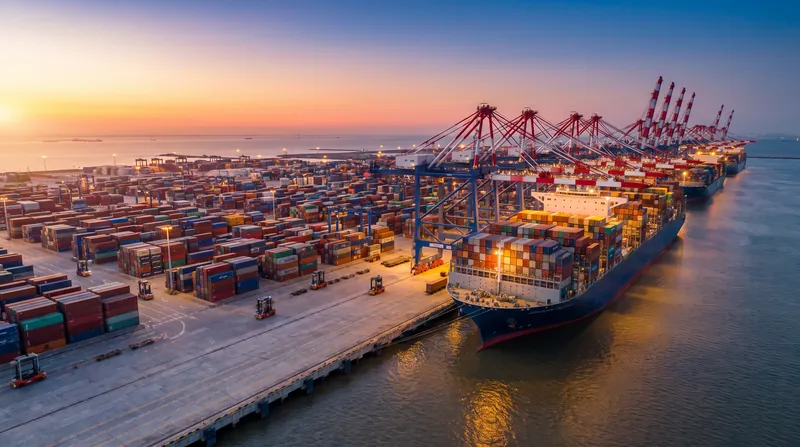
Hapag-Lloyd has acquired a 25 percent equity stake in the highly automated APM Terminals Maasvlakte II facility in Rotterdam. The investment secures guaranteed handling capacity for the Gemini Cooperation alliance while funding a massive physical expansion of the port.
By Marina Lopez

Share this story
German shipping line Hapag-Lloyd has agreed to acquire a 25 percent stake in the APM Terminals Maasvlakte II facility in Rotterdam. The transaction, announced jointly with terminal operator APM Terminals, cements the infrastructure foundation for the Gemini Cooperation—a new operational alliance between Hapag-Lloyd and A.P. Møller-Mærsk.
By buying directly into one of Europe’s most advanced container facilities, Hapag-Lloyd is securing guaranteed handling capacity at a critical node in the global supply chain. The move represents a broader shift in maritime logistics, where ocean carriers are increasingly purchasing equity in the physical ports that process their vessels to ensure network reliability.[1][2]
The corporate mechanics of the deal reflect a strategic partnership rather than a complete takeover. Hapag-Lloyd will hold its 25 percent equity through Hanseatic Global Terminals, the carrier’s dedicated terminal and infrastructure division. APM Terminals, a subsidiary of Maersk, will retain full operational control over the day-to-day management of the facility. Financial terms of the acquisition remain undisclosed, and the final transfer of equity is subject to standard regulatory approvals. The arrangement allows Hapag-Lloyd to secure priority access without assuming the burden of managing the terminal's workforce or technical systems.[1][2]
The investment arrives as Maasvlakte II undergoes a massive physical expansion designed to accommodate the next generation of ultra-large container vessels. The project will add 1,000 meters of new deep-sea berth to the facility, effectively doubling its current quay length to 2,000 meters. This extension allows the terminal to simultaneously dock multiple mainline ships, reducing the queuing time that often plagues congested European ports. The Port of Rotterdam Authority is actively involved in the expansion, coordinating the dredging and foundational civil engineering required to support the new berths.[1][2]
Beyond the waterfront, the expansion fundamentally upgrades the terminal’s landside equipment layer. The facility is adding four new rail tracks to accelerate the transfer of containers from ocean vessels directly to the European hinterland, bypassing local truck traffic. The yard itself is being densified and equipped with a new fleet of Automated Terminal Tractors (ATTs) and remote-controlled gantry cranes. These robotic systems are designed to move containers between the quay and the stacks with mathematical precision, eliminating the human variability that can slow down traditional port operations during peak surges.[1][2]
When the current construction phase concludes, Maasvlakte II will see its annual handling capacity rise to approximately 5.4 million twenty-foot equivalent units (TEU). This scale is not merely aspirational; it is a structural requirement for the volume of cargo the terminal is expected to process.
As global trade routes consolidate, mega-terminals must be capable of absorbing massive, sudden influxes of containers discharged by single vessels. The 5.4 million TEU threshold ensures that the facility has enough buffer space in its yard to prevent gridlock when multiple ships arrive within the same 48-hour window.[1][2]
The driving force behind this capacity surge is the Gemini Cooperation, the vessel-sharing agreement between Maersk and Hapag-Lloyd that reshaped the ocean freight market. Unlike traditional maritime alliances, which rely on sprawling point-to-point networks that call at numerous ports, Gemini is built on a strict hub-and-spoke architecture.
The alliance aims to achieve a 90 percent schedule reliability rate—a metric that has historically eluded the shipping industry. To hit that target, the carriers are reducing the number of direct port calls their largest ships make, concentrating volume at a few highly controlled mega-hubs.[3][4]
Under the Gemini model, Rotterdam serves as the primary pivot point for Northern Europe. Massive mainline vessels arriving from Asia or the Americas will discharge their entire European cargo load at Maasvlakte II and immediately turn around.
A synchronized fleet of smaller shuttle vessels and feeder ships will then distribute those containers to secondary ports across the continent, from the Baltics to the UK. This system minimizes the risk of a mainline ship getting delayed by weather or congestion at a minor port, but it places immense pressure on the central hub to execute the transfer flawlessly.[3]
This architecture exposes the vulnerability of relying on third-party infrastructure. In a standard port environment, a delayed vessel loses its assigned berth window and must wait at anchor until the terminal has an opening.
For a hub-and-spoke network, a missed window at the central pivot point causes a cascading failure: the mainline ship is delayed, the connecting shuttle vessels depart empty, and the cargo misses its onward rail connections. The entire system relies on the terminal’s ability to prioritize the alliance's ships and adjust yard operations dynamically to catch up on lost time.[3]
Equity ownership solves the berth window problem. By purchasing a 25 percent stake in Maasvlakte II, Hapag-Lloyd transitions from a customer to a proprietor. The carrier gains institutional leverage to ensure that Gemini vessels receive priority handling, even during periods of severe regional congestion.
The partnership aligns the financial incentives of the terminal operator with the operational needs of the shipping lines. When the terminal and the vessels are managed as a single integrated system, the flow of cargo can be optimized from end to end, rather than optimized for the terminal's standalone profitability.[1][3]
Automation is the critical enabler of this integration. Hapag-Lloyd explicitly cited Maasvlakte II’s heavily automated environment as a primary factor in its investment decision. Automated terminals offer a predictable, flat rate of crane moves per hour, unaffected by shift changes, fatigue, or localized labor disputes.
For a network that promises 90 percent reliability, predictability is more valuable than absolute peak speed. The robotic ATTs and automated stacking cranes allow the terminal's operating system to sequence container moves hours in advance, perfectly synchronizing the discharge of a mainline ship with the loading of a waiting shuttle vessel.[1][2]
The Rotterdam acquisition is part of a broader, aggressive infrastructure strategy by Hapag-Lloyd to build a defensive moat of owned terminals. Through Hanseatic Global Terminals, the carrier recently agreed to acquire a 20 percent stake in the Eurogate Container Terminal in Hamburg and doubled its equity in Tangier Med’s TC3 terminal in Morocco to 20 percent.
These investments mirror the long-standing strategy of its Gemini partner, Maersk, which has spent decades using APM Terminals to control its physical touchpoints. The carriers are effectively internalizing the most volatile nodes of their supply chains.[1][4]
For global supply chains and the cargo owners that rely on them, this consolidation of infrastructure presents a distinct trade-off. Shippers routing goods through the Gemini network can expect higher predictability and fewer rolled bookings, as the carriers control the physical assets necessary to keep their promises.
However, this reliability comes at the cost of routing flexibility. Cargo owners become deeply tethered to the operational health of a few specific mega-hubs. If a shipper's destination is not well-served by the alliance's shuttle network, the hub-and-spoke model may introduce new transit delays.[3][4]
The primary risk to this model is hub congestion. While Maasvlakte II is expanding to 5.4 million TEU, the sheer density of cargo flowing through a single point creates a fragile equilibrium. If a severe winter storm halts North Sea shuttle operations, or if the European rail network experiences a strike, containers will rapidly pile up in the Rotterdam yard.
An automated terminal can only operate efficiently if it has empty slots to shuffle boxes into; once yard density exceeds a critical threshold, productivity plummets. The success of the Gemini Cooperation hinges entirely on keeping the Maasvlakte II yard fluid.[3]
The timeline for realizing the full benefits of this integration is tight. The main expansion phase at Maasvlakte II is already underway, with the first tranches of new capacity targeted for completion by the end of 2026. Delivering a massive civil engineering project while simultaneously operating one of Europe's busiest terminals requires precise coordination between APM Terminals, the Port of Rotterdam Authority, and the local works councils. Any delay in commissioning the new deep-sea berths will directly constrain the Gemini network's ability to scale its operations.[1][2]
The timeline for realizing the full benefits of this integration is tight.
Ultimately, Hapag-Lloyd’s investment in Rotterdam illustrates the evolution of ocean shipping from a commoditized transport service into an integrated industrial system. Carriers are no longer content to simply move ships between public docks; they are engineering end-to-end networks where the vessel, the crane, and the rail car operate as a single synchronized machine. By securing a permanent foothold in Maasvlakte II, Hapag-Lloyd is betting that the future of global trade belongs to the operators who control the physical chokepoints of the supply chain.[1][3]
Key points
- Hapag-Lloyd is acquiring a 25 percent stake in the APM Terminals Maasvlakte II facility in Rotterdam.
- The deal secures guaranteed terminal capacity for the Gemini Cooperation, a new alliance between Hapag-Lloyd and Maersk.
- APM Terminals will retain full operational control of the highly automated facility.
- Maasvlakte II is currently expanding its deep-sea berth by 1,000 meters to accommodate ultra-large vessels.
Unanswered questions
- The exact financial value of Hapag-Lloyd's 25 percent equity purchase.
- Whether the ongoing civil engineering expansion will meet its strict end-of-2026 completion target without disrupting current operations.
- How competing alliances will respond to the Gemini Cooperation's aggressive acquisition of terminal infrastructure.
How we got here
2015
APM Terminals Maasvlakte II officially opens in Rotterdam as a fully automated container facility.
Early 2025
Maersk and Hapag-Lloyd officially launch the Gemini Cooperation, shifting their networks to a hub-and-spoke model.
August 2026
Hapag-Lloyd agrees to acquire a 25 percent stake in Maasvlakte II to secure guaranteed capacity for the Gemini network.
End of 2026
The first phase of the 1,000-meter deep-sea berth expansion at Maasvlakte II is targeted for completion.
- Alliance Carriers
- Focuses on securing guaranteed terminal capacity to ensure the 90 percent schedule reliability target of the Gemini Cooperation.
- Terminal Operators
- Prioritizes physical expansion, automation upgrades, and maintaining operational control over the daily flow of cargo.
- Supply Chain Analysts
- Evaluates the trade-offs between the high predictability of a hub-and-spoke network and the vulnerability of relying on a single mega-hub.
Perspectives this story doesn't cover
- European rail and barge operators managing the hinterland connections
- Local port labor unions navigating the transition to fully automated equipment
Sources
Source coverage
4 outlets
3 viewpoints surfaced




- [1]Splash247Terminal Operators
Hapag-Lloyd takes 25% stake in Maersk's Rotterdam terminal
Read on Splash247 → - [2]Hapag-LloydAlliance Carriers
APM Terminals and Hapag-Lloyd partner to drive future growth at Maasvlakte II
- [3]Ship UniverseSupply Chain Analysts
Gemini Cooperation Explained: What the New Container Network Means for Reliability and Ports
- [4]Speed CommerceSupply Chain Analysts
Maersk Company Profile and 2025 Tariff Calculator
More in Transportation
See all →Port Infrastructure
U.S. Army Corps Approves Federal Permit for $1.8 Billion Louisiana International Terminal
5 sources
Aviation Safety
The V1, VR, and V2 Speeds: How Three Critical Velocities Define a Commercial Aircraft's Takeoff Decision
10 sources

Power Systems
Why Heavy Transport Relies on 120-Degree Three-Phase AC for Continuous Torque
6 sources
Maritime Law
SOLAS, MARPOL, and STCW: The Treaties Port Inspectors Use to Regulate Global Shipping
5 sources
Comments
Every angle. Every day.
Get Transportation stories with full source coverage and perspective breakdowns, free every day.