
Federal NEVI Rules Mandate Dual-Connector NACS Support for US EV Charging
The integration of Tesla's North American Charging Standard (NACS) into the $5 billion NEVI program marks a turning point for US charging networks. By mandating dual-connector sites, the federal government is standardizing the charging experience for all EV drivers.

Share this story
In short
- The federal government has officially endorsed NACS (SAE J3400) for NEVI-funded charging stations.
- Updated guidance allows states to use federal funds for dual-connector sites supporting both NACS and CCS.
- The shift aligns the $5 billion federal infrastructure program with the auto industry's rapid pivot to the NACS standard.
The US federal government's integration of the North American Charging Standard (NACS) into the $5 billion National Electric Vehicle Infrastructure (NEVI) program marks the definitive end of the EV charging format war. By explicitly endorsing the standard—now officially designated as SAE J3400—federal regulators have aligned the nation's largest infrastructure investment with the hardware reality of the automotive market.[6]
For anyone considering buying an electric vehicle in the next few years, this policy shift translates directly into a frictionless ownership experience. Instead of navigating a fragmented landscape of competing plugs and carrying bulky adapters in the trunk, drivers will increasingly find that the federally funded stations along major highways natively support the connector built right into their cars.[6]
The NEVI program was established under the Bipartisan Infrastructure Law to deploy a seamless, nationwide network of high-speed chargers, ensuring that a family road trip in an EV is as predictable as one in a gas-powered car. When the Federal Highway Administration (FHWA) published its initial final rule in early 2023, it mandated the use of the Combined Charging System (CCS) to establish a non-proprietary baseline across all federally funded sites.[1][4]
At the time, CCS was the presumed default for non-Tesla automakers. However, the landscape shifted dramatically later that year when Tesla open-sourced its proprietary connector design, inviting the broader industry to adopt what it dubbed the North American Charging Standard.[5]
The industry response was swift and unprecedented. Recognizing the ergonomic advantages and proven reliability of the NACS plug, nearly every major automaker—from Ford and General Motors to Rivian and Volkswagen—committed to transitioning their future vehicles to the standard, fundamentally changing the calculus for buyers.[6]
This rapid market pivot placed federal regulators in a difficult position. Enforcing a strict CCS-only mandate for the $5 billion NEVI program risked creating a nationwide network of stranded assets—stations equipped with plugs that the vast majority of new EVs rolling off dealership lots would require an adapter to use.[2]
In response, the FHWA and the Joint Office of Energy and Transportation began updating their guidance to reflect what drivers actually need. Through revised Q&A documents and updated certification requirements, the agencies clarified that NEVI funds could indeed be used to purchase and install J3400 connectors and supporting equipment, provided the stations still met the program's overarching accessibility and reliability standards.[3]
The technical appeal of NACS for daily drivers lies in its elegant, lightweight engineering. Unlike CCS, which requires a large, cumbersome plug with dedicated pins for direct current (DC) fast charging, NACS handles both alternating current (AC) and DC power through a single, compact 5-pin interface that is much easier to maneuver in cold weather or tight spaces.[5]
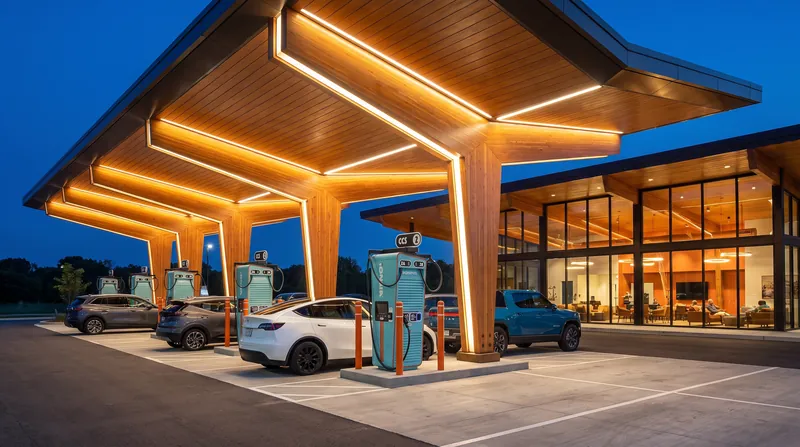
Under the updated federal framework, the industry is coalescing around a dual-connector standard for new NEVI sites. Rather than ripping out CCS entirely and abandoning early EV adopters, federally funded stations are now generally expected to feature both CCS and NACS connectors, ensuring backward compatibility for legacy EVs while accommodating the incoming wave of NACS-native models.[6]
Beyond the physical plug, the NEVI program enforces rigorous performance metrics that operators must meet to qualify for the 80% federal cost coverage. Chief among these is a strict 97% uptime mandate, requiring each charging port to be operational and available nearly constantly—meaning drivers can trust that a station will actually work when they pull up with a low battery.[1]
Stations must also meet high-capacity power requirements to keep road trips moving. The federal standard dictates that each NEVI-funded site must feature at least four DC fast chargers, each capable of delivering a minimum of 150 kilowatts simultaneously. This ensures that drivers can quickly add hundreds of miles of range during a brief highway stop, rather than waiting hours for a trickle charge.[1][4]
The software layer is equally critical to the federal vision of a seamless driver experience. NEVI standards require chargers to support advanced communication protocols, including OCPP 2.0.1 and ISO 15118. These protocols enable "Plug and Charge" functionality, allowing a vehicle to automatically authenticate and process payment the moment it is plugged in, bypassing the need for credit card readers, RFID tags, or proprietary smartphone apps.[1]
As states progress through the NEVI deployment phases, the federal government has also introduced greater flexibility for local planners. Once a state certifies that its designated Alternative Fuel Corridors are "Fully Built Out"—meaning compliant chargers are stationed every 50 miles—it can redirect remaining NEVI funds to community locations, rural roads, and urban charging hubs where local renters and apartment dwellers need them most.
This flexibility, combined with the endorsement of NACS, accelerates the buildout of a charging network that actually reflects consumer behavior and market demand. Operators can deploy the hardware that drivers prefer, while states can target funding toward the neighborhoods and routes with the highest utilization potential.[6]
This flexibility, combined with the endorsement of NACS, accelerates the buildout of a charging network that actually reflects consumer behavior and market demand.
Ultimately, the alignment of federal policy with the NACS standard removes one of the most significant psychological barriers to EV adoption: charging anxiety. By guaranteeing that the nation's premier public charging network will natively support the industry's dominant plug, the government is paving the way for a more accessible, reliable, and unified electric future for every driver.[6]
Jargon, explained
- NACS (SAE J3400)
- The North American Charging Standard, originally developed by Tesla, which uses a single compact plug for both AC and DC charging.
- CCS (Combined Charging System)
- The legacy fast-charging standard that uses a larger plug with dedicated pins for direct current (DC) power.
- NEVI
- The National Electric Vehicle Infrastructure Formula Program, a federal initiative to deploy EV chargers along major highways.
- Charge Point Operator (CPO)
- A company that manages, maintains, and operates public electric vehicle charging stations.
- Plug and Charge (ISO 15118)
- A software protocol that allows an EV to automatically authenticate and pay for charging the moment it is plugged in.
Common questions
What is the NEVI program?
The National Electric Vehicle Infrastructure (NEVI) program is a $5 billion federal initiative designed to build a unified, high-speed EV charging network across the United States.
Will I need an adapter to charge my EV?
Under the updated federal guidance, new NEVI-funded stations are generally required to feature dual-connector setups, supporting both legacy CCS and the new NACS standard natively.
Why did the government endorse NACS?
After the vast majority of automakers committed to adopting Tesla's charging standard (now SAE J3400), the federal government updated its requirements to match market reality and prevent building obsolete stations.
What is the 97% uptime mandate?
Federal rules require that all NEVI-funded charging ports be operational and available for use at least 97% of the time, with compliance tracked via automated reporting.
Competing readings
The Federal Regulatory View
Ensuring a unified, reliable, and accessible national charging network.
For federal agencies like the FHWA and the Joint Office of Energy and Transportation, the primary goal of the NEVI program is to build a cohesive national network that does not leave drivers stranded. Initially, this meant mandating CCS to establish a non-proprietary baseline. However, as the market overwhelmingly shifted toward NACS, regulators recognized that clinging exclusively to CCS would result in billions of dollars spent on infrastructure that the majority of new EVs could not natively use. By updating the guidance to endorse dual-connector configurations, the government ensures that federal funds are spent on future-proof stations that meet strict 97% uptime requirements while serving the broadest possible cross-section of the driving public.
The Automaker & Operator View
Leveraging a superior hardware standard to remove friction from the EV ownership experience.
Automakers and Charge Point Operators (CPOs) view the transition to NACS as a necessary correction to years of fragmented and often unreliable public charging. The NACS connector is widely regarded as more ergonomic, reliable, and efficient than its CCS counterpart, handling both AC and DC power through a single compact interface. For manufacturers, standardizing on NACS means they can eliminate the engineering overhead of supporting multiple charge ports. For network operators, the federal endorsement unlocks NEVI funding for the hardware their customers actually want to use, allowing them to focus on software integration, Plug and Charge capabilities, and scaling their footprint rather than managing adapter logistics.
- Federal Regulators
- Focuses on standardizing the national charging network, ensuring 97% uptime, and preventing stranded assets.
- Automakers & Charging Networks
- Values the efficiency, reliability, and widespread adoption of the NACS standard to accelerate EV sales.
- Industry Analysts
- Prioritizes seamless charging experiences, eliminating adapter anxiety, and transparent pricing for drivers.
Perspectives this story doesn't cover
- Independent Repair Shops
- Legacy EV Owners
Sources
Source coverage
6 outlets
3 viewpoints surfaced






- [1]Federal RegisterFederal Regulators
National Electric Vehicle Infrastructure Standards and Requirements
Read on Federal Register → - [2]Regulations.govFederal Regulators
National Electric Vehicle Infrastructure Formula Program
Read on Regulations.gov → - [3]Joint Office of Energy and TransportationFederal Regulators
NEVI Progress Update
Read on Joint Office of Energy and Transportation → - [4]Department of EnergyFederal Regulators
National Electric Vehicle Infrastructure (NEVI) Formula Program
Read on Department of Energy → - [5]TeslaAutomakers & Charging Networks
Opening the North American Charging Standard
Read on Tesla → - [6]Factlen Editorial TeamIndustry Analysts
Synthesis by Factlen editorial team
Read on Factlen Editorial Team →
More in Automotive & Transportation
See all →Engine Tech
How a VGT's Variable Vanes Eliminate Turbo Lag and Broaden the Torque Curve
6 sources
Marine Tech
How Lithium Iron Phosphate (LiFePO4) House Banks Are Replacing Marine Diesel Generators
2 sources

Tire Physics
Water Wedge Pressure: How Speed, Tread Depth, and Tire Pressure Dictate the Onset of Hydroplaning
7 sources

Marine Battery Tech
Coulomb Counting, Voltage Measurement, and Kalman Filtering: How Battery Management Systems Estimate State of Charge and State of Health
5 sources
Comments
Every angle. Every day.
Get Automotive & Transportation stories with full source coverage and perspective breakdowns, free every day.