
GuideAutomotive and Marine EngineeringRevision 1Updated
The Definitive Guide to Automotive and Marine Engineering Principles
A comprehensive breakdown of the physical laws and mechanical systems that govern modern transportation. From hull hydrodynamics and propeller slip to electric vehicle safety architectures and autonomous driving regulations.
By Dev Anand

Share this story
In short
- Displacement, planing, and semi-displacement hulls balance speed against fuel efficiency.
- Propeller pitch and slip dictate how effectively engine torque translates into forward motion.
- Sacrificial anodes prevent marine galvanic corrosion, with material choice depending on water salinity.
The physics of moving vehicles through fluids and across solid surfaces dictate every engineering decision in the automotive and marine industries. Whether designing a hull to part the ocean efficiently or a tire to shed rainwater at highway speeds, engineers must constantly balance thermodynamic limits, hydrodynamic drag, and electrical safety.
This comprehensive guide explores the foundational principles governing modern transportation. It breaks down the mechanical and electrical systems that define how boats and cars operate, from the combustion cycles that generate mechanical power to the high-voltage relays that keep electric vehicles safe during a collision.
By understanding these core mechanisms, operators, builders, and buyers can make informed decisions. A vessel's hull shape, a car's tire tread depth, and the specific metal used in a sacrificial anode are not arbitrary aesthetic choices, but precise mathematical solutions to unforgiving environmental challenges.
The Principles of Hull Design
A boat's hull dictates its interaction with the water, forcing a permanent compromise between speed, fuel efficiency, and stability. Every ship that moves through water owes its performance to this foundational element, which must withstand structural loads while minimizing hydrodynamic resistance.[3][4]
Displacement hulls push water aside as they move, supporting the vessel's weight entirely by buoyancy. This design provides excellent stability in rough seas and high efficiency at lower speeds, making it the standard for ocean-crossing trawlers and large commercial ships.[3][4]
Because they sit deep in the water, displacement hulls are limited by their theoretical hull speed. Pushing them past this limit requires an exponential increase in power, resulting in severe fuel penalties without meaningful gains in forward momentum.[3]
Planing hulls operate on an entirely different physical principle. As speed builds—usually around 15 to 20 knots—the hull lifts and skims across the water's surface, dramatically reducing the wetted surface area and cutting hydrodynamic drag.[3][4]
This lift allows planing vessels to achieve high top speeds, but it comes at the cost of fuel efficiency and ride comfort in choppy conditions. At low speeds, planing hulls operate inefficiently and produce large, disruptive wakes.[3]
Semi-displacement hulls sit between these two approaches, offering a middle ground for vessels that require moderate cruising speeds. They are designed to run efficiently above theoretical hull speed by rising slightly out of the water, but they never lift completely clear.[3][4]
Propeller Geometry and Efficiency
A vessel's propeller geometry determines how engine torque translates into forward motion in a fluid environment. The most critical measurement is pitch, which represents the theoretical axial distance a propeller would advance in one complete revolution through a solid medium.[1][2]
For example, a propeller stamped with a 19-inch pitch is designed to move forward exactly 19 inches per rotation. However, because water is a yielding fluid rather than a solid nut, the propeller never actually advances by its full pitch.[1][2]
This shortfall is known as slip, and it is a vital indicator that the propeller is working under load. Slip is the difference between the theoretical speed of the propeller and the actual speed of the ship, expressed as a percentage.[1][2]
Planing runabouts typically operate with 10 to 15 percent slip, while heavy displacement hulls might see slip figures between 20 and 40 percent. A high slip percentage indicates lost potential movement and energy inefficiency, meaning the engine is working harder than necessary.[1][2]
Diameter is the second critical factor, calculated based on engine horsepower and shaft revolutions per minute. Generally, maximizing efficiency requires moving a large volume of water slowly, which favors a larger diameter and lower RPM, provided the hull has adequate clearance.[1]
Preventing Marine Galvanic Corrosion
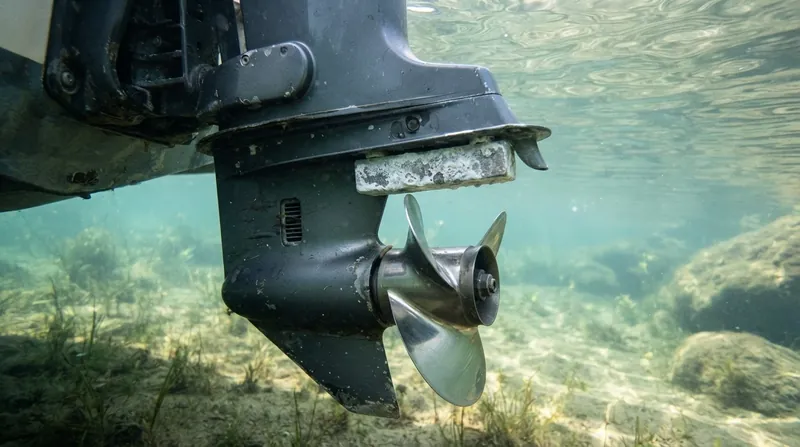
When two different metals are electrically connected and submerged in an electrolyte like seawater, they form a galvanic cell. This electrochemical process generates a current that gradually deteriorates the more reactive metal, threatening critical components like propellers, trim tabs, and shafts.[11][12]
To prevent this destructive process, marine engineers utilize sacrificial anodes. These anodes are made from highly active metals that readily give up electrons, intentionally corroding first to protect the more valuable, less noble metals on the vessel.[11][12]
Selecting the correct anode material depends entirely on the water environment. Zinc is the traditional choice for saltwater, but it fails completely in freshwater because it develops an insulating, calcareous coating that stops the galvanic reaction entirely.[11][12]
Freshwater environments require magnesium anodes. Magnesium is highly active and provides strong protection in less conductive freshwater, but it corrodes far too rapidly if exposed to the high conductivity of saltwater or brackish environments.[11][12]
Aluminum anodes offer a versatile and environmentally friendly alternative. They work effectively in both saltwater and brackish water, last longer than traditional zinc, and do not contain cadmium, a heavy metal that poses severe risks to marine ecosystems.[11][12]
The Thermodynamics of the Otto Cycle
The absolute limit of a gasoline engine's efficiency is mathematically locked in by cylinder geometry and the thermodynamics of air. Every spark-ignition engine follows the Otto cycle, an idealized thermodynamic model codified by Nikolaus Otto in 1876.[7][8]
The air-standard Otto cycle consists of four reversible processes: isentropic compression, constant-volume heat addition, isentropic expansion, and constant-volume heat rejection. It strips away friction and heat loss to reveal the core thermodynamic logic of the internal combustion engine.[7][8]
The thermal efficiency of this ideal cycle depends almost entirely on the compression ratio, which is the cylinder volume at bottom dead center divided by the volume at top dead center. The formula is expressed as a function of this ratio and the specific heat of air.[7][8]
If an engine has a compression ratio of 10:1, the ideal Otto cycle predicts a thermal efficiency of roughly 59 percent. Pushing the ratio to 13:1 raises the theoretical ceiling to 65 percent, demonstrating why engineers constantly chase higher compression.[7][8]
In reality, production engines capture only 30 to 40 percent brake thermal efficiency. The ideal cycle ignores pumping losses, friction, and the practical ceiling of autoignition, or engine knock, which prevents designers from raising compression ratios indefinitely.[7][8]
The Physics of Hydroplaning
Hydroplaning is not an unpredictable act of nature, but a strict mathematical threshold where fluid pressure overcomes a vehicle's downward force. It occurs when a tire arrives at a wet section of road faster than the water can escape through the tread grooves.[5][6]
Because water is virtually incompressible, it builds up at the leading edge of the contact patch, creating a hydrodynamic water wedge. When the pressure in this wedge equals the contact pressure pushing the tire down, the tire lifts completely off the pavement.[5][6]
Deprived of frictional contact, the vehicle loses traction, rendering steering and braking ineffective. Research originally conducted by NASA for wet-runway aircraft safety proved that hydroplaning onset speed depends heavily on tire inflation pressure and tread depth.[5][6]
A tire's grooves act as a precision drainage system. When tread depth degrades below 4 millimeters, the tire's capacity to channel water drops exponentially, significantly lowering the speed at which the water wedge can lift the vehicle.[5][6]
Inflation pressure is equally critical. Higher tire pressure increases the contact pressure between the rubber and the road, requiring more hydrodynamic lift to overcome. An underinflated tire offers far less resistance to the water wedge, even if the tread is new.[5][6]
High-Voltage Isolation in Electric Vehicles
Modern electric vehicles carry massive high-voltage battery packs, yet they are engineered to prevent the bodywork from becoming live during an accident. Unlike traditional cars that use the steel chassis as a negative earth return, EVs utilize strictly isolated circuits.[14]
This Isolé-Terre electrical architecture ensures that high-voltage current remains continuously contained within heavy-duty, insulated cabling. Neither the positive nor the negative high-voltage cables connect to the vehicle's metal chassis, keeping the passenger cabin and exterior body panels completely isolated from dangerous electrical faults.[14]
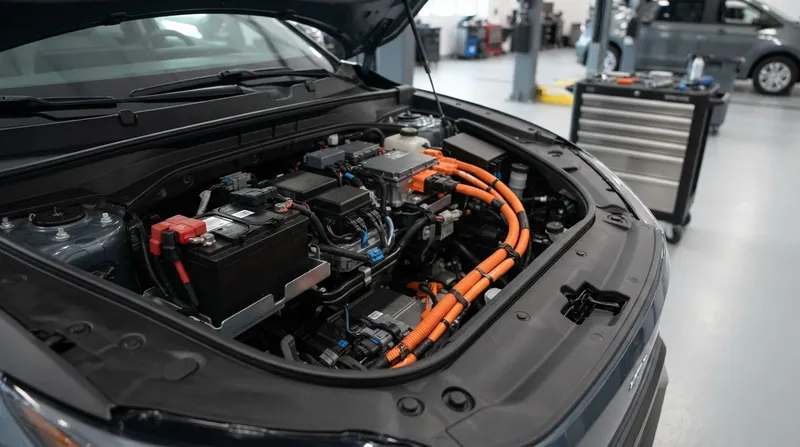
To safely connect and disconnect the battery from the drivetrain, EVs rely on heavy-duty electromechanical switches called contactors. These high-voltage isolation relays require a continuous 12-volt electrical input from the auxiliary battery to physically close the circuit.[14]
If the 12-volt auxiliary battery dies, the contactors spring open, completely immobilizing the vehicle even if the main high-voltage pack is fully charged. This fail-safe design ensures the high-voltage system defaults to a disconnected, safe state.[14]
During a severe collision, the vehicle's restraint control module fires a pyrotechnic switch, or pyro-fuse, which severs the main cables inside the sealed battery casing in less than ten milliseconds. Simultaneously, the electromagnetic contactors snap open, trapping the energy safely inside the enclosure.[14]
Standardizing EV Charging Infrastructure
The transition to electric mobility relies heavily on reliable public fast-charging networks. To support this, the federal National Electric Vehicle Infrastructure program mandates strict hardware standards for newly funded charging sites along major travel corridors.[9][10]
Starting in September 2026, every new NEVI-funded site must feature dual-connector designs, incorporating both the Combined Charging System Type 1 and the North American Charging Standard. This ensures compatibility across different vehicle brands without requiring adapters.[9][10]
The NACS connector, originally developed by Tesla and standardized as SAE J3400, supports both alternating current and direct current charging through a single, compact port. Its widespread adoption simplifies manufacturing and expands network access for drivers.[9][10]
NEVI regulations also enforce strict power specifications. Each funded site must host a minimum of four DC fast-charging ports, each capable of simultaneously delivering at least 150 kilowatts. "The 150 kW per-port requirement ensures that drivers receive genuinely fast charging, not just a shared power pool that drops when multiple vehicles plug in," notes regulatory compliance expert Lisa Chen.[10]
Furthermore, these chargers must safely operate within a wide voltage band of 250 to 920 volts DC. This range accommodates the diverse battery architectures on the market, from compact passenger cars to heavy-duty electric trucks with 800-volt systems.[9][10]
Federal Frameworks for Autonomous Vehicles
The regulatory landscape for autonomous vehicles is shifting from prescriptive design standards written for human drivers toward performance-based safety equivalency. The National Highway Traffic Safety Administration is actively modernizing federal rules to accommodate driverless technology.[13]
Historically, Federal Motor Vehicle Safety Standards required manual controls, such as steering wheels, brake pedals, and transmission shifters. NHTSA has finalized rules removing these mandates for vehicles designed exclusively for Automated Driving Systems, recognizing that human-centric controls serve no purpose in a fully autonomous cabin.[13]
This regulatory update acknowledges that manual controls add unnecessary expense and complexity to purpose-built robotaxis and autonomous delivery vehicles. However, these vehicles must still meet the exact same stopping distance and crash-safety performance criteria as traditional cars.[13]
To facilitate commercial deployment, NHTSA utilizes Part 555 exemptions for purpose-built vehicles. In granting a recent exemption, the agency determined that the specific driverless design "would provide an equivalent level of safety" to a fully compliant traditional vehicle.[13]
To facilitate commercial deployment, NHTSA utilizes Part 555 exemptions for purpose-built vehicles.
This flexible, data-driven oversight framework allows the agency to monitor real-world performance while expanding operational scope incrementally as the technology matures. By eliminating redundant requirements, the federal government aims to establish a single national standard that prevents a confusing patchwork of conflicting state laws.[13]
From the thermodynamic limits of the Otto cycle to the electrochemical realities of marine corrosion, transportation engineering relies on strict physical laws. As autonomous software and high-voltage architectures redefine the modern vehicle, these foundational principles continue to dictate how safely and efficiently we move.
Comparison
| Material | Water Environment | Relative Activity | Environmental Note |
|---|---|---|---|
| Magnesium | Freshwater only | Highest (-1.5V) | Corrodes too rapidly in saltwater |
| Aluminum | Salt and brackish water | Moderate (-1.1V) | Cadmium-free, environmentally safe |
| Zinc | Saltwater only | Lowest (-1.03V) | Contains toxic cadmium |
Frequently asked
Why can't I use a zinc anode in freshwater?
Freshwater lacks the conductivity of saltwater, causing zinc to develop an insulating calcareous coating. This crust stops the galvanic reaction entirely, rendering the anode useless.
What happens if an electric vehicle's 12-volt battery dies?
The high-voltage contactors require a continuous 12-volt supply to stay closed. If the auxiliary battery dies, these relays spring open, safely immobilizing the vehicle.
Does a heavier vehicle resist hydroplaning better?
No. Hydroplaning onset speed is dictated primarily by tire inflation pressure and tread depth, not the overall weight of the vehicle pressing down.
Why don't automakers raise engine compression ratios infinitely?
While higher compression increases theoretical efficiency, it eventually causes the air-fuel mixture to auto-ignite before the spark fires. This engine knock damages internal components.
Viewpoints in depth
Automotive Engineers
Focus on maximizing thermodynamic efficiency and high-voltage safety within strict physical and material limits.
Automotive engineers operate within strict thermodynamic and material boundaries. In internal combustion engines, they push compression ratios to the edge of autoignition to extract maximum efficiency from the Otto cycle. In electric vehicles, the focus shifts to electrical safety, where engineers design Isolé-Terre architectures and pyrotechnic fuses to ensure high-voltage energy remains isolated from the passenger cabin during catastrophic impacts.
Marine Architects
Prioritize hydrodynamic stability, fuel efficiency, and long-term corrosion prevention in harsh aquatic environments.
Marine architects must balance the competing demands of fluid dynamics and structural integrity. Designing a hull requires choosing between the high efficiency of a displacement design and the speed of a planing hull, knowing that water resistance increases exponentially with speed. Furthermore, they must engineer robust cathodic protection systems, selecting specific sacrificial anodes to prevent galvanic corrosion from destroying critical underwater running gear.
Regulatory Bodies
Establish baseline safety and interoperability standards to protect consumers and standardize emerging technologies.
Agencies like NHTSA and federal programs like NEVI are tasked with standardizing rapidly evolving transportation technologies. By mandating dual-connector charging stations and wide voltage operating bands, regulators ensure public infrastructure serves all drivers equally. Simultaneously, by removing outdated manual control mandates for autonomous vehicles, they create a performance-based framework that allows innovation to proceed without compromising public safety.
What changed
- · Revision 1Published.
Related explainers
- Propeller Pitch, Diameter, and Slip: How Blade Geometry Dictates Boat Speed and Efficiency
- The Principles of Hull Design: Comparing Displacement, Planing, and Semi-Displacement Hulls on Speed, Efficiency, and Stability
- NHTSA Proposes Removing Physical Brake Control Mandate for Truly Driverless Autonomous Vehicles
- Automaker-Backed IONNA Network Tops JD Power EV Charging Reliability Rankings
- The Compression Ratio and the Gamma Term: How the Otto Cycle Defines the Maximum Theoretical Efficiency of a Gasoline Engine
- Water Wedge Pressure: How Speed, Tread Depth, and Tire Pressure Dictate the Onset of Hydroplaning
- High-Voltage Isolation Relays Require a 12-Volt Circuit to Close Safely, Immobilizing Electric Vehicles When the Auxiliary Battery Dies
- Congress Advances SELF DRIVE Act, Proposing Comprehensive Federal Framework for All Autonomous Vehicles and Allowing Removal of Manual Controls
- Federal NEVI Rules Mandate Dual-Connector NACS Support for US EV Charging
- The Physics of the Cylinder: Why Bore-to-Stroke Ratios Dictate Engine Torque
- Zinc Anodes Fail in Freshwater: Why Impressed Current and Magnesium Prevent Stray-Current Hull Corrosion
- Passive In-Cabin Cameras and Sensors Behind the Federal Impaired-Driving Mandate
- Automotive Engineers
- Focus on maximizing thermodynamic efficiency and high-voltage safety within strict physical and material limits.
- Marine Architects
- Prioritize hydrodynamic stability, fuel efficiency, and long-term corrosion prevention in harsh aquatic environments.
- Regulatory Bodies
- Establish baseline safety and interoperability standards to protect consumers and standardize emerging technologies.
Perspectives this story doesn't cover
- Independent repair shops dealing with high-voltage systems
- Legacy automakers adapting to NACS standards
Sources
Source coverage
14 outlets
3 viewpoints surfaced














- [1]Scribd
The term 'Pitch' and 'Slip' with respect to the ship propeller
Read on Scribd → - [2]Boat Calculators
Propeller pitch calculator
Read on Boat Calculators → - [3]Yachtway
Understanding Hull Design: Displacement, Planing, and Semi-Displacement
Read on Yachtway → - [4]WordPress
Ship Hull Design: Types, Principles, and Efficiency
Read on WordPress → - [5]Dial A Tire Halifax
The Speed and Tread Depth That Define Your Risk of Hydroplaning
Read on Dial A Tire Halifax → - [6]CED Technologies
Understanding Hydroplaning: The Mechanics Behind the Slide
Read on CED Technologies → - [7]DEV Community
The Air-Standard Otto Cycle and Compression Ratios
Read on DEV Community → - [8]Real Engine Simulator
What Is the Otto Cycle? Efficiency and Thermodynamics
Read on Real Engine Simulator → - [9]EVSE
What Changes on September 15, 2026 Under the Updated NEVI Standard
Read on EVSE → - [10]FBK POWER
NEVI Compliant EV Charging Stations: Requirements for 2026
Read on FBK POWER → - [11]West Marine
Protect your boat from galvanic corrosion with the right zinc anodes
Read on West Marine → - [12]Martyr Anodes
Anodes: Why They Wear (or Don't) and How to Choose the Right One
Read on Martyr Anodes → - [13]Baker Donelson
NHTSA Grants First Part 555 Exemption for ADS-Equipped Vehicle Without Manual Controls
Read on Baker Donelson → - [14]AUTODOC
High-Voltage Safety in Electric Vehicles: Isolation and Contactors
Read on AUTODOC →

More in Automotive & Transportation
See all →Cathodic Protection
Zinc Anodes Fail in Freshwater: Why Impressed Current and Magnesium Prevent Stray-Current Hull Corrosion
3 sources
Engine Physics
The Physics of the Cylinder: Why Bore-to-Stroke Ratios Dictate Engine Torque
7 sources
Marine Fluid Dynamics
The Fluid Dynamics of Propeller Walk in Single-Screw Vessels
4 sources
EV Architecture
High-Voltage Isolation Relays Require a 12-Volt Circuit to Close Safely, Immobilizing Electric Vehicles When the Auxiliary Battery Dies
7 sources
Comments
Every angle. Every day.
Get Automotive & Transportation stories with full source coverage and perspective breakdowns, free every day.