
The Science of EV Battery Health: Why Your Car Will Likely Outlast Its Power Pack
Massive 2026 telematics studies reveal that modern electric vehicle batteries degrade far slower than expected, retaining over 85% capacity after nearly a decade of use.
By Tao Yang

In short
- Massive 2026 studies prove modern EV batteries degrade at just 2.3% per year, meaning they will likely outlast the car itself.
- Used EVs aged eight to nine years old still retain a median of 85% of their original factory capacity.
- Extreme heat and frequent DC fast charging are the primary drivers of accelerated battery degradation.
For years, a single, persistent anxiety has hovered over the electric vehicle transition: the fear of the dying battery. Conditioned by smartphones that struggle to hold a charge after two years and laptops that eventually need to be tethered to a wall, many consumers naturally assumed that a car powered by lithium-ion cells would suffer a similarly short, frustrating lifespan.
The prospect of a $15,000 battery replacement looming just outside the warranty window has been a major psychological hurdle for prospective buyers. But as the first massive wave of modern EVs enters its second decade on the road, the empirical data is finally in. The smartphone comparison is fundamentally flawed.[4]
A wave of comprehensive 2025 and 2026 studies has definitively proven that the "ticking time bomb" narrative is a myth. The most significant of these is the Generational 2025 Battery Performance Index, a massive UK-based diagnostic study that analyzed more than 8,000 electric passenger cars and light commercial vehicles. The dataset spanned 36 different manufacturers and included vehicles ranging from brand-new to 12 years old, with some clocking over 160,000 miles. The conclusion was unequivocal: battery degradation is no longer the systemic risk it was once assumed to be.
The numbers from the Generational study are striking. Across the entire 8,000-vehicle dataset, the average battery State of Health (SoH) sat at an impressive 95.15% of its original factory capacity. Even more revealing is the performance of the oldest vehicles on the road.
Electric cars aged between eight and nine years old retained a median of 85% of their original capacity. This comfortably exceeds the 70% minimum threshold that most automakers guarantee in their standard eight-year warranties, proving that the vast majority of EV batteries will never trigger a warranty claim.[3]
These findings are corroborated by Geotab, a global leader in connected vehicle telematics. In early 2026, Geotab released an updated battery health study analyzing real-world data from 22,700 electric vehicles across 21 makes and models. Their telematics data revealed an average annual battery degradation rate of just 2.3%. While this is a slight increase from their 2024 findings—largely due to the growing prevalence of high-power highway fast charging—it still translates to a battery that will retain over 80% of its range after eight years of daily driving.[1]
The consensus among data analysts and automotive engineers is now clear: an electric vehicle's battery pack is highly likely to outlast the usable life of the vehicle's chassis. When an EV is eventually scrapped after 15 or 20 years, the battery will likely still have enough capacity to be repurposed for stationary grid storage. But while the baseline durability of modern cells is excellent, the science of electrochemistry dictates that how an owner drives, charges, and stores their vehicle can still dramatically influence that 2.3% annual degradation rate.[4]
To understand how to extend an EV's lifespan, it helps to understand why batteries degrade in the first place. Degradation is a natural process driven by two primary factors: charge cycle wear and calendar aging.
Cycle wear is the physical toll taken every time lithium ions shuttle back and forth between the battery's anode and cathode during charging and discharging. Calendar aging refers to the slow, inevitable chemical breakdown that occurs over time, regardless of whether the vehicle is driven 100 miles a day or sits parked in a garage for a month.
When plotted on a graph, this degradation does not follow a straight downward line. Instead, it forms what battery engineers call an "S-Curve." During the first year or two of an EV's life, the battery experiences a noticeable initial drop in capacity—often losing 2% to 3% right out of the gate as the internal chemistry settles.
After this initial settling period, the battery enters a prolonged, highly stable plateau, where it undergoes a very slow, linear decline for many years. It is only at the extreme end of its life, long after the car has been retired, that the curve drops sharply into catastrophic failure.
While time and cycles are inevitable, extreme temperature is the ultimate hidden killer of battery health. High heat accelerates the chemical reactions inside the battery, which speeds up the degradation of the internal components. Parking an electric vehicle in direct sunlight in a hot climate for extended periods, or pushing the battery hard on a racetrack without adequate cooling, forces the cells to work outside their optimal thermal window. Over time, this heat exposure permanently reduces the amount of energy the pack can store.[2]
This is why modern EVs are equipped with sophisticated Thermal Management Systems (TMS). Unlike the passive air-cooling used in early models like the original Nissan Leaf—which suffered notorious degradation issues—virtually all modern EVs use active liquid cooling and heating. These systems circulate coolant through the battery pack to pull heat away during aggressive driving or fast charging, and they use heaters to warm the cells in freezing weather. Geotab's data confirms that vehicles with robust liquid cooling degrade significantly slower than those without it.[1][2]
Conversely, cold weather is frequently misunderstood by new EV owners. While freezing temperatures will temporarily reduce an electric vehicle's range and significantly slow down its charging speed, the cold does not cause permanent chemical damage to the battery. The ions simply move more sluggishly through the cold electrolyte. Once the battery warms back up, the "lost" range returns. Experts recommend using the vehicle's preconditioning feature—which warms the battery using grid power while the car is still plugged in—to mitigate cold-weather range loss.[2]
Beyond temperature control, the single most effective habit an owner can adopt is the "20-80% Rule." Lithium-ion batteries experience the most physical stress when they are completely empty or completely full. Consistently draining the battery to 0% forces a deep discharge that strains the cell architecture, while holding the battery at 100% creates high internal voltage that accelerates chemical wear. By setting the car's daily charge limit to 80% and plugging in before it drops below 20%, owners keep the battery in its most comfortable, low-stress state.[2]
There is, however, a notable exception to this rule: Lithium Iron Phosphate (LFP) batteries. An increasing number of automakers are shifting to LFP chemistry for their standard-range vehicles because it is cheaper, uses no cobalt, and is remarkably durable. Unlike standard Nickel Manganese Cobalt (NMC) batteries, LFP cells actually prefer to be charged to 100% at least once a week to help the battery management system calibrate its range estimates. For LFP owners, the stress of a full charge is negligible, making them incredibly robust for daily commuting.
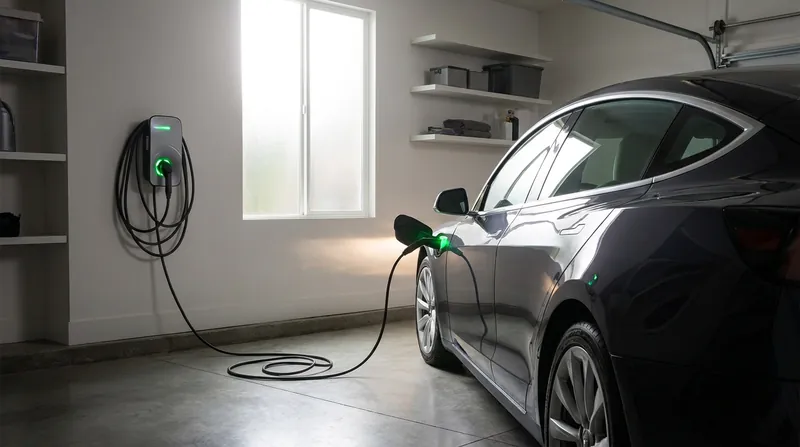
The speed at which electricity is forced into the battery also plays a crucial role in its long-term health. AC Level 2 charging—the kind provided by a dedicated home wallbox or a standard public parking charger—delivers a slow, steady flow of power. This generates very little heat and is considered the gentlest way to replenish the battery. For the vast majority of daily driving, overnight Level 2 charging is the gold standard for preserving the pack's state of health.[2]
DC Fast Charging, on the other hand, is designed for road trips. These massive stations bypass the car's onboard converter to push direct current straight into the battery at incredibly high speeds, generating significant heat in the process. Geotab's 2026 analysis revealed that charging power is now the dominant operational influence on battery health. Vehicles that relied heavily on DC fast chargers exceeding 100 kW experienced degradation rates of up to 3.0% per year—roughly double the rate of vehicles that primarily used slower AC charging.[1]
Interestingly, the Generational study found that high mileage does not automatically equate to a ruined battery. Vehicles that had traveled more than 100,000 miles still frequently returned battery health readings between 88% and 95%. In fact, the data suggests that a well-maintained, three-year-old ex-fleet EV with 75,000 miles on the odometer may actually have a healthier battery than a six-year-old vehicle that has only been driven 30,000 miles but was left sitting at a 100% state of charge in a hot driveway for weeks at a time.
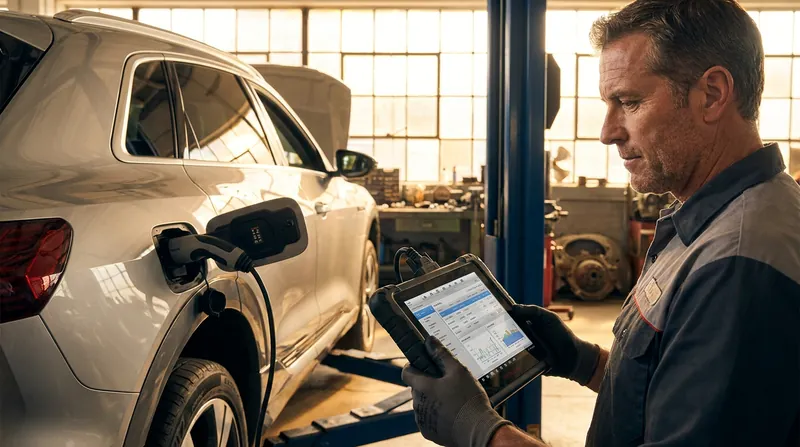
This revelation is beginning to transform the used EV market. Historically, buyers and dealerships valued used electric cars based almost entirely on their age and odometer readings, just as they did with combustion engines. Today, independent battery health assessments are becoming standard practice. By plugging a diagnostic tool into the OBD-II port, buyers can instantly view the battery's exact State of Health, removing the guesswork and allowing well-maintained, high-mileage EVs to command the resale value they actually deserve.[3]
This revelation is beginning to transform the used EV market.
Ultimately, the science of EV battery degradation tells an overwhelmingly positive story. The technology has matured past its fragile early days, and the data proves that modern packs are engineered to go the distance. By understanding the basic principles of electrochemistry—avoiding extreme heat, utilizing the 20-80% rule for daily driving, and saving DC fast charging for when it is truly needed—owners can easily ensure their electric vehicle remains a reliable, high-performing asset for decades to come.[4]
Key terms
- State of Health (SoH)
- A percentage representing a battery's current maximum capacity compared to its original capacity when it was brand new.
- DC Fast Charging
- High-power charging that delivers direct current straight to the battery, allowing for rapid top-ups but generating more heat than home charging.
- S-Curve Degradation
- The typical lifecycle pattern of an EV battery, featuring an initial noticeable drop, a long stable plateau, and a steep decline at the very end of its life.
- Thermal Management System
- The liquid cooling and heating architecture built into modern EVs that keeps the battery within its optimal operating temperature range.
- Lithium Iron Phosphate (LFP)
- A highly durable battery chemistry increasingly used in EVs that can be routinely charged to 100% without suffering significant degradation.
Frequently asked
Does charging my EV to 100% damage the battery?
Yes, consistently charging a standard lithium-ion EV battery to 100% accelerates chemical degradation. Experts recommend a daily limit of 80%, reserving 100% charges only for long road trips.
Will cold weather permanently ruin my EV battery?
No. Cold weather temporarily reduces your driving range and slows down charging speeds, but it does not cause permanent chemical degradation like extreme heat does.
Do I need to replace my EV battery after 100,000 miles?
It is highly unlikely. Recent 2026 studies show that EVs with over 100,000 miles still retain between 88% and 95% of their original battery health, far exceeding warranty thresholds.
Viewpoints in depth
The Data Analysts' View
Telematics experts argue that battery degradation is no longer a systemic risk.
Firms like Geotab and Generational look at the macro picture across tens of thousands of vehicles. Their data shows that the average EV battery degrades at just 2.3% per year, meaning the battery will almost certainly outlast the chassis of the car. They emphasize that high mileage is not the enemy; in fact, fleet vehicles driven constantly but charged on slower AC connections often show better battery health than low-mileage cars left sitting at 100% charge in hot driveways.
The Battery Engineers' View
Chemists and engineers focus on mitigating the physical stress placed on lithium-ion cells.
From an engineering perspective, every battery is on an inevitable path to degradation via cycle wear and calendar aging. Engineers emphasize that heat is the ultimate enemy of electrochemistry, which is why they have prioritized robust liquid thermal management systems in modern architectures. They advocate for strict adherence to the 20-80% charging rule to minimize the high-voltage stress that physically degrades the cell's internal structure over time.
The Consumer Advocates' View
Market watchers believe battery health transparency will revolutionize the used car market.
Consumer groups argue that the lingering fear of a $15,000 battery replacement is artificially depressing used EV prices. They point to the fact that 8-to-9-year-old EVs still retain 85% of their original capacity, far exceeding warranty thresholds. Advocates are pushing for standardized State of Health (SoH) testing at dealerships, arguing that once buyers can transparently see a battery's exact condition, the used EV market will stabilize and thrive.
- Data Analysts & Fleet Managers
- Telematics experts focus on macro data showing minimal degradation and high return on investment for high-mileage use.
- Automotive Engineers
- Chemists and engineers focus on mitigating the physical stress placed on lithium-ion cells through thermal management.
- Consumer Advocates
- Market watchers focus on alleviating range anxiety and proving that used EVs are safe, reliable investments.
Perspectives this story doesn't cover
- Solid-state battery researchers
- Independent EV repair shops
Sources
Source coverage
4 outlets
3 viewpoints surfaced




- [1]GeotabData Analysts & Fleet Managers
Updated electric vehicle (EV) battery health data
Read on Geotab → - [2]Burt BrothersAutomotive Engineers
EV Battery Health: How to Extend the Life of Your Electric Vehicle
Read on Burt Brothers → - [3]EV LifeConsumer Advocates
A comprehensive new analysis indicates that the majority of used EV batteries retain high capacity
Read on EV Life → - [4]Factlen Editorial Team
Synthesis by Factlen editorial team
Read on Factlen Editorial Team →
More in Automotive & Transportation
See all →EV Ownership
The Ultimate Guide to EV Maintenance: What Actually Breaks and How to Prevent It
4 sources
Right to Repair
House Committee Advances Federal REPAIR Act, Mandating Automaker Access to Vehicle Data for Independent Shops
6 sources

AV Safety Data
US Senators Demand NHTSA Review of Autonomous Vehicle Safety Claims Amid Data Transparency Push
3 sources
Right to Repair
House Committee Advances 'Right to Repair' Bill, But Critics Say It Fails to Address Modern Telematics Data Lockout
6 sources
Comments
Every angle. Every day.
Get Automotive & Transportation stories with full source coverage and perspective breakdowns, free every day.