
GuideSupercars and HypercarsRevision 1Updated
Supercars and Hypercars: The Complete Engineering Guide
From 1,800-horsepower hybrid V16 powertrains to active aerodynamics and synthetic e-fuels, explore the mechanical innovations defining the absolute limits of automotive performance.

Share this story
In short
- Modern hypercars are transitioning to sophisticated hybrid powertrains, blending high-revving combustion engines with torque-vectoring electric motors.
- The Bugatti Tourbillon utilizes an 8.4-liter V16 and three electric motors to generate a combined 1,800 horsepower.
- Active aerodynamics dynamically balance low drag for straight-line speed with massive downforce for high-speed cornering stability.
The definition of a supercar has always been a moving target, dictated by the absolute limits of automotive engineering. Today, the boundary between a high-performance sports car and a true hypercar is defined by extreme power outputs, aerospace-grade materials, and multi-million-dollar price tags.[6][7]
While a standard sports car balances performance with everyday usability, a hypercar exists to push boundaries without compromise. The segment demands extraordinary speed, often exceeding 300 kilometers per hour, and acceleration that subjects the driver to immense gravitational forces.[7]
For decades, the internal combustion engine was the undisputed heart of the supercar. However, the pursuit of unprecedented power and the pressure of global emissions regulations have forced a radical evolution. The modern hypercar relies on highly sophisticated hybrid powertrains.[12][13]
This transition is not merely about efficiency; it is about unlocking performance that combustion alone can no longer provide. By integrating high-voltage battery architectures and multiple electric drive units, engineers can precisely control power delivery to individual wheels.[13]
The resulting machines are engineering marvels that require specialized maintenance and command immense premiums. Buyers are not just purchasing transportation; they are acquiring a piece of cutting-edge technology that often serves as a testbed for innovations that will eventually trickle down to mass-market vehicles.[15]
The Hybrid V16 and V8 Era
Nowhere is this technological shift more evident than in the Bugatti Tourbillon. Unveiled in 2024 as the successor to the Chiron, the Tourbillon abandons the brand's iconic quad-turbocharged W16 engine. In its place sits a naturally aspirated 8.4-liter Cosworth V16, paired with a sophisticated 800-volt hybrid system.[12]
The Tourbillon's powertrain is a masterpiece of modern engineering. The V16 engine alone produces 1,000 horsepower and revs to a staggering 9,000 rpm. It is supplemented by three electric motors that contribute an additional 800 horsepower, bringing the combined output to a monumental 1,800 horsepower.[12][13]
Despite the addition of a 25-kilowatt-hour battery pack and three electric motors, the Tourbillon is actually lighter than the outgoing Chiron. The entire rear powertrain assembly, including the V16 engine and an eight-speed dual-clutch transmission, weighs just 430 kilograms.[13]
The Tourbillon's chassis is equally revolutionary. It utilizes an aerospace-grade carbon-composite monocoque that integrates the battery pack as a stressed structural member. Furthermore, the suspension assemblies are manufactured using advanced 3D-printed aluminum, reducing their mass by nearly half compared to traditional cast components.[12][13]
Porsche is also navigating this complex transition. The German manufacturer originally previewed its next hypercar with the all-electric Mission X concept in 2023. The concept promised a one-to-one power-to-weight ratio and significantly more downforce than a 911 GT3 RS, signaling a fully electric future.[10][11]
However, recent reports indicate a dramatic pivot in Zuffenhausen. Porsche has reportedly shelved the pure-electric Mission X in favor of a new hypercar modeled on the 963 Le Mans endurance racer. This forthcoming flagship is expected to utilize a twin-turbocharged hybrid V8 powertrain.[10]
This hybrid V8 approach allows Porsche to leverage its extensive motorsport experience. The 963 race car utilizes a 4.6-liter twin-turbo hybrid V8 derived from the 918 Spyder, producing over 500 kilowatts of power. Adapting this endurance-proven technology ensures blistering track performance.[10]
The decision to abandon the electric Mission X in favor of a Le Mans-derived V8 underscores a critical reality in the hypercar market. While electric motors provide unmatched acceleration, the mechanical symphony and visceral vibration of a high-revving combustion engine remain central to the supercar experience.[15]
Mastering Active Aerodynamics
Generating 1,800 horsepower is only half the equation; a hypercar must also remain stable at velocities where air becomes a structural force. At speeds exceeding 300 kilometers per hour, aerodynamic drag and lift can easily overwhelm mechanical grip.[4]
Static aerodynamic surfaces are no longer sufficient for this task. Modern supercars employ active aerodynamics, utilizing computer-controlled wings, flaps, and diffusers that adjust in real-time. These systems adapt to vehicle speed, steering angle, and braking force, dynamically balancing the conflicting demands of low drag and high downforce.[4][5]
When a hypercar accelerates down a straight, active rear wings retract and front flaps open to minimize frontal area and reduce drag. As the driver applies the brakes for a corner, the rear wing deploys aggressively, acting as an air brake to stabilize the vehicle under heavy deceleration.[4]
Ground effect aerodynamics play a crucial role in this delicate balance. By designing the underbody to accelerate airflow beneath the car, engineers create a low-pressure zone that literally sucks the vehicle toward the pavement. This generates massive downforce with a significantly lower drag penalty.[4][5]
The McLaren P1 serves as a benchmark for this active aerodynamic philosophy. Its rear wing can adjust its pitch dynamically, optimizing downforce for high-speed cornering and flattening out to reduce drag on straightaways. This adaptability allows the vehicle to generate massive downforce without crippling its top speed.[5]
Managing high-pressure air trapped within the wheel wells is another critical aerodynamic challenge. High-speed tire rotation pumps massive volumes of air into these enclosed spaces, generating upward pressure that reduces steering feel. Vented fender louvers extract this turbulent air, neutralizing the lift and maintaining front-end grip.[15]
Pushrod Suspension Geometry
The immense downforce generated by active aerodynamics presents a severe challenge for the vehicle's suspension. A hypercar producing thousands of pounds of aerodynamic load requires incredibly stiff springs to prevent the chassis from bottoming out at high speeds.[8][9]
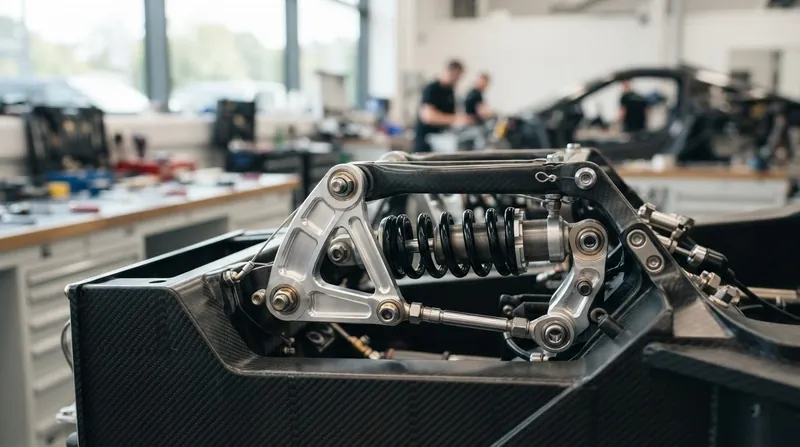
To resolve this conflict, engineers utilize pushrod and bellcrank suspension systems, a technology directly derived from Formula 1. Unlike conventional outboard suspensions, a pushrod setup moves the springs and dampers inboard, mounting them horizontally or longitudinally within the chassis.[8][9]
This inboard packaging offers significant aerodynamic advantages. By removing the bulky springs and shock absorbers from the airstream, engineers can design highly streamlined, teardrop-shaped suspension arms that minimize drag. This clean airflow is also directed more efficiently into the vehicle's radiators.[8]
More importantly, the bellcrank allows engineers to decouple wheel travel from spring compression. By altering the pivot points on the bellcrank, they create a rising-rate geometry. The suspension remains relatively compliant at low speeds for ride comfort, but becomes exponentially stiffer as aerodynamic downforce compresses the chassis.[9]
This mechanical adjustability is vital for track-focused machines. As one engineering analysis notes, "The bell crank is also adjustable allowing the pickup points to be moved, altering the wheel rates of the anti-roll bar and damper." This allows mechanics to quickly tune the vehicle's handling characteristics.[8]
Carbon-Ceramic Braking Systems
Accelerating to 300 kilometers per hour is a feat of power; stopping from that speed is a monumental test of thermal capacity. The relationship between velocity and kinetic energy is exponential. A hypercar traveling at 300 km/h carries nine times the kinetic energy of one moving at 100 km/h.[1]
During a single high-speed deceleration event, the braking system must convert roughly five megajoules of kinetic energy into heat. Over a typical track session, the cumulative thermal load can easily exceed one thousand megajoules. Conventional iron brake rotors simply cannot manage this extreme heat.[1]
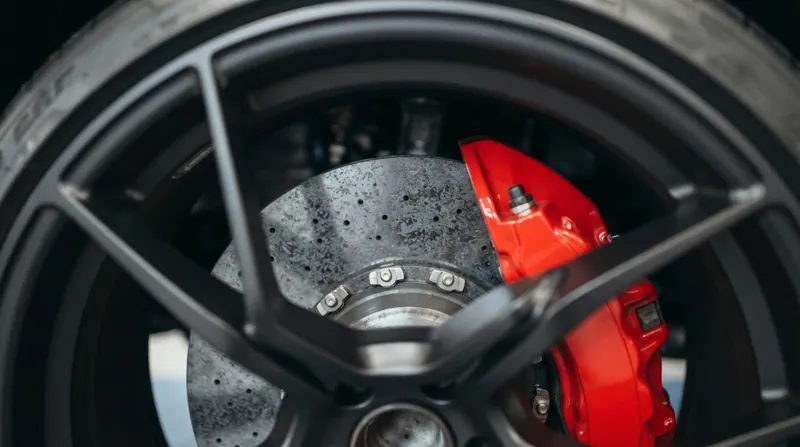
To survive these conditions, supercars rely on carbon-ceramic matrix rotors. These advanced components are manufactured from a core of ceramic material reinforced with carbon fiber. The resulting matrix possesses a dramatically higher specific heat capacity than iron, allowing it to absorb and dissipate massive amounts of thermal energy.[1][2]
Carbon-ceramic brakes also offer a profound weight advantage, typically weighing 50 to 60 percent less than equivalent iron rotors. In a hypercar where every gram is scrutinized, reducing this unsprung, rotating mass at each corner significantly improves steering response, suspension compliance, and overall chassis agility.[1][3]
However, these advanced materials require specific operating conditions. Carbon-ceramic rotors rely on adherent friction, necessitating a microscopic transfer layer of melted pad material on the disc surface. Without the extreme heat generated by aggressive driving to form this layer, the brakes can suffer from low initial bite.[1]
Manufacturers offer different formulations to suit specific use cases. Silicon carbide-coated rotors provide exceptional longevity and better cold-bite for road-going supercars. Conversely, uncoated rotors offer maximum thermal capacity and ultimate friction at extreme sustained temperatures, making them the preferred choice for dedicated track weapons.[1]
The Synthetic E-Fuel Lifeline
While hybrid systems represent the immediate future of the hypercar, the long-term survival of the internal combustion engine may depend on synthetic e-fuels. As global legislation moves to ban the sale of new fossil-fuel vehicles, manufacturers are investing heavily in carbon-neutral alternatives.[14]
Synthetic e-fuels are created by combining hydrogen with carbon dioxide captured directly from the atmosphere. The hydrogen is produced via electrolysis, powered entirely by renewable energy sources such as wind or solar. The resulting synthetic hydrocarbon functions identically to conventional petroleum.[14]
Porsche has taken a leading role in this technology, opening a pilot production plant in Punta Arenas, Chile. The remote location was chosen for its extreme and consistent winds, allowing wind turbines to operate at maximum capacity for roughly 270 days a year to power the electrolysis process.[14]
The environmental premise of e-fuels is a closed carbon cycle. The carbon dioxide emitted when the synthetic fuel is burned in a supercar's engine is offset by the carbon dioxide that was extracted from the atmosphere to produce it, theoretically rendering the combustion process carbon-neutral.[14]
This dual strategy acknowledges that while mass-market vehicles will inevitably electrify, the emotional appeal of a screaming combustion engine remains irreplaceable for enthusiasts. E-fuels provide a legislative loophole that could allow high-performance internal combustion engines to survive well into the zero-emission era.[14][15]
Despite the promise, synthetic fuels face significant hurdles. The production process is currently highly inefficient and expensive compared to direct electrification. Critics argue that the massive amounts of renewable energy required to synthesize e-fuels would be better utilized by charging battery-electric vehicles directly.[14]
Managing High-Compression Combustion
The internal combustion engines that power these vehicles operate under immense stress. To maximize power output from a given displacement, engineers utilize extremely high compression ratios. This forces the air-fuel mixture into a tightly confined space before ignition, resulting in a more violent expansion.[15]
However, this high cylinder pressure creates a critical vulnerability: engine knock. If the pressure and temperature inside the cylinder become too great, the air-fuel mixture can detonate prematurely. This uncontrolled explosion sends destructive shockwaves through the engine block, capable of shattering pistons in milliseconds.[15]
To prevent this catastrophic failure, high-compression supercar engines require high-octane fuel. The octane rating of a fuel is not a measure of its energy content, but rather its resistance to detonation under pressure. A hypercar engine demands premium fuel to operate at its absolute limit.[15]
Engine control units constantly monitor the combustion process using acoustic knock sensors. If these sensors detect the onset of premature detonation, the computer instantly retards the ignition timing, sacrificing peak power to protect the engine's internal components from catastrophic damage.[15]
Engine control units constantly monitor the combustion process using acoustic knock sensors.
Engineering the Impossible
The modern hypercar is a paradox. It is a vehicle engineered to operate at velocities that are illegal on public roads, utilizing technologies that are largely irrelevant to daily commuting. Yet, the pursuit of these extreme performance metrics drives innovations in materials science and thermal management.[15]
From the 1,800-horsepower hybrid V16 of the Bugatti Tourbillon to the active aerodynamic surfaces that keep it tethered to the earth, every component represents the absolute limit of current engineering capability. The integration of these disparate systems into a cohesive machine is a monumental achievement.[15]
The transition toward electrification and synthetic fuels ensures that the hypercar will survive the demise of traditional fossil fuels. While the powertrains will evolve, the fundamental ethos remains unchanged: the relentless pursuit of speed, the mastery of physics, and the creation of automotive art.[15]
As manufacturers continue to push the boundaries of what is mechanically possible, the hypercar will remain the ultimate expression of human ingenuity. These vehicles are not just cars; they are rolling testaments to our desire to conquer the elements and to engineer the impossible.[15]
Comparison
| Material Type | Primary Use Case | Thermal Capacity | Cold-Bite Performance | Wear Resistance |
|---|---|---|---|---|
| CCB (Silicon Carbide Coated) | Road and occasional track | High | Excellent | 5x longer lifespan |
| CCM (Uncoated) | Dedicated track use | Maximum | Poor (requires heat) | Standard |
Key terms
- Torque Vectoring
- The ability to precisely control and distribute power to individual wheels, improving cornering agility and stability.
- Downforce
- The aerodynamic vertical force that pushes a vehicle down toward the track, increasing tire grip at high speeds.
- Pushrod Suspension
- An inboard suspension geometry that uses a diagonal rod and bellcrank to transfer wheel movement to internal springs and dampers.
- Synthetic E-Fuel
- A carbon-neutral hydrocarbon fuel created by combining hydrogen from renewable electrolysis with captured atmospheric carbon dioxide.
- Engine Knock
- The premature and uncontrolled detonation of the air-fuel mixture inside a cylinder, capable of causing catastrophic engine damage.
Frequently asked
What is the difference between a supercar and a hypercar?
Hypercars represent the extreme top tier of supercars. They typically feature over 1,000 horsepower, multi-million-dollar price tags, and groundbreaking engineering that pushes the absolute limits of physics.
Why do hypercars use pushrod suspensions?
Pushrod suspensions move bulky springs and dampers inside the chassis. This reduces aerodynamic drag and allows engineers to create a rising-rate geometry that handles massive downforce without ruining low-speed ride quality.
Do carbon-ceramic brakes work well on the street?
They can, but they require specific formulations. Uncoated track rotors need extreme heat to function properly and will squeal at low speeds, while silicon carbide-coated rotors are designed for better cold-bite on public roads.
What are synthetic e-fuels?
E-fuels are carbon-neutral hydrocarbons made by combining renewable hydrogen with captured atmospheric CO2. They are designed to replace fossil fuels in existing combustion engines without requiring mechanical modifications.
Why do high-compression engines need high-octane fuel?
High-octane fuel resists premature detonation under extreme cylinder pressures. Using standard fuel in a hypercar can cause engine knock, which sends destructive shockwaves through the engine block.
Viewpoints in depth
Automotive Traditionalists
Advocate for the preservation of high-displacement combustion engines through synthetic e-fuels.
This perspective argues that the soul of a hypercar lies in its mechanical complexity and acoustic signature. Traditionalists maintain that while electric motors offer superior acceleration, they lack the visceral emotion and engagement of a high-revving V16 or V8. They heavily support investments in synthetic e-fuels, viewing them as the only viable lifeline to keep internal combustion engines legally and environmentally viable in the future.
Electrification Advocates
Believe that pure battery-electric powertrains represent the ultimate future of hypercar performance.
Advocates for full electrification argue that combustion engines have reached their physical and thermal limits. They point to the instant torque, precise per-wheel torque vectoring, and lower center of gravity offered by battery-electric architectures as insurmountable advantages. From this viewpoint, synthetic e-fuels are an inefficient distraction that wastes renewable energy better spent directly charging advanced solid-state batteries.
Hybrid Pragmatists
Support the integration of electric motors with combustion engines to achieve the ultimate balanced performance.
This camp views hybrid powertrains not as a compromise, but as the optimal engineering solution. By using electric motors to fill the torque gaps of high-revving, naturally aspirated engines, manufacturers can deliver unprecedented power without the massive weight penalty of a pure battery-electric vehicle. Pragmatists see cars like the Bugatti Tourbillon as the pinnacle of this philosophy, blending the best attributes of both technologies.
What changed
- · Revision 1Published.
Related explainers
- Porsche Abandons All-Electric Mission X, Pivots to Hybrid V8 Hypercar Based on 963 Racer
- How Pushrod Bellcranks Balance Supercar Aerodynamic Downforce With Low-Speed Ride Compliance
- Why High-Compression Supercar Engines Require 100-Octane Fuel to Prevent Catastrophic Knock
- How Bugatti Engineered the 1,800-HP Tourbillon: Inside the V16 Hybrid Powertrain
- How Fender Louvers Bleed Trapped Wheel-Arch Pressure to Cancel Front-Axle Aerodynamic Lift
- Carbon-Ceramic Brakes Require Pre-Formed Transfer Layers to Bite, Causing Street-Speed Cold Squeal
- How Synthetic E-Fuels Are Saving the Supercar's Combustion Engine
- How Active Aerodynamics Are Replacing Fixed Wings on Electric Supercars
- How Bugatti's 1,775-Horsepower V16 Hybrid Powertrain Actually Works
- Active Aerodynamics: How Supercars Dynamically Balance Downforce and Drag
- Aston Martin Unveils the Valen, an 838-Horsepower V12 Supercar Limited to 150 Units
- Why Carbon-Ceramic Brakes Prevent Track Fade but Fail to Justify Costs on the Road
- Automotive Traditionalists
- Advocate for the preservation of high-displacement combustion engines through synthetic e-fuels.
- Hybrid Pragmatists
- Support the integration of electric motors with combustion engines to achieve the ultimate balanced performance.
- Electrification Advocates
- Believe that pure battery-electric powertrains represent the ultimate future of hypercar performance.
Perspectives this story doesn't cover
- Environmental Policymakers
- Mass-Market Consumers
Sources
Source coverage
15 outlets
3 viewpoints surfaced














- [1]AutoModExpress
Why Carbon Ceramic Is Essential at Supercar Speeds
Read on AutoModExpress → - [2]SlashGear
Why Are Carbon Ceramic Brakes Used In Supercars?
Read on SlashGear → - [3]Surface Transforms
New Carbon-Ceramic Brake Disc Kit for McLaren 765LT
Read on Surface Transforms → - [4]MPH.com
The Science Behind Supercar Aerodynamics
Read on MPH.com → - [5]Skill-Lync
Aerodynamic Features Transforming Modern Supercars
Read on Skill-Lync → - [6]Wikipedia
Supercar
Read on Wikipedia → - [7]Auto ExpressHybrid Pragmatists
Best hypercars 2025
Read on Auto Express → - [8]Suspension Secrets
Pushrod Suspension Design and Aerodynamics
Read on Suspension Secrets → - [9]University of Cincinnati
Adjustable Pushrod Suspension Design
Read on University of Cincinnati → - [10]CarExpertAutomotive Traditionalists
Porsche drops electric hypercar plans for hybrid V8
Read on CarExpert → - [11]PistonHeadsElectrification Advocates
Porsche Mission X concept revealed
Read on PistonHeads → - [12]Wikipedia
Bugatti Tourbillon
Read on Wikipedia → - [13]Rimac NewsroomElectrification Advocates
Rimac Technology engineers the hybrid powertrain for Bugatti Tourbillon
Read on Rimac Newsroom → - [14]AutocarAutomotive Traditionalists
Porsche e-fuels: synthetic petrol explained
Read on Autocar → - [15]Factlen Editorial TeamHybrid Pragmatists
Synthesis by Factlen editorial team
Read on Factlen Editorial Team →
More in Automotive & Transportation
See all →Hypercar Development
F1 Champion Lando Norris Tests McLaren MCL-HY Hypercar Prototype at Portimão
5 sources
Brake Tribology
Carbon-Ceramic Brakes Require Pre-Formed Transfer Layers to Bite, Causing Street-Speed Cold Squeal
4 sources
Aerodynamics
How Fender Louvers Bleed Trapped Wheel-Arch Pressure to Cancel Front-Axle Aerodynamic Lift
3 sources
Suspension Geometry
How Pushrod Bellcranks Balance Supercar Aerodynamic Downforce With Low-Speed Ride Compliance
7 sources
Comments
Every angle. Every day.
Get Automotive & Transportation stories with full source coverage and perspective breakdowns, free every day.