
Dry-Sump vs. Wet-Sump: How High-Performance Engines Prevent Oil Starvation Under High G-Forces
While standard vehicles rely on a simple oil pan, high-performance engines separate their oil storage to survive lateral G-forces. This architecture prevents oil starvation in corners, lowers the vehicle's center of gravity, and unlocks parasitic horsepower.
By Dev Anand

Share this story
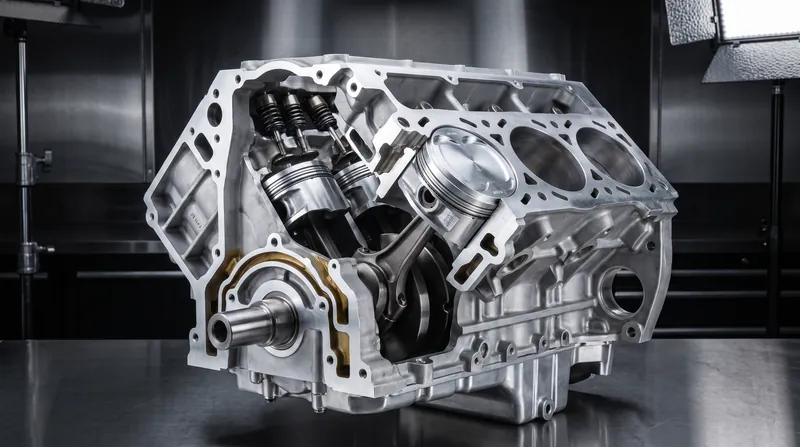
A standard commuter car relies on gravity to pool its engine oil in a single pan beneath the crankshaft, a design perfectly suited for stop-and-go traffic and highway cruising. The high-performance dry-sump system differs in one critical respect: it completely separates the oil storage from the engine block, treating lubrication not as a passive pool, but as an actively managed, multi-stage fluid circuit.[4]
For a track-day driver navigating a sustained sweeper at 1.2 lateral Gs, that distinction is the difference between a successful lap and catastrophic engine failure. In a traditional wet-sump layout, centrifugal force pushes the oil away from the pickup tube. If the pump sucks air even for a few seconds at 7,000 RPM, the hydrodynamic film protecting the rod bearings collapses, resulting in immediate metal-on-metal contact.[4]
"The primary advantage of a dry sump system is the reliable supply of oil to the engine under all conditions," notes Neil Brown Engineering, a prominent motorsport engine builder. By utilizing a tall, external reservoir, the system ensures that the pressure pump always has a solid column of oil to draw from, regardless of how violently the chassis changes direction or accelerates.
The architecture relies on a series of scavenge pumps—often three to six stages—bolted directly to the engine block. These pumps actively vacuum oil and blow-by gases out of the shallow collection pan as soon as the fluid drops from the bearings. According to Dart Machinery, this aggressive scavenging creates a partial vacuum in the crankcase, which fundamentally changes how the engine operates under load.
That vacuum solves a secondary problem that plagues high-revving wet-sump engines: windage. When a crankshaft spins at 8,000 RPM through a cloud of vaporized oil, the fluid creates severe parasitic drag. "Windage robs horsepower," JEGS technicians explain in their system breakdown, noting that removing this dense oil cloud allows the rotating assembly to spin more freely, often unlocking 10 to 15 additional horsepower in a V8 application.
For the supercar buyer, the most immediate physical manifestation of a dry-sump system is the vehicle's stance. Because the engine no longer requires a deep, six-inch oil pan bolted to its underside, engineers can mount the entire block lower in the chassis. This drops the vehicle's center of gravity, directly translating to sharper turn-in response and reduced body roll.[4]
However, the terminology in modern showrooms can be misleading. As Seacoast Specialist Cars details in their analysis of Porsche architectures, the transition from the air-cooled era to the water-cooled M96 engine in 1997 introduced the "integrated dry sump." Unlike a true motorsport system with a remote tank, the integrated design stores oil in a separate chamber within the engine block itself.
While integrated systems utilize multiple scavenge pumps to pull oil from the cylinder heads, they still share a housing with the crankcase. This hybrid approach saves manufacturing costs and reduces the complexity of external plumbing, but it does not offer the absolute starvation protection of a standalone reservoir during sustained track use on sticky racing tires.
The complexity of a true dry-sump system introduces significant maintenance considerations for the owner. A standard wet-sump oil change might require five quarts of fluid and a single drain plug. A dry-sump system, by contrast, often holds 12 to 16 quarts to ensure adequate cooling and de-aeration, requiring mechanics to drain both the external tank and the engine block separately.[4]
Checking the oil level also demands a specific, often counterintuitive procedure. Because the oil settles into the engine block when the vehicle sits, checking the dipstick on a cold engine will falsely indicate a low level. Owners must bring the oil to operating temperature and check it while the engine is idling, ensuring the scavenge pumps have returned the fluid to the reservoir.[4]
The historical precedent for these systems in lightweight sports cars is extensive. Elantrikbits, a Lotus resource hub, documents how early Lotus Elan builders in the 1960s adapted dry-sump systems to keep their low-slung chassis competitive. The fundamental physics of keeping oil at the pickup tube have not changed in sixty years, even as the machining tolerances of the pumps have improved.
Aeration remains the hidden enemy of engine bearings, and the dry-sump reservoir acts as a dedicated centrifuge to combat it. As the scavenge pumps return a frothy mix of oil and air to the tank, the fluid is directed along the curved inner walls. Motor Authority highlights that this swirling action forces the heavier oil to the outside while the air escapes through a breather at the top, ensuring the pressure pump receives only pure, incompressible fluid.[2]
For aftermarket builders, the decision to upgrade hinges on the intended use case. Woda Auto Parts emphasizes that the thousands of dollars required for a billet oil pump, custom pan, braided lines, and a remote tank are wasted on a street car that will never exceed 0.8 Gs on a public road. A well-designed wet sump with trap-door baffles is entirely sufficient for spirited canyon driving.[3]
Yet, as tire technology advances, the threshold for requiring a dry sump is dropping. Modern 200-treadwear track tires generate grip levels that were exclusive to racing slicks a decade ago. Mechanical Guide Hub notes that when a heavy, modern sports car generates 1.3 Gs on a banked circuit, the oil in a wet sump will climb the side of the block, completely exposing the pickup tube.[1]
The lubrication architecture serves as the engine's operational ceiling. While a wet sump is a triumph of cost-effective, gravity-fed simplicity, the dry sump represents the engineering extreme: a mechanized, multi-stage guarantee that no matter the RPM, the temperature, or the lateral force, the engine's most critical components will never run dry.[4]
Viewpoints in depth
OEM Engineers
Automakers balance the performance benefits of a dry sump against manufacturing costs and packaging constraints.
For manufacturers like Porsche and Chevrolet, implementing a dry-sump system is as much about vehicle dynamics as it is about engine longevity. Removing the deep oil pan allows the engine to sit inches lower in the chassis, fundamentally improving the car's roll center and handling characteristics. However, true remote-reservoir systems are expensive to manufacture and complicate assembly line procedures, leading many brands to develop 'integrated' dry sumps that offer a middle ground between cost and performance.
Aftermarket Builders
Engine builders view dry-sump systems as a tool to unlock horsepower and ensure survival at high RPMs.
In the aftermarket and motorsport sectors, the primary draw of a dry sump is crankcase vacuum. By aggressively scavenging oil and air out of the block, builders eliminate the parasitic drag caused by the crankshaft whipping through a cloud of oil. This 'windage' reduction can free up double-digit horsepower figures in large-displacement V8s, while the constant supply of de-aerated oil ensures that expensive rotating assemblies survive sustained 8,000 RPM track sessions.
Track Enthusiasts
Drivers must adapt to the unique maintenance and operational quirks of a dry-sump vehicle.
For the owner, a dry sump changes the relationship with the vehicle's maintenance schedule. Oil capacities often double, increasing the cost of routine fluid changes, and the procedure for checking the oil level requires the engine to be hot and idling. Despite these hurdles, track-day drivers view the system as mandatory insurance; as modern 200-treadwear tires generate unprecedented lateral grip, a standard wet sump is no longer sufficient to prevent oil starvation in long, sweeping corners.
- OEM Engineers
- Focuses on packaging, center of gravity, and warranty-safe reliability for high-performance production cars.
- Aftermarket Builders
- Values the horsepower gains from reduced windage and the absolute protection against bearing failure.
- Track Enthusiasts
- Views the dry sump as a necessary, albeit expensive, insurance policy for running sticky tires on road courses.
Sources
Source coverage
4 outlets
3 viewpoints surfaced




- [1]Mechanical Guide HubTrack Enthusiasts
Difference Between Wet Sump and Dry Sump Lubrication System
Read on Mechanical Guide Hub → - [2]Motor AuthorityOEM Engineers
The differences between wet and dry sump oil systems
Read on Motor Authority → - [3]Woda Auto PartsAftermarket Builders
Wet Sump vs Dry Sump: Best Oil System for Engines
Read on Woda Auto Parts → - [4]Factlen Editorial Team
Synthesis by Factlen editorial team
Read on Factlen Editorial Team →

More in Automotive & Transportation
See all →Hypercar Development
F1 Champion Lando Norris Tests McLaren MCL-HY Hypercar Prototype at Portimão
5 sources

Engine Dynamics
The Brake Mean Effective Pressure (BMEP): How the Average Pressure on the Piston Defines an Engine's Power Density
6 sources
Transmission Tech
Dual-Clutch Transmissions Split Odd and Even Gears to End Torque Interruption
6 sources

Active Aero
How Active Aerodynamics Are Replacing Fixed Wings on Electric Supercars
6 sources

Comments
Every angle. Every day.
Get Automotive & Transportation stories with full source coverage and perspective breakdowns, free every day.