
US DOT Launches 3-Year Pilot Program for Pre-Certified eVTOL and STOL Aircraft Operations
The FAA and DOT have selected eight projects across 26 states to allow pre-certified electric aircraft to conduct revenue-generating cargo and medical flights in live commercial airspace.
By Derya Kaplan

Picture the last time you sat in bumper-to-bumper traffic, staring at a 12-mile commute that somehow swallowed an hour of your morning. Now imagine bypassing that gridlock entirely, covering the same distance in six minutes, 1,500 feet above the highway in an aircraft quieter than a household dishwasher. For years, that vision of electric air taxis has felt like a perpetual science fiction promise, always hovering just out of reach in slick corporate presentations and tightly controlled test environments.
But the timeline for when regular commuters and local logistics networks will actually interact with these vehicles has just accelerated dramatically. The abstract concept of urban air mobility is finally descending into local neighborhoods, shifting from a distant technological novelty to an immediate infrastructure reality that city planners, hospital administrators, and daily travelers will soon have to navigate.[3][5]
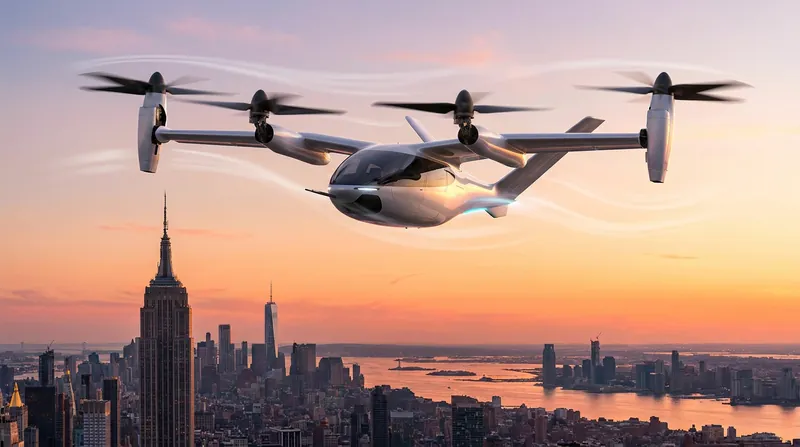
The catalyst for this shift arrived with the launch of the eVTOL Integration Pilot Program (eIPP), a landmark three-year initiative spearheaded by the U.S. Department of Transportation and the Federal Aviation Administration. Under this new framework, the federal government has selected eight advanced air mobility projects spanning 26 states to bring electric vertical takeoff and landing (eVTOL) and short takeoff and landing (STOL) aircraft into live commercial airspace.
For the first time in U.S. aviation history, aircraft that have not yet received full FAA type certification are being legally permitted to fly revenue-generating missions. They will operate at active commercial airports, interact with live air traffic control, and carry actual cargo—and eventually, paying customers—under carefully negotiated federal agreements.[1][2][8]
To make this unprecedented operational leap possible, the FAA is utilizing Other Transaction Agreements (OTAs) rather than traditional certification pathways. Typically, an aircraft manufacturer must complete a grueling five-stage type certification process before a single commercial flight can take place. The eIPP bypasses this bottleneck for specific, controlled missions, allowing companies to fly pre-certified aircraft to generate the very operational data the FAA needs to finalize its long-term regulations.
These agreements define exactly what each participant can and cannot do, establishing strict safety parameters while lowering the initial risk thresholds. By permitting these flights under OTAs, regulators are effectively letting companies fly commercial missions first, using the resulting real-world data to write the permanent rulebook afterward.[1][3][4]
The roster of companies stepping into this live airspace includes some of the most heavily capitalized names in the advanced air mobility sector. Joby Aviation and Archer Aviation, both of which are developing piloted four-passenger electric air taxis, are key participants looking to validate their urban transport models.
BETA Technologies is bringing both its conventional fixed-wing electric aircraft and its VTOL variants into the fold, focusing heavily on medical and cargo logistics. Other participants include Wisk Aero, a Boeing subsidiary pushing a pilotless autonomous model, alongside Electra and Elroy Air. These aircraft, which generally exceed 1,320 pounds, represent the first entirely new category of civil aviation recognized by the FAA since the introduction of helicopters in the 1940s.[1][3][4]
For local communities, the first visible impact of this program will not be passenger air taxis whisking executives to downtown high-rises, but rather quiet, electric workhorses handling regional logistics. Early operations within the eIPP are heavily weighted toward cargo deliveries, emergency medical transport, and critical-care airlift.
Because freight operations carry a significantly lower risk threshold and simpler liability math than passenger flights, at least three of the eight selected projects are expected to log revenue freight flights by the end of the year. A regional hospital in Texas or a rural clinic in Vermont could soon receive time-sensitive medical supplies via an electric aircraft landing on a retrofitted helipad, fundamentally altering the speed and reliability of local healthcare logistics.[4][6]
This operational shift forces a sudden reckoning for local infrastructure planners and real estate developers. The eIPP is not just testing the aircraft; it is testing the physical footprint required to support them. The FAA will be actively collecting data on the load-bearing requirements of vertiport landing pads, the dimensional sizing of taxiways, and the placement of high-capacity recharging stations.
Cities and private developers must now figure out how to integrate these dedicated landing sites into existing urban fabrics. The program will measure approach and departure slopes, taxiing performance, and turn radii, providing the empirical data needed to zone and build the neighborhood vertiports that will eventually serve as the bus stops of the sky.[7]
However, operating pre-certified aircraft in commercial airspace introduces complex new liabilities that operators and local partners must shoulder. The Department of Transportation's Office of Inspector General has explicitly noted that the OTAs governing these flights are not standard procurement contracts, meaning they do not convey sovereign immunity or federal indemnification to the private companies involved.
The eIPP is not a mechanism to bypass ultimate safety requirements, and participants are operating entirely at their own commercial risk. Consequently, eVTOL manufacturers and their local operating partners must secure robust private insurance or self-insure for hull and liability coverage, a significant financial hurdle for an industry that has yet to prove its long-term profitability.[4]
As the selected projects finalize their operational agreements, the first commercial flights under the eIPP could begin within 90 days. While this three-year window will generate invaluable public visibility and operational data, full commercialization—where hundreds of electric air taxis are delivered to paying customers—still depends on the underlying FAA type certification process, which remains on its own distinct timeline.
Nevertheless, the launch of this pilot program marks the definitive moment when advanced air mobility transitions from a speculative investment thesis into a tangible transportation service. For the daily commuter, the local logistics manager, and the urban planner, the era of electric aviation is no longer a distant horizon; it is actively entering their local airspace.[1][2][3]
Key points
- The U.S. DOT and FAA have launched a three-year pilot program allowing pre-certified eVTOL aircraft to fly in commercial airspace.
- Eight projects across 26 states will participate, utilizing Other Transaction Agreements to bypass traditional certification delays for specific missions.
- Initial operations will focus on lower-risk cargo deliveries and emergency medical transport rather than passenger flights.
- The program will generate crucial data on vertiport infrastructure, including load-bearing requirements and charging station placement.
How we got here
October 2024
The FAA finalizes pilot training and certification rules for powered-lift aircraft, establishing the first new civil aircraft category since the 1940s.
June 2025
An executive order on aviation innovation directs the FAA to establish a pilot program to accelerate advanced air mobility.
March 2026
The DOT and FAA officially select eight projects across 26 states for the eVTOL Integration Pilot Program.
August 2026
Operational agreements are finalized, clearing the way for the first pre-certified revenue flights in U.S. airspace.
- eVTOL Manufacturers
- Eager to demonstrate operational viability and secure early revenue streams while awaiting full certification.
- Aviation Regulators
- Focused on gathering real-world operational data to safely integrate a new class of aircraft into the national airspace.
- Aviation Analysts
- Monitoring the liability, insurance, and infrastructure hurdles that could delay widespread commercialization.
Perspectives this story doesn't cover
- Local community advocates concerned about the noise and visual impact of low-altitude electric aircraft.
- Traditional commercial airlines evaluating how air taxis will disrupt or complement their regional hub-and-spoke models.
Sources
Source coverage
8 outlets
3 viewpoints surfaced








- [1]EVXLAviation Analysts
DOT & FAA Select 8 eVTOL Projects Across 26 States — Electric Air Taxis Enter Live Airspace This Summer
Read on EVXL → - [2]Compass VermontAviation Analysts
eVTOL Integration Pilot Program (eIPP) is a new federal initiative
Read on Compass Vermont → - [3]ExoSwaneVTOL Manufacturers
eVTOL Stocks to Watch: Certification Front-Runners
Read on ExoSwan → - [4]JDA Aviation SolutionsAviation Analysts
FAA's eIPP lets Wisk and Reliable Robotics fly commercial before certification, and that changes everything
Read on JDA Aviation Solutions → - [5]AvGeekeryeVTOL Manufacturers
Eight projects from across the United States have been picked for a new eVTOL pilot program
Read on AvGeekery → - [6]Autonomy GlobaleVTOL Manufacturers
Archer and several other eVTOL, e-STOL and other large autonomous OEMs will soon take to U.S. skies
Read on Autonomy Global → - [7]U.S. Department of TransportationAviation Regulators
Electric Vertical Takeoff and Landing Integration Pilot Program
Read on U.S. Department of Transportation → - [8]Federal Aviation AdministrationAviation Regulators
eVTOL Integration Pilot Program (eIPP)
Read on Federal Aviation Administration →
More in Automotive & Transportation
See all →Aerodynamics
How Rising Stall Speeds and Falling Sonic Velocity Trap High-Altitude Jets in Coffin Corner
4 sources

Aircraft Certification
FAA Review Panel Finds Boeing 737 MAX Software Flaw Not a Safety Risk, Clearing Obstacle for MAX 10 Certification
7 sources

Aviation Infrastructure
Transportation Secretary Seeks $30 Billion More for ATC Modernization
5 sources

Aerodynamics
Lift, Weight, Thrust, and Drag: How the Four Forces Must Balance for Sustained Flight
6 sources

Comments
Every angle. Every day.
Get Automotive & Transportation stories with full source coverage and perspective breakdowns, free every day.