
GuideElectric Utilities and Power Grid InfrastructureRevision 1Updated
The Complete Guide to Electric Utilities and Power Grid Infrastructure
From bare-metal transmission lines to solid-state transformers, the modern electrical grid relies on a complex interplay of thermodynamic cycles, sub-second frequency regulation, and regional market coordination. This guide breaks down the physical, financial, and technological mechanisms that keep the world's largest machine running.
By Aarav Khanna

Share this story
In short
- High-voltage transmission lines rely on bare metal conductors and ambient air for insulation, as wrapping them would trap destructive heat.
- Regional Transmission Organizations (RTOs) manage the bulk flow of electricity across state lines, operating wholesale markets and balancing supply instantaneously.
- Industrial facilities face steep financial penalties from utilities if their power factor drops below regulated thresholds, driving the need for reactive power correction.
The modern electrical grid is often described as the largest machine ever built, a continent-spanning network that must balance supply and demand at the speed of light. At its core is a deceptively simple infrastructure: thousands of miles of bare metal wire strung high above the ground.[5][6]
High-voltage transmission lines, operating anywhere from 115 kilovolts up to 765 kilovolts, form the bulk transport arteries of this system. Unlike the insulated cords in a residential home, these massive conductors rely entirely on the ambient air for dielectric insulation.[5][6]
Wrapping transmission lines in standard polymer insulation is physically unworkable at scale. The insulation would trap the immense heat generated by line resistance, and the added weight would require vastly heavier, more expensive steel lattice towers to prevent structural collapse.[5][6]
Instead, utilities deploy engineered bare conductors, predominantly Aluminum Conductor Steel Reinforced (ACSR) cables. The outer aluminum strands deliver high electrical conductivity, while the high-tensile steel core provides the mechanical strength necessary to limit sag under heavy wind and ice loads.[6]
Because the wires are bare, grid engineers must meticulously calculate tower heights and phase spacing. These clearances ensure that the high-voltage current cannot arc to the ground, neighboring lines, or encroaching vegetation, maintaining reliability across harsh environmental conditions.[5]
Managing the Flow: ISOs and RTOs
Moving electricity across these bare-metal highways requires intense, centralized coordination. In the United States, the grid is not operated by a single federal entity, but rather by a patchwork of regional organizations that manage the flow of power across state lines.[3][4]
Independent System Operators (ISOs) and Regional Transmission Organizations (RTOs) are non-profit entities that control the high-voltage transmission system. Together, seven of these grid operators manage the delivery of two-thirds of the electricity consumed by the American public.[3][4]
The modern RTO framework traces its origins to the 1990s, specifically FERC Orders 888 and 889, which mandated non-discriminatory access to transmission lines. In 1999, FERC Order 2000 further encouraged the formation of RTOs to administer the grid on a broad regional basis.[3][4]
These organizations perform two critical functions: they operate the physical grid in real time to maintain stability, and they run the wholesale electricity markets. By decoupling the ownership of power plants from the control of the transmission lines, RTOs foster competitive energy pricing.[4]
PJM Interconnection, which originated as a power pool in the 1920s, now serves as a massive RTO coordinating electricity across 13 states and the District of Columbia. Its operators forecast load, schedule generation, and dispatch assets instantaneously to keep the system balanced.[4]
The Physics of Billing: Power Factor
While RTOs manage the bulk flow of megawatts, the actual efficiency of power consumption at the industrial level is governed by a hidden geometric ratio. This metric, known as the power factor, dictates how utilities bill large commercial facilities for their electrical footprint.[7][8]
In alternating current systems, real power—measured in kilowatts—performs the actual physical work, such as turning a motor shaft or heating an industrial oven. However, inductive loads like transformers and motors also draw a second component known as reactive power.[7]
"Reactive power (kVAR) does no work at all. It flows back and forth each cycle, establishing the magnetic fields that inductive equipment needs in order to function," explains The Demand Charge. This reactive current still occupies physical capacity on the grid.[7]
Apparent power, measured in kilovolt-amperes (kVA), is the vector sum of both real and reactive power. The power factor is simply the ratio of real power to apparent power, representing the cosine of the phase angle between voltage and current.[7]
A power factor of 1.0 indicates perfect efficiency, but heavily inductive industrial sites often operate at 0.80 or lower. Because the utility must size its conductors and transformers to carry the total apparent power, it penalizes facilities that draw excessive reactive current.[7][8]
These financial penalties are strictly enforced through state tariff orders. In Gujarat, for example, high-tension consumers face a 1 percent surcharge on their energy charges for every 1 percent their power factor drops below a mandated 0.90 threshold, driving rapid adoption of correction capacitor banks.[8]
Sub-Second Stability: Ancillary Services
Beyond the raw delivery of megawatts and the management of reactive power, the grid requires a hidden layer of sub-second interventions to survive. These critical support functions, known collectively as ancillary services, act as the grid's sequential defense mechanisms.[9]
The most immediate of these is frequency regulation. The entire North American alternating current grid is synchronized to operate at exactly 60 Hertz, while European networks target 50 Hertz. Maintaining this frequency requires a perfect, instantaneous match between generation and load.[9]
If demand suddenly outstrips supply, the grid's frequency drops; if supply exceeds demand, the frequency spikes. Deviations of just 0.2 Hertz can damage sensitive equipment or trigger automated protective relays, potentially cascading into a widespread regional blackout.[9]
To prevent this, grid operators procure regulation services from fast-responding assets. Battery storage systems and automated generation facilities constantly adjust their output on a second-by-second basis, responding to telemetry signals from the ISO to inject or withdraw power as needed.[9]
Voltage control forms another pillar of ancillary services, requiring generators to inject or absorb reactive power to keep transmission voltages within safe limits. Meanwhile, spinning reserves provide synchronized, immediately available backup capacity that can replace a suddenly failed power plant.[9]
Restarting from Zero: Black Start Generators
Despite these layered defenses, extreme weather events or cascading equipment failures can occasionally overwhelm the system, resulting in a total grid collapse. When a region goes entirely dark, operators face a daunting paradox: power plants need electricity to generate electricity.[1][2]
Large thermal facilities, including nuclear and combined-cycle gas plants, rely on the grid to power their massive boiler feed pumps, cooling systems, and digital controls. In a total blackout, these multi-gigawatt facilities are entirely paralyzed and cannot restart themselves.[1][2]
The solution lies in specialized assets known as black-start generators. "Black start is the process of restoring an electric power system... without drawing energy from the external transmission network," notes industry guide Impedyme.[1]
These units, typically hydroelectric turbines, aeroderivative gas turbines, or grid-forming battery systems, can start using only stored energy. Once running, they carefully energize a dedicated transmission route known as a cranking path.[1]
This cranking path delivers the initial auxiliary power required to wake up a larger thermal plant. As each successive generator comes online, operators slowly synchronize these isolated electrical islands, painstakingly rebuilding the regional grid over a period of hours or days.[1][2]
Pushing Thermodynamic Limits: Combined-Cycle Plants
When the grid is functioning normally, the primary objective shifts from sheer survival to thermodynamic efficiency. For decades, traditional simple-cycle gas turbines wasted massive amounts of energy, venting exhaust gases directly into the atmosphere and capping thermal efficiency around 40 percent.[10][11]
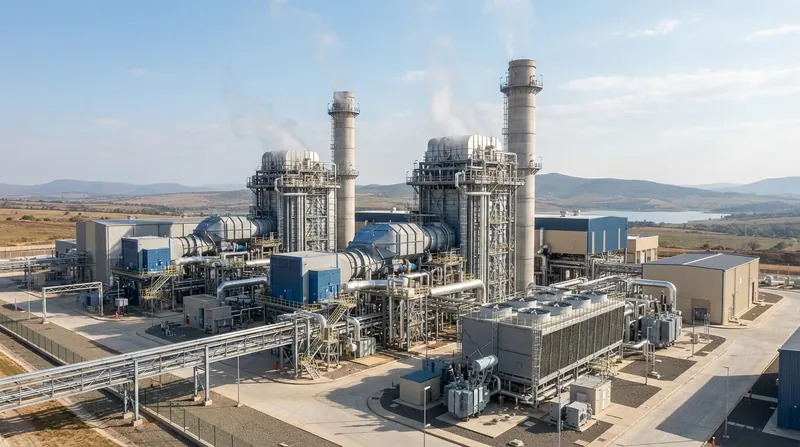
Engineers overcame this limitation by developing the combined-cycle gas turbine (CCGT) power plant. This architecture integrates two distinct thermodynamic processes—the Brayton cycle of the gas turbine and the Rankine cycle of a steam turbine—into a single, highly efficient generation facility.[10][11]
In a CCGT plant, the primary gas turbine burns natural gas to generate electricity. The resulting exhaust gas, which often exits the turbine at temperatures exceeding 600 degrees Celsius, is captured rather than vented, and routed into a massive heat recovery steam generator.[11]
This recovered waste heat boils water into high-pressure steam, which is then used to drive a secondary steam turbine. By extracting two separate streams of work from the exact same volume of fuel, the combined-cycle architecture dramatically reduces carbon emissions per megawatt-hour.[11]
The efficiency gains achieved by this cascading thermal process are staggering. Modern state-of-the-art facilities, such as those equipped with advanced JAC-series turbines from Mitsubishi Heavy Industries, now routinely achieve world-class thermal efficiencies exceeding 64 percent in commercial operation.[10]
The Decentralized Future: Virtual Power Plants
While massive combined-cycle plants dominate centralized generation, the edge of the grid is undergoing a radical, decentralized transformation. The proliferation of rooftop solar panels, residential battery systems, and electric vehicles has created millions of distributed energy resources (DERs).[12]
Individually, a single home battery or smart thermostat is too small for a grid operator to dispatch. However, when thousands of these devices are networked together through advanced cloud software, they form a highly responsive Virtual Power Plant (VPP).[12]
"A virtual power plant (VPP) is an aggregated network of distributed energy resources... connected and managed through advanced software to function as a single, coordinated entity," according to energy software provider gridX.[12]
By pooling these assets, a VPP can bid into wholesale energy markets and provide critical ancillary services just like a traditional physical power plant. During moments of peak demand, the VPP can discharge thousands of home batteries simultaneously to stabilize the grid.[12]
This software-driven approach allows utilities to shift or reduce electricity demand behind the meter in real time. By leveraging the untapped flexibility of existing consumer hardware, VPPs save billions of dollars that would otherwise be spent constructing new peaking power plants.[12]
The Semiconductor Shift: Solid-State Transformers
The final frontier of grid modernization lies in the physical hardware that steps voltage up and down across the distribution network. For over a century, this task has been performed by conventional transformers relying on heavy copper windings and massive iron cores.[13]
These legacy transformers are highly reliable but entirely passive; they cannot actively manage power flow or respond to the dynamic, bidirectional currents generated by modern rooftop solar arrays and electric vehicle charging networks.[13]
Enter the Solid-State Transformer (SST), a next-generation device that replaces traditional magnetic induction with high-frequency power electronics. "A Solid-State Transformer (SST) performs the same fundamental role but does so through advanced power electronics," reports the SuperGrid Institute.[13]
Enter the Solid-State Transformer (SST), a next-generation device that replaces traditional magnetic induction with high-frequency power electronics.
SSTs utilize wide-bandgap semiconductor materials, most notably Silicon Carbide (SiC). These advanced semiconductors can handle significantly higher voltages and switch at much faster frequencies than traditional silicon, drastically reducing the physical footprint and weight of the transformer.[13]
Beyond mere size reduction, the true value of an SST lies in its digital intelligence. These devices can actively regulate voltage, correct poor power factors, and seamlessly manage the bidirectional flow of electricity between the alternating current grid and direct current microgrids.[13]
By acting as smart interfaces rather than passive iron blocks, solid-state transformers are poised to bridge the gap between legacy infrastructure and the highly electrified, hybrid AC-DC power systems required for the next century of energy distribution.[13]
Comparison
| Technology | Thermodynamic Cycles | Typical Efficiency | Primary Use Case | Startup Time |
|---|---|---|---|---|
| Simple-Cycle Gas Turbine | Brayton Cycle only | 33% – 43% | Peaking generation (high demand) | Minutes |
| Combined-Cycle Gas Turbine | Brayton + Rankine Cycles | 60% – 64%+ | Baseload and intermediate generation | Hours |
Definitions
- Apparent Power (kVA)
- The total electrical capacity a grid must provide to a facility, representing the vector sum of both real and reactive power.
- Reactive Power (kVAR)
- Electrical current that does no physical work but is required to sustain the magnetic fields in inductive equipment like motors and transformers.
- Cranking Path
- A dedicated, pre-planned transmission route used during a black start to deliver initial auxiliary power from a self-starting generator to a larger power plant.
- Ancillary Services
- Sub-second grid support functions, such as frequency regulation and voltage control, that maintain the stability of the electrical network.
- Wide-Bandgap Semiconductor
- Advanced materials, such as Silicon Carbide, that allow solid-state transformers to switch at higher frequencies and handle higher voltages than traditional silicon.
Questions & answers
Why are high-voltage transmission lines left bare instead of insulated?
Wrapping transmission lines in plastic insulation would trap the intense heat generated by electrical resistance. The added weight of the insulation would also require vastly heavier and more expensive steel towers to prevent the lines from collapsing.
What is the difference between an ISO and an RTO?
Functionally, both operate transmission systems and run wholesale electricity markets. RTOs simply meet additional regulatory requirements set by FERC regarding transmission access and stakeholder governance, but the terms are often used interchangeably.
Why do utilities charge a power factor penalty?
Inductive equipment like motors draws reactive power, which does no physical work but still occupies capacity on the grid's wires and transformers. Utilities apply penalties to recover the costs of this wasted infrastructure capacity.
How does a black-start generator differ from a standard power plant?
Most large power plants require electricity from the grid to run their internal pumps and control systems before they can generate power. A black-start generator can start from a completely de-energized state using only stored energy, allowing it to reboot the grid.
What makes a combined-cycle power plant so efficient?
A combined-cycle plant captures the intensely hot exhaust gas from its primary gas turbine and uses it to boil water. This steam drives a second turbine, extracting two streams of electricity from the same fuel and pushing efficiency past 60 percent.
Analysis by camp
Grid Operators and Regulators
Focus on maintaining strict sub-second reliability and balancing regional supply and demand.
For Independent System Operators (ISOs) and Regional Transmission Organizations (RTOs), the primary directive is absolute stability. They view the grid not as a commercial marketplace first, but as a fragile physical machine that must be kept in perfect balance. Their policies prioritize mandatory ancillary services, strict power factor penalties, and rigorous black-start testing to ensure that the system can survive extreme weather and sudden equipment failures without cascading into a regional blackout.
Industrial Consumers
Prioritize minimizing energy costs and avoiding steep utility penalties for reactive power.
Large commercial and industrial facilities operate on tight margins where utility penalties can severely impact profitability. From their perspective, grid regulations like power factor thresholds are financial hurdles to be managed through engineering. By deploying automatic capacitor banks and detuned reactors, these consumers aim to correct their power factor at the meter, effectively shielding themselves from the utility's kVA demand charges while optimizing their own internal electrical infrastructure.
Decentralized Energy Advocates
Argue that the future of grid stability lies in aggregating distributed resources.
Proponents of Virtual Power Plants (VPPs) and microgrids argue that the traditional model of massive, centralized power plants is obsolete and financially inefficient. They advocate for a software-driven grid where millions of distributed energy resources—such as home batteries, electric vehicles, and smart thermostats—are networked together. This camp believes that empowering consumers to provide frequency regulation and peak load reduction behind the meter is the most resilient and cost-effective way to modernize the electrical network.
What changed
- · Revision 1Published.
Related explainers
- Why Overhead Power Lines Run as Bare Metal Without Insulation
- Black-Start Generators Energize Dedicated Cranking Paths to Supply Auxiliary Power and Rebuild Collapsed Electric Grids
- Transformer Saturation and Corona Losses Impose an Absolute Voltage Ceiling on Terrestrial Power Transmission
- The Cosine of the Phase Angle: How the Power Factor Dictates Utility Reactive Power Penalties
- How Independent System Operators and Regional Transmission Organizations Manage the US Electric Grid
- How Virtual Power Plants Are Rewiring the Electrical Grid
- The Sub-Second Services That Stabilize the Electric Grid
- Cascading 600°C Exhaust Pushes Combined-Cycle Power Plant Efficiency Past 60 Percent
- How Solid-State Transformers Use Semiconductors to Enable Bi-Directional Smart Grids
- Grid Operators and Regulators
- Focus on maintaining strict sub-second reliability and balancing regional supply and demand.
- Industrial Consumers
- Prioritize minimizing energy costs and avoiding steep utility penalties for reactive power.
- Decentralized Energy Advocates
- Argue that the future of grid stability lies in aggregating distributed resources.
- Power Equipment Manufacturers
- Drive the physical limits of generation and distribution hardware to maximize thermodynamic and electrical efficiency.
Perspectives this story doesn't cover
- Residential Ratepayers
- Environmental Conservation Groups
Sources
Source coverage
14 outlets
4 viewpoints surfaced












- [1]Impedyme
What Is a Black Start Generator?
Read on Impedyme → - [2]USP&E
Black Start Power Plant: How Generators Restart a Dead Grid
Read on USP&E → - [3]Federal Energy Regulatory CommissionGrid Operators and Regulators
Regional Transmission Organizations (RTO) and Independent System Operator (ISO)
Read on Federal Energy Regulatory Commission → - [4]Penn State UniversityGrid Operators and Regulators
Regional Transmission Organizations
Read on Penn State University → - [5]Hastings Utilities
Understanding Overhead Power Lines and How They Function
Read on Hastings Utilities → - [6]Relco Electricals
Types of Transmission Lines in Power Grids: The Complete Technical Guide
Read on Relco Electricals → - [7]The Demand ChargeIndustrial Consumers
Power Factor Penalty Explained, and How to Reduce It
Read on The Demand Charge → - [8]Heaven Green EnergyIndustrial Consumers
Power Factor Penalty
Read on Heaven Green Energy → - [9]gridXDecentralized Energy Advocates
Ancillary services
Read on gridX → - [10]Mitsubishi Heavy IndustriesPower Equipment Manufacturers
Gas Turbine Combined Cycle (GTCC) Power Plants
Read on Mitsubishi Heavy Industries → - [11]Siemens EnergyPower Equipment Manufacturers
Combined cycle power plants
Read on Siemens Energy → - [12]gridXDecentralized Energy Advocates
Virtual power plant (VPP)
Read on gridX → - [13]SuperGrid InstitutePower Equipment Manufacturers
Solid-State-Transformer (SST)
Read on SuperGrid Institute → - [14]Factlen Editorial Team
Synthesis by Factlen editorial team
Read on Factlen Editorial Team →
More in Energy
See all →Grid Modernization
AI Boom Forces US Grid Overhaul as Data Centers Near 20% of National Power Use
7 sources
Power Grid Physics
Transformer Saturation and Corona Losses Impose an Absolute Voltage Ceiling on Terrestrial Power Transmission
6 sources
Thermodynamics
Cascading 600°C Exhaust Pushes Combined-Cycle Power Plant Efficiency Past 60 Percent
4 sources
Grid Infrastructure
US Utilities Plan Massive Fossil Fuel Expansion to Meet AI Data Center Demand, Sierra Club Finds
4 sources
Comments
Every angle. Every day.
Get Energy stories with full source coverage and perspective breakdowns, free every day.