
Black-Start Generators Energize Dedicated Cranking Paths to Supply Auxiliary Power and Rebuild Collapsed Electric Grids
When a regional power grid suffers a total collapse, standard power plants cannot restart themselves because they require massive amounts of electricity just to run their internal systems. Grid operators overcome this paradox by deploying isolated black-start generators to push power down dedicated transmission corridors, systematically waking up larger plants to rebuild the network piece by piece.
By Hunter Cole

In short
- Large thermal power plants cannot restart themselves during a blackout, requiring up to 10% of their capacity in auxiliary power just to run internal systems.
- Grid operators use isolated black-start generators to push power down dedicated cranking paths, waking up larger plants to create stable power islands.
- While natural gas and hydro traditionally dominate black-start operations, grid-forming battery storage is emerging as a zero-emission alternative with sub-second response times.
When a regional power grid collapses into total darkness, the most critical engineering challenge is not repairing broken wires or securing fuel. It is overcoming the "power to make power" paradox. Large thermal power plants cannot simply be switched back on from a dead state.[1]
A standard 500-megawatt combined-cycle natural gas plant requires massive amounts of electricity just to operate its internal systems before it can generate a single watt. Boiler feedwater pumps, combustion air blowers, cooling systems, and control electronics all demand immediate power.[1]
This auxiliary power requirement, often called station service, can consume up to 10% of a plant's total generating capacity. Without an external grid to supply that initial 50 megawatts of electricity, the massive turbines remain entirely inert, extending a blackout indefinitely.[1]
To break this deadlock, grid operators rely on a highly choreographed sequence. As industry guidelines define it, "Black start is the ability to start a generating unit or restoration resource without an external electrical supply and then energize the loads and network needed for system restoration."[2]
The Power to Make Power
The process begins with specialized, isolated generating units that can start themselves using on-site batteries or compressed air. These units operate completely independent of the broader transmission network, serving as the initial spark for the entire region.[1][2]
Under the North American Electric Reliability Corporation (NERC) EOP-005-3 standard, transmission operators are legally required to maintain and regularly test these dedicated black-start resources. A facility cannot simply claim the capability; it must prove it can energize a dead bus during simulated outages.[2][3]
Historically, grid operators have relied heavily on hydroelectric plants and small industrial diesel generators to provide this initial spark. Hydroelectric facilities are particularly effective because opening a penstock valve requires minimal direct-current battery power, allowing gravity to spin the massive turbines.[1]
In the United States, natural gas turbines currently represent the majority of NERC-registered black-start units, accounting for roughly 60% of the total fleet. Hydropower units comprise another significant portion at 37%, chosen for their ability to operate reliably in an isolated mode.[1]
When a blackout occurs, these units automatically detect the loss of alternating-current power and initiate their start sequences. An undervoltage relay triggers direct-current motors powered by on-site battery banks, which spin the turbine's lube oil pumps and starting clutches.[4]
The reliability standards for these units are exceptionally stringent. NERC mandates that black-start resources maintain enough on-site fuel to operate at maximum output for a minimum of 72 hours, ensuring they can sustain the grid restoration effort even if supply chains are severed.[3]
Energizing the Cranking Path
Once the black-start generator reaches its full operating speed and stabilizes its voltage, it faces its most dangerous task. The unit must close its main circuit breaker and push power out into the dead grid, energizing a specific, pre-planned transmission corridor known as a cranking path.[1][4]
A cranking path is an isolated segment of the high-voltage transmission system that connects the black-start unit directly to a larger, non-black-start power plant. Energizing this empty line is highly volatile, as the sudden introduction of voltage can cause severe transient spikes.[4]
The black-start generator must absorb massive inrush currents as it wakes up the dormant transformers along the route. If the generator's excitation system cannot maintain a stable 60-hertz frequency during this shock, the unit will trip offline, stalling the entire regional recovery.[3]
Because of these physics constraints, a grid operator cannot simply connect a black-start unit to the nearest available line. The cranking path is strictly isolated from the rest of the grid, ensuring the limited starting power is delivered exactly where it is needed without being drained by civilian loads.[1][2]
Waking the Thermal Giants
When the cranking path successfully delivers power to the target thermal plant, the heavy lifting begins. The delivered electricity is routed directly to the plant's auxiliary buses, bypassing the main generators to power the massive induction motors that drive the facility's pumps and compressors.[1]
Starting these industrial motors requires a sudden surge of power that can be six to eight times their normal operating current. The black-start unit at the other end of the cranking path must dynamically adjust its output to prevent the localized grid from collapsing under the sudden load.[4]
Once the thermal plant's auxiliary systems are running, operators can ignite the main boilers or gas turbines. As the massive rotors accelerate and synchronize with the frequency established by the black-start unit, the thermal plant begins generating its own massive output.[1]
This milestone marks the creation of a stable power island. The grid now has a reliable, high-capacity anchor point that can sustain itself and begin taking on external loads, shifting the restoration process from a fragile emergency operation to a systematic expansion.[1][2]
Synchronizing Power Islands
Across a deeply blacked-out region, this exact sequence occurs simultaneously in multiple locations. Different black-start units energize their respective cranking paths, waking up several large thermal plants to create distinct, independent power islands operating at slightly different frequencies.[1]
The next phase of restoration involves expanding these islands by carefully reconnecting civilian substations. Grid operators add load in small, calculated increments, ensuring the newly awakened thermal plants have enough spinning inertia to absorb the demand without stalling.[4]
Eventually, the expanding power islands meet at major transmission interconnects. Before they can be merged, operators must use specialized synchroscopes to perfectly align the voltage, frequency, and phase angle of the two independent grids.[1]
Closing a breaker between two out-of-phase islands would cause catastrophic damage to the generators on both sides. Once synchronized, the islands merge into a single, more resilient grid, allowing operators to wake up even larger nuclear and coal facilities that require massive cranking power.[2]
The Rise of Battery Storage
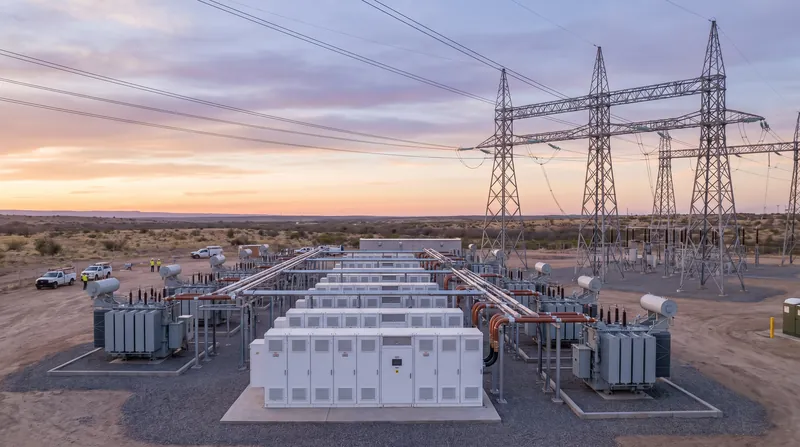
While diesel and hydro have dominated black-start operations for decades, the energy transition is forcing a rapid technological shift. As older fossil-fuel plants retire, grid operators are increasingly turning to utility-scale battery energy storage systems to provide the initial spark.[2]
Traditional renewable energy sources like wind and solar cannot perform a black start because they rely on grid-following inverters. These standard inverters require an existing alternating-current signal to function, meaning they remain offline during a blackout regardless of how much sun or wind is available.[2]
However, the deployment of advanced grid-forming inverters is changing this dynamic. A battery system equipped with a grid-forming inverter can synthetically generate its own stable 60-hertz waveform, establishing the voltage reference needed to energize a cranking path.[2][5]
These battery systems offer sub-second response times and zero fuel dependency, eliminating the mechanical failure risks associated with diesel starter motors. Recent field tests have proven that a megawatt-scale battery can successfully soft-start a dead transformer and crank a larger turbine.[2]
Despite these advantages, batteries face strict energy limitations. A battery must maintain a high enough state of charge to survive multiple failed start attempts, meaning a portion of its capacity must be permanently locked away from daily energy markets to satisfy NERC restoration requirements.[2][3]
The Vulnerability of Restoration
The entire black-start sequence remains one of the most complex and fragile operations in modern engineering. A single failed relay, a depleted battery bank, or a misaligned breaker can set a regional recovery back by hours or even days.[1][3]
During the 2021 Texas winter storms, the state's grid came within minutes of a total collapse that would have required a full black start. Subsequent investigations revealed that nine out of the state's thirteen primary black-start generators were experiencing operational failures during the crisis.[1]
This vulnerability highlights why grid operators prioritize the maintenance of cranking paths above almost all other infrastructure. The speed at which modern civilization recovers from a total blackout is entirely dictated by the geographic distribution and mechanical readiness of these isolated starter units.[1][5]
How we did this
- Method
- Ratio derivation and capacity normalisation
- What we found
- By normalising the auxiliary load against standard black-start generator sizes, the analysis reveals a strict 1:10 operational bottleneck: a grid operator must maintain at least 50 MW of isolated, high-torque cranking capacity for every 500 MW thermal plant they intend to restart, meaning grid recovery speed is capped by the geographic distribution of these specific starter units rather than total system generation.
- What we worked from
- Thermal plant auxiliary power requirement: 10% of generating capacity — FDE Hydro
- Typical black-start gas generator capacity: 50 MW — Power Engineering
- Limits of this analysis
- This ratio assumes standard combined-cycle gas or coal plants; nuclear facilities and newer highly-efficient plants may have different auxiliary load profiles, and battery-led soft starts can alter the peak inrush current requirements.
Terms to know
- Black-Start Unit
- A specialized generator that can start itself without external power, typically using on-site batteries or compressed air.
- Cranking Path
- An isolated segment of the transmission grid used to deliver power from a black-start unit to a larger dormant power plant.
- Auxiliary Power
- The electricity required by a power plant to run its own internal systems, such as pumps and fans, before it can generate output.
- Power Island
- A stable, isolated section of the grid created during restoration before it is synchronized with other restored areas.
- Grid-Forming Inverter
- Advanced technology that allows battery systems to synthetically generate their own stable alternating-current voltage and frequency.
- Synchroscope
- A specialized instrument used by grid operators to perfectly align the voltage, frequency, and phase angle of two power islands before merging them.
Questions readers ask
Why can't a nuclear or coal plant just restart itself?
Large thermal plants require massive amounts of electricity to run boiler feedwater pumps, cooling systems, and control electronics before they can generate power.
How long does a full black start take?
Depending on the size of the grid, restoring the main transmission backbone and synchronizing power islands can take anywhere from 12 to 36 hours.
Can solar and wind farms perform a black start?
Traditionally no, because they rely on grid-following inverters. However, new grid-forming inverters paired with battery storage now allow them to establish the initial voltage.
What happens if a black-start generator fails?
If the initial generator fails, no downstream plants on that cranking path can restart, stalling the regional recovery until an alternative path is established.
Different angles
Transmission System Operators
Focuses on strict reliability compliance and the proven track record of synchronous machines.
Grid operators prioritize certainty over innovation during a blackout. They rely heavily on the physical spinning inertia of hydroelectric plants and natural gas turbines, arguing that these traditional synchronous machines are uniquely capable of absorbing the massive inrush currents required to energize dormant transformers without tripping offline. For these operators, NERC's strict 72-hour on-site fuel requirements ensure that a mechanical starter will remain available even if supply chains are entirely severed during a prolonged regional crisis.
Renewable Energy Advocates
Argues that grid-forming battery storage offers a faster, zero-emission alternative to fossil-fuel starters.
Proponents of the energy transition emphasize that battery energy storage systems (BESS) can respond in milliseconds without relying on mechanical starter motors or on-site fuel reserves. By using grid-forming inverters, these systems can establish a synthetic voltage reference instantly, reducing the mechanical failure points that plagued traditional generators during recent winter storms. They argue that dedicating a portion of a battery's capacity to black-start reserves is a more efficient use of capital than maintaining idle diesel generators.
Thermal Plant Operators
Highlights the extreme physical demands of starting industrial induction motors from a dead state.
The engineers responsible for waking up massive coal and nuclear facilities point out that their auxiliary pumps require a sudden surge of power up to eight times their normal operating current. They maintain a cautious stance on inverter-based resources, questioning whether synthetic voltage can dynamically handle these violent transient spikes as effectively as the brute-force momentum of a spinning turbine. For these operators, the cranking path must deliver raw, unfiltered torque to overcome the inertia of their dormant machinery.
- Grid Reliability Regulators
- Focuses on strict compliance, 72-hour fuel mandates, and the proven track record of synchronous machines.
- Energy Transition Proponents
- Argues that grid-forming battery storage offers a faster, zero-emission alternative to fossil-fuel starters.
- System Operations & Engineering
- Highlights the extreme physical demands of starting industrial induction motors from a dead state.
Perspectives this story doesn't cover
- Industrial electricity consumers
- Cybersecurity infrastructure analysts
Sources
Source coverage
5 outlets
3 viewpoints surfaced





- [1]FDE HydroEnergy Transition Proponents
Understanding the Black Start Process: Your Grid's Emergency Restart System
Read on FDE Hydro → - [2]Green Gas TurbinesGrid Reliability Regulators
Black Start Requirements and Battery Energy Storage
Read on Green Gas Turbines → - [3]iFactoryGrid Reliability Regulators
Why Black Start Generators Demand a Higher Reliability Standard Than Any Other Equipment
Read on iFactory → - [4]Power EngineeringSystem Operations & Engineering
Black Start: The Power to Restart
Read on Power Engineering → - [5]Factlen Editorial TeamSystem Operations & Engineering
Synthesis by Factlen editorial team
Read on Factlen Editorial Team →
More in Energy
See all →Distributed Generation
Chinese Solar Panels Fall to 12 Cents Per Watt, Accelerating Global Energy Transition
6 sources
Grid Physics
The Cosine of the Phase Angle: How the Power Factor Dictates Utility Reactive Power Penalties
7 sources
Grid Expansion
Nevada PUC Approves 360 MW of Private Gas-Fired Generation for Data Center Campus
5 sources
Grid Stability
The Inertia Floor: How Grid-Forming Inverters Replace the Kinetic Energy of Spinning Turbines
4 sources
Comments
Every angle. Every day.
Get Energy stories with full source coverage and perspective breakdowns, free every day.