
SoftBank Logs $7.4 Billion Quarterly Loss as US Data Center and AI Investments Swell
The Japanese technology conglomerate reported an unexpected second-quarter deficit driven by aggressive capital expenditure in artificial intelligence infrastructure and valuation drops in its Vision Fund portfolio.

Share this story
SoftBank Group reported a massive $7.4 billion net loss for its fiscal second quarter on Tuesday, confounding market expectations of a profitable period. The deficit highlights the severe financial toll of the Japanese conglomerate’s aggressive pivot toward artificial intelligence infrastructure.[1][4]
The unexpected shortfall, equivalent to roughly 1.1 trillion yen, marks a sharp reversal for the technology investment giant. Analysts had broadly projected a positive net income for the three months ending in September 2026, following a period of relative stability in global equity markets earlier in the year.[3][5]
Instead, the Tokyo-based firm absorbed heavy blows from two distinct fronts during the 90-day reporting period. Massive capital expenditures on physical computing infrastructure combined with a sudden downturn in software valuations to erase previous gains.[2][4]
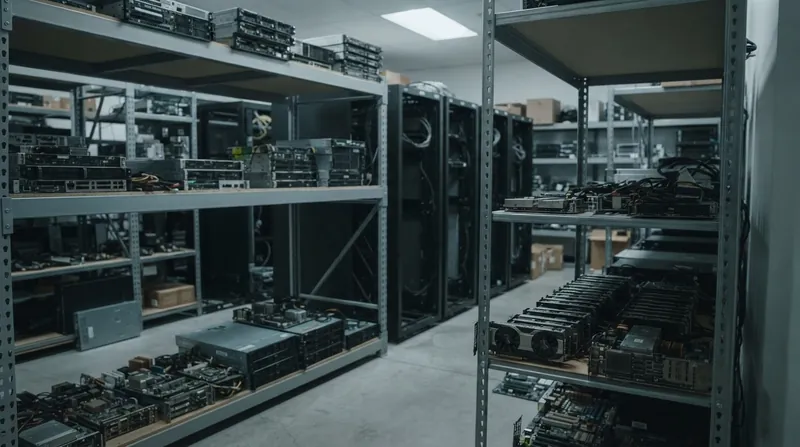
At the core of the earnings miss is a multibillion-dollar spending spree on data centers across the United States. SoftBank has been aggressively acquiring land, securing power contracts, and purchasing high-performance graphics processing units to build foundational capacity for 2027 and beyond.[1][6]
Infrastructure Over Investment
This infrastructure build-out represents a fundamental shift in corporate strategy under founder Masayoshi Son. Rather than merely taking minority equity stakes in software startups through its Vision Fund 1 and Vision Fund 2 vehicles, the conglomerate is now attempting to own the physical hardware layer.[1][2]
The costs associated with this transition are staggering. Securing gigawatt-scale power agreements and outfitting facilities with advanced liquid cooling systems requires immense upfront capital, which immediately depresses quarterly earnings before any revenue can be realized from leasing server space.[4][5]
SoftBank’s management has signaled through its capital allocation that these data center investments are essential for maintaining relevance. However, the sheer scale of the $7.4 billion quarterly deficit illustrates the immense financial friction of transitioning from a venture capital model to an infrastructure operator.[1][6]
Compounding the infrastructure costs was a sharp contraction in the value of SoftBank’s existing investment portfolio. The Vision Fund entities, historically the primary engine of the company's profitability, recorded significant markdowns during the quarter as global technology stocks experienced heightened volatility.[2][3]
Portfolio Valuation Pressures
A broader market rout in artificial intelligence equities over the summer of 2026 severely impacted the carrying value of SoftBank’s public and private holdings. Investors broadly reassessed the near-term monetization potential of generative AI applications, triggering a sell-off that hit the Vision Fund directly.[3][5]
The technology-heavy Nasdaq Composite index experienced sharp fluctuations during the reporting period, dropping significantly in August before recovering. These ripple effects forced SoftBank to write down the value of several high-profile portfolio companies, amplifying the cash drain from the data center build-out.[2][4]
Currency fluctuations also played a complex role in the final earnings calculation. The Japanese yen exhibited significant volatility, swinging between 140 and 155 against the US dollar during the quarter, complicating the valuation of SoftBank’s predominantly dollar-denominated assets when translated back to its domestic balance sheet.[1][3]
Initial financial disclosures and flash earnings reports released on Tuesday did not contain direct executive quotations regarding forward-looking guidance. This absence of immediate executive commentary left market analysts to parse the raw balance sheet data for strategic signals regarding the pace of future spending.[2][5]
The Arm Holdings Anchor
Despite the staggering headline loss, the conglomerate maintains a robust liquidity position. SoftBank continues to hold substantial cash reserves and highly liquid assets, anchored by its controlling 90 percent stake in the British semiconductor design firm Arm Holdings.[5][6]
Arm remains the strategic centerpiece of Masayoshi Son’s artificial intelligence ambitions. The chip designer's architecture is increasingly utilized in data center processors, providing SoftBank with a crucial structural advantage as it builds out its own physical computing infrastructure in the United States.[1][4]
The underlying value of the Arm stake, which boasts a market capitalization exceeding $100 billion, provides SoftBank with the financial flexibility to absorb multi-billion-dollar quarterly deficits. This asset backing allows the conglomerate to pursue capital-intensive projects that would be impossible for a traditional venture firm.[2][6]
However, the dual pressures of infrastructure spending and portfolio volatility are testing the patience of institutional investors. The 1.1 trillion yen loss serves as a stark reminder of the execution risks inherent in attempting to build a vertically integrated artificial intelligence empire from scratch.[3][5]
Navigating Future Volatility
Market analysts note that the transition period will likely feature continued earnings volatility through the remainder of the 2026 fiscal year. As SoftBank deploys billions into server racks and power infrastructure, the lag between capital expenditure and operational revenue will inevitably create further quarterly friction.[4][6]
The broader technology sector is watching SoftBank’s infrastructure pivot closely. If successful, the US data center network could position the Japanese firm as a primary landlord for the global artificial intelligence industry, generating steady, utility-like returns by the end of the decade.[1][5]
Conversely, if the anticipated demand for generative AI computing power fails to materialize at the projected scale, SoftBank risks being left with stranded assets. The massive upfront costs of 15-year power contracts and specialized cooling systems cannot be easily unwound if market dynamics shift.[2][4]
The scale of the US data center market presents both a massive opportunity and a daunting logistical challenge. SoftBank is competing directly against hyperscale cloud providers—including Amazon Web Services, Microsoft Azure, and Google Cloud—for access to limited high-voltage power connections and specialized construction labor.[2][4]
Strategic Implications
Securing these resources requires aggressive bidding and long-term financial commitments, which further inflates the capital expenditure recorded in the second quarter. The $7.4 billion deficit reflects not just the cost of hardware, but the premium required to secure prime infrastructure real estate in constrained markets.[1][6]
This aggressive posture underscores a fundamental reality of the current technology landscape in late 2026. The barrier to entry for foundational artificial intelligence infrastructure has risen so high that only entities willing to absorb multi-billion-dollar quarterly losses can participate at the highest level.[3][5]
For now, the conglomerate appears fully committed to its infrastructure-heavy trajectory. The second-quarter results indicate that management is willing to endure severe short-term accounting losses to secure the physical assets required for the next decade of computing.[3][6]
Moving forward, investors will closely monitor SoftBank’s capital allocation metrics in subsequent quarters. The critical metric will no longer be the paper valuation of software startups, but the operational efficiency and utilization rates of its expanding US data center portfolio as facilities come online in 2027.[1][4]
Key points
- SoftBank Group posted a $7.4 billion net loss for the second quarter, missing analyst expectations of a return to profitability.
- The deficit stems largely from massive capital expenditures on US data centers and AI infrastructure to support future growth.
- Valuation declines across the Vision Fund portfolio further weighed on earnings amid broader volatility in global technology stocks.
- Founder Masayoshi Son continues to pivot the conglomerate away from traditional venture capital toward foundational artificial intelligence assets.
What we don’t know
- The exact geographical distribution and megawatt capacity of the new US data centers SoftBank is currently developing.
- How much of the $7.4 billion loss was strictly cash capital expenditure versus non-cash portfolio markdowns.
- Direct executive commentary and specific forward-looking quotations, which were not available in the initial financial disclosures.
How we got here
2017
SoftBank launches the $100 billion Vision Fund, focusing heavily on software and consumer technology startups.
2023
Arm Holdings goes public, providing SoftBank with a massive liquidity anchor to fund future ventures.
Early 2026
Masayoshi Son accelerates the conglomerate's pivot toward foundational artificial intelligence infrastructure and physical data centers.
Nov 2026
SoftBank reports a $7.4 billion Q2 loss as infrastructure costs and portfolio markdowns peak simultaneously.
- Technology Infrastructure Bulls
- Argue that massive upfront capital expenditure in data centers is necessary to capture the foundational layer of the AI economy.
- Value Investors
- Express concern over the severe earnings volatility and the execution risks of transitioning from venture capital to physical infrastructure.
- Industry Competitors
- Hyperscale cloud providers who view SoftBank's aggressive entry into the US data center market as a catalyst for increased competition over power and land.
Perspectives this story doesn't cover
- Local US municipalities hosting the new data centers
- Hardware suppliers fulfilling the GPU orders
Sources
Source coverage
6 outlets
3 viewpoints surfaced






- [1]The Japan TimesTechnology Infrastructure Bulls
SoftBank logs $7 billion loss after U.S. data center costs swell
Read on The Japan Times → - [2]BW BusinessworldIndustry Competitors
SoftBank Posts $7 Bn Loss As Investment Volatility, AI Costs Bite
Read on BW Businessworld → - [3]Investing.comValue Investors
Softbank Group logs unexpected, $7 bln Q2 loss as AI rout hits portfolio
Read on Investing.com → - [4]Sweden HeraldIndustry Competitors
SoftBank Posts Unexpected $7.4 Billion Quarterly Loss Amid AI Investment Pressures
Read on Sweden Herald → - [5]Business TodayTechnology Infrastructure Bulls
SoftBank Posts Unexpected US$7 Billion Loss As AI Concerns Hit Portfolio
Read on Business Today → - [6]GuruFocusValue Investors
SoftBank Group Reports $7 Billion Loss Amid AI Investments
Read on GuruFocus →
More in Business
See all →AI Infrastructure
Bank of Korea Warns Semiconductor Exports Could Fall $100 Billion on AI Spending Slowdown
7 sources

AI Infrastructure
Broadcom Prepares $21 Billion Bond Sale to Fund Anthropic AI Chip Facility
4 sources

Corporate Restructuring
Qantas to Cut 850 Technology Jobs in AI-Driven Outsourcing Agreement With Accenture
7 sources
Diamond Industry
Botswana Secures Agreement to Double De Beers Stake to 30% Amid Anglo American Divestment
7 sources

Comments
Every angle. Every day.
Get Business stories with full source coverage and perspective breakdowns, free every day.