
AMD Projects It Will Surpass Intel in Quarterly Revenue for the First Time in History
Advanced Micro Devices expects to generate $17 billion in the fourth quarter of 2026, eclipsing Intel's guidance of $15 billion to $16 billion. The historic financial crossover is driven by surging data center demand for AMD's server processors and artificial intelligence accelerators.

Share this story
For the first time since the two companies were founded at the dawn of the silicon age, Advanced Micro Devices is projecting it will generate more quarterly revenue than Intel. AMD expects to reach $17 billion in the fourth quarter of 2026. Intel, meanwhile, has guided investors to expect between $15 billion and $16 billion.[1][2]
This financial crossover marks a profound realignment in the semiconductor industry. Intel has operated as the undisputed revenue heavyweight of American chipmaking for decades. Now, a rival that spent much of the 2010s on the brink of bankruptcy is poised to claim the top spot.[4][5]
To understand the magnitude of this shift, one must look at the historical baseline. During the early 2000s, AMD briefly challenged Intel with its Athlon processors, capturing enthusiast market share before Intel aggressively pushed them back. For the next fifteen years, AMD rarely generated even a quarter of Intel's total revenue.[4][5]
The turnaround began in 2017 with the introduction of AMD's Zen architecture. By redesigning its processors from the ground up and committing to a modular chiplet design, AMD steadily closed the performance gap. The strategy required years of consistent execution to convince risk-averse enterprise customers that AMD was a reliable supplier.[5][6]
The current shift is not driven by a sudden collapse in Intel's core consumer business. Instead, it reflects a structural change in what the technology sector currently values. Data center operators are buying high-margin server processors and artificial intelligence accelerators at unprecedented volumes, and AMD has positioned itself to capture that demand.[1][6]
The data center divide
The primary engine behind AMD's $17 billion projection is its data center division. Sales of the company's Epyc server processors have steadily eroded Intel's once-monolithic market share in enterprise computing. Cloud providers are increasingly optimizing their server racks for power efficiency and core density, metrics where AMD has consistently delivered.[1][6]
Beyond traditional central processing units, AMD is riding the wave of generative artificial intelligence infrastructure. The company's Instinct line of AI accelerators has emerged as the most viable alternative to Nvidia's dominant hardware. While Nvidia still controls the vast majority of the accelerator market, AMD's silicon is securing lucrative secondary contracts.[1][2]
Intel's competing data center offerings have struggled to maintain the same momentum. The company's Xeon server chips face intense pricing pressure, and its Gaudi AI accelerators have not achieved the widespread adoption necessary to offset those margin declines. This divergence in data center fortunes is the mathematical wedge driving the revenue flip.[6]
It is important to separate shipped silicon from marketing narratives when evaluating these figures. AMD's revenue surge is backed by actual hardware deliveries to hyperscale cloud providers, not just speculative orders. The $17 billion guidance reflects booked capacity at fabrication plants and finalized purchase agreements for the fourth quarter.[2][3]
The fabless advantage
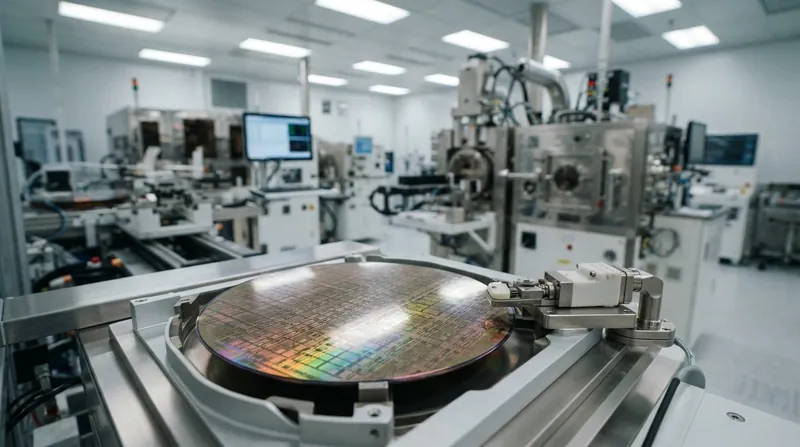
A critical factor in this historic reversal is how the two companies actually manufacture their products. AMD is a fabless designer, meaning it engineers its chips but outsources the physical production to Taiwan Semiconductor Manufacturing Company. This allows AMD to leverage TSMC's cutting-edge manufacturing nodes without bearing massive factory construction costs.[5][6]
Intel operates as an integrated device manufacturer, designing its chips and building them in its own fabrication facilities. This model provided Intel with a massive advantage for decades when its manufacturing technology led the world. However, as Intel stumbled in its transition to smaller transistor nodes, the integrated model became a heavy financial anchor.[6]
Maintaining and upgrading fabrication plants requires tens of billions of dollars in continuous investment. Intel is currently executing an expensive turnaround plan to modernize its foundries and attract external customers. Those capital requirements drag down Intel's overall profitability and limit its ability to aggressively price its data center components against AMD.[2][6]
Intel is not ignoring this existential threat. The company has split its product design and manufacturing arms into separate financial entities, a move designed to expose the true costs of its fabrication business. This internal foundry model forces Intel's product teams to compete for manufacturing resources just like external customers would.[6]
AMD's reliance on TSMC is not without its own risks, particularly regarding geopolitical exposure and supply chain bottlenecks. However, in the current market, it provides the agility needed to rapidly scale production of high-demand AI accelerators. TSMC's advanced packaging capabilities are essential for the complex chiplet designs AMD uses today.[1][5]
The client PC battleground
While the data center dictates the revenue momentum, the traditional personal computer market remains a massive battlefield. Intel still ships significantly more laptop and desktop processors by volume than AMD. The Intel Core brand maintains deep entrenchment in corporate fleet purchasing and mainstream consumer laptops.[4][6]
Yet AMD has successfully targeted the premium segments of the PC market. Its Ryzen processors command high average selling prices in gaming desktops and high-performance creator laptops. By winning the high-margin tiers, AMD extracts disproportionate revenue from its smaller overall market share in the client computing sector.[2][4]
Both companies are currently marketing artificial intelligence PCs equipped with neural processing units to handle local machine learning tasks. The industry is pushing these devices heavily, though consumer demand for on-device AI remains largely untested. The revenue impact of this new category is baked into both companies' fourth-quarter projections.[1][6]
The $17 billion guidance from AMD also includes contributions from its embedded systems and gaming divisions. While console chip sales for devices like the PlayStation 5 have cooled late in their lifecycle, the embedded division provides a steady, high-margin revenue floor that stabilizes AMD's quarterly earnings.[2][3]
Software and ecosystems
Hardware performance is only half the equation in the artificial intelligence sector. Nvidia's massive market share is protected by CUDA, a proprietary software platform that developers have used for over a decade to write AI applications. To sell its Instinct accelerators, AMD must convince developers to port their workloads to its open-source alternative.[1][6]
Progress on the software front has been slow but deliberate. Major cloud providers are highly motivated to break Nvidia's pricing power, leading them to invest their own engineering resources into making AMD's platform viable for their specific workloads. This collaborative effort is beginning to yield results, reflecting directly in AMD's projections.[1][2]
Intel faces a similar software hurdle with its Gaudi accelerators, but it is starting from a smaller installed base of enterprise AI customers. The company is heavily promoting open ecosystem initiatives to counter Nvidia, but converting enterprise developers requires more than just capable silicon. It requires a frictionless deployment experience.[6]
Sustaining the momentum
The question for the semiconductor industry is whether this fourth-quarter crossover represents a permanent changing of the guard or a temporary peak. Intel's guidance of $15 billion to $16 billion reflects a company in the middle of a painful, multi-year restructuring effort. If Intel's upcoming manufacturing nodes deliver, it could reclaim its margins.[2][6]
For AMD, the challenge is maintaining its growth trajectory in an AI market that is evolving rapidly. The company must prove that its Instinct accelerators can secure repeat orders from cloud providers once the initial wave of infrastructure panic-buying subsides. Software ecosystem maturity will dictate whether AMD can truly challenge Nvidia's dominance.[1][5]
Financial analysts note that revenue is only one metric of corporate health, but in the semiconductor industry, scale dictates research and development budgets. Generating more revenue than Intel allows AMD to fund the next generation of chip architectures without taking on excessive debt. It creates a self-reinforcing cycle of investment and execution.[3][4]
The psychological impact of this milestone on the broader technology sector is substantial. For generations of engineers and investors, Intel was synonymous with silicon supremacy. AMD's projected victory in the fourth quarter of 2026 proves that even the most entrenched hardware monopolies are vulnerable to focused competitors executing on a clear architectural vision.[4][5]
Because the published financial guidance documents and initial analyst summaries do not contain verbatim executive commentary on the specific revenue crossover, the internal reactions from AMD and Intel leadership remain private. The numbers, however, provide a definitive statement on the current trajectory of both companies.
Key points
- AMD projects $17 billion in fourth-quarter 2026 revenue, surpassing Intel's $15 billion to $16 billion guidance for the first time.
- The revenue shift is primarily driven by surging data center demand for AMD's Epyc processors and Instinct artificial intelligence accelerators.
- Intel's integrated manufacturing model has become a heavy capital burden, while AMD's fabless reliance on TSMC provides agility and lower overhead.
- Despite AMD's momentum in enterprise servers, Intel continues to ship a higher volume of traditional laptop and desktop processors.
Open questions
- Whether AMD can sustain its artificial intelligence hardware growth once initial cloud infrastructure build-outs are completed.
- How quickly Intel's upcoming 18A manufacturing node will yield competitive server processors that can challenge AMD's Epyc line.
- The exact internal reactions from executive leadership, as published guidance summaries did not include verbatim commentary on the crossover.
- Data Center Operators
- Cloud providers are actively seeking viable alternatives to Nvidia's hardware to regain pricing leverage.
- Financial Analysts
- Market observers emphasize the structural advantages of AMD's fabless model over Intel's capital-intensive foundries.
- Intel Leadership
- Intel views the current revenue deficit as a temporary trough in a long-term manufacturing turnaround.
Perspectives this story doesn't cover
- Independent software developers porting applications to ROCm
- TSMC capacity planners managing the surge in AMD orders
Sources
Source coverage
6 outlets
3 viewpoints surfaced






- [1]TechRadarData Center Operators
AMD says it will outsell Intel for the first time in its history as Epyc and Instinct sales soar on AI demand
Read on TechRadar → - [2]Tom's HardwareData Center Operators
AMD expects to outsell Intel in Q4 for the first time in history — $17B guidance would exceed Intel's projections
Read on Tom's Hardware → - [3]TechPowerUpFinancial Analysts
AMD Guidance Points to Its First Quarter Ever With More Revenue Than Intel
Read on TechPowerUp → - [4]PC GamerIntel Leadership
AMD says it's going to beat Intel in total revenue for the very first time by the end of 2026
Read on PC Gamer → - [5]TechzineIntel Leadership
AMD close to a historic first: more chip revenue than Intel
Read on Techzine → - [6]Counterpoint ResearchFinancial Analysts
AMD vs Intel: Same CPU Boom, Different Data Center Stories
Read on Counterpoint Research →
More in Technology
See all →Process Node
TSMC Reportedly Begins Pilot Production of 1.4nm Chips Ahead of 2028 Target
6 sources
3D DRAM
TSMC Evaluates Advanced 3D DRAM Memory Production Following Nvidia Request
8 sources
AI Hardware
Chinese AI Developers to Receive One Percent of $70 Billion Nvidia RTX Chip Orders
7 sources
Chip Manufacturing
Intel Explores Strategic Foundry and Custom Chip Collaboration With Archrival AMD
4 sources
Comments
Every angle. Every day.
Get Technology stories with full source coverage and perspective breakdowns, free every day.