
QuantumScape Unveils Osprey Solid-State Battery, Achieving 1,000 Cycles at Room Pressure
QuantumScape has introduced Osprey, a new all-solid-state battery platform that eliminates the need for heavy steel clamping. The breakthrough could pave the way for lighter, cheaper, and longer-range electric vehicles.
By Derya Kaplan

Share this story
For the everyday car buyer, the promise of the solid-state battery has long felt like a glossy brochure for a housing development that never breaks ground. The technology promises massive range and rapid charging, but always seems years away from the showroom. That timeline may have just taken a material step forward.
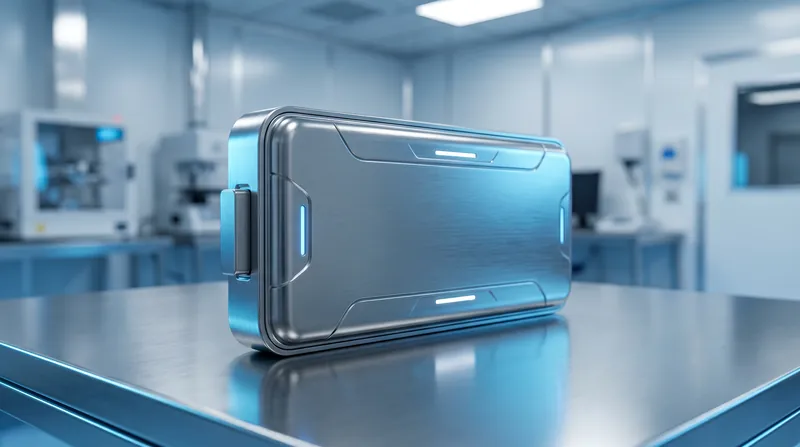
QuantumScape has unveiled Osprey, a new all-solid-state battery platform that solves one of the industry's heaviest engineering bottlenecks. The company demonstrated a sulfide-based battery cell that completed 1,000 full charge cycles while operating at normal room pressure.[1][4][5]
For consumers weighing their next vehicle purchase, this technical milestone translates directly to the driveway. A battery that functions without massive external pressure means automakers can shed thousands of pounds of structural steel, paving the way for lighter, cheaper, and longer-range electric vehicles.[1]
Shedding the Steel Corset
To understand the Osprey breakthrough, buyers need to look at how competing solid-state batteries are currently built. Most developers use sulfide-based materials, which are excellent at moving energy but notoriously difficult to keep intact over time.[1][2]
As these batteries charge and discharge, the internal materials expand and contract. To prevent the cell from losing contact and failing, engineers have to clamp the battery under extreme force—often between 30 and 100 atmospheres of pressure.[1][2]
"The industry has invested heavily in sulfide-based batteries but keeps hitting the same fundamental limits," QuantumScape CEO Siva Sivaram noted in the company's announcement. He added that the Osprey platform was specifically designed to address these physical constraints.[4][5]
In a passenger vehicle, applying 20 atmospheres of pressure across a battery pack requires thick steel end plates and heavy tie rods. That structural corset adds massive weight and cost to the car, effectively canceling out the energy benefits of the solid-state chemistry for the end user.[1]
A Breakthrough at Room Pressure
QuantumScape’s Osprey platform sidesteps the clamping problem entirely. By pairing a solid sulfide cathode with the company’s proprietary ceramic separator and an anode-free lithium-metal design, the new cell architecture operates efficiently at just one atmosphere of pressure.[1][4][5]
In laboratory testing, a two-layer Osprey cell successfully ran through 1,000 full charge and discharge cycles at 30 degrees Celsius (86 degrees Fahrenheit). At the end of the run, the battery still retained approximately 80 percent of its original capacity.[1][2][4]
That degradation curve is roughly equivalent to driving an electric vehicle for more than a decade without needing a battery replacement. QuantumScape claims this is the first publicly available data showing a sulfide-based cathode achieving such longevity without heavy compression.[1][5]
The Osprey design also marks a shift for QuantumScape itself. The company’s current QSE-5 prototype cells still rely on a liquid catholyte, meaning they are not entirely solid. Osprey replaces that liquid with a solid sulfide material, achieving a true all-solid-state architecture.[1][2]
Reading the Inspection Report
While the baseline longevity numbers are promising, buyers looking at the spec sheet should read the fine print. The cell that achieved 1,000 cycles is a small, two-layer laboratory prototype, holding roughly 0.3 to 0.4 Amp-hours of energy—a fraction of the 5 Amp-hours found in QuantumScape’s larger QSE-5 cells.[1][2]
The company also touted a blistering five-minute fast charge, taking the battery from 10 percent to 80 percent capacity. However, testing documents reveal that this specific charging feat was performed at 80 degrees Celsius (176 degrees Fahrenheit).[1][2][4]
That temperature is significantly hotter than the standard preconditioning protocols used by current electric vehicles before they plug into a fast charger. QuantumScape has not yet published equivalent fast-charging data for the Osprey platform at standard room temperatures.[1]
The platform also demonstrated notable resilience in freezing conditions, a common pain point for EV owners in colder climates. A single-layer Osprey test cell remained operational down to minus 20 degrees Celsius (minus 4 degrees Fahrenheit), retaining 68 percent of its room-temperature capacity.[1][2][4]
Other metrics remain forward-looking projections rather than immediate realities. The company estimates the Osprey platform could eventually achieve energy densities of up to 1,100 Watt-hours per liter, but that figure is based on high-loading tests in coin-sized cells.[1][2][4]
Licensing the Foundation
Rather than keeping the technology locked behind closed doors, QuantumScape is treating Osprey like an open-source foundation for the broader automotive market. The company is offering the platform for licensing and co-development to competing battery manufacturers and automakers.[1][4][5]
This represents a major strategic pivot. For years, QuantumScape argued that sulfide materials were fundamentally flawed for use as battery separators. Now, they are offering their own ceramic separator to companies that have already spent billions developing sulfide cathodes.[1]
"Osprey is the result of years of frontier R&D efforts, and we’re excited to share it publicly for the first time," Sivaram stated. The company confirmed it is already working with automotive partners to integrate the Osprey architecture into future vehicle designs.[4][5]
For the consumer market, this open-house collaborative approach could accelerate the arrival of solid-state vehicles. If automakers can plug their existing sulfide research into QuantumScape’s pressure-free separator, the timeline for commercial production and showroom availability could shrink significantly.[1][5]
Moving Toward Move-In Day
The broader automotive industry is already racing toward a solid-state future. Competitors like Samsung SDI and Toyota are targeting mass production of their own sulfide-based batteries between 2027 and 2028, while BYD plans small-batch production as early as 2027.[1][2]
QuantumScape itself is currently scaling up its QSE-5 pilot line, with a larger 100-megawatt-hour production facility not expected to come online until 2028. Osprey remains firmly in the laboratory phase, with significant process engineering required before it can be manufactured at scale.[1][2]
For buyers holding onto their aging gas vehicles in anticipation of a solid-state revolution, the Osprey announcement offers concrete proof that the technology's biggest hurdles are solvable. The foundation has been poured; the industry just needs to build the house.
Key points
- QuantumScape unveiled Osprey, an all-solid-state battery platform that operates at normal room pressure.
- The new cell architecture completed 1,000 full charge cycles in laboratory testing while retaining 80 percent of its capacity.
- Eliminating the need for heavy steel clamping could allow automakers to build significantly lighter and cheaper electric vehicles.
- The company is offering the Osprey platform for licensing and co-development to accelerate commercial solid-state production.
What we don’t know
- Whether the 1,000-cycle longevity achieved in small laboratory cells can be replicated in full-size electric vehicle battery packs.
- How the Osprey platform's fast-charging capabilities perform at standard room temperatures, rather than the 80 degrees Celsius used in testing.
- The exact timeline for when vehicles utilizing the Osprey architecture will be available in consumer showrooms.
How we got here
2020
QuantumScape goes public, promising to commercialize solid-state lithium-metal batteries.
2024
The company begins shipping early QSE-5 prototype cells to automotive partners for testing.
Nov 2026
QuantumScape unveils the Osprey platform, achieving 1,000 cycles at one atmosphere of pressure.
2028
Target date for QuantumScape's 100-megawatt-hour production facility to come online.
- Industry Analysts
- Emphasize that while lab results are promising, the timeline to commercial mass production remains years away and requires significant process engineering.
- Solid-State Developers
- Argue that new architectures like anode-free designs and ceramic separators are required to overcome the physical limitations of sulfide batteries.
- Financial Markets
- Focus on the commercial viability of licensing models and co-development partnerships as a pathway to revenue before full-scale production.
Perspectives this story doesn't cover
- Automotive Manufacturers
- Consumer Advocates
Sources
Source coverage
6 outlets
3 viewpoints surfaced





- [1]ElectrekIndustry Analysts
QuantumScape unveils Osprey all-solid-state cell: 1,000 cycles at 1 atm
Read on Electrek → - [2]MLQIndustry Analysts
QuantumScape unveils Osprey, an all-solid-state cell that ran 1,000 cycles at one atmosphere
Read on MLQ → - [3]Investing.comFinancial Markets
QuantumScape unveils Osprey solid-state battery platform
Read on Investing.com → - [4]StreetInsiderFinancial Markets
QuantumScape launches Osprey all-solid-state battery platform
Read on StreetInsider → - [5]QuantumScapeSolid-State Developers
QuantumScape Expands Commercial Roadmap with Osprey, the Open All-Solid-State Platform for Battery Development
Read on QuantumScape → - [6]UA.NewsFinancial Markets
QuantumScape says its Osprey all-solid-state platform completed 1000 cycles while retaining about 80% capacity at one atmosphere of external pressure
Read on UA.News →
More in Automotive & Transportation
See all →Battery Chemistry
Why Solid-State EV Batteries Still Short-Circuit During 15-Minute Fast Charges
3 sources
Hybrid Tech
How Planetary Power-Split Hybrids Synthesize Stepless Ratios Without Belts or Clutches
4 sources

EV Engineering
Falling Motor Back-EMF Cuts Regenerative Braking at Low Speeds, Requiring Hydraulic Blending or Battery Draw to Reach Zero
3 sources

Policy Reversal
Trump Administration Finalizes Rollback of Fuel Economy Standards, Ending Federal EV Targets
6 sources

Comments
Every angle. Every day.
Get Automotive & Transportation stories with full source coverage and perspective breakdowns, free every day.