
Guidehow the film industry worksRevision 1Updated
How the Film Industry Works: The Technology and Economics Behind the Screen
Behind every theatrical release is a rigid industrial apparatus governing encrypted data packages, optical physics, and the high-margin concession sales that keep cinemas afloat.
By Jana Rami

Share this story
In short
- Modern theatrical releases are delivered as encrypted Digital Cinema Packages (DCPs) utilizing 250 Mbps JPEG 2000 compression.
- Cinema screens are perforated with millions of holes to allow center-channel audio to pass through, sacrificing 5 percent of image brightness.
- Because studios take up to 90 percent of opening-week ticket sales, theaters rely heavily on concessions marked up by 800 percent.
The modern cinema experience feels like magic, but it is actually a rigid industrial standard. When the lights go down, audiences assume they are simply watching a video file. In reality, they are experiencing a highly regulated intersection of optical physics, encrypted data, and high-margin snack economics.
Behind every blockbuster is a complex ecosystem that dictates exactly how loud an explosion can be, what shape the lens flares take, and who keeps the money from the ticket. The film industry operates on a series of technical and financial compromises that have evolved over a century.
From the anonymous parents who classify the content to the open-source software now winning Academy Awards, the mechanisms of Hollywood are largely hidden from the audience. Understanding how the industry works means looking past the red carpet and examining the screens, the servers, and the spreadsheets.
The Digital Cinema Package
The era of shipping heavy canisters of 35mm film is long gone. Today, movies arrive at theaters as a Digital Cinema Package, or DCP. This is not a single video file, but a complex, encrypted folder of assets governed by the Digital Cinema Initiatives (DCI) specification.[1][2]
A standard DCP uses JPEG 2000 compression to deliver image data at massive bitrates of up to 250 megabits per second. This is substantially higher than the compression used by streaming services, reflecting the immense data required to project an image onto a 60-foot screen without visible artifacts.[1][2]
The color science of a DCP also differs from home televisions. Instead of the standard RGB color space, digital cinema uses the XYZ color space. This specialized color mapping allows for a wider and more accurate gamut of colors, ensuring the director's grade translates perfectly to the projector.[1][2]
Filmmakers must navigate two primary DCP standards: the legacy Interop format and the modern SMPTE standard. While Interop remains widely compatible, SMPTE enforces stricter metadata rules and supports higher frame rates and immersive audio formats like Dolby Atmos. Failing DCI compliance means the film simply will not play.[1][2]
Security is a paramount concern for distributors, which is why DCPs are heavily encrypted. To unlock the film, the theater must receive a Key Delivery Message (KDM). This small XML file contains the decryption keys and is locked to the specific serial number of the cinema's playback server.[1]
A KDM is strictly time-bound. It dictates exactly when the theater can begin showing the movie and when the file will lock itself again. If a cinema wants to extend a film's run, they cannot simply keep playing the DCP; they must negotiate with the distributor for a new KDM.[1]
The DCI specification also standardizes resolution containers. A 4K DCP uses a container of 4096 by 2160 pixels, while a 2K DCP uses 2048 by 1080 pixels. Films shot in wider aspect ratios do not change the container size; they simply leave the unused pixels black, a process known as padding.[2]
The 5 Percent Void
The screen itself is a massive acoustic filter. In a traditional cinema, the center-channel speakers are mounted directly behind the projection surface. This ensures that dialogue sounds exactly like it is coming from the actors' mouths, a critical component of theatrical immersion.[4]
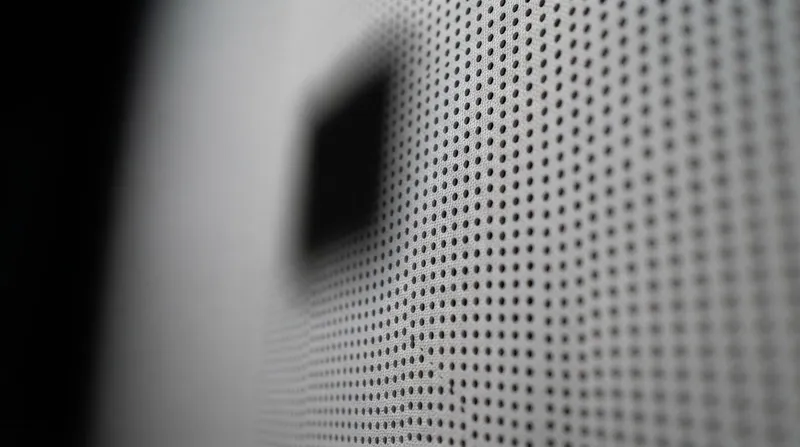
To allow sound to pass through, standard cinema screens are perforated with millions of millimeter-wide holes. These perforations typically account for about 5 percent of the screen's total surface area. While this achieves acoustic transparency, it comes with a hidden cost known as the "perforation tax."[4][5]
Because 5 percent of the screen is essentially empty space, a significant amount of projected light blows right through the voids and is lost. Theater designers must compensate for this luminance drop by using brighter, more expensive projectors to meet the strict DCI brightness standards.[5]
High-end home theaters and some premium cinemas are now shifting toward woven acoustically transparent screens. Unlike perforated vinyl, the random woven structure minimizes high-frequency audio reflections and comb filtering. This results in more natural dialogue and accurate tonal balance for the speakers hidden behind the fabric.[4]
However, woven screens introduce their own technical hurdles. When paired with modern RGB triple-laser projectors, the woven texture can sometimes exacerbate visible laser speckle. Screen manufacturers must engineer advanced anti-speckle coatings to diffuse the reflected laser light while maintaining the acoustic transparency.[4]
Audio Calibration and Dynamic Range
The audio passing through those screens is just as strictly regulated as the image. Theatrical audio is delivered as uncompressed 24-bit PCM files, supporting up to 16 discrete channels. This allows for massive, uncompressed soundscapes that home streaming simply cannot replicate.[2]
Cinema audio is mixed to a strict 85-decibel reference standard (85 dBC Leq). This calibration ensures that a film sounds exactly the same in a theater in Tokyo as it does in a mixing stage in Los Angeles. The 85-decibel baseline leaves massive headroom for explosive sound effects.[2]
This extreme dynamic range is why theatrical mixes often sound terrible when played on a standard living room television. The quiet whispers are mixed low, and the explosions are mixed to utilize the full headroom. Without a dedicated home theater system, the uncompressed mix overwhelms standard TV speakers.[2]
Modern cinemas are increasingly adopting object-based audio systems like Dolby Atmos. Instead of routing sound to a specific channel, object-based audio assigns a coordinate in 3D space to a sound effect. The cinema's processor then calculates in real-time which of its dozens of speakers should play the sound.[2]
The 90/10 Split and the House Nut
The financial relationship between the studio that makes the movie and the theater that shows it is a constant tug-of-war. When a viewer buys a $15 ticket, the theater does not keep the full amount. Box office revenue is divided according to a sliding-scale split.[6][7]
During a blockbuster's opening weekend, the studio often takes up to 90 percent of the ticket revenue after the theater deducts its "house nut." The house nut is a fixed allowance that covers the cinema's basic operational overhead, including electricity, staffing, and building leases.[6][7]
As the movie plays into its second and third weeks, the split gradually shifts in the theater's favor, moving to 80/20 or 70/30. However, because modern films make the vast majority of their money in the first two weeks, theaters are left with very little actual profit from ticket sales.[6]
To survive, cinemas operate essentially as restaurants that use $200 million movies as bait. Theaters rely on concession sales, where items like popcorn and fountain drinks carry markups of up to 800 percent. Because studios take no cut of the snacks, concessions are the true economic engine of exhibition.[6][7]
The transition to digital projection also introduced the Virtual Print Fee (VPF). Because digital projectors cost tens of thousands of dollars, studios agreed to pay a VPF to theaters for each booking. This fee subsidized the theater's equipment upgrade, since the studios were saving millions by not printing 35mm film.[6]
Independent filmmakers face a different financial reality. Without the leverage of a major studio, indie creators sometimes engage in "four-walling." In this arrangement, the filmmaker pays a flat fee to rent the theater space outright, keeping 100 percent of the ticket sales but assuming all the financial risk.[7]
The Geometry of Widescreen
The iconic widescreen look of cinema is the result of optical manipulation. In the 1950s, studios wanted wider aspect ratios to differentiate theaters from television, but they still needed to use standard 4-perf 35mm film cameras. The solution was the anamorphic lens.[8][9]
An anamorphic lens optically compresses a wide field of view into a standard, squarish film frame. The industry standard is a 2x squeeze factor. When the film is projected, a complementary lens stretches the image back out, creating a massive, panoramic vista without sacrificing resolution.[8][9]
This optical squeezing introduces distinct visual characteristics that have become synonymous with high-end cinema. Anamorphic lenses produce stretched, oval-shaped bokeh in the out-of-focus areas and create intense, horizontal lens flares when hit by direct light—flaws that filmmakers now deliberately embrace.[8][9]
The exact dimensions of widescreen have shifted over time. Originally standardized at 2.35:1, projectionists in 1970 began shaving a fraction of an inch off the projector gates to hide the distracting flashes of tape where film reels were spliced together. This mechanical trim permanently shifted the standard to 2.39:1.[8][9]
Today, many digital filmmakers attempt to replicate the anamorphic look using 1.33x anamorphic adapters on 16:9 sensors. However, purists argue that the 1.33x squeeze fails to produce the dramatic bokeh and breathing characteristics of a true 2x anamorphic lens, resulting in a decidedly different aesthetic.[8]
The placement of the anamorphic element within the lens barrel also dictates the final look. Front-mounted anamorphic elements produce the most pronounced flares and distortion. Rear-mounted elements provide the widescreen aspect ratio but generally lack the classic optical flaws that many cinematographers desire.[8]
The MPA Rating System
Before a film reaches the screen, its financial fate is heavily influenced by its classification. In the United States, the Motion Picture Association (MPA) operates a rating system that relies on an anonymous board of parents to evaluate content for violence, language, and nudity.[3]
The system is technically voluntary, meaning there is no federal law requiring a film to be rated. However, most major theater chains refuse to screen unrated films, and media outlets often reject advertising for them, making an MPA rating a financial necessity for a wide theatrical release.[3]
The ratings themselves have evolved to protect studio investments. The PG-13 rating was created in 1984 following backlash over intense scenes in PG-rated films like Indiana Jones and the Temple of Doom. Today, PG-13 is the most lucrative rating, allowing moderate violence while keeping the teenage demographic intact.[3]
At the other end of the spectrum is the NC-17 rating, which restricts anyone under 17 from entering the theater. Because many cinema chains refuse to book NC-17 films, studios view the rating as a box office death sentence, often forcing directors to recut their films to secure an R rating.[3]
Filmmakers do have the right to appeal a rating. If a director feels their film was judged too harshly, they can present their case to an appeals board. More commonly, studios simply edit the offending scenes and resubmit the film, a process that highlights the subjective nature of the anonymous board.[3]
The Open-Source Revolution
While the traditional Hollywood apparatus relies on massive budgets and proprietary technology, a new wave of independent filmmakers is democratizing the medium. The historic success of the Latvian animated film Flow has proven that small teams can compete on the global stage.[10][11]
Directed by Gints Zilbalodis, Flow is a dialogue-free feature about a cat surviving a catastrophic flood alongside a capybara, a lemur, a secretary bird, and a dog. It was created entirely using Blender, a free, open-source animation software that can run on standard consumer laptops.[10][11]
The film was produced over five years on a budget of less than $4 million. Rather than attempting photo-realistic CGI, Flow utilizes an impressionistic, painterly style. The lush forests and tempestuous oceans are drawn in broad brush strokes, serving the emotional resonance of the animation over technical perfection.[10][11]
In 2025, Flow won the Academy Award for Best Animated Feature, defeating massive studio projects from Pixar and DreamWorks. The victory highlighted how accessible, open-source tools are breaking down the financial barriers to high-quality animation, allowing independent artists to bypass the traditional studio system entirely.[11][12]
As the industry moves forward, the tension between massive theatrical infrastructure and democratized production tools will only grow. The physical cinema requires 250-megabit encrypted packages and acoustically transparent screens, but the art itself is increasingly being forged on free software by artists working outside the Hollywood machine.[2][11]
Comparison
| Standard | Subtitle Format | Maximum Frame Rate | Immersive Audio |
|---|---|---|---|
| Interop DCP | PNG / SRP | 24 fps | Not Supported |
| SMPTE DCP | XML-based | Up to 60 fps | Dolby Atmos Supported |
Viewpoints in depth
The Theatrical Purists
Advocate for strict DCI compliance and uncompressed formats to preserve the premium cinema experience.
This camp, largely composed of studio executives and high-end cinematographers, argues that the rigid DCI specifications are the only thing separating cinema from television. They defend the massive file sizes, the 85 dBC audio calibration, and the strict SMPTE metadata rules as necessary guardrails. In their view, standardizing the exhibition format guarantees that the director's exact vision—down to the XYZ color space and the 2.39:1 anamorphic framing—is perfectly replicated in every theater on Earth.
The Independent Innovators
Champion open-source tools and alternative distribution to bypass the financial gatekeeping of the studio system.
Independent animators and filmmakers view the traditional Hollywood apparatus as an exclusionary financial barrier. They point to the Oscar-winning success of Flow, created on the free software Blender, as proof that massive budgets and proprietary rendering farms are no longer required to produce world-class art. This camp advocates for democratized production tools and flexible distribution models, arguing that the industry's future lies in lowering the cost of entry rather than enforcing rigid, expensive exhibition standards.
What changed
- · Revision 1Published.
Related explainers
- An Anonymous Board of Parents Decides MPA Ratings and Hollywood Movie Success
- The DCI Specification and the Interop vs. SMPTE DCP: How Digital Cinema Packages Actually Work
- Sliding-Scale Box Office Splits: Why Studios Take 90 Percent of Opening-Week Sales
- The 5 Percent Void: How Perforated Cinema Screens Anchor Dialogue Without Leaking Light
- The 90/10 Split and the House Nut: How Movie Theaters and Studios Divide Box Office Revenue
- The 0.015-Inch Cut: How Hiding Film Splices Shifted Widescreen Cinema From 2.35:1 to 2.39:1
- How Open-Source Software is Fueling an Indie Animation Renaissance
- The 2x Squeeze and the Desqueeze: How Anamorphic Lenses Create Widescreen Aspect Ratios
- The BBFC, the MPAA, and the FSK: How Film Classification Systems Actually Work
- DCI Calibration Fixes Cinema Audio at 85 dBC Leq, Making Home Releases Sound Too Quiet on TV Speakers
- Exhibitors & Theaters
- Argue that high concession markups are the only way to survive the studios' aggressive box office splits and massive infrastructure costs.
- Studio Distributors
- Focus on maximizing opening-weekend box office returns and enforcing strict DCI compliance to protect their massive production investments.
- Independent Filmmakers
- Value open-source tools and alternative distribution models to bypass the financial barriers of the traditional Hollywood system.
Perspectives this story doesn't cover
- Theater projectionists
- Independent cinema owners
Sources
Source coverage
13 outlets
3 viewpoints surfaced












- [1]FabricStudio Distributors
What is a DCP
Read on Fabric → - [2]Netflix Partner HelpStudio Distributors
Digital Cinema Package (DCP): Best Practices
Read on Netflix Partner Help → - [3]Axentra
What Is the MPAA Rating System?
Read on Axentra → - [4]WUPRO Cinema
WUPRO Cinema 4K Weave Acoustically Transparent Fixed Frame Projector Screen
Read on WUPRO Cinema → - [5]Luminatii
The Perforation Tax on LED Dome Brightness
Read on Luminatii → - [6]QuoraExhibitors & Theaters
How much does it cost to put your movie in a theater?
Read on Quora → - [7]QuoraExhibitors & Theaters
Do movie theaters pay for movies, or do the distribution companies pay the theaters to show their movies?
Read on Quora → - [8]Cooke Optics
Anamorphic lenses
Read on Cooke Optics → - [9]Wikipedia
Anamorphic format
Read on Wikipedia → - [10]TumbleweirdIndependent Filmmakers
Flow is the first Academy Award-winning feature produced in Latvia
Read on Tumbleweird → - [11]CBCIndependent Filmmakers
Latvia's Flow wins Oscar for animated feature
Read on CBC → - [12]Animation MagazineIndependent Filmmakers
Latvia's 'Flow' and Iran's 'In the Shadow of the Cypress' Win Best Animated Feature and Short Oscars
Read on Animation Magazine → - [13]Factlen Editorial Team
Synthesis by Factlen editorial team
Read on Factlen Editorial Team →
More in Entertainment
See all →Franchise Casting
Robert Pattinson and Nicholas Hoult Emerge as Late Contenders in James Bond Screen Tests
6 sources
Audio Engineering
DCI Calibration Fixes Cinema Audio at 85 dBC Leq, Making Home Releases Sound Too Quiet on TV Speakers
4 sources
Cinema Technology
The 5 Percent Void: How Perforated Cinema Screens Anchor Dialogue Without Leaking Light
6 sources
Box Office Record
Spider-Man: Brand New Day Passes 'Star Wars: The Force Awakens' to Become All-Time Domestic Box Office Champion
6 sources
Comments
Every angle. Every day.
Get Entertainment stories with full source coverage and perspective breakdowns, free every day.