
Why Drain Pipes Require a 2-Feet-Per-Second Flow to Prevent Solid Waste Blockages
A precise gravitational slope ensures wastewater moves fast enough to carry solids without outrunning them, a physics threshold that dictates every residential plumbing layout.
By Tao Yang

- Hydraulic Engineers
- Focus on the mathematical fluid dynamics and friction coefficients that dictate flow rates in partially filled channels.
- Municipal Regulators
- Prioritize standardized minimums to prevent catastrophic failures in civic infrastructure and public health systems.
- Residential Plumbers
- Focus on the practical application of codes, navigating tight framing constraints, and choosing the right materials.
Perspectives this story doesn't cover
- DIY Homeowners
- Sewer Maintenance Crews
A homeowner who finishes a basement bathroom with a drain pipe pitched slightly too flat guarantees a future sewage backup behind the drywall, while one pitched too steeply leaves solid waste stranded in the line as the water rushes past. The difference between a maintenance-free plumbing system and a chronic sanitation failure comes down to a strict physics threshold: the self-cleaning velocity.[10]
Gravity-fed wastewater systems do not rely on pressure to clear waste. Instead, they rely on the precise angle of the pipe to accelerate water to a minimum speed of 2.0 feet per second. At this velocity, the kinetic energy of the water is sufficient to lift and carry solid waste, toilet paper, and grease along the bottom of the pipe without allowing it to settle.[1][5]
"Sewers shall be designed and constructed to give mean velocities, when flowing full, of not less than 2.0 feet per second," mandates the Minnesota Department of Health in its widely adopted Recommended Standards for Wastewater Facilities, commonly known as the Ten States Standards. This 2014 regulatory benchmark forms the foundation of modern plumbing codes across North America.[3]
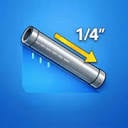
Achieving this exact speed requires a delicate balance known in the trades as the "Goldilocks slope." For standard residential drain pipes measuring three or four inches in diameter, the International Plumbing Code requires a pitch of exactly one-quarter inch of drop for every foot of horizontal run.[2][8]
Over a 10-foot span of basement ceiling, that translates to exactly 2.5 inches of vertical drop. If a contractor attempts to save headroom by reducing that drop to a single inch, the water velocity drops below the 2.0 feet per second threshold. The liquid drains away, but the heavier solids drop out of suspension and adhere to the polyvinyl chloride (PVC) or cast-iron walls.[8][10]
Conversely, over-pitching a pipe creates an equally severe failure mode. If a homeowner installs a drain line with a steep one-inch-per-foot drop, the liquid accelerates well beyond 3.0 feet per second. The water outruns the solids, leaving the waste behind to dry, harden, and eventually occlude the entire diameter of the pipe.[6]
The mathematics governing this flow rely on Manning's equation, an empirical formula developed in the late 19th century that calculates the velocity of liquid in an open channel or partially filled pipe. The equation factors in the pipe's cross-sectional area, the hydraulic radius, the slope, and a roughness coefficient known as "Manning's n."[7]
The equation factors in the pipe's cross-sectional area, the hydraulic radius, the slope, and a roughness coefficient known as "Manning's n."
According to the American Society of Plumbing Engineers (ASPE) Plumbing Engineering Design Handbook, modern PVC and ABS plastic pipes possess a Manning's n value of approximately 0.009 to 0.013, making them significantly smoother than legacy cast-iron or clay pipes. This smooth interior reduces friction, allowing water to reach the self-cleaning velocity at slightly lower slopes.[7]
However, plumbing codes remain conservative. Even with ultra-smooth modern materials, the one-quarter-inch-per-foot rule remains the standard for pipes up to two and a half inches in diameter. For larger mains measuring three to six inches, the codes permit a shallower slope of one-eighth inch per foot, because the larger volume of water provides more carrying capacity.[2]
"Understanding self-cleansing velocity is the single most critical factor in drainage design," notes a 2026 technical briefing from civil engineering firm Civilistix. When engineers design municipal sanitary sewers, they must calculate the anticipated flow rates from hundreds of homes to ensure the main lines maintain this 2.0 feet per second speed even during low-flow overnight periods.[5]
Stormwater drains face a different standard. Because storm runoff carries heavier inorganic debris like sand, gravel, and silt, the National Programme on Technology Enhanced Learning (NPTEL) hydraulic design guidelines specify a higher self-cleaning velocity of 2.5 to 3.0 feet per second for storm sewers to prevent sediment accumulation.[4][9]
For the residential property owner, these engineering principles dictate the physical layout of a home. A bathroom addition located 40 feet away from the main soil stack requires a full 10 inches of vertical drop within the floor joists. If the framing cannot accommodate that slope, gravity drainage becomes impossible, forcing the installation of a mechanical macerating pump.[10]
The 2.0 feet per second rule also explains why modern low-flow fixtures occasionally cause issues in older homes. A toilet that flushes only 1.28 gallons of water provides less total volume to fill the pipe. If the existing cast-iron pipes were sized for older 3.5-gallon flushes, the shallow water depth fails to achieve the necessary hydraulic radius to carry waste, even if the slope is correct.[1][10]
Resolving these flow dynamics requires precision tools. Professional plumbers rely on torpedo levels featuring specific vials calibrated to read exactly one-quarter and one-eighth inch per foot slopes, ensuring the pipe hangers lock the drainage system into the exact geometry required by physics.[8]
The integrity of a home's sanitation system relies entirely on this invisible geometry. As long as the hangers hold and the slope remains true, the 2.0 feet per second velocity ensures the infrastructure cleans itself with every use, operating silently behind the drywall for a lifetime.[10]
Key points
- Gravity-fed plumbing requires wastewater to reach a minimum speed of 2.0 feet per second to carry solid waste without leaving it behind.
- For standard 3-inch and 4-inch residential drain pipes, achieving this speed requires a precise slope of 1/4 inch of drop per horizontal foot.
- Pipes pitched too steeply fail just as often as flat pipes, because the liquid outruns the solids and leaves waste stranded in the line.
- Larger pipes (3 to 6 inches) can operate at a shallower 1/8-inch-per-foot slope because their larger water volume provides more carrying capacity.
Key terms
- Self-Cleaning Velocity
- The minimum speed—generally 2.0 feet per second—that wastewater must travel to keep solid waste and debris suspended in the flow rather than settling on the pipe floor.
- Manning's Equation
- A mathematical formula used by engineers to calculate the velocity of liquid flowing in an open channel or partially filled pipe driven by gravity.
- Roughness Coefficient (Manning's n)
- A value representing the friction created by the interior surface of a pipe; lower numbers indicate smoother materials like PVC, while higher numbers indicate rougher materials like concrete or cast iron.
- Hydraulic Radius
- A measurement of flow efficiency, calculated by dividing the cross-sectional area of the water by the wetted perimeter (the portion of the pipe actually touching the water).
Sources
Source coverage
10 outlets
3 viewpoints surfaced









- [1]Civil Engineering/Design SiteHydraulic Engineers
Sanitary Sewer Design: Minimum Slopes and Pipe Sizing
Read on Civil Engineering/Design Site → - [2]Pipe Slope CalculatorResidential Plumbers
Minimum Slope for Drain Pipe: IPC, UPC & NPC Chart
Read on Pipe Slope Calculator → - [3]Minnesota Department of HealthMunicipal Regulators
Recommended Standards for Wastewater Facilities
Read on Minnesota Department of Health → - [4]NPTELHydraulic Engineers
Module 7: Hydraulic Design of Sewers and Storm Water Drains Lecture 8
Read on NPTEL → - [5]CivilistixHydraulic Engineers
Understanding Self-Cleansing Velocity in Drainage Design
Read on Civilistix → - [6]Studio MatrxResidential Plumbers
STP Pipe Sizing Guide
Read on Studio Matrx → - [7]ASPEHydraulic Engineers
Plumbing Engineering Design Handbook: Drain Pipe Slope
Read on ASPE → - [8]ifanproResidential Plumbers
How Much Slope Does a PVC Drain Pipe Need?
Read on ifanpro → - [9]Turf Drainage Company of AmericaResidential Plumbers
Self Cleaning Velocity
Read on Turf Drainage Company of America → - [10]Factlen Editorial Team
Synthesis by Factlen editorial team
Read on Factlen Editorial Team →
Comments
More in Home
See all →Color Science
The 10-Degree Shift: How the Munsell Color System Predicts a Paint's Appearance Under Different Light Sources
7 sources

5S Framework
The Sort, Set in Order, Shine, Standardize, Sustain Sequence: How the 5S Methodology Actually Organizes a Home
4 sources

Circadian Lighting
The 460-480 Nanometer Peak: How Blue Light Wavelengths Actually Suppress Melatonin and Govern Circadian Rhythm
9 sources

Water Filtration
The Science of Water Filtration: Comparing Sediment, Carbon, and Reverse Osmosis Systems
9 sources
Every angle. Every day.
Get Home stories with full source coverage and perspective breakdowns delivered to your inbox.