
US Weighs Moving Major Military Bases From Gulf States to Israel Following $400M in Damage From Iranian Attacks
The Pentagon is reportedly considering relocating key Middle East military installations westward to Israel after Iranian strikes inflicted over $400 million in unacknowledged damage to the U.S. Navy's primary hub in Bahrain.
By Adel Khoury

Share this story
The United States is fundamentally reassessing its military posture in the Middle East, weighing a historic relocation of major bases from the Persian Gulf to Israel. The proposed shift comes as military planners seek to move high-value American assets out of the immediate range of Iran's increasingly sophisticated missile and drone arsenals, which have battered regional outposts for months.
If executed, the realignment would represent the most significant redrawing of the American security umbrella in the region since the Gulf War, signaling a tactical retreat from traditional Arab allies in favor of a fortified Mediterranean flank.[1][2]
The catalyst for this strategic pivot is the staggering, previously unacknowledged toll of the ongoing regional war. A new investigation has revealed that Iranian retaliatory strikes inflicted at least $400 million in damage to the Naval Support Activity Bahrain, the Middle East's only U.S. Navy base and the long-standing home of the Fifth Fleet. For months, the true extent of the destruction at the Manama facility was kept tightly under wraps, but newly surfaced satellite imagery and internal procurement documents have laid bare the vulnerability of America's forward-deployed maritime command.[1]
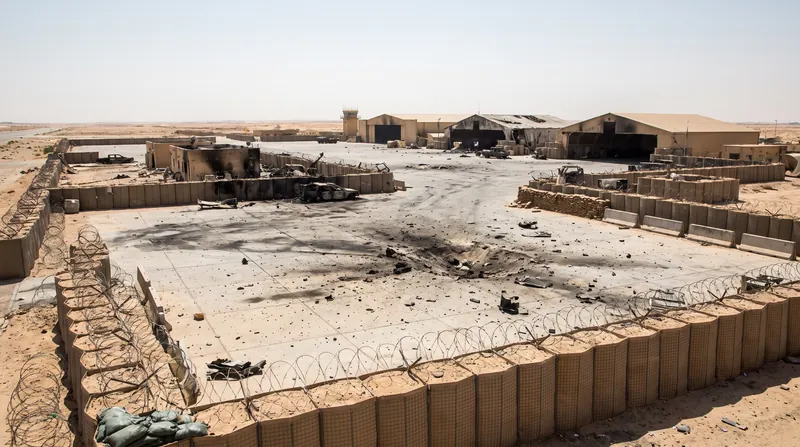
Satellite imagery and internal assessments paint a picture of severe devastation at the Bahrain facility, which sits a mere 150 miles south of the Iranian coastline. Iranian strikes successfully penetrated the base's multi-layered air defenses to destroy the Fifth Fleet's main headquarters building, rendering the nerve center of U.S. naval operations completely unusable.
The relentless bombardment also wiped out a Navy security forces training center, heavily damaged an emergency management warehouse housing a fleet of ambulances, and struck vital life-support infrastructure, including the main dining hall, a massive potable water tank, and barracks designed to house 450 personnel.[1]
The $400 million estimate likely represents only a fraction of the true financial burden the Pentagon will ultimately shoulder. Defense analysts note that the current figure is based strictly on raw construction costs and the military's public cost models for rebuilding standard facilities.
It completely omits the staggering expense of replacing highly classified, specialized military hardware destroyed inside those buildings. For instance, two satellite communication terminals obliterated early in the conflict cost approximately $20 million each, suggesting the final bill for restoring the Fifth Fleet's operational capacity will easily dwarf initial projections.[1]
The destruction in Bahrain is merely the centerpiece of a broader vulnerability crisis for forward-deployed American forces. Since the U.S.-Israeli bombing campaign against Iran began in late February, Iranian forces and their regional proxy militias have damaged at least 16 U.S. military installations spread across eight Middle Eastern countries. The precision strikes have systematically targeted advanced radar systems, critical communications nodes, and grounded aircraft, rendering some American frontline positions virtually inoperable and forcing commanders to constantly shuffle assets to maintain regional deterrence.
Despite the severe infrastructure losses, U.S. military leadership has fiercely defended its defensive performance under unprecedented fire. U.S. Central Command emphasized that over the course of the four-month war, Iran has fired more than 8,000 ballistic missiles, cruise missiles, and suicide drones at American positions. By intentionally prioritizing the protection of personnel over physical buildings—rushing troops to hardened bunkers while leaving surface infrastructure exposed—commanders argue they successfully prevented mass casualties. Officials note that despite the sheer volume of incoming fire, only two direct hits resulted in U.S. fatalities region-wide.[3]
Nevertheless, the sheer scale of the material damage has forced Washington to reconsider the long-term viability of its legacy footprint. The Pentagon is now actively exploring plans to shrink its military presence not just in Bahrain, but also in Kuwait and Saudi Arabia. The overarching objective is to shift logistical hubs and command operations westward, increasing the geographic buffer between American bases and Iranian launch sites to buy precious minutes of early warning time for air defense batteries.[2]
Israel has emerged as the primary candidate to host these relocated operations, a move that would fundamentally alter the dynamics of the U.S.-Israeli alliance. Moving command centers and logistical hubs to Israeli territory would place them under the protective umbrella of Israel's dense, multi-layered air defense network, which includes the Iron Dome, David's Sling, and Arrow systems. Furthermore, the increased distance from Iran would force Tehran to rely on longer-range, more easily detectable ballistic missiles rather than the cheap, swarming drones that overwhelmed defenses in the Gulf.[2]
Such a move would represent a seismic realignment of the Middle East's security architecture. For decades, Gulf Arab states have served as the indispensable anchor of American military power in the region, hosting tens of thousands of troops to secure global energy shipments and deter Iranian expansion. A westward retreat could severely strain these long-standing alliances, leaving Gulf capitals feeling abandoned by their primary security guarantor and increasingly vulnerable to Tehran's coercion just as the regional power balance is being violently renegotiated.
Conversely, establishing major U.S. bases in Israel would cement the bilateral defense pact to an unprecedented degree, intertwining American and Israeli military infrastructure. However, it would also permanently entangle American forces in the immediate crossfire of the Israeli-Iranian conflict, complicating future diplomatic efforts to de-escalate regional tensions. As the administration navigates fragile back-channel communications to prevent further escalation, the ultimate decision of where to park the Fifth Fleet will signal Washington's long-term commitment to a region fundamentally reshaped by war.[1][2]
Key points
- The U.S. is weighing moving major military bases from the Gulf States to Israel.
- The shift follows $400 million in unacknowledged damage to the U.S. Navy base in Bahrain.
- Iranian strikes destroyed the Fifth Fleet headquarters, barracks, and satellite terminals.
- U.S. Central Command says prioritizing personnel over buildings prevented mass casualties.
Open questions
- Whether the Gulf States will attempt to block the U.S. withdrawal by offering financial incentives or enhanced base security.
- How much the total replacement of destroyed classified military hardware in Bahrain will ultimately cost.
- Which specific Israeli military installations are being considered to host the relocated U.S. forces.
Timeline
Feb 28, 2026
U.S.-Israeli bombing campaign against Iran begins.
March - May 2026
Iran launches over 8,000 retaliatory missiles and drones at U.S. positions.
May 1, 2026
Reports reveal 16 U.S. installations across the Middle East have sustained damage.
June 25, 2026
Investigation exposes $400 million in unacknowledged damage to the U.S. Fifth Fleet headquarters in Bahrain.
June 26, 2026
Pentagon reportedly considers relocating major Gulf bases westward to Israel.
- U.S. Defense Strategists
- Argue that moving assets westward is a necessary tactical retreat to protect high-value equipment from Iran's overwhelming short-range missile capabilities.
- Gulf Arab Allies
- Fear that a U.S. withdrawal from the Persian Gulf signals an abandonment of the region's security architecture, leaving them vulnerable to Iranian coercion.
- Israeli Defense Establishment
- Views the potential relocation as a strategic boon that deepens the U.S.-Israel alliance and provides an additional layer of deterrence against Tehran.
- U.S. Military Command
- Emphasizes that despite severe infrastructure damage, the current defensive strategy successfully minimized American casualties against an unprecedented barrage.
Perspectives this story doesn't cover
- Iranian military command
- Local Bahraini civilians
Sources
Source coverage
3 outlets
4 viewpoints surfaced



- [1]The Wall Street JournalU.S. Defense Strategists
Iran's Strikes Dealt $400 Million in Unacknowledged Damage to U.S. Navy Base in Bahrain
Read on The Wall Street Journal → - [2]The Times of IsraelIsraeli Defense Establishment
US considering relocating some Gulf bases damaged by Iran to Israel — WSJ
Read on The Times of Israel → - [3]U.S. Central CommandU.S. Military Command
CENTCOM Statement on Force Protection and Regional Infrastructure
Read on U.S. Central Command →
More in News & Politics
See all →Drone Warfare
CIA Director Says Russian Recruits Survive Just 20 to 30 Minutes on Ukraine Front Lines
8 sources

PLA Armor
China Deploys Premier Type 99 Heavy Tanks to Coastal Units Facing Taiwan and Japan
4 sources
Pacific Defense
US Marines Deploy Iron Dome-Based Missile Defense System to Japan Amid Taiwan Tensions
3 sources
Missile Proliferation
Iran Unveils Dual Liquid-Propellant Ballistic Missile Launcher at New Underground Base
4 sources
Comments
Every angle. Every day.
Get News & Politics stories with full source coverage and perspective breakdowns, free every day.