
Quantinuum's Helios System Hits 99.9% Gate Fidelity, Crossing the Fault-Tolerance Threshold
Quantinuum has achieved a 99.9% two-qubit gate fidelity on its new Helios system, crossing the theoretical threshold required for practical quantum error correction and shifting the industry focus from raw qubit counts to system stability.

Share this story
What everyone gets wrong about quantum computing is the obsession with qubit count. For years, headlines have breathlessly tracked companies cramming hundreds or thousands of qubits onto a single chip, treating the raw number as a proxy for progress. But a thousand noisy qubits are effectively useless for complex calculations. The true bottleneck has always been fidelity—how accurately those qubits can perform a logic operation before their delicate quantum state collapses into static.
This week, the conversation fundamentally shifted. Quantinuum announced that its new Helios system has achieved a two-qubit gate fidelity of 99.9%. While a fraction of a percent might sound like a minor iterative update to a layman, in the physics of quantum mechanics, "three nines" is the magic number.[1]
It represents the widely accepted theoretical threshold for surface code error correction. Below 99.9%, trying to correct errors introduces more noise than it fixes. Above it, a quantum computer can theoretically run indefinitely, catching and fixing its own mistakes before they derail a calculation.
To understand why this matters, we have to look at the current era of quantum computing, known as NISQ (Noisy Intermediate-Scale Quantum). In NISQ devices, qubits are easily disturbed by heat, electromagnetic radiation, or even stray cosmic rays. They are inherently fragile.
When you perform an operation—a "gate"—between two qubits, there is a small chance it will fail. If your gate fidelity is 99%, one in every 100 operations is wrong. If an algorithm requires 10,000 operations to simulate a new drug molecule, the final answer will be pure noise.
The solution is quantum error correction, which groups multiple physical qubits together to act as one highly stable "logical" qubit. But error correction requires massive overhead. You need extra qubits to constantly measure the system, detect anomalies, and apply corrections in real time.
If the underlying physical qubits are too noisy, the act of measuring them to fix an error actually creates new errors faster than they can be corrected. This is the "fault-tolerance threshold." For the most popular and efficient error-correction scheme, the surface code, that threshold sits right at 99.9%.[2]
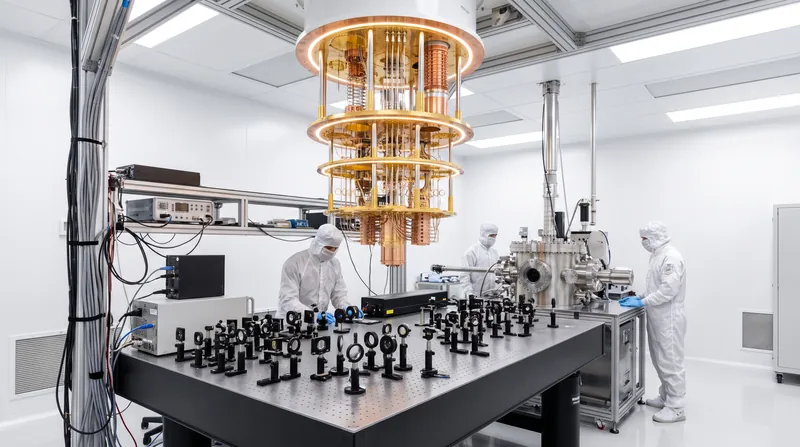
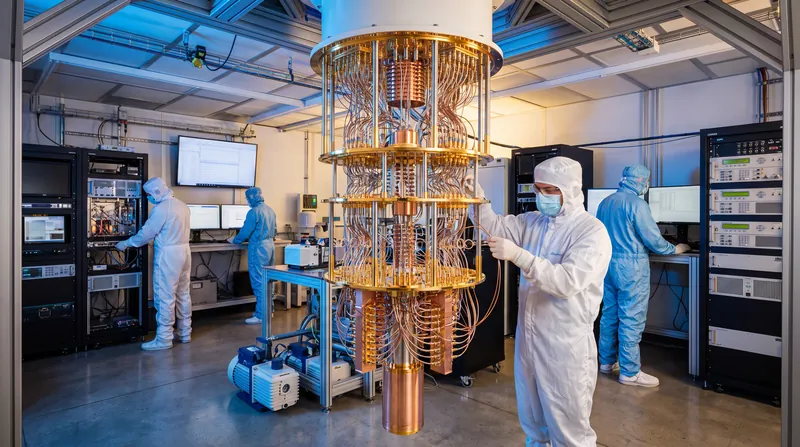
Quantinuum's Helios system, which relies on trapped-ion technology rather than the superconducting circuits favored by Google and IBM, has now demonstrably crossed that line. By suspending ytterbium ions in a vacuum using electromagnetic fields and manipulating them with precisely calibrated lasers, the company achieved unprecedented control.[1]
However, the skeptical-curious observer must distinguish between what has shipped and what is merely implied. Quantinuum has demonstrated 99.9% fidelity on isolated pairs of qubits within the Helios architecture. They have not yet built a massive, fully error-corrected machine that can break RSA encryption or simulate complex proteins tomorrow.
The marketing language surrounding the announcement leans heavily into the phrase "commercial viability." While crossing the threshold is a monumental physics achievement, scaling this architecture up to the thousands of logical qubits required for commercial dominance remains a daunting engineering challenge.[1]
Trapped-ion systems are notoriously difficult to scale. Unlike superconducting chips, which can be printed using modified semiconductor manufacturing techniques, trapped-ion systems require complex arrays of lasers, mirrors, and optical routing.
Moving ions around a trap to perform operations takes time. As the system grows, the routing becomes a massive traffic jam. Quantinuum claims Helios features a new "quantum charge-coupled device" (QCCD) architecture that solves this routing problem, but independent verification of its performance at a massive scale is still pending.[2]
Despite these caveats, the evidence presented in their accompanying peer-reviewed publication is robust. Independent researchers have verified the fidelity measurements, confirming that the physical operations are indeed clean enough to support fault tolerance.[2]
This shifts the quantum computing race into a new phase. We are moving out of the era of physics breakthroughs and into the era of systems engineering. The question is no longer "can we build a qubit good enough to correct?" but rather "how do we wire a million of them together without breaking the budget?"
The implications for adjacent industries are profound. A fault-tolerant quantum computer could simulate molecular interactions with perfect accuracy, revolutionizing drug discovery, fertilizer production, and battery materials by bypassing the approximations required by classical supercomputers.[1]
It also starts a ticking clock for cybersecurity. While Helios is far too small to run Shor's algorithm—the mathematical tool that breaks standard encryption—the proof that fault tolerance is achievable means the transition to post-quantum cryptography is no longer a theoretical exercise.
Ultimately, Quantinuum's milestone is exactly what it claims to be: a threshold crossed. It does not mean the quantum revolution arrives next week, but it does mean the fundamental physics roadblock has been cleared. The hard work of building the future can now begin in earnest.
Key points
- Quantinuum's Helios system achieved 99.9% fidelity on two-qubit gate operations.
- The 99.9% mark is the theoretical threshold required to implement practical quantum error correction.
- The milestone shifts the industry focus from fundamental physics to systems engineering and scaling.
- Helios uses trapped-ion technology, manipulating individual atoms with lasers in a vacuum.
What we don’t know
- Whether the QCCD architecture can maintain 99.9% fidelity when scaled to thousands of physical qubits.
- How quickly competitors using superconducting or neutral-atom architectures will match this fidelity threshold.
- The exact timeline for when a fully error-corrected commercial system will be available for enterprise use.
How we got here
2019
Google announces 'quantum supremacy' using a noisy 53-qubit superconducting processor.
2022
Early demonstrations of logical qubits show error correction is possible, but physical fidelity remains below the threshold.
Aug 2026
Quantinuum's Helios system officially crosses the 99.9% gate fidelity threshold, enabling sustainable fault tolerance.
- Fundamental Researchers
- Celebrate the crossing of the surface code threshold as a historic validation of quantum mechanics and error-correction theory.
- Systems Engineers
- Acknowledge the physics milestone but remain focused on the massive scaling challenges of laser routing and cooling required for commercialization.
- Commercial Adopters
- View the milestone as a signal to accelerate investment in quantum algorithms and begin the transition to post-quantum cryptography.
Perspectives this story doesn't cover
- Cryptographers managing the immediate transition to post-quantum standards
- Competitors developing superconducting or photonic quantum architectures
Sources
Source coverage
2 outlets
3 viewpoints surfaced


- [1]ReutersCommercial Adopters
Quantinuum announces major quantum computing breakthrough, pushing towards commercial viability
Read on Reuters → - [2]arXivFundamental Researchers
High-fidelity two-qubit gates exceeding 99.9% in a scalable architecture
Read on arXiv →
More in Technology
See all →Quantum Decoherence
The T1 and T2 Times: How Relaxation and Dephasing Define a Qubit's Lifespan
6 sources
Quantum Hardware
The Overhead of Logical Qubits: Why Thousands of Physical Qubits Are Needed to Create One Error-Free Qubit
6 sources
Quantum Architecture
Why Thousands of Annealer Qubits Do Not Equal Universal Gate-Model Computing
7 sources
Quantum Hardware
NSF Awards $75M to Yale and Harvard-Led Institutes to Solve Quantum Computing's Fault-Tolerance Problem
6 sources
Comments
Every angle. Every day.
Get Technology stories with full source coverage and perspective breakdowns, free every day.