
The T1 and T2 Times: How Relaxation and Dephasing Define a Qubit's Lifespan
Quantum hardware developers are shifting focus from raw qubit counts to T1 and T2 relaxation times, the strict physical limits that dictate how long a quantum computer can actually hold information.
By Tariq Nasser

Share this story
In short
- T1 measures how long a qubit takes to lose its energy to the environment.
- T2 measures how long a qubit can maintain its phase coherence before scrambling.
- A fundamental law of physics dictates that T2 can never exceed twice the value of T1.
On May 26, 2026, the quantum hardware industry formally consolidated its benchmark standards around two strict physical limits: the T1 and T2 relaxation times, as detailed in a comprehensive framework published by Quantum Zeitgeist. Rather than focusing solely on qubit counts—a metric often inflated by marketing language—hardware developers are now forced to report the actual lifespan of their quantum states.[3][4]
While press releases frequently tout processors with hundreds of physical qubits, the actual capability of a quantum computer is bottlenecked by its coherence. If a quantum circuit requires 1,000 sequential operations, the qubit must survive long enough to execute them—regardless of how many neighboring qubits sit idle on the chip.[4]
The absolute ceiling for this survival is known as the T1 relaxation time. T1 measures energy relaxation—the duration it takes for a qubit excited to a |1⟩ state to spontaneously decay back to its |0⟩ ground state.[3]
When a qubit undergoes T1 relaxation, it transfers its excitation energy to the surrounding environment. The process is often compared to a vibrating tuning fork losing its acoustic energy to a soft pillow, permanently leaking its quantum information into the surrounding thermal bath.[1][3]
However, energy loss is not the only threat to a quantum calculation. The more fragile property is phase coherence, measured by the T2 relaxation time. T2 tracks how long a qubit can maintain its precise phase relationship—the delicate timing that allows quantum states to interfere constructively and destructively.[1]
In quantum algorithms, phase coherence is the mechanism that drives the system toward the correct answer. When T2 expires, the qubit loses approximately 63% of its original phase coherence, transitioning from a useful quantum state into a randomized classical bit.[1]
Crucially, a fundamental law of physics dictates that T2 can never exceed twice the value of T1. In practical hardware, T2 is almost always significantly shorter because it can be degraded by environmental fluctuations that exchange no energy at all.[1][2][3]
These pure dephasing events—quantified by a third metric called Tφ—arise from microscopic disturbances. Magnetic field fluctuations, charge noise from chip defects, and stray photons can all cause a qubit's phase to drift, scrambling the calculation without triggering an energy decay.[1][3]
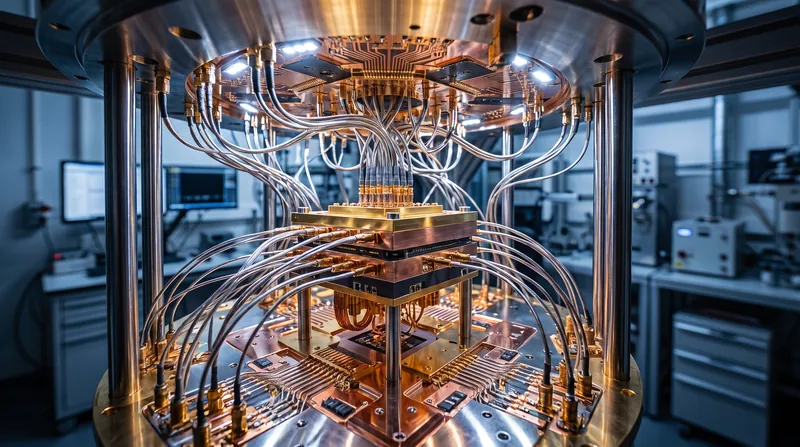
Different hardware modalities exhibit wildly different T1 and T2 lifespans. Superconducting transmons, the architecture favored by major legacy tech firms, typically operate with T1 and T2 times hovering between 80 and 300 microseconds.[3]
While hundreds of microseconds sounds brief, superconducting gates are exceptionally fast, executing in roughly 50 nanoseconds. This allows the system to squeeze thousands of operations into a single coherence window before the state collapses.[3]
In contrast, trapped-ion systems trade gate speed for extreme longevity. On August 5, 2024, Alpine Quantum Technologies demonstrated T1 times of 1.14 seconds across a 20-qubit ion chain, with T2 times ranging from 0.5 to 1.2 seconds.[2]
Because trapped ions are suspended in a vacuum and isolated from solid-state defects, they behave as identical twins, allowing quantum memory to persist for up to 1,000 gate operations despite their slower 10-to-100 microsecond gate speeds.[2]
Emerging architectures are also pushing the boundaries of coherence. Researchers at the University of Notre Dame recently achieved a breakthrough with electron charge qubits on a solid neon surface, pushing both T1 and T2 to a record 0.1 milliseconds.[5]
This milestone yielded a coherence-to-gate time ratio exceeding 10,000. "The OPX has been a powerful enabler in our lab, helping us quickly characterize the performance of our recently discovered new qubits," noted Professor Dafei Jin of the University of Notre Dame, emphasizing how advanced control hardware is required to measure these fleeting states.[5]
To combat T2 dephasing across all these platforms, engineers deploy a technique called dynamical decoupling. By firing a rapid sequence of refocusing pulses—often called a Hahn Echo—the control hardware effectively rewinds the phase drift caused by slow-moving environmental noise.[1][3]
The industry's pivot toward T1 and T2 benchmarks strips away the hype of raw qubit counts. A massive processor is practically useless if its qubits decohere before completing a basic algorithm. The next verifiable checkpoint for the field is pushing logical qubits—error-corrected ensembles of physical qubits—to maintain phase coherence indefinitely, a milestone that requires physical T1 and T2 times to reliably clear the fault-tolerance threshold.[3][6]
Terms to know
- Qubit
- The fundamental unit of quantum information, capable of existing in a superposition of multiple states simultaneously.
- Decoherence
- The process by which a quantum system loses its delicate quantum properties due to interaction with its surrounding environment.
- Superposition
- A quantum state where a particle exists in a complex combination of multiple distinct states at the same time.
- Dynamical Decoupling
- A technique that applies rapid control pulses to a qubit to cancel out environmental noise and extend its coherence time.
- Hahn Echo
- A specific sequence of radio frequency pulses used to refocus a qubit's drifting phase and reverse the effects of slow-moving noise.
Questions readers ask
Why is T2 always shorter than T1?
T1 requires a specific exchange of energy with the environment, which is relatively difficult to trigger. T2 can be degraded by any minor fluctuation, such as a magnetic field shift, even if no energy is exchanged.
How do engineers measure a qubit's T2 time?
Researchers typically use a Ramsey Experiment or a Hahn Echo sequence, applying pulses with a delay between them to observe how the quantum state decays over time.
Which quantum hardware has the longest coherence time?
Trapped-ion systems currently hold the lead, with coherence times measured in seconds to minutes, compared to the microsecond lifespans of superconducting qubits.
Does decoherence permanently destroy quantum information?
The information is not fundamentally destroyed, but it leaks into the environment in a way that makes it practically impossible for the computer to recover or use.
Different angles
Superconducting Advocates
Prioritizing gate speed and scalability over raw coherence time.
Proponents of superconducting architectures argue that while their T1 and T2 times are limited to hundreds of microseconds, their gate operations are incredibly fast. Because a gate can execute in just 50 nanoseconds, a superconducting processor can still perform thousands of operations within a single coherence window. They view short coherence as an engineering hurdle to be solved through rapid error correction rather than a fundamental flaw.
Trapped-Ion Proponents
Focusing on natural isolation and identical qubits for maximum memory lifespan.
Developers building trapped-ion systems emphasize that their qubits are naturally isolated in a vacuum, shielding them from the solid-state defects that plague other architectures. This isolation yields T1 and T2 times measured in seconds or even minutes. While their gate speeds are slower, the extreme longevity of the quantum memory allows for deep, complex circuits without the immediate need for massive error-correction overhead.
Alternative Architecture Developers
Seeking the middle ground with novel solid-state designs.
Researchers working on electron charge qubits and neutral atoms argue that the industry does not have to choose between the fabrication ease of solid-state chips and the coherence of isolated atoms. By confining electrons on solid neon or utilizing optical tweezers, these alternative architectures are achieving coherence-to-gate time ratios that rival the established leaders, offering a new pathway to scalable quantum memory.
- Trapped-Ion Proponents
- Focusing on natural isolation and identical qubits for maximum memory lifespan.
- Alternative Architecture Developers
- Seeking the middle ground with novel solid-state designs.
- Hardware-Agnostic Analysts
- Evaluating the entire ecosystem based on standardized physical benchmarks.
Perspectives this story doesn't cover
- Software developers writing algorithms for near-term hardware
- Materials scientists fabricating the qubit substrates
Sources
Source coverage
6 outlets
3 viewpoints surfaced






- [1]QuEraAlternative Architecture Developers
What Is A T2 Relaxation? Quantum Systems & Methods
Read on QuEra → - [2]Alpine Quantum TechnologiesTrapped-Ion Proponents
Qubits in an ion chain behave like twins
Read on Alpine Quantum Technologies → - [3]Dr. Donovan's GuideHardware-Agnostic Analysts
Complete 2026 Guide To Quantum Decoherence
Read on Dr. Donovan's Guide → - [4]IonQTrapped-Ion Proponents
Quantum Computing 101: Introduction, Evaluation, and Applications
Read on IonQ → - [5]Quantum MachinesAlternative Architecture Developers
A Quantum Revolution in Electron Charge Qubits
Read on Quantum Machines → - [6]Factlen Editorial TeamHardware-Agnostic Analysts
Synthesis by Factlen editorial team
Read on Factlen Editorial Team →
More in Technology
See all →Quantum Hardware
Infleqtion Entangles 30 Logical Qubits on Neutral-Atom Quantum Processor
6 sources
Hybrid Supercomputing
IonQ Deploys First On-Premise Quantum Processor at NVIDIA Research Center
3 sources
Quantum Hardware
IonQ Demonstrates Real-Time Quantum Error Decoder on a Single CPU
6 sources
Quantum Algorithms
The Mathematical Lens That Breaks RSA: How the Quantum Fourier Transform Extracts Hidden Periods
6 sources
Comments
Every angle. Every day.
Get Technology stories with full source coverage and perspective breakdowns, free every day.